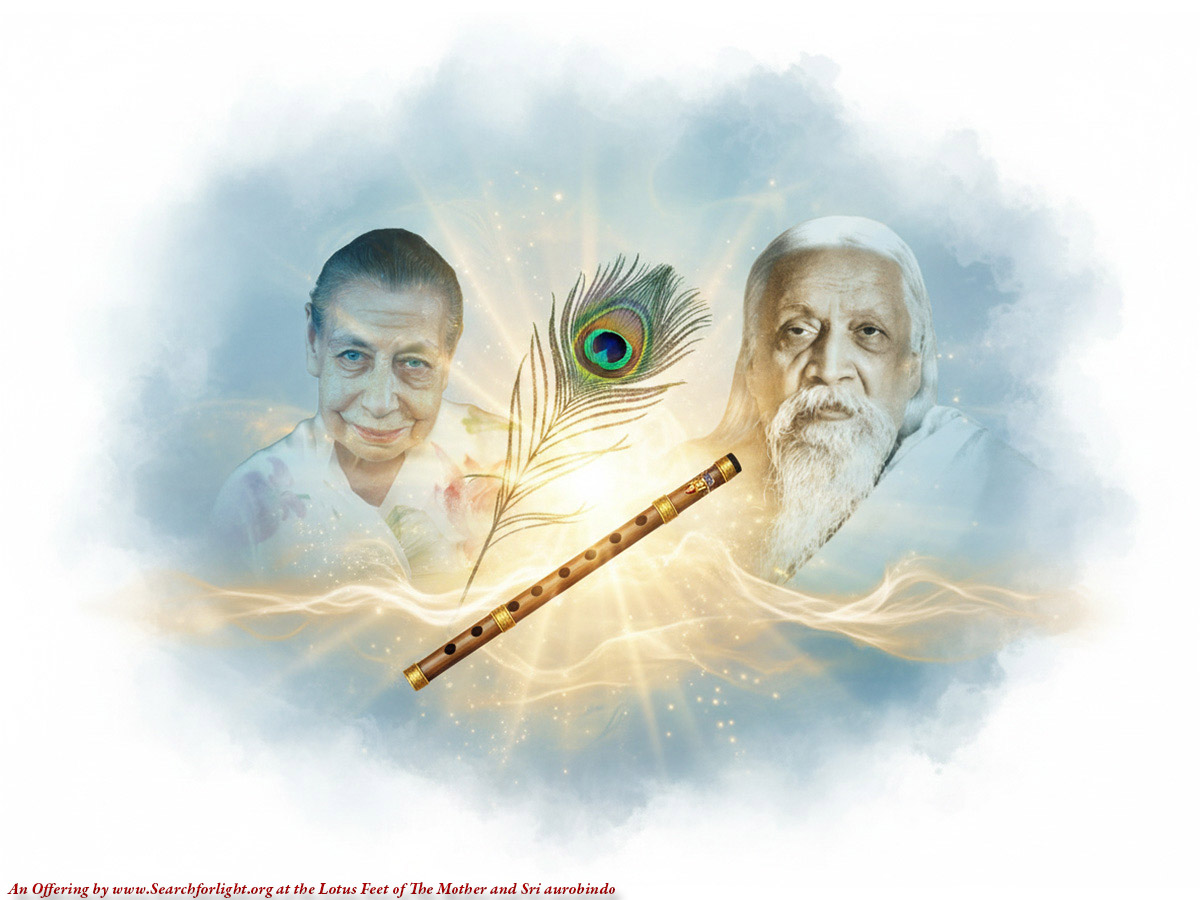
The Mother and Sri Aurobindo and Sri Krishna

He who chooses the Infinite has been chosen by the Infinite.

Siddhi Day or the Day of Victory
Sri Aurobindo experienced the descent of Krishna Consciousness.

He said," The descent of Krishna would mean the descent of the Overmind Godhead preparing, though not itself actually bringing, the descent of Supermind and Ananda." -  24 Nov 1926

Sri Krishna

Permanent Influence of the Krishna, Avatar- Sri Aurobindo

Sri Krishna, the Teacher of the Gita - Sri Aurobindo

Historicity of Sri Krishna - Sri Aurobindo

24 November 1926 – the Day of Siddhi

Sri Aurobindo and Sri Krishna

From His Uttarpara speech

”When I was arrested and hurried to the Lal Bazar I was shaken in faith for a while, for I could not look into the heart of His intention. Therefore I faltered for a moment and cried out in my heart to Him, “What is this that has happened to me? I believed that I had a mission to work for the people of my country and until that work was done, I should have Thy protection. Why then am I here and on such a charge?” A day passed and a second day passed and a third, when a voice came to me from within, ”Wait and see.” Then I grew calm and waited. I was taken from Lal Bazar to Alipore and was placed for one month in a solitary cell apart from men. There I waited day and night for the voice of God within me, to learn what I had to do. In this seclusion the earliest realisation, the first lesson came to me.”


 “Then He placed the Gita in my hands, His strength entered into me and I was able to do the Sadhana of the Gita. I was not only to understand intellectually but to realise what Sri Krishna demanded of Arjuna and what He demands of those who aspire to do His work, to be free from repulsion and desire, to do work for Him without the demand for fruit, to renounce self-will and become a passive and faithful instrument in His hands, to have an equal heart for high and low, friend and opponent, success and failure, yet not to do His work negligently.”


 “So it was arranged, (permission to walk outside his cell) and it was while I was walking that His strength again entered into me. I looked at the jail that secluded me from men and it was no longer by its high walls that I was imprisoned; no, it was Vasudeva who surrounded me. I walked under the branches of the tree in front of my cell, but it was not the tree, I knew it was Vasudeva, it was Sri Krishna whom I saw standing there and holding over me His shade. I looked at the bars of my cell, the very grating that did duty for a door and again I saw Vasudeva. It was Narayana who was guarding and standing sentry over me. Or I lay on the coarse blankets that were given me for a couch and felt the arms of Sri Krishna around me, the arms of my Friend and Lover.”


 ………….”When the case opened in the lower court and we were brought before the Magistrate, I was followed by the same insight. He said to me, ”when you were cast into jail, did not your heart fail and did you not cry out to me, where is Thy protection? Look now at the Magistrate, look now at the Prosecuting Counsel.” I looked and it was not the Magistrate whom I saw, it was Vasudeva, it was Narayana who was sitting there on the bench. I looked at the Prosecuting Counsel and it was not the Counsel for the prosecution, that I saw; it was Sri Krishna who sat there, it was my Lover and Friend who sat there and smiled. “Now do you fear?” He said, “I am in all men and I overrule their actions and their words. My protection is still with you and you shall not fear. This case which is brought against you, leave it in my hands. It is not for you. It was not for the trail that I brought you here but for something else. The case itself is only a means for my work and nothing more.”

Sri Aurobindo

Sri Aurobindo: On Himself


It [the 24th November 1926] was the descent of Krishna into the physical….. Krishna is not the supramental Light. The descent of Krishna would mean the descent of the Overmind Godhead preparing, though not itself actually bringing, the descent of Supermind and Ananda. Krishna is the Anandamaya; he supports the evolution through the Overmind leading it towards his Ananda.

- Sri Aurobindo

24th November 1926 - From: A.B. Purani “The Life of Sri Aurobindo”


The Mother by Sri Aurobindo

THE COSMIC DANCE

(Dance of Krishna, Dance of Kali)

Two measures are there of the cosmic dance.

Always we hear the tread of Kali’s feet

Measuring in rhythms of pain and grief and chance

Life’s game of hazard terrible and sweet.


The ordeal of the veiled Initiate,

The hero soul at play with Death’s embrace,

Wrestler in the dread gymnasium of Fate

And sacrifice a lonely path to Grace.


Man’s sorrows made a key to the Mysteries,

Truth’s narrow road out of Time’s wastes of dream,

The soul’s seven doors from Matter’s tomb to rise,

Are the common motives of her tragic theme.


But when shall Krishna’s dance through Nature move,

His mask of sweetness, laughter, rapture, love?

Sri Aurobindo
Collected Poems
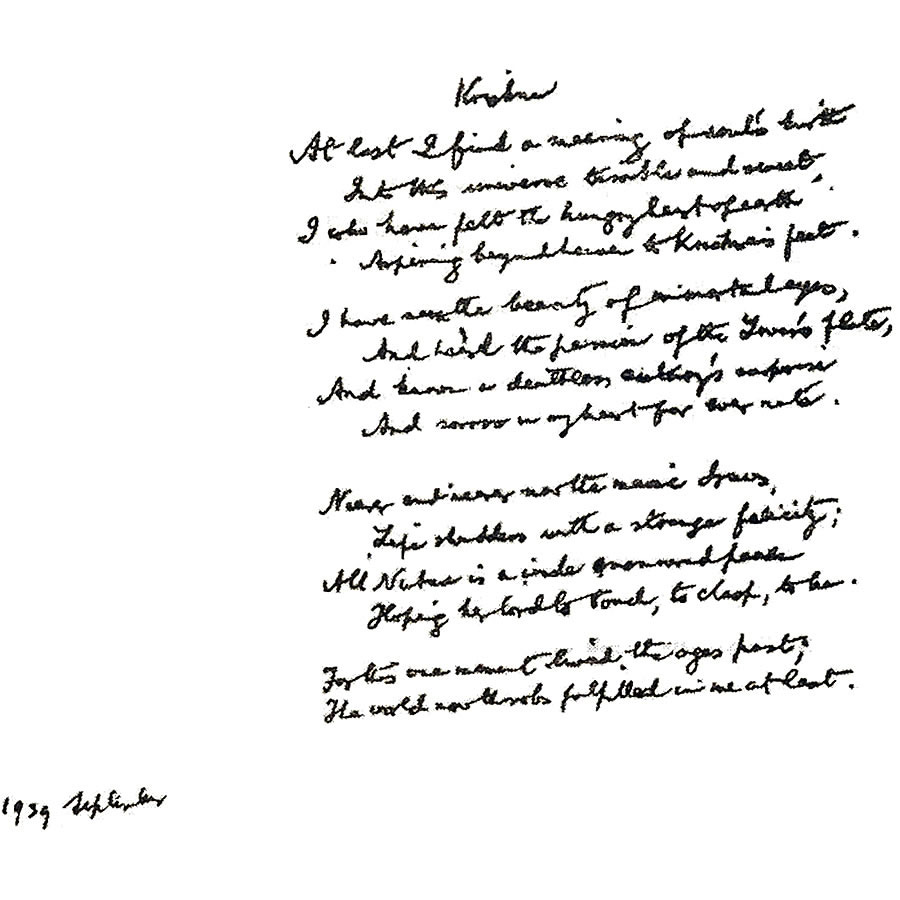
Sri Aurobindo's writing

Krishna

At last I find a meaning of soul's birth,
Into this universe terrible and sweet,
I who have felt the hungry heart of earth
Aspiring beyond heaven to Krishna's feet.

I have seen the beauty of immortal eyes,
And heard the passion of the Lover's flute,
And known a deathless ecstasy's surprise
And sorrow in my heart for ever mute.

Nearer and nearer now the music draws,
Life shudders with a strange felicity;
All Nature is a wide enamoured pause
Hoping her lord to touch, to clasp, to be.

For this one moment lived the ages past;
The world now throbs fulfilled in me at last.

Sri Aurobindo
15.9.1939

18 Jun 1943


I thought I had already told you that your turn towards Krishna was not an obstacle. In any case I affirm that positively in answer to your question. If we consider the large and indeed predominant part he played in my own sadhana, it would be strange if the part he has in your sadhana could be considered objectionable. Sectarianism is a matter of dogma, ritual etc., not of spiritual experience; the concentration on Krishna is a self-offering to the iṣṭa-deva. If you reach Krishna you reach the Divine; if you can give yourself to him, you give yourself to me. Your inability to identify may be because you are laying too much stress on the physical aspects, consciously or unconsciously.

- Sri Aurobindo
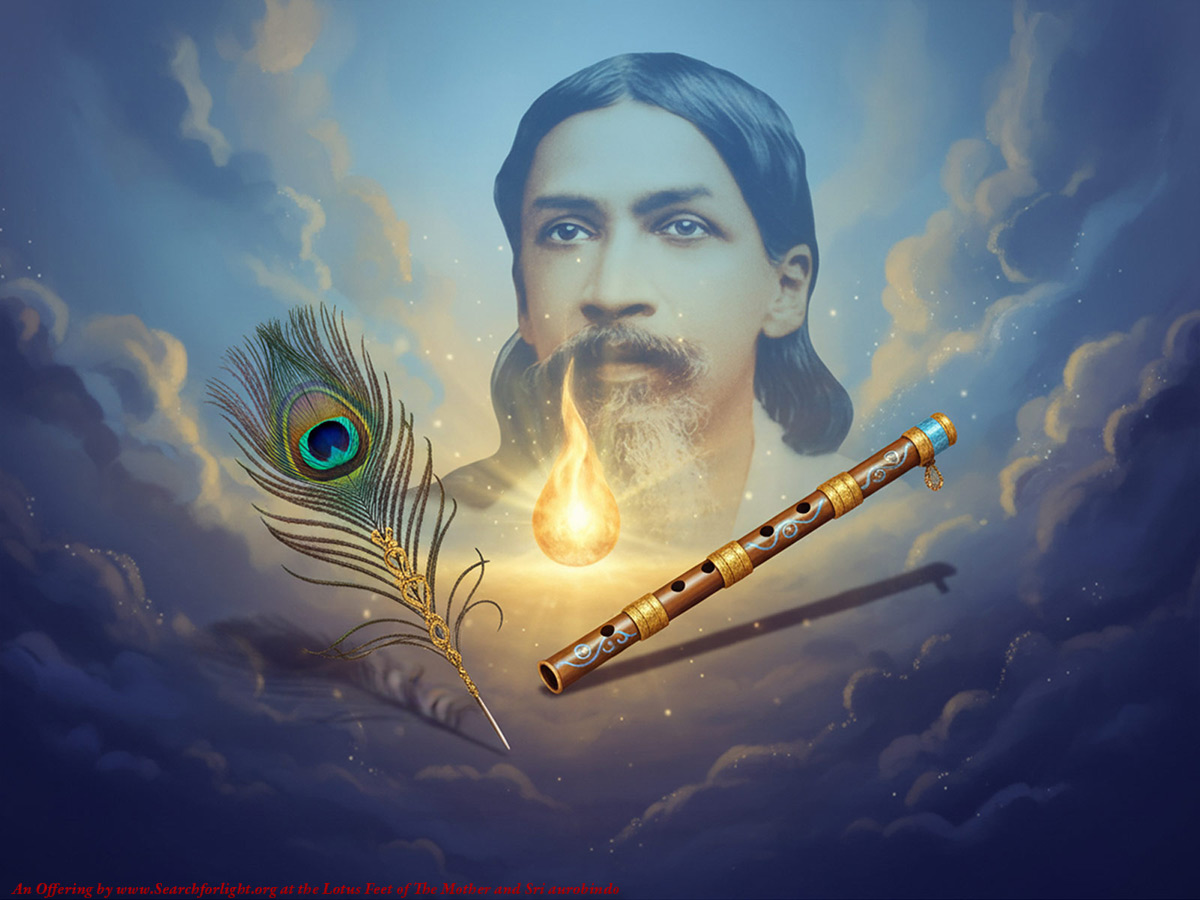
The Mother
Sri Aurobindo
Written by The Mother

From a book by Champaklal, one of the earliest disciples of, and personal attendant to, Sri Aurobindo:

“Kamala’s brother Mahesh had come with me in 1923. Obviously we both came for the same purpose, but I found a difference in Sri Aurobindo's way of dealing with us. To me he was speaking and guiding me in his Yoga but to Mahesh he talked of bhakti and upasana [worship] of Sri Krishna. Later I found out that Mahesh was intensely drawn to Sri Krishna and his path was different from mine. One day, however, he expressed his difficulty in reconciling his adoration of Sri Krishna with his surrender to Sri Aurobindo. Sri Aurobindo told him: “There is no difference between Krishna and me.”

Champaklal Speaks

Sri Aurobindo 
Sri Aurobindo's writing

Krishna

Cretics

O immense Light and thou, O spirit-wide boundless Space,
Whom have you clasped and hid, deathless limbs, gloried face?
Vainly lie Space and Time, "Void are we, there is none."
Vainly strive Self and World crying, "I, I alone."
One is there, Self of self, Soul of Space, Fount of Time,
Heart of hearts, Mind of minds, He alone sits, sublime.
Oh, no void Absolute self-absorbed, splendid, mute,
Hands that clasp hold and red lips that kiss blow the flute.
All He loves, all He moves, all are His, all are He!
Many limbs sate His whims, bear His sweet ecstasy.
Two in One, Two who know difference rich in sense,
Two to clasp, One to be, this His strange mystery.

From Sri Aurobindo's Thoughts and Aphorisms


Kali is Krishna revealed as dreadful Power and wrathful Love. She slays with her furious blows the self in body, life and mind in order to liberate it as spirit eternal. 
Canst thou see God in thy torturer and slayer even in thy moment of death or thy hours of torture? Canst thou see Him in that which thou art slaying, see and love even while thou slayest? Thou hast thy hand on the supreme knowledge. How shall he attain to Krishna who has never worshipped Kali?
 I did not know for some time whether I loved Krishna best or Kali; when I loved Kali, it was loving myself, but when I loved Krishna, I loved another, and still it was myself with whom I was in love. Therefore I came to love Krishna better even than Kali. 
When I first met Krishna, I loved Him as a friend and playmate till He deceived me; then I was indignant and could not forgive Him. Afterwards I loved Him as a lover and He still deceived me; I was again and much more indignant, but this time I had to pardon. 
When I saw others than Krishna and myself in the world, I kept secret God’s doings with me; but since I began to see Him and myself everywhere, I have become shameless and garrulous. 
My Lover took His crown and royal necklace from His head and neck and clothed me with them; but the disciples of the saints and the prophets abused me and said, “He is hunting after Siddhis.
 Living in Krishna, even enmity becomes a play of love and the wrestling of brothers. 
The Semites have afflicted mankind with the conception of a God who is a stern and dignified king and solemn judge and knows not mirth. But we who have seen Krishna, know Him for a boy fond of play and a child full of mischief and happy laughter.
 When will the world change into the model of heaven? When all mankind becomes boys and girls together with God revealed as Krishna and Kali, the happiest boy and strongest girl of the crowd, playing together in the gardens of Paradise. The Semitic Eden was well enough, but Adam and Eve were too grown up and its God Himself too old and stern and solemn for the offer of the Serpent to be resisted. 
The divine Friend of all creatures conceals His friendlines in the mask of an enemy till He has made us ready for the highest heavens; then, as in Kurukshetra, the terrible form of the Master of strife, suffering and destruction is withdrawn and the sweet face, the tenderness, the oft-clasped body of Krishna shine out on the shaken soul and purified eyes of his eternal comrade and playmate.
 

In a letter dated 14.08.1945 to Dilip Kumar Roy, Sri Aurobindo wrote: “If you had an unprecedented peace for so long a time, it was due to my persistent inner pressure. I refuse to give up all the credit to my double, Krishna.”

- Sri Aurobindo

What you were told of the incompatibility of love and adoration of Krishna with this Yoga, is not true. There is not and cannot be any such incompatibility. Otherwise we would not have encouraged you in your aspiration. You can seek for him quite as well here as in Brindaban.

- Sri Aurobindo's letter to Dilip
Sri Aurobindo's writing

Thoughts and Aphorisms

There are four very great events in history , the siege of Troy, the life and crucifixion of Christ, the exile of Krishna in Brindavan and the colloquy with Arjuna on the field of Kurukshetra. The siege of Troy created Hellas, the exile in Brindavan created devotional religion, (for before there was only meditation and worship), Christ from his cross humanised Europe, the colloquy at Kurukshetra will yet liberate humanity .Yet it is said that none of these four events ever happened.


The Mother on Sri Aurobindo's Birth

The Eternal Birth

15th August 1872

Physically, it means that the consciousness of this birth will last as long as the Earth. The consequences of Sri Aurobindo's birth will be felt throughout the entire existance of the Earth......


Mentally, it is a birth the memory of which will last eternally. Through the ages Sri Aurobindo's birth will be remembered, with all the consequences it has had....


Psychically, it is a birth which will recur eternally, from age to age, in the history of the universe. This birth is a manifestation which takes place periodically, from age to age, in the history of the Earth.....


And finally, from the purely spiritual point of view, it will be said that it is the birth of the Eternal on Earth. For each time the Avatar takes a physical form it is the birth of the Eternal himself on Earth.

-The Mother
 

Permanent Influence of the Krishna, Avatar

- Sri Aurobindo

The Avatar may descend as a great spiritual teacher and saviour, the Christ, the Buddha, but always his work leads, after he has finished his earthly manifestation, to a profound and powerful change not only in the ethical, but in the social and outward life and ideals of the race. He may on the other hand, descend as an incarnation of the divine life, the divine personality and power in its characteristic action, for a mission ostensibly social, ethical, and political, as is represented in the story of Rama or Krishna; but always then this descent becomes in the soul of the race a permanent power for the inner living and the spiritual rebirth. It is indeed curious to note that the permanent, vital, universal effect of Buddhism and Christianity has been the force of their ethical, social and practical ideals and their influence even on the men and the ages which have rejected their religious and spiritual beliefs, forms and disciplines; later Hinduism which rejected Buddha, his sarigha, and his dharma, bears the ineffaceable imprint of the social and ethical influence of Buddhism and its effect on the ideas and the life of the race, while in modem Europe, Christian only in name, humanitarianism is the translation into the ethical and social sphere and the aspiration to liberty , equality and fraternity the translation into the social and political sphere of the spiritual truths of Christianity, the latter especially being effected by men who aggressively rejected the Christian religion and spiritual discipline and by an age which in its intellectual effort of emancipation tried to get rid of Christianity as a creed.

On the other hand, the life of Rama and Krishna belongs to the prehistoric past which has come down only in poetry and legend and may even be regarded as myths; but it is quite immaterial whether we regard them as myths or historical facts, because their permanent truth and value lie in their persistence as a spiritual form, presence, influence in the inner consciousness of the race and the life of the human soul. Avatarhood is a fact of divine life and consciousness which may realise itself in an outward action, but must persist, when that action is over and has done its work, in a spiritual influence; or may realise itself in a spiritual influence and teaching, but must then it have its permanent effect, even when the new religion or discipline is exhausted, in the thought, temperament and outward life of mankind.

The inner fruit of the Avatar' s coming is gained by those who learn from it the true nature of the divine birth and the divine works and who, growing full of him in their I consciousness and taking refuge in him with their whole I being, man may ii miim upiisritii, purified by the realising force of their knowledge and delivered from the lower nature, attain to the divine being and divine nature, madbhiivam. The Avatar comes to reveal the divine nature in man above this lower nature and to show what are the divine works, free, unegoistic, disinterested, impersonal, universal, full of the divine light, the divine power and the divine love. He comes as the divine personality which shall fill the consciousness of the human being and replace the limited egoistic personality , so that it shall be liberated out of ego into infinity and universality , out of birth into immortality .He comes as the divine power and love which calls men to itself, so that they may take refuge in that and no longer in the insufficiency of their human wills and the strife of their human fear, wrath and passion, and liberated from all this unquiet and suffering may live in the calm and bliss of the Divine.

Sri Aurobindo

Sri Krishna, the Teacher of the Gita

All existence is a manifestation of God because He is the only existence and nothing can be except as either a real figuring or else a figment of that one reality .Therefore every conscious being is in part or in some way a descent of the Infinite into the apparent finiteness of name and form. But it is a veiled manifestation and there is a gradation between the supreme being of the Divine and the consciousness shrouded partly or wholly by ignorance of self in the finite.

The inner Divinity is the eternal Avatar in man; the human manifestation is its sign and development in the external world.

It is ...the eternal Avatar, this God in man, the divine Consciousness always present in the human being who manifested in a visible form speaks to the human soul in the Gita, illumines the meaning of life and the secret of divine action and gives it the light of the divine knowledge and guidance and the assuring and fortifying word of the Master of existence in the hour when it comes face to face with the painful mystery of the world. This is what the Indian religious consciousness seeks to make near to itself in whatever form, whether in the symbolic human image it enshrines in its temples or in the worship of its Avatars or in the devotion to the human Guru through whom the voice of the one world-Teacher makes itself heard. Through these it strives to awaken to that inner voice, unveil that form of the Formless and stand face to face with that manifest divine Power, Love and Knowledge.Secondly, there is the typical, almost the symbolic significance of the human Krishna who stands behind the great action of the Mahabharata, not as its hero, but as its secret centre and hidden guide. That action is the action of a whole world of men and nations, some of whom have come as helpers of an effort and result by which they do not personally profit, and to these he is a leader, some as its opponents and to them he also is an opponent, the baffler of their designs and their slayer and he seems even to some of them an instigator of all evil and destroyer of their old order and familiar world and secure conventions of virtue and good;

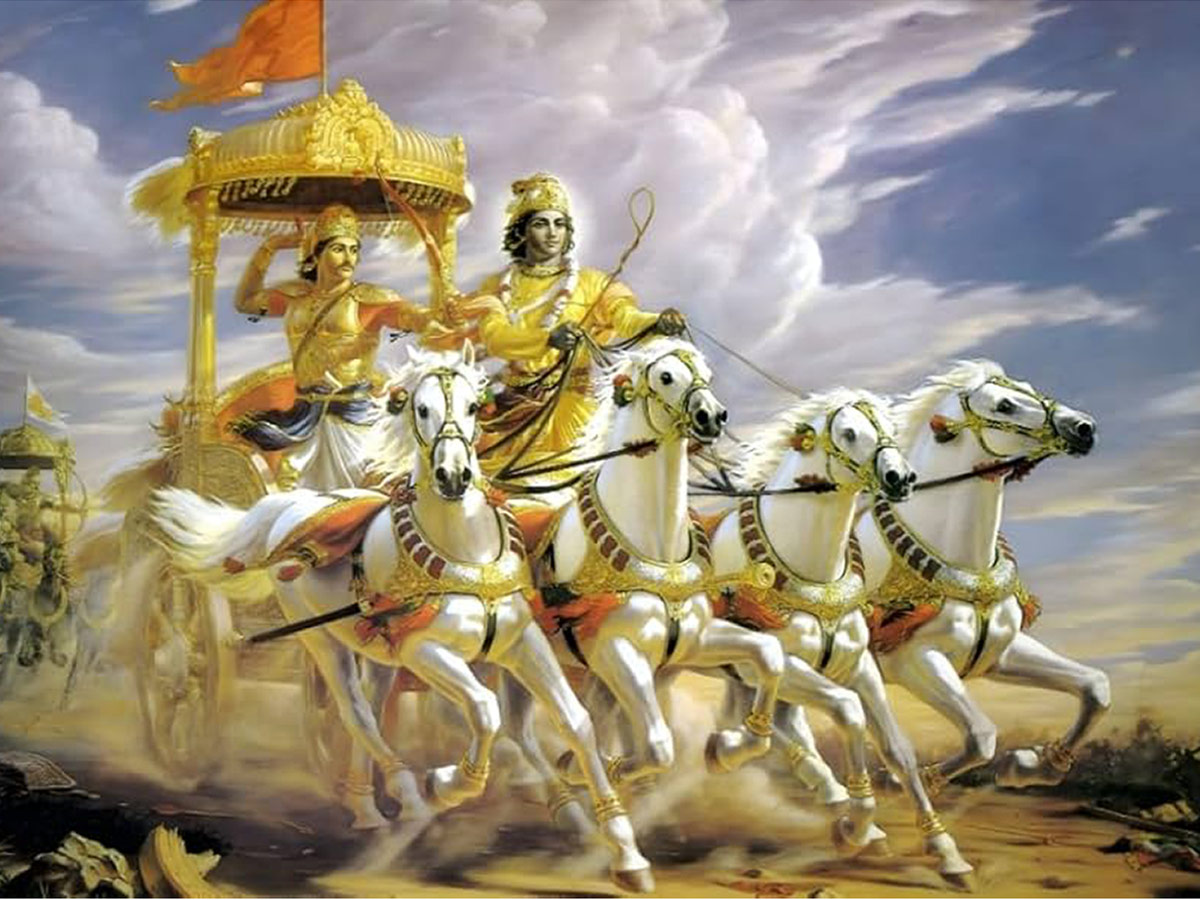
some are, representatives of that which has to be fulfilled and to them he is counsellor, helper, friend. Where the action pursues its natural course or the doers of the work have to suffer at the hands of its enemies and undergo the ordeals which prepare them for mastery, the Avatar is unseen or appears only for occasional comfort and aid, but at every crisis his hand is felt, yet in such a way that all imagine themselves to be the protagonists and even Arjuna, his nearest friend and chief instrument, does not perceive that he is an instrument and has to confess at last that all the while he did not really know his divine Friend. He has received counsel from his wisdom, help from his power, has loved and been loved, has even adored without understanding his divine nature; but he has been guided like all others through his own egoism and the counsel, help and direction have been given in the language and received by the thoughts of the Ignorance. Until the moment when all has been pushed to the terrible issue of the struggle on the field of Kurukshetra and the Avatar stands at last, still not as fighter, but as the charioteer in the battle car which carries the destiny of the fight, he has not revealed Himself even to those whom he has chosen.

Thus the figure of Krishna becomes, as it were, the symbol of the divine dealings with humanity .Through our egoism and ignorance we are moved, thinking that we are the doers of the work, vaunting of ourselves as the real cases of the result, and that which moves us we see only occasionally as some vague or even some human and earthly fountain of knowledge, aspiration, force, some Principle or Light or Power which we acknowledge and adore without knowing what it is until the occasion arises that forces us to stand arrested before the Veil. And the action in which this divine figure moves is the whole wide action of man in life, not merely the inner life, but all this obscure course of the world which we can judge only by the twilight of the human reason as it opens up dimly before our uncertain advance the little span in front.

The symbolic companionship of Arjuna and Krishna, the human and the divine soul, is expressed elsewhere in Indian thought, in the heavenward journey of Indra and Kutsa seated in one chariot, in the figure of the two birds upon one tree in the Upanishad, in the twin figures of Nara and Narayana, the seers who do tapasya together for the knowledge. But in all three it is the idea of the divine knowledge in which, as the Gita says, all action culminates that is in view; here it is instead the action which leads to that knowledge and in which the divine Knower figures Himself. Arjuna and Krishna, this human and this divine, stand together not as seers in the peaceful hermitage of meditation, but as fighter and holder of the reins in the clamorous field, in the midst of the hurtling shafts, in the chariot of battle. The Teacher of the Gita is therefore not only the God in man who unveils Himself in the world of knowledge, but the God in man who moves our whole world of action, by and for whom all our humanity exists and struggles and labours, towards whom all human life travels and progresses. He is the secret Master of works and sacrifice and the friend of the human peoples.

Such then is the divine Teacher of the Gita, the eternal Avatar, the Divine who has descended into the human consciousness, the Lord seated within the heart of all beings, He who guides from behind the veil all our thought and action and heart's seeking even as He directs from behind the veil of visible and sensible forms and forces and tendencies the great universal action of the world which He has manifested in His own being. All the strife of our upward endeavour and seeking finds its culmination and ceases in a satisfied fulfilment when we can rend the veil and get behind our apparent self to this real Self, can realise our whole being in this true Lord of our being, can give up our personality to and into this one real Person, merge our ever-dispersed and ever- converging mental activities into His plenary light, offer up our errant and struggling will and energies into His vast, luminous and undivided Will, at once renounce and satisfy all our dissipated outward-moving desires and emotions in the plenitude of His self-existent Bliss. This is the world- Teacher of whose eternal knowledge all other highest teaching is but the various reflection and partial word, this the Voice to which the hearing of our soul has to awaken.

The Mother

Historicity of Sri Krishna

- Sri Aurobindo

I

The historicity of Krishna is of less spiritual importance and is not essential, but it has still a considerable value. It does not seem to me that there can be any reasonable doubt that Krishna the man was not a legend or a poetic invention but actually existed upon earth and played a part in the Indian past. Two facts emerge clearly, that he was regarded as an important spiritual figure, one whose spiritual illumination was recorded in one of the Upanishads, and that he was traditionally regarded as a divine man, one worshipped after his death as a deity; this is apart from the story in the Mahabharata and the Puranas. There is no reason to suppose that the connection of his name with the development of the Bhagavata religion, an important current in the stream of Indian spirituality , was founded on a mere legend or poetic invention. The Mahabharata is a poem and not history , but it is clearly a poem founded on a great historical event, traditionally preserved in memory; some of the figures connected with it, Dhritarashtra, Parikshit, for instance, certainly existed and the story of the part played by Krishna as leader, warrior and statesman can be accepted as probable in itself and to all appearance founded on a tradition which can be given a historical value and has not the air of a myth or a sheer poetical invention. That is as much as can be positively said from the point of view of the theoretical reason as to the historic figure of the man Krishna; but in my view there is much more than that in it and I have always regarded the incarnation as a fact and accepted the historicity of Krishna as I accept the historicity of Christ.

II

The Krishna consciousness is a reality, but if there were no Krishna, there could be no Krishna consciousness; except in arbitrary metaphysical abstractions there can be no consciousness without a Being who is conscious. It is the person who gives value and reality to the personality , he expresses himself in it and is not constituted by it. Krishna is a being, a person and it is as the Divine Person that we meet him, hear his voice, speak with him and feel his presence. To speak of the consciousness of Krishna as something separate from Krishna is an error of the mind, which is always separating the inseparable and which also tends to regard the impersonal, because it is abstract, as greater, more real and more enduring than the person. Such divisions may be useful to the mind for its own purposes, but it is not the real truth; in the real truth the being or person and its impersonality or state of being are one reality.

- Sri Aurobindo

24th November 1926

From: A.B. Purani “The Life of Sri Aurobindo”, pages 210-217.

From the beginning of November 1926 the pressure of the Higher Power began to be unbearable. Then at last the great day, the day for which the Mother had been waiting for so many long years, arrived on 24 November. The sun had almost set, and everyone was occupied with his own activity – some had gone out to the seaside for a walk – when the Mother sent round word to all the disciples to assemble as soon as possible in the verandah where the usual meditation was held. It did not take long for the message to go round to all. By six o’clock most of the disciples had gathered. It was becoming dark. In the verandah on the wall near Sri Aurobindo’s door, just behind his chair, a black silk curtain with gold lace work representing three Chinese dragons was hung. The three dragons were so represented that the tail of one reached up to the mouth of the other and the three of them covered the curtain from end to end. We came to know afterwards that there is a prophecy in China that the Truth will manifest itself on earth when the three dragons (the dragons of the earth, of the mind region and of the sky) meet. Today on 24 November the Truth was descending and the hanging of the curtain was significant.

There was a deep silence in the atmosphere after the disciples had gathered there. Many saw an oceanic flood of Light rushing down from above. Everyone present felt a kind of pressure above his head. The whole atmosphere was surcharged with some electrical energy. In that silence, in that atmosphere full of concentrated expectation and aspiration, in the electrically charged atmosphere, the usual, yet on this day quite unusual, tick was heard behind the door of the entrance. Expectation rose in a flood. Sri Aurobindo and the Mother could be seen through the half-opened door. The Mother with a gesture of her eyes requested Sri Aurobindo to step out first. Sri Aurobindo with a similar gesture suggested to her to do the same. With a slow dignified step the Mother came out first, followed by Sri Aurobindo with his majestic gait. The small table that used to be in front of Sri Aurobindo’s chair was removed this day. The Mother sat on a small stool to his right.

Silence absolute, living silence – not merely living but overflowing with divinity. The meditation lasted about forty-five minutes. After that one by one the disciples bowed to the Mother.

She and Sri Aurobindo gave blessings to them. Whenever a disciple bowed to the Mother, Sri Aurobindo’s right hand came forward behind the Mother’s as if blessing him through the Mother. After the blessings, in the same silence there was a short meditation.

In the interval of silent meditation and blessings many had distinct experiences. When all was over they felt as if they had awakened from a divine dream. Then they felt the grandeur, the poetry and the absolute beauty of the occasion. It was not as if a handful of disciples were receiving blessings from their Supreme Master and the Mother in one little corner of the earth. The significance of the occasion was far greater than that. It was certain that a Higher Consciousness had descended on earth. In that deep silence had burgeoned forth, like the sprout of a banyan tree, the beginning of a mighty spiritual work. This momentous occasion carried its significance to all in the divine dynamism of the silence, in its unearthly dignity and grandeur and in the utter beauty of its every little act. The deep impress of divinity which everyone got was for him a priceless treasure.

Sri Aurobindo and the Mother went inside. Immediately Datta was inspired. In that silence she spoke: “The Lord has descended into the physical today.”

The names of those disciples who were present on 24 November 1926: 


01 – Bijoy Kumar Nag;

 02 – Nolini Kanta Gupta; 

03 – K. Amrita;

 04 – Moni (= Suresh Chakravarty);

 05 – Pavitra (= Philippe Barbier Saint-Hilaire); 

06 – Barindra Kumar Ghose, Sri Aurobindo’s younger brother;

 07 – Datta (= Miss Dorothy Hodgson);

 08 – K. Rajangam; 

09 – Satyen;

 10 – A.B. Purani (author of this text);

 11 – Lilavati (= Purani’s wife); 

12 – Punamchand; 

13 – Champa Ben (= Punamchand’s wife); 

14 – Rajani Kanta Palit; 

15 – Dr. Upendra Nath Banerjee; 

16 – Champaklal; 

17 – Kanailal Gangulee; 

18 – Khitish Chandra Dutt; 

19 – V. Chandra Sekharam;

 20 – Pujalal; 

21 – Purushottam Patel; 

22 – Rati Palit;

 23 – Rambhai Patel; 

24 – Nani Bala

- A B Purani