
Invocation
Nobody can give you the true mantra. It's not something that is given: it's something that wells up from within. It must spring from within all of a sudden, spontaneously, like a profound, intense need of your being—then it has power, because it's not something that comes from outside, it's your very own cry.
I saw, in my case, that my mantra has the power of immortality; whatever happens, if it is uttered, it's the Supreme that has the upper hand, it's no longer the lower law. And the words are irrelevant, they may not have any meaning—to someone else, my mantra is meaningless, but to me it's full, packed with meaning. And effective, because it's my cry, the intense aspiration of my whole being.
A mantra given by a guru is only the power to realize the experience of the discoverer of the mantra. The power is automatically there, because the sound contains the experience. I saw that once in Paris, at a time when I knew nothing of India, absolutely nothing, only the usual nonsense. I didn't even know what a mantra was. I had gone to a lecture given by some fellow who was supposed to have practiced "yoga" for a year in the Himalayas and recounted his experience (none too interesting, either). All at once, in the course of his lecture, he uttered the sound OM. And I saw the entire room suddenly fill with light, a golden, vibrating light.... I was probably the only one to notice it. I said to myself, "Well!" Then I didn't give it any more thought, I forgot about the story. But as it happened, the experience recurred in two or three different countries, with different people, and every time there was the sound OM, I would suddenly see the place fill with that same light. So I understood. That sound contains the vibration of thousands and thousands of years of spiritual aspiration—there is in it the entire aspiration of men towards the Supreme. And the power is automatically there, because the experience is there.
It's the same with my mantra. When I wanted to translate the end of my mantra, "Glory to You, O Lord," into Sanskrit, I asked for Nolini's help. He brought his Sanskrit translation, and when he read it to me, I immediately saw that the power was there—not because Nolini put his power into it (!), God knows he had no intention of "giving" me a mantra! But the power was there because my experience was there. We made a few adjustments and modifications, and that's the japa I do now—I do it all the time, while sleeping, while walking, while eating, while working, all the time. [Mother later clarified: "'Glory to You, O Lord' isn't MY mantra, it's something I ADDED to it—my mantra is something else altogether, that's not it. When I say that my mantra has the power of immortality, I mean the other, the one I don't speak of! I have never given the words.... You see, at the end of my walk, a kind of enthusiasm rises, and with that enthusiasm, the 'Glory to You' came to me, but it's part of the prayer I had written in Prayers and Meditations: 'Glory to You, O Lord, all-triumphant Supreme' etc. (it's a long prayer). It came back suddenly, and as it came back spontaneously, I kept it. Moreover, when Sri Aurobindo read this prayer in Prayers and Meditations, he told me it was very strong. So I added this phrase as a kind of tail to my japa. But 'Glory to You, O Lord' isn't my spontaneous mantra—it came spontaneously, but it was something written very long ago. The two things are different."]
And that's how a mantra has life: when it wells up all the time, spontaneously, like the cry of your being—there is no need of effort or concentration: it's your natural cry. Then it has full power, it is alive. It must well up from within.... No guru can give you that.
Mother's Agenda, May 11, 1963
Sri Aurobindo
His soul stood free, a witness and a king.![]()
Sri Aurobindo's translation of Gayatri Mantra
( CWSA, Vol.35, p.831, in The Mother's handwriting )
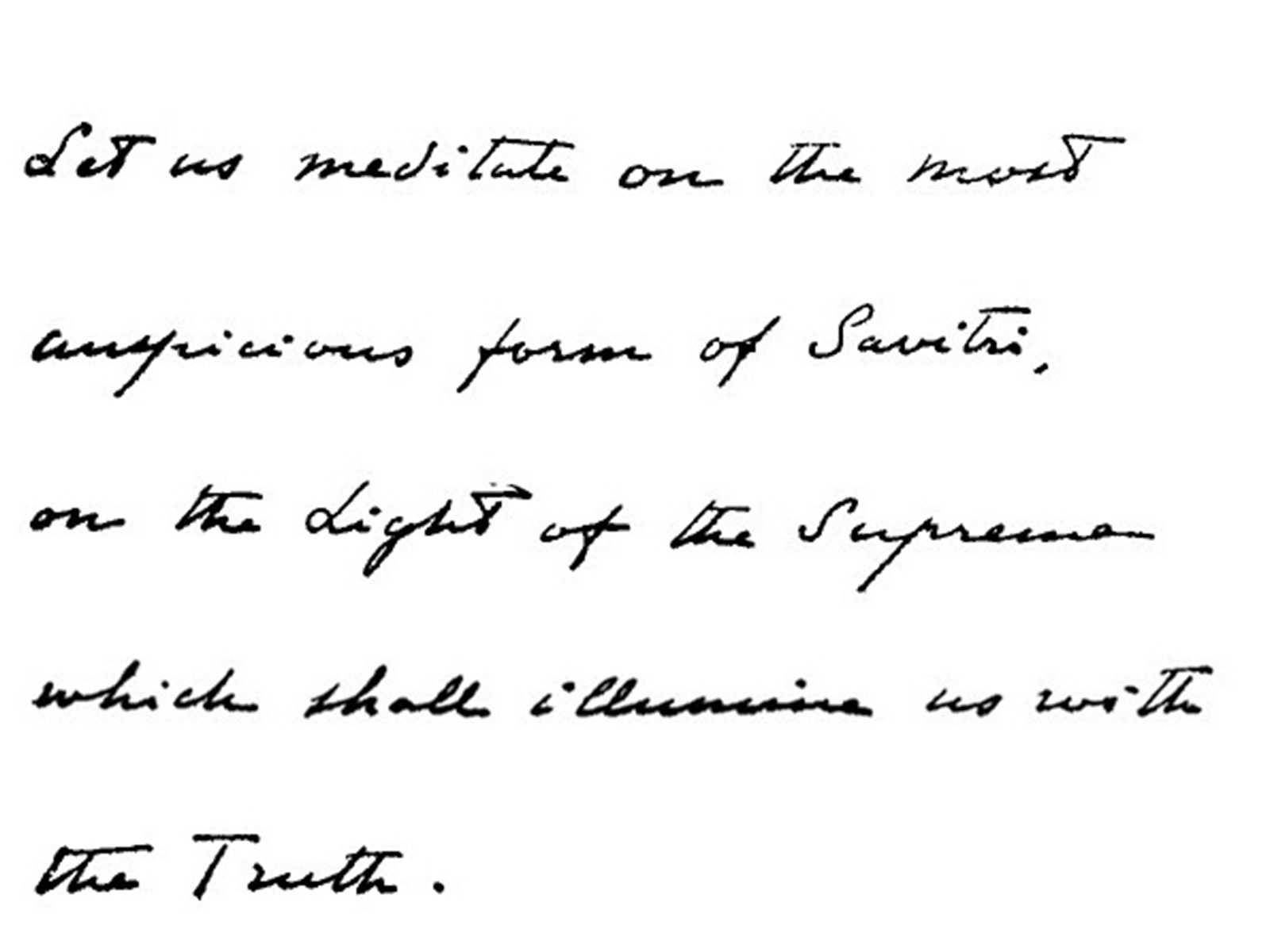
Let us meditate on the most
auspicious (best) form of Savitri,
on the Light of the Supreme
which shall illumine us with
the Truth.
The japa is usually successful only on one of two conditions—if it is repeated with a sense of its significance, a dwelling of something in the mind on the nature, power, beauty, attraction of the Godhead it signifies and is to bring into the consciousness,—that is the mental way; or if it comes up from the heart or rings in it with a certain sense or feeling of bhakti making it alive,—that is the emotional way. Either the mind or the vital has to give it support or sustenance. But if it makes the mind dry and the vital restless, it must be missing that support and sustenance. There is, of course, a third way, the reliance on the power of the mantra or name in itself; but then one has to go on till that power has sufficiently impressed its vibration on the inner being to make it at a given moment suddenly open to the Presence or the Touch. But if there is a struggling or insistence for the result, then this effect which needs a quiet receptivity in the mind is impeded. That is why I insisted so much on mental quietude and not on too much straining or effort, to give time to allow the psychic and the mind to develop the necessary condition of receptivity—a receptivity as natural as when one receives an inspiration for poetry and music...
(Letters on Yoga : Sadhana through Meditation
The Blessing Without Words
THE MOTHER ON MANTRA
( Mother's Agenda, September 16, 1958)
I have a whole stock of mantras; they have all come spontaneously, never from the head. They sprang forth spontaneously, as the Veda is said to have sprung forth.
I don't know when it began—a very long time ago, before I came here, although some of them came while I was here. But in my case, they were always very short. For example, when Sri Aurobindo was here in his body, at any moment, in any difficulty, for anything, it always came like this: 'My Lord!'—simply and spontaneously—'My Lord!' And instantly, the contact was established. But since He left, it has stopped. I can no longer say it, for it would be like saying 'My Lord, My Lord!' to myself.
I had a mantra in French before coming to Pondicherry. It was Dieu de bonté et de miséricorde ... [God of kindness and mercy], but what it means is usually not understood—it is an entire program, a universal program. I have been repeating this mantra since the beginning of the century; it was the mantra of ascension, of realization. At present, it no longer comes in the same way, it comes rather as a memory. But it was deliberate, you see; I always said Dieu de bonté et de miséricorde, because even then I understood that everything is the Divine and the Divine is in all things and that it is only we who make a distinction between what is or what is not the Divine.
My experience is that, individually, we are in relationship with that aspect of the Divine which is not necessarily the most in conformity with our natures, but which is the most essential for our development or the most necessary for our action. For me, it was always a question of action because, personally, individually, each aspiration for personal development had its own form, its own spontaneous expression, so I did not use any formula. But as soon as there was the least little difficulty in action, it sprang forth. Only long afterwards did I notice that it was formulated in a certain way—I would utter it without even knowing what the words were. But it came like this: Dieu de bonté et de miséricorde. It was as if I wanted to eliminate from action all aspects that were not this one. And it lasted for ... I don't know, more than twenty or twenty-five years of my life. It came spontaneously.
Just recently one day, the contact became entirely physical, the whole body was in great exaltation, and I noticed that other lines were spontaneously being added to this Dieu de bonté et de miséricorde, and I noted them down. It was a springing forth of states of consciousness—not words.
Seigneur, Dieu de bonté et de miséricorde
Seigneur, Dieu d'unité souveraine
Seigneur, Dieu de beauté et d'harmonie
Seigneur, Dieu de puissance et de réalisation
Seigneur, Dieu d'amour et de compassion
Seigneur, Dieu du silence et de la contemplation
Seigneur, Dieu de lumière et de connaissance
Seigneur, Dieu de vie et d'immortalité
Seigneur, Dieu de jeunesse et de progrès
Seigneur, Dieu d'abondance et de plénitude
Seigneur, Dieu de force et de santé.
Lord, God of kindness and mercy
Lord, God of sovereign oneness
Lord, God of beauty and harmony
Lord, God of power and realization
Lord, God of love and compassion
Lord, God of silence and contemplation
Lord, God of light and knowledge
Lord, God of life and immortality
Lord, God of youth and progress
Lord, God of abundance and plenitude
Lord, God of strength and health.
The words came afterwards, as if they had been superimposed upon the states of consciousness, grafted onto them. Some of the associations seem unexpected, but they were the exact expression of the states of consciousness in their order of unfolding. They came one after another, as if the contact was trying to become more complete. And the last was like a triumph. As soon as I finished writing (in writing, all this becomes rather flat), the impetus within was still alive and it gave me the sense of an all-conquering Truth. And the last mantra sprang forth:
Seigneur, Dieu de la Vérité victorieuse!
Lord, God of victorious Truth!
Like a triumph. But I didn't write that one down because I did not want to spoil my impression.
Of course, these things should not be published. We can file them in this Agenda of the Supramental Manifestation for later on. Later on, when the Victory is won, we shall say, 'If you want to see the curve...'
But what is going to come now? I constantly hear the Sanskrit mantra:
OM NAMO BHAGAVATEH
It is there, all around me; it takes hold of all the cells and at once they spring forth in an ascension. And Narada's mantra, too:
Narayana, Narayana...
(it is actually a Command which means: now you shall do as I wish), but it doesn't come from the heart.
What will it be?
It will simply spring forth in a flash, all of a sudden, and it will be very powerful. Only power can do something. Love vanishes like water running through sand: people remain beatific ... and nothing moves! No, power is needed—like Shiva, stirring, churning ...
When I have this mantra, instead of saying hello, good-bye, I shall say that. When I say hello, good-bye, it means 'Hello: the Presence is here, the Light is here.' 'Good-bye: I am not going away, I am staying here.'
But when I have this mantra, I believe something will happen.
(silence)
For the moment, of all the formulas or mantras, the one that acts most directly on this body, that seizes all the cells and immediately does this (vibrating motion) is the Sanskrit mantra: OM NAMO BHAGAVATEH.
As soon as I sit for meditation, as soon as I have a quiet minute to concentrate, it always begins with this mantra, and there is a response in the body, in the cells of the body: they all start vibrating.
This is how it happened: Y had just returned, and he brought back a trunk full of things which he then proceeded to show me, and his excitement made tight, tight little waves in the atmosphere, making my head ache; it made ... anyway, it was unpleasant. When I left, just after that had happened, I sat down and went like this (gesture of sweeping out) to make it stop, and immediately the mantra began.
It rose up from here (Mother indicates the solar plexus), like this: Om Namo Bhagavateh OM NAMO BHAGAVATEH OM NAMO BHAGAVATEH. It was formidable. For the entire quarter of an hour that the meditation lasted, everything was filled with Light! In the deeper tones it was of golden bronze (at the throat level it was almost red) and in the higher tones it was a kind of opaline white light: OM NAMO BHAGAVATEH, OM NAMO BHAGAVATEH, OM NAMO BHAGAVATEH.
The other day (I was in my bathroom upstairs), it came; it took hold of the entire body. It rose up in the same way, and all the cells were trembling. And with such a power! So I stopped everything, all movement, and I let the thing grow. The vibration went on expanding, ever widening, as the sound itself was expanding, expanding, and all the cells of the body were seized with an intensity of aspiration ... as if the entire body were swelling—it became overwhelming. I felt that it would all burst.
I understood those who withdraw from everything to live that totally.
And it has such a transformative power! I felt that if it continued, something would happen, something like a change in the equilibrium of the body's cells.
Unfortunately, I was unable to continue, because ... I don't have the time; it was just before the balcony darshan and I was going to be late. Something told me, 'That is for people who have nothing to do.' Then I said, 'I belong to my work,' and I slowly withdrew. I put on the brakes, and the action was cut short. But what remains is that whenever I repeat this mantra ... everything starts vibrating.
So each one must find something that acts on himself, individually. I am only speaking of the action on the physical plane, because mentally, vitally, in all the inner parts of the being, the aspiration is always, always spontaneous. I am referring only to the physical plane.
The physical seems to be more open to something that is repetitious—for example, the music we play on Sundays, which has three series of combined mantras. The first is that of Chandi, addressed to the universal Mother:
Ya devi sarvabhuteshu matrirupena sansthita
Ya devi sarvabhuteshu shaktirupena sansthita
Ya devi sarvabhuteshu shantirupena sansthita
Namastasyai namastasyai namastasyai namo namah
The second is addressed to Sri Aurobindo (and I believe they have put my name at the end). It incorporates the mantra I was speaking of:
Om namo namah shrimirambikayai
Om namo bhagavateh shriaravindaya
Om namo namah shrimirambikayai.
And the third is addressed to Sri Aurobindo: 'Thou art my refuge.'
Shriaravindah sharanam mama.
Each time this music is played, it produces exactly the same effect upon the body. It is strange, as if all the cells were dilating, with a feeling that the body is growing larger ... It becomes all dilated, as if swollen with light—with force, a lot of force. And this music seems to form spirals, like luminous ribbons of incense smoke, white (not transparent, literally white) and they rise up and up. I always see the same thing; it begins in the form of a vase, then swells like an amphora and converges higher up to blossom forth like a flower.
So for these mantras, everything depends upon what you want to do with them. I am in favor of a short mantra, especially if you want to make both numerous and spontaneous repetitions—one or two words, three at most. Because you must be able to use them in all cases, when an accident is about to happen, for example. It has to spring up without thinking, without calling: it should issue forth from the being spontaneously, like a reflex, exactly like a reflex. Then the mantra has its full force.
For me, on the days when I have no special preoccupations or difficulties (days I could call normal, when I am normal), everything I do, all the movements of this body, all, all the words I utter, all the gestures I make, are accompanied and upheld by or lined, as it were, with this mantra:
OM NAMO BHAGAVATEH ... OM NAMO BHAGAVATEH ...
all, all the time, all the time, all the time.
That is the normal state. It creates an atmosphere of an intensity almost more material than the subtle physical; it's like ... almost like the phosphorescent radiations from a medium. And it has a great action, a very great action: it can prevent an accident. And it accompanies you all the time, all the time.
But it is up to you to know what you want to do with it.
Satprem: To sustain the aspiration—to remember. We so easily lapse into forgetfulness. To create a kind of automatism.
You have no mantras that have come to you, that give you a more living feeling? ... Are their mantras long?
Satprem: Yes, they are long. And he has not given me any mantra of the Mother, so ... They exist, but he has not given me any ... I don't know, they don't have much effect on me. It is something very mental.
That's why it should spring forth from you.
(silence)
This one, this mantra, OM NAMO BHAGAVATEH, came to me after some time, for I felt ... well, I saw that I needed to have a mantra of my own, that is, a mantra consonant with what this body has to do in the world. And it was just then that it came. It was truly an answer to a need that had made itself felt. So if you feel the need—not there, not in your head, but here (Mother points to the center of her heart), it will come. One day, either you will hear the words, or they will spring forth from your heart ... And when that happens, you must hold onto it.