And man aspire to the Eternal’s light… — Sri Aurobindo
यत्र नार्यस्तु पूज्यन्ते रमन्ते तत्र देवताः ।
Where women are worshiped, there lives the Gods.
- मनुस्मृति ( ३/५६ )
After I knew that God was a woman,
I learned something from far-off about love;
but it was only when I became a woman and
served my Master and Paramour that I knew love utterly.
The mediaeval ascetics hated women and thought they were created by God for the temptation of monks. One may be allowed to think more nobly both of God and of woman. If a woman has tempted thee, is it her fault or thine? Be not a fool and a self-deceiver. There are two ways of avoiding the snare of woman, one is to shun all women and the other to love all beings.
Sri Aurobindo
.. There will be a new creation, the supramental creation. Well, there's no reason why this creation may not have ... may not take a different form from the one which has been here up till now. And as for me, what I say there is that this is the only solution to the problem, that instead of there being this division, it may be a creation, a being which will be... which will unite "conception and execution, vision and creation in one single consciousness and action" - because that's what has produced the differentiation, the fact that there was the conception and then the execution of this conception, the vision of what had to be and the creation of this vision, that is, the objective realisation of this vision; well, there is no reason why it should be divided; the two things can be done by the same being and therefore there should be only one single being. Instead of there being two lines, one masculine and one feminine, there should be one single being, and that's what I conceive as the solution of all problems - all problems, not only this one - and as the prototype of the supramental creation.
The Mother
At the head she stands of birth and toil and fate,
In their slow round the cycles turn to her call;
Alone her hands can change Time's dragon base.
Hers is the mystery the Night conceals;
The spirit's alchemist energy is hers;
She is the golden bridge, the wonderful fire.
The luminous heart of the Unknown is she,
A power of silence in the depths of God;
She is the Force, the inevitable Word,
The magnet of our difficult ascent,
The Sun from which we kindle all our suns,
The Light that leans from the unrealised Vasts,
The joy that beckons from the impossible,
The Might of all that never yet came down.
- Savitri
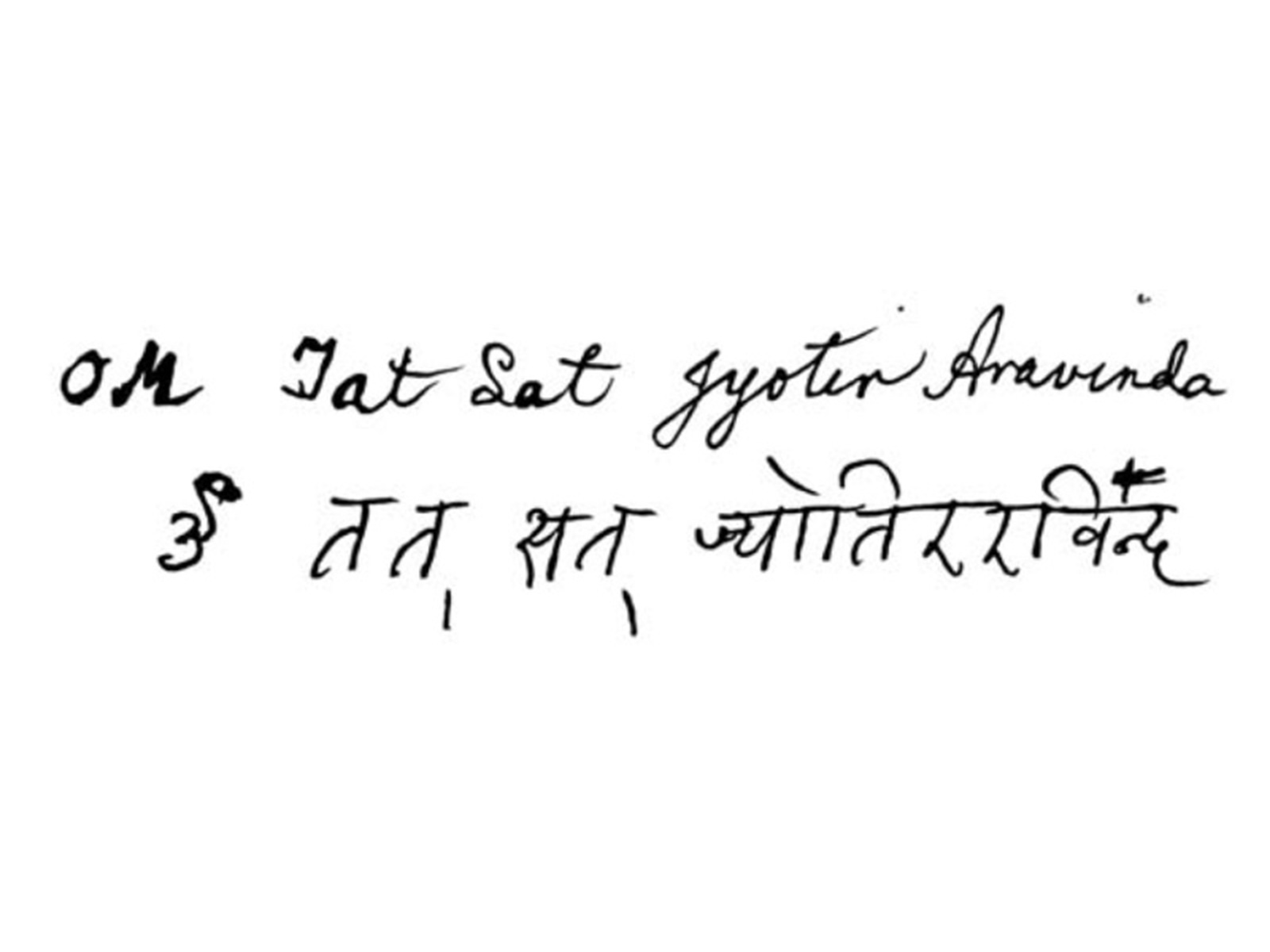
Handwritten by Sri Aurobindo
"Om Tat Sat Jyotir Arvinda"
All Nature dumbly calls to her alone
To heal with her feet the aching throb of life
And break the seals on the dim soul of man
And kindle her fire in the closed heart of things.
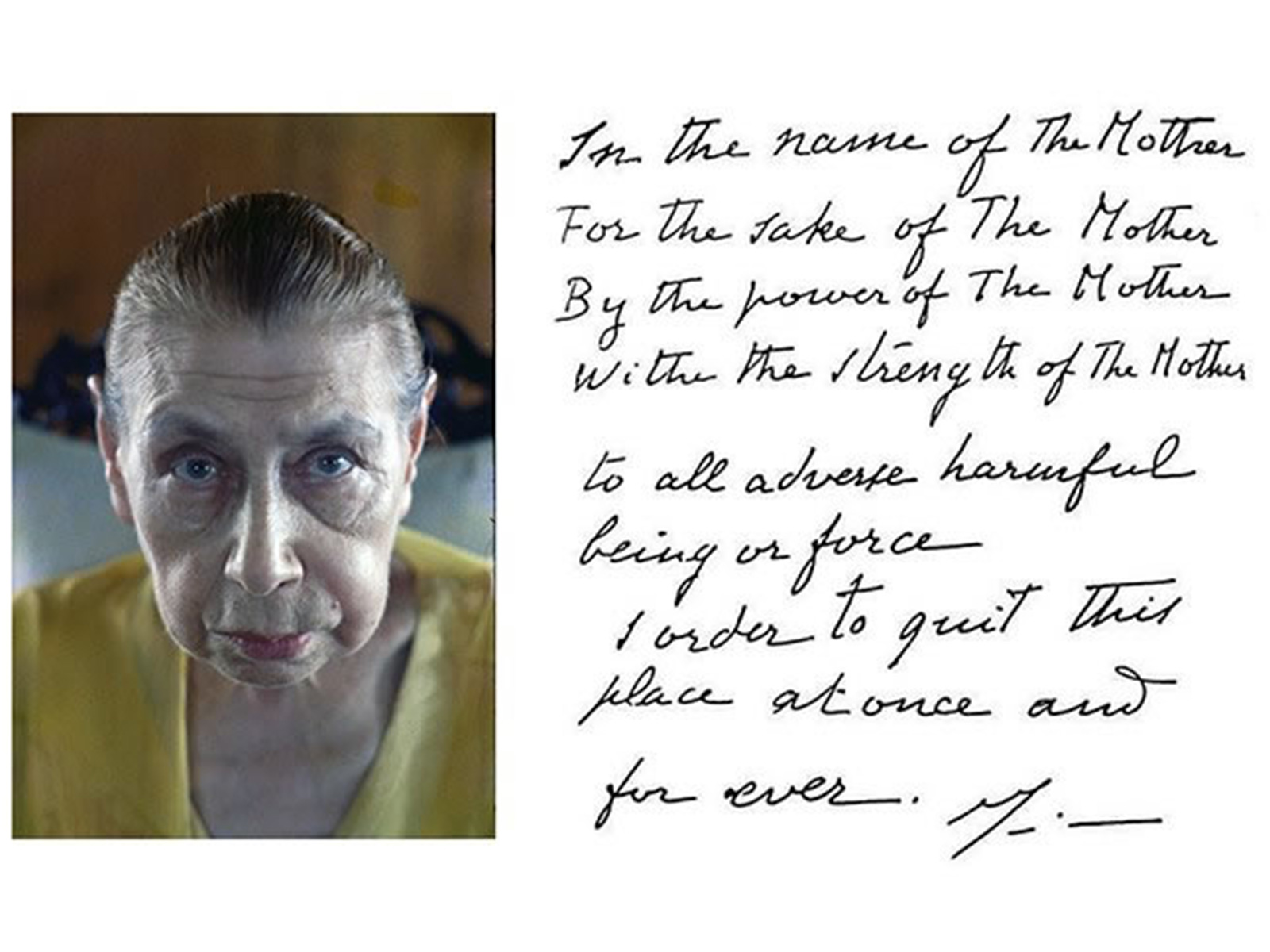
The Mother Hand-Written by The Mother
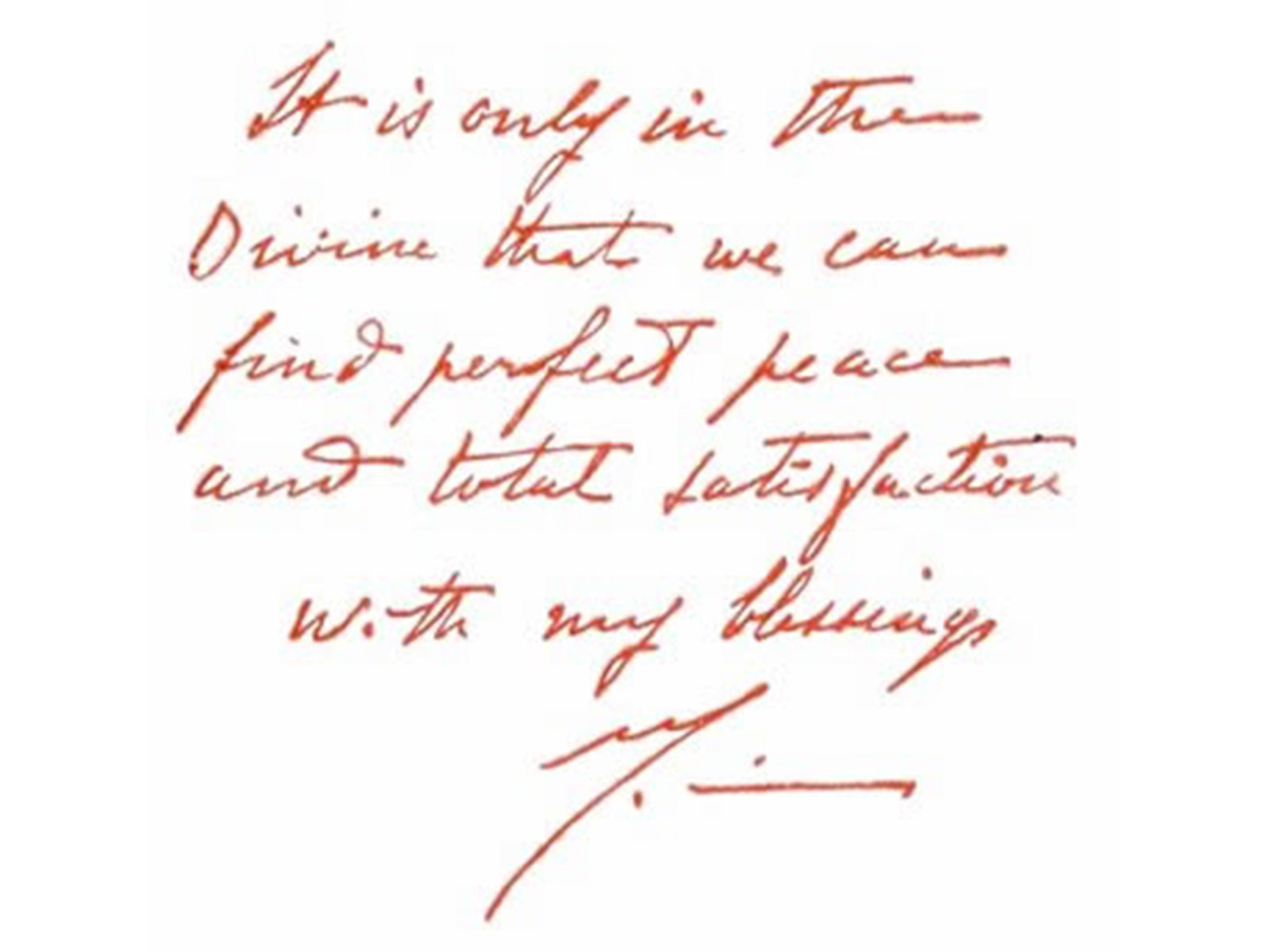
It is only in the
Divine that we can
find perfect peace
and total satisfaction.
With my Blessings .
- The Mother
O Sun-Word, thou shalt raise the earth-soul to Light
And bring down God into the lives of men...
Savitri
Mantra Given by Sri Aurobindo
The Gita does not speak expressly of the Divine Mother; it speaks always of surrender to the Purushottama - it mentions her only as the Para Prakriti who becomes the Jiva, that is, who manifests the Divine in the multiplicity and through whom all these worlds are created by the Supreme and he himself descends as the Avatar. The Gita follows the Vedantic tradition which leans entirely on the Ishwara aspect of the Divine and speaks little of the Divine Mother because its object is to draw back from world-nature and arrive at the supreme realisation beyond it; the Tantric tradition leans on the Shakti or Ishwari aspect and makes all depend on the Divine Mother because its object is to possess and dominate the world-nature and arrive at the supreme realisation through it. This Yoga insists on both the aspects; the surrender to the Divine Mother is essential for without it there is no fulfilment of the object of the Yoga.
In regard to the Purushottama the Divine Mother is the supreme divine Consciousness and Power and above the worlds, Adya Shakti; she carries the Supreme in herself and manifests the Divine in the worlds through the Akshara and Kshara. In regard to the Akshara she is the same Para Shakti holding the Purusha immobile in herself and also herself immobile in him at the back of all creation. In regard to the Khsara she is the mobile cosmic Energy manifesting all beings and forces.
We may note also in passing that the Indian ideal of the relation between man and woman has always been governed by the symbolism of the relation between the Purusha and Prakriti (in the Veda Nr and Gna), the male and female divine Principles in the universe. Even, there is to some degree a practical correlation between the position of the female sex and this idea. In the earlier Vedic times when the female principle stood on a sort of equality with the male in the symbolic cult, though with a certain predominance for the latter, woman was as much the mate as the adjunct of man; in later times when the Prakriti has become subject in idea to the Purusha, the woman also depends entirely on the man, exists only for him and has hardly even a separate spiritual existence. In the Tantrik Sakta religion which puts the female principle highest, there is an attempt which could not get itself translated into social practice, - even as this Tantrik cult could never entirely shake off the subjugation of the Vedantic idea, - to elevate woman and make her an object of profound respect and even of worship.
-Sri Aurobindo
On Marriage
To unite your physical lives, your material interests, to become partners in order to face together the difficulties and successes, the defeats and victories of life - that is the very foundation of marriage, but you already know, that it is not enough.
To be united in your sensations, to have the same aesthetic tastes and enjoyments, to be moved in common by the same things, one through the other and one for the other - that is good, that is. necessary, but it is not enough.
To be one in your deeper feelings, to keep a mutual affection and tenderness that never vary in spite of all the blows of life and can withstand every weariness and irritation and disappointment, to be always and on every occasion happy, extremely happy, to be together, to find in every circumstance tranquillity, peace and joy in each other - that is good, that is very good, that is indispensable, but it is not enough.
To unite your minds, to harmonise your thoughts and make them complementary, to share your intellectual preoccupations and discoveries; in short, to make your sphere of mental activity identical through a widening and enrichment acquired by both at once - that is good, that is absolutely necessary, but it is not enough.
Beyond all that, in the depths, at the centre, at the summit of the being, there is a Supreme Truth of being, an Eternal Light, independent of all the circumstances of birth, country, environment, education; That is the origin, cause and master our spiritual development; it is That which gives a permanent direction to our lives; it is That which determines Destinies; it is in the consciousness of That that you must unite. To be one in aspiration and ascension, to move forward the same pace on the same spiritual path, that is the secret of a lasting union.
-Sri Aurobindo
To walk through life armoured against fear, peril and disaster,
only two things are needed, two that go always together:
the Grace of the Divine
and on your side an inner state made up of
faith, sincerity and surrender.
A divine life in a divine body is the formula of the ideal that we envisage. But what will be the divine body? What will be the nature of this body, its structure, the principle of its activity, the perfection that distinguishes it from the limited and imperfect physicality within which we are now bound? What will be the conditions and operations of its life, still physical in its base upon the earth, by which it can be known as divine?
If it is to be the product of an evolution, and it is so that we must envisage it, an evolution out of our human imperfection and ignorance into a greater truth of spirit and nature, by what process or stages can it grow into manifestation or rapidly arrive? The process of the evolution upon earth has been slow and tardy—what principle must intervene if there is to be a transformation, a progressive or sudden change?
-Sri Aurobindo
Om namo bhagwate.
Mantra written by The Mother
The whole principle of this Yoga is to give oneself entirely to the Divine alone and to nobody and nothing else, and to bring down into ourselves by union with the Divine Mother all the transcendent light, power, wideness, peace, purity, Truth-consciousness and Ananda of the Supramental Divine.
Sri Aurobindo
God as Mother
Human conceptions of the Divine divide themselves first into the worship of the formed and the aspiration towards the formless, secondly, into the adoration of the Qualified and the urge of the rarest spirits towards the Unqualified, the Absolute. For all these stages the Tantric worship and discipline provides. How can the Formless invest Himself with form, asks the religious rationalist. The universe is there to reply.
Hinduism worships Narayana in the stone, the tree, the animal, the human being. That which the intellectual and spiritual pride or severity of other religions scorns, it makes its pride and turns into its own form of logical severity. Stocks and stones, the quadruped and the human being, all these are equals in God, our brothers in the Divine, forms that the Omnipresent has not disdained to assume. But beyond the material forms there are others that are ideal and symbolic, but not less, if anything more real, more full of divine power than any actual physical manifestation. These are the mental images in which we worship God. The Hindu believes that to whatever form he brings his devotion, the love of God is bound to assume and vivify it, and we cannot say that the belief is irrational. For if there is a Consciousness in the universe and transcending it which answers to the yearning of all these creatures and perhaps itself yearns towards them with the love of the Father, the Mother, the Friend, the Lover, and a love surpassing all these, then it is idle to suppose that It would assume or create for its own pleasure and glory the forms of the universe, but would disdain as an offence to Its dignity or purity those which the love of the worshipper offers to It and which after all Itself has formed in his heart or his imagination. To these mental forms mental worship may be offered, and this is the higher way; or we may give the material foundation, the pratistha, of a statue or pictured image to form a physical nodus for a physical act of worship.
In the formless also we worship God, in His qualities, in His Love, Power, Bliss, Wisdom, in the great cosmic Principles by which He manifests Himself to the eye of knowledge. We worship Him as the Impersonality manifested in these things or the Personality containing them. And we rise at the apex of the pinnacle into that which is not only formless, arupa, but nirguna, qualityless, the indefinable, anir-desyam, of the Gita. In our human ignorance, with our mental passion for degrees and distinctions, for superiorities and exclusions, we thus grade these things and say that this is superior, that is for ignorant and inferior souls. Do we know? The Theist looks down with reprobation on the form-adoring man-worshipping idolater and polytheist; the Adwaitin looks down with a calm and tolerant indulgence on the ignorance of the quality adoring personality-bemused Theist. But it seems to us that God scorns nothing, that the Soul of all things may take as much delight in the prayer of a little child or the offerings of a flower or a leaf before a pictured image as in the philosopher's leap from the summit of thought into the indefinable and unknowable and that he does best who can rise and widen into the shoreless realisation and yet keep the heart of the little child and the capacity of the seer of forms.
At any rate, this is an attitude towards which these Hymns to the Goddess bring us very near. They are full of the glories of her form, her visible body; full of the thinker's perception of her in all the shapes of the universe; full of the power of her psychological aspects; pervaded too by a sense behind and often expressed of her final unity and transcendence. Mr. Avalon brings this out with great force and vividness in his Introduction. But it should be manifest even to a careless reader of the Hymns. Take the following passage: -
Reverence to her who is eternal, Raudra,
To Gauri and Dhatri, reverence and again reverence,
To Her who is moonlight and in the form of the moon,
To Her who is supreme bliss, reverence for ever.
This is from the famous hymn in the Chandi-Mahatmya, deservedly one of the best known in sacred literature; but everywhere we find the same crowding of different aspects.
In a hymn of which the eleventh verse is a sensuous description of the physical goddess, -
O Gauri! with all my heart
I contemplate Thy form,
Beauteous of face,
With its weight of hanging hair,
With full breasts and rounded slender waist,
Holding in three hands a rosary, a pitcher and book
And with thy fourth hand making the Jnana-mudra, -
(mark how the close passes naturally into the psychological symbolism of the form), the ninth is a remarkable piece of Yogic imagery, -
O Mother! like the sleeping King of serpents
Residing in the centre of the first lotus,
Thou didst create the universe.
Thou dost ascend like a streak of lightning, And attainest the ethereal region; -
and the opening is the highest philosophy expressed with great poetic force and interspersed with passages of the richest poetical colour, -
The cause and thinker of the World,
She whose form is that of the Shabdabrahman, And whose substance is bliss.
Thou art the primordial One,
Mother of countless creatures,
Creatrix of the bodies of the Lotus-born, Vishnu and Shiva,
Who creates, preserves and destroys the worlds....
Although thou art the primordial cause of the world,
Yet art thou ever youthful.
Although thou art the Daughter of the Mountain-King,
Yet art thou full of tenderness.
Although thou art the Mother of the Vedas,
Yet they cannot describe Thee.
Although men must meditate upon Thee,
Yet cannot their mind comprehend Thee.
This hymn is quoted as culled from a Tantric compilation, the Tantrasara. Its opening is full of the supreme meaning of the great Devi symbol, its close is an entire self-abandonment to the adoration of the body of the Mother. This catholicity is typical of the whole Tantric system, which is in its aspiration one of the greatest attempts yet made to embrace the whole of God manifested and unmanifested in the adoration, self-discipline and knowledge of a single human soul.
-Sri Aurobindo
The Mother Of Dreams
Goddess supreme, Mother of Dream, by the ivory doors when thou standest,
Who are they then that come down unto men
in thy visions that troop, group upon group,
down the path of the shadows slanting?
Dream after dream, they flash and they gleam with the flame of the stars still around them:
Shadows at thy side in a darkness ride
where the wild fires dance, stars glow and glance
and the random meteor glistens;
There are voices that cry to their kin who reply;
voices sweet, at the heart they beat
and ravish the soul as it listens.
What then are these lands and these golden sands
and these seas more radiant than earth can imagine?
Who are those that pace by the purple waves that race
to the cliff-bound floor of thy jasper shore
under skies in which mystery muses,
Lapped in moonlight not of our night
or plunged in sunshine that is not diurnal?
Who are they coming thy Oceans roaming
with sails whose strands are not made by hands,
an unearthly wind advances?
Why do they join in a mystic line
with those on the sands linking hands
in strange and in stately dances?
Thou in the air, with a flame in thy hair,
the whirl of thy wonders watching,
Holdest the night in thy ancient right,
Mother divine, hyacinthine,
with a girdle of beauty defended.
Sworded with fire, attracting desire,
thy tenebrous kingdom thou keepest,
Starry-sweet, with the moon at thy feet
now hidden now seen the clouds between
in the gloom and the drift of thy tresses.
Only to those whom thy fancy chose,
0 thou heart-free, is it given to see
thy witchcraft and feel thy caresses.
Open the gate where thy children wait
in their world of a beauty undarkened.
High-throned on a cloud, victorious, proud
I have espied Maghavan ride
when the armies of wind are behind him;
Food has been given for my tasting from heaven
and fruit of immortal sweetness;
I have drunk wine of the kingdoms divine
and have heard the change of music strange
from a lyre which our hands cannot master;
Doors have swung wide in the chambers of pride
where the Gods reside and the Apsaras dance
in their circles faster and faster.
For thou art she whom we first can see
when we pass the bounds of the mortal,
There at the gates of the heavenly states
thou hast planted thy wand enchanted
over the head of the Yogin waving.
From thee are the dream and the shadows that seem
and the fugitive lights that delude us;
Thine is the shade in which visions are made;
sped by thy hands from celestial lands
come the souls that rejoice for ever.
Into thy dread-worlds we pass or look in thy magic glass,
then beyond thee we climb out of Space and Time
to the peak of divine endeavour.
Sri Aurobindo
HYMN TO THE MOTHER OF RADIANCES
This 'Hymn to the Mother of Radiances' was written by Amrita in January 1927. Later, Amrita's drafts were revised by Sri Aurobindo and arranged to make a three-part hymn. The revised version was also copied out in Sri Aurobindo's own hand.
An INNER fullness has come in like the coming in of light in dark caves. It fills, it illumines, it vibrates the multiple strings of life; it has found the contact with the forgotten achievements of the past to enable me to start the new ones of the future on the basis of the changing formations of the present. The currents of life well up to meet the descending rays of light from the upper heavens for transmutation of the base and the dark into the luminous and the true, for transmutation of the ugly and the wrong into the beautiful and the right.
O Mother of Radiances, you have dawned in the narrow horizons of my mind. Out of its depthless rigidities, in the midst of its walled-up spaces you have created a heart-like something that will live its eternal life. You have revealed to me a chamber alive and warm within the mind's substanceless polar regions and there I can safely retire and find in you my refuge.
The lower network of moving forces remains, but I feel your presence in its midst. The higher network of moving forces remains, and here you have stepped in also shedding a warmth of life that was not there before, you have turned the dull grey luminosity into a brilliance of living waters. Your active arid living presence is every- where; you have heeded my words of aspiration, the fire of my demand for your omnipresence. More than what I ignorantly sought for, you have revealed to me. You are intimate and one with me when in truth and in law and yet away and far off from one me when in error and in falsehood.
When there are no more darkening shadows about me; when you see me bared of all shams and shows in every part of the being; when you see in every cell of my body an eternal home for you and an eternal temple; when you see me one with you in identity and still worshipping you; when you melt the compact gold of knowledge in the living and running waters of devotion; when you break my earth and release the energies; when you turn my pride into power in your hands and my ignorance into light, my narrowness into wideness, my selfishness into a true gathering together of forces in one centre, my greed into a capacity of untiring search after the truth for the attainment of its substances, my egoism into the true and conscious instrumental centre, my mind into a channel for you to descend, my heart into your heart of pure fire and flame, my life into a pure and translucent substance for your handling, my body into a conscious vessel for holding what of you is meant for me; then, O Mother of Radiances, my aim in life now and hereafter will be fulfilled in the true and right and vast way. Aspiration wakes in me! Achieve in me all that I flame for!
Create in me a state of consciousness in which whatever I hear from you may at once turn into an intimate knowledge, a self-revelation, an expression of identity, an awareness at once of the within and the without. O Mother, whatever I gather from you, let it be of the deep vasts of the within which is omnipresent. May I be one with you in every way to have the supreme Delight, yet separate from you to stream forth devotion to you, one and yet separate like life and its movements, like heat and light, like power and its expression, like true knowledge and its effecting force. Let what you give me be not a treasure to me but as if a thing of my own self-discovered.
Wipe out the division in my consciousness that I may see and listen to you as part of yourself. The life-energies in me- aspire for the knowledge that comes from identity, for the vision that is born of identity, for the listening that takes its orientation in identity,-the identity that is yourself.
May I be the manifestation of a portion of you in your limitless and shining spaces.
Increase my fires and aspiration, make the surrender in me possible at once and in every way; widen my openness and receptivity; remove the coverings that delay the workings of psyche deep within; take away, O Mother, from me what I have and what I have not
The cells of my body, the filaments of my nervous coat, the five streams of my mind,-all make their unconditioned surrender to you, O Mother of Radiances, that there may not be falsehood in existence, division in consciousness, death in the living waters, want of harmony and misery in the nervecoils, disease in the body. Thy voice replies to me:
"By the fivefold powers of surrender in the physical, by the quiet intensity of the psychic urge that is behind you, centrally, increase ever and ever the inherent Ananda and the hidden opulences of your consciousness. First of all, become conscious of what I have willed in you; be, next, that of which you have become conscious. Know at once and for ever, 'In me is your all.' "