
The Mother
"There is a domain far above the mind which we could call the world of Harmony and, if you can reach there, you will find the root of all harmony that has been manifested in whatever form upon earth. For instance, there is a certain line of music, consisting of a few supreme notes, that was behind the productions of two artists who came one after another - one a concerto of Bach, another a concerto of Beethoven. The two are not alike on paper and differ to the but in their essence they are the same. One and the same vibration of consciousness, one wave of significant harmony touched both these artists. Beethoven caught a larger part, but in him it was more mixed with the inventions and interpolations of his mind; Bach received less, but what he seized of it was purer. The vibration was that of victorious emergence of consciousness, consciousness tearing itself out of unconsciousness in a triumphant uprising and birth. If by Yoga you are capable of reaching this source of all art, then you are master, if you will, of all the arts. "
The Mother
Among the great modern musicians there have been several whose consciousness, when they created, came into touch with a higher consciousness. Caesar Frank played on the organ as one inspired; he had an opening into the psychic life and he was conscious of it and to a great extent expressed it. Beethoven, when he composed the Ninth Symphony, had the vision of an opening into a higher world and of the descent of a higher world into this earthly plane. Wagner had strong powerful intimations of the occult world; he had the instinct of occultism and the sense of the occult and through it he received his greatest inspiration. But he worked mainly on the vital level and his mind came in constantly to interfere and mechanised his inspiration. His work for the greater part is too mixed, too often obscure and heavy, although powerful. But when he could cross the vital and the mental levels and reach a higher world, some of the glimpses he had were of an exceptional beauty, as in Parsifal, in some parts of Tristan and lseult and most in its last great Act.
The Mother
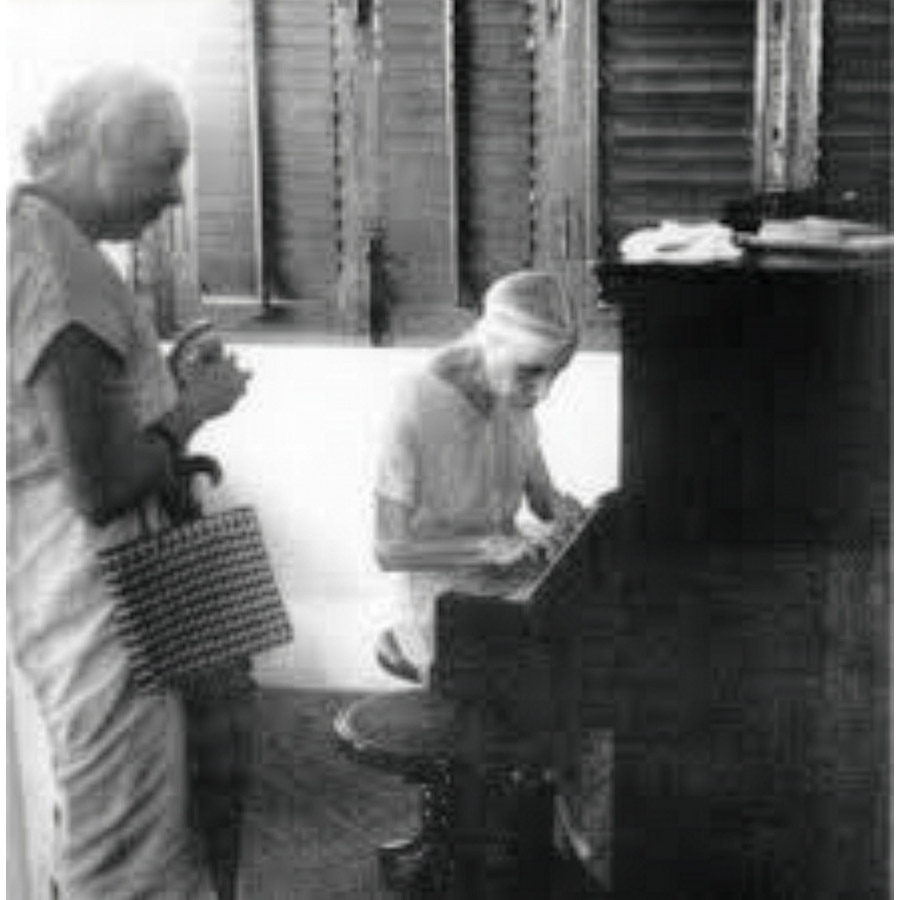 The Mother with a Sadhika
(The Mother, while describing some experience...)
... suddenly I heard, as if they came from all the corners of the earth, those great notes one sometimes hears in the subtle physical, a little like those of Beethoven's Concerto in D-major, which come in moments of great progress, as though fifty orchestras had burst forth all in unison, without a single false note, to express the joy of this new communion between Nature and Spirit, the meeting of old friends who come together again after having been separated for so long.
- The MotherMusic - a Part of Life of Yoga?
Plato in his Republic has dealt with extraordinary emphasis on the importance of music in education; as is the music to which a people is accustomed, so, he says in effect, is the character of that people. The importance of painting and sculpture is hardly less. The mind is profoundly influenced by what it sees and, if the eye is trained from the days of childhood to the contemplation and understanding of beauty, harmony and just arrangement in line and color, the tastes, habits and character will be insensibly trained to follow a similar law of beauty, harmony and just arrangement in the life of adult man... A similar result is produced on the emotions by the study of beautiful or noble art. We have spoken of the purification of the heart, the chittaSuddhi, which Aristotle assigned as the essential office of poetry, and have pointed out that it is done in poetry by the detached and disinterested enjoyment of the eight rasas or forms of emotional aestheticism which make up life unalloyed by the disturbance of the lower self-regarding passions. Painting and sculpture work in the same direction by different means. Art sometimes uses the same means as poetry but cannot do it to the same extent because it has not the movement of poetry; it is fixed, still, it expresses only a given moment, a given point in space and cannot move freely through time and region. But it is precisely this stillness, this calm, this fixity which gives its separate value to Art. Poetry raises the emotions and gives each its separate delight. Art stills the emotions and teaches them the delight of a restrained and limited satisfaction, - this indeed was the characteristic that the Greeks, a nation of artists far more artistic than poetic, tried to bring into their poetry. Music deepens the emotions and harmonises them with each other. Between them music, art and poetry are a perfect education for the soul; they make and keep its movements purified, self-controlled, deep and harmonious. These, therefore, are agents which cannot profitably be neglected by humanity on its onward march or degraded to the mere satisfaction of sensuous pleasure which will disintegrate rather than build the character. They are, when properly used, great educating, edifying and civilising forces.
Sri Aurobindo
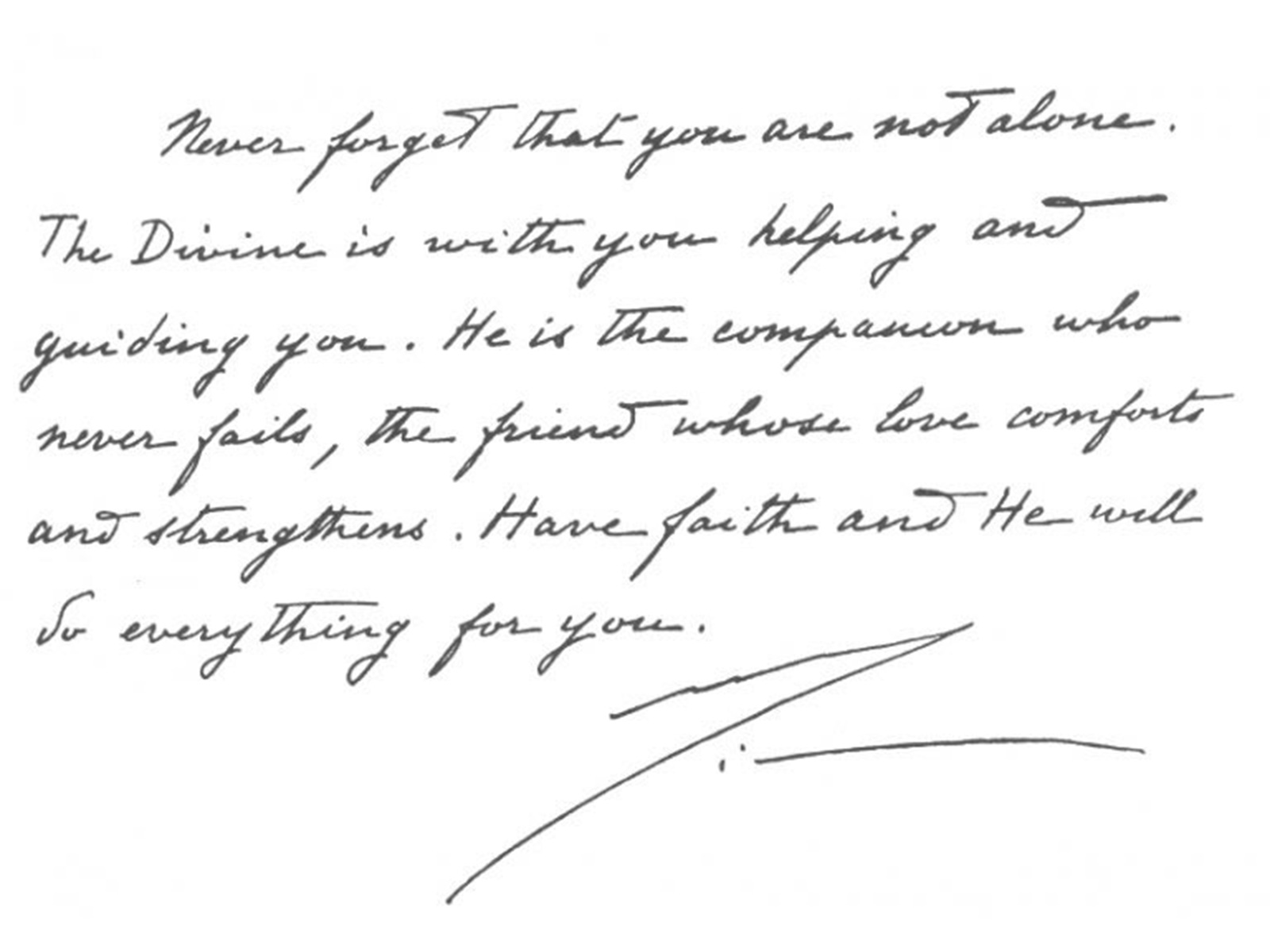
Never forget that you are not alone .
The Divine is with you helping and guiding you.
He is the companion who never fails,
the friend whose love comforts abd strenthens.
Have faith and He will do everything for you.
Q: Mother, when one hears music, how should one truly hear it?
The Mother: For this - if one can be completely silent, you see, silent and attentive, simple as though one were an instrument which has to record it - one does not move, and is only something that is listening - if one can be absolutely silent, absolutely still and like that, then the thing enters. And it is only later, sometime later, that you can become aware of the effect, either of what it meant or the impression it had on you. But the best way of listening is this. It is to be like a still mirror and very concentrated, very silent. In fact, we see people who truly love music... I have seen musicians listening to music, musicians, composers or players who truly love music, I have seen them listening to music... they sit completely still, you know, they are like that, they do not move at all. Everything, everything is like that. And if one can stop thinking, then it is very good, then one profits fully... it is one of the methods of inner opening and one of the most powerful.
The Mother
Q: Mother, how can one enter into the feelings of a piece of music played by someone else?
"There are different levels. There is a whole category of music that comes from the higher vital, which is very catching, somewhat (not to put it exactly) vulgar, it is something that twists your nerves. This music is not necessarily unpleasant, but generally seizes you there in the nervous centers. So there is one type of music which has a vital origin. There is music which has a psychic origin - it is altogether different. And then there is music which has a spiritual origin; it is very bright and it carries you away, captures you entirely. But if you want to execute this music correctly you must be able to make it come through the vital passage. Your music coming from above may become externally quite flat if you do not possess that intensity o f vital vibration which gives it its splendor and strength. I knew people who had truly a very high inspiration and it became quite flat, because the vital did not stir. I must admit that by their spiritual practices they had put to sleep their vital completely - it was literally asleep, it did not act at all - and the music came straight into the physical, and if one were connected with the origin of that music, one could see that it was something wonderful, but externally it had no force, it was a little melody, very poor, very thin; there was none of the strength of harmony. When you can bring the vital into play, then all the strength of vibration is there. If you draw into it this higher origin, it becomes the music of a genius.
For music it is very special; it is difficult, it needs an intermediary. And it is like that for all other things, for literature also, for poetry, for painting, for everything one does. The true value of one's creation depends on the origin of one's inspiration, on the level, the height where one finds it. But the value of the execution depends on the vital strength which expresses it. To complete the genius both must be there. This is very rare. Generally it is the one or the other, more often the vital. And then there are those other kids of music we have - the music of the cafe-concert, of the cinema - it has an extraordinary skill, and at the same time an exceptional platitude, an extraordinary vulgarity. But as it has an extraordinary skill, it seizes you in the solar plexus and it is this music that you remember. It grasps you at once and holds you and it is very difficult to free yourself from it, for it is well-made music, music very well made. It is made vitally with vital vibrations, but what is behind is frightful.
But imagine this same vital power of expression,with the inspiration coming from far above - the highest inspiration possible, when all the heavens open before us - then that becomes wonderful. There are certain passages of Caesar Frank, certain passages of Beethoven, certain passages of Bach, there are pieces by others also which have this inspiration and power. But it is only a moment, it comes as a moment, it does not last. You cannot take the entire work of an artist as being on that level. Inspiration comes like a flash; sometimes it lasts sufficiently long, when the work is sustained; and when that is there, the same effect is produced, that is, if you are attentive and concentrated, suddenly that lifts you up, lifts up all your energies, it is as though someone opened out your head and you were flung into the air to tremendous heights and magnificent lights. It produces in a few seconds results that are obtained with so much difficulty through so many years of yoga. Only, in general, one may fall down afterwards, because the consciousness is not there is the basis; one has the experience and afterwards does not even know what has happened. But if you are prepared, if you have indeed prepared your consciousness by yoga and then the thing happens, it is almost definitive. "
The Mother
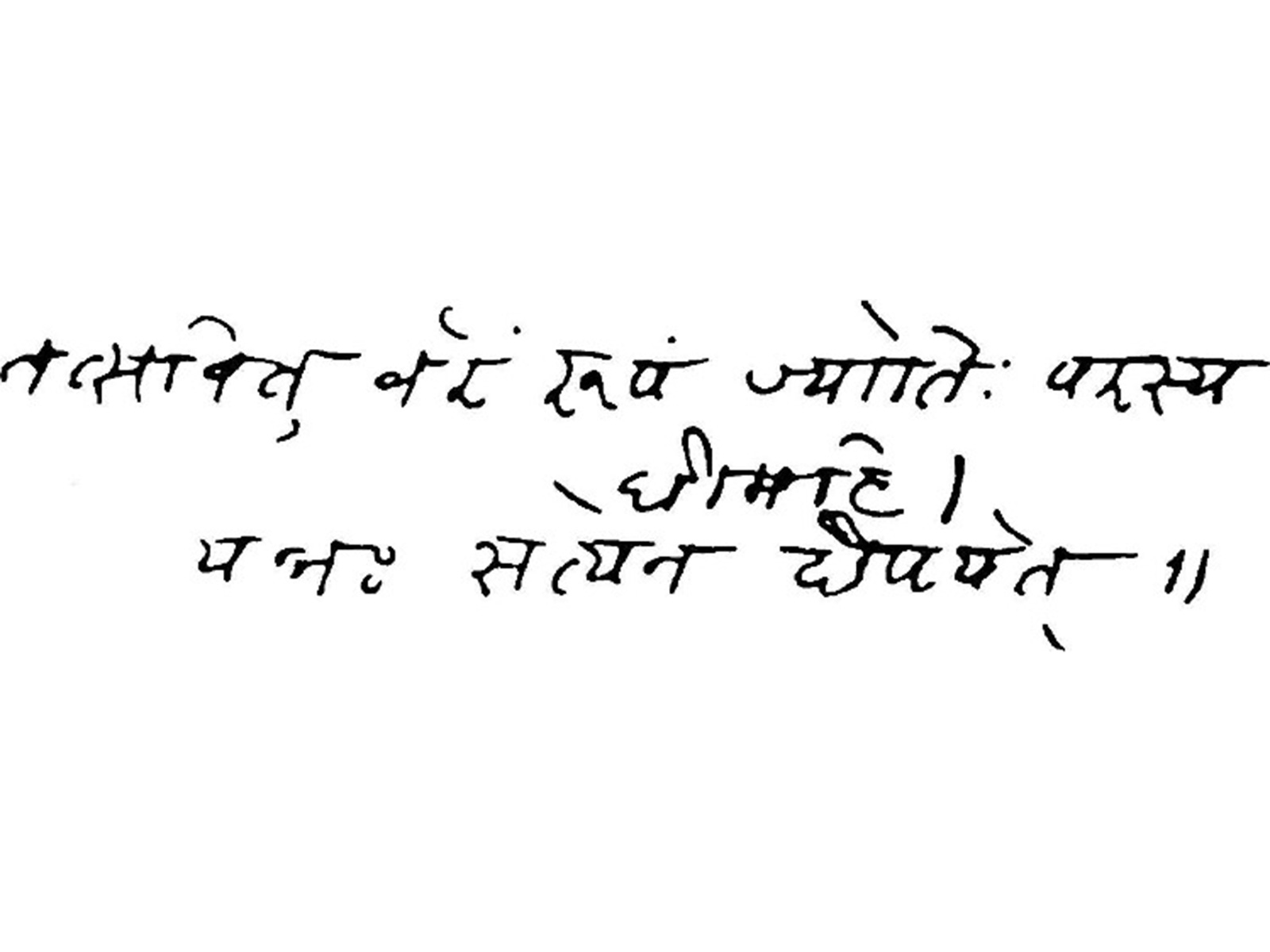
"Let us meditate on the most auspicious form of Savitur, on the Light of the Supreme which shall illumine us with the Truth."
Q: Is sound peculiar only to the physical world or is there sound in the other domains also?
There is sound there also.
The Mother
Q: In the same way as here?
There certainly is a sound in all the manifested worlds, and when one has the appropriate organs one hears it. There are sounds which belong to the highest regions, and in fact, the sound we have here gives the feeling of a noise in comparison with that sound. For example, there are regions harmonious and musical in which one hears something which is the origin of the music we have here - but the sounds of material, physical music seem absolutely barbaric in comparison with that music! When one has heard that, even the most perfect instrument is inadequate. All constructed instruments, among which the violin certainly has the purest sound, are very much inferior in their expression to the music of this world of harmonies. The human voice when absolutely pure is of all instruments the one which expresses it best; but it is still... it has a sound which seems so harsh, so gross compared with that. When one has been in that region, one truly knows what music is. And it has so perfect a clarity that at the same time as the sound one has the full understanding of what s said. That is, one has the principle of the idea, without words, simple with the sound and all the inflexion of the... one can't call it sensations, nor feelings... what seems to be closest would be some kind of soul-states or states of consciousness. All these inflexions are clearly perceptible through the nuances of the sound. And certainly, those who were great musicians, geniuses from the point of view of music, must have been more or less consciously in contact with that. The physical world as we have it today is an absolutely gross world; it looks like a caricature. Conscious Hands ... I knew how the consciousness works. Well, it is impossible to learn piano or to do painting unless the consciousness enters into the hands and the hands become conscious independently of the head. The head can be busy elsewhere, that has no importance.
Q: Is it possible to make my hands conscious so that they do nothing imperfect, incorrect or wrong? What is the way to do it, Mother?
It is quite possible, by concentrating on the hands when they are doing something. The hands of painters, sculptors, musicians (especially pianists) are usually very conscious and always are skillful. It is a question of training.
The Mother
Q: Mother, how can one enter into the feelings of a piece of music played by someone else?
In the same way as one can share the emotions of another person by sympathy, spontaneously, by an affinity more or less deep, or else by an effort of concentration which ends in identification. It is this last process that one adopts when one listens to music with an intense and concentrated attention, to the point of checking all other noise in the head and obtaining a complete silence, into which fall, drop by drop, the notes of the music whose sound alone remains; and with the sound all the feelings, all the movements of emotion can be perceived, experienced, felt as if they were produced in ourselves.
The Mother
