In the physical world, of all things it is beauty that expresses best the Divine. The physical world is the world of form and the perfection of form is beauty. Beauty interprets, expresses, manifests the Eternal. Its role is to put all manifested nature in contact with the Eternal through the perfection of form, through harmony and a sense of the Ideal which uplifts and leads towards something higher .
Sri Aurobindo
When a painter paints a picture, if he observes himself painting the picture, the picture will never be good, it will always be a kind of projection of the painter's personality; it will be without life, without force, without beauty. But if, all of a sudden, he becomes the thing he wants to express, if he becomes the brushes, the painting, the canvas, the subject, the image, the colours, the value, the whole thing, and is entirely inside it and lives it, he will make something magnificent.
The Mother
Painting is not done to copy Nature, but to express an impression, a feeling, an emotion that we experience on seeing the beauty of Nature. It is this that is interesting and it is this that has to be expressed. . . .
The Mother
The sense of the good and bad, beautiful and unbeautiful, which afflicts our understanding and our senses, must be replaced by akhanda rasa, undifferentiated and unabridged delight in the delightfulness of things, before the highest can be reached. On the way to this goal full use must be made of the lower and abridged sense of beauty which seeks to replace the less beautiful by the more, the lower by the higher, the mean by the noble.
At a certain stage of human development the aesthetic sense is of infinite value in this direction. It raises and purifies conduct by instilling a distaste for the coarse desires and passions of the savage, for the rough, uncouth and excessive in action and manner, and restraining both feeling and action by a striving after the decent, the beautiful, the fit and seemly....
SriAurobindo
True art means the expression of beauty in the material world. In a work wholly converted, that is to say, expressing integrally the divine reality, art must serve as the revealer and teacher of this divine beauty in life.
The Mother
'The Great Secret' - a play by The Mother.
Six Monologues and a Conclusion
The Mother's script of 'The Artist'
Born into a thoroughly respectable bourgeois family where art was considered as a pastime rather than a career and artists as rather unreliable people, prone to debauchery and with a dangerous disregard for money, I felt, perhaps out of contrariness, a compelling need to become a painter. My entire consciousness was centred in my eyes and I could express myself more easily by a sketch than in words. I learnt much better by looking at pictures than by reading books, and what I had once seen - landscapes, faces or drawings - I never forgot.
At the age of thirteen, through much effort, I had almost mastered the techniques of drawing, water colour, pastels and oil painting. Then I had the chance to do some small commissions for friends and acquaintances of my parents, and as soon as I earned some money, my family began to take my vocation seriously. I took advantage of this to pursue my studies as far as I could. When I was old enough to be admitted, I joined the School of Fine Arts and almost immediately started taking part in competitions. I was one of the youngest artists ever to win the 'Prix de Rome' and that gave me the opportunity to make a thorough study of Italian art. Later on, travelling scholarships allowed me to visit Spain, Belgium, Holland, England and other countries too. I did not want to be a man of one period or one school, and I studied the art of all countries, in all forms, oriental as well as occidental.
At the same time I went ahead with my own work, trying to find a new formula. Then came success and fame; I won first prizes in exhibitions, I sat on juries, my paintings were shown in the leading museums of the world and snatched up by the art dealers. It meant wealth, titles, honours; even the word "genius" was used... But I am not satisfied. My conception of genius is quite different. We have to create new forms, with new methods and processes, in order to express a new kind of beauty that is higher and purer, truer and nobler. So long as I still feel bound to human animality, I cannot free myself completely from the forms of material Nature. The aspiration was there, but the knowledge, the vision was lacking.
The Mother
You have said: "if you surrender [to the Divine] you have to give up effort, but that does not mean that you have to abandon also all willed action." But if one wants to do something, it means personal effort, doesn't it? What then is the will?
There is a difference between the will and this feeling of tension, effort, of counting only on oneself, having recourse to oneself alone which personal effort means; this kind of tension, of something very acute and at times very painful; you count only on yourself and you have the feeling that if you do not make an effort at every minute, all will be lost. That is personal effort.
But the will is something altogether different. It is the capacity to concentrate on everything one does, to do it as best one can and not stop doing it unless one receives a very precise intimation that it is finished. It is difficult to explain to you. But suppose, for example, that through a combination of circumstances a work comes into your hands. Take an artist who has in one way or another received an inspiration and decided to paint a picture. He knows very well that if he has no inspiration and is not sustained by forces other than his own, he will do nothing much. It will look more like a daub than a painting. He knows this. But it has been settled, the painting is to be done; there may be many reasons for it, but the painting is to be done. Then if he had the passive attitude, well, he would get out his palette, his colours, his brushes, his canvas and then sit down in front of them and say to the Divine: "Now you are going to paint." But the Divine does not do things that way. The painter himself must take up everything and arrange everything, concentrate on his subject, find the forms, the colours that will express it and put his whole will for a more and more perfect execution. His will must be there all the time. But he will keep the sense that he must be open to the inspiration, he will not forget that in spite of all his knowledge of technique, in spite of the care he takes to arrange, organise and prepare his colours and the forms of his design, in spite of all that, if he has no inspiration, it will be one picture among a million others and it will not be very interesting. He does not forget. He attempts, he tries to see, to feel what he wants his painting to express and in what way it should be expressed. He has his colours, he has his brushes, he has his model, he has made his sketch which he will enlarge and make into a picture, he calls his inspiration. There are even some who manage to have a clear, precise vision of what is to be done. But then, day after day, hour after hour, they have this will to work, to study, to do with care all that must be done until they reproduce as perfectly as they can the first inspiration.... That person has worked for the Divine, in communion with Him, but not in a passive way, not with a passive surrender; it is with an active surrender, a dynamic will. The result generally is something very good. Well, the example of the painter is interesting, because a painter who is truly an artist is able to see what he is going to do, he is able to connect himself to the divine Power that is beyond expression and inspires all expression. For the poet, the writer, it is the same thing and for all people who do something, it is the same.
The Mother
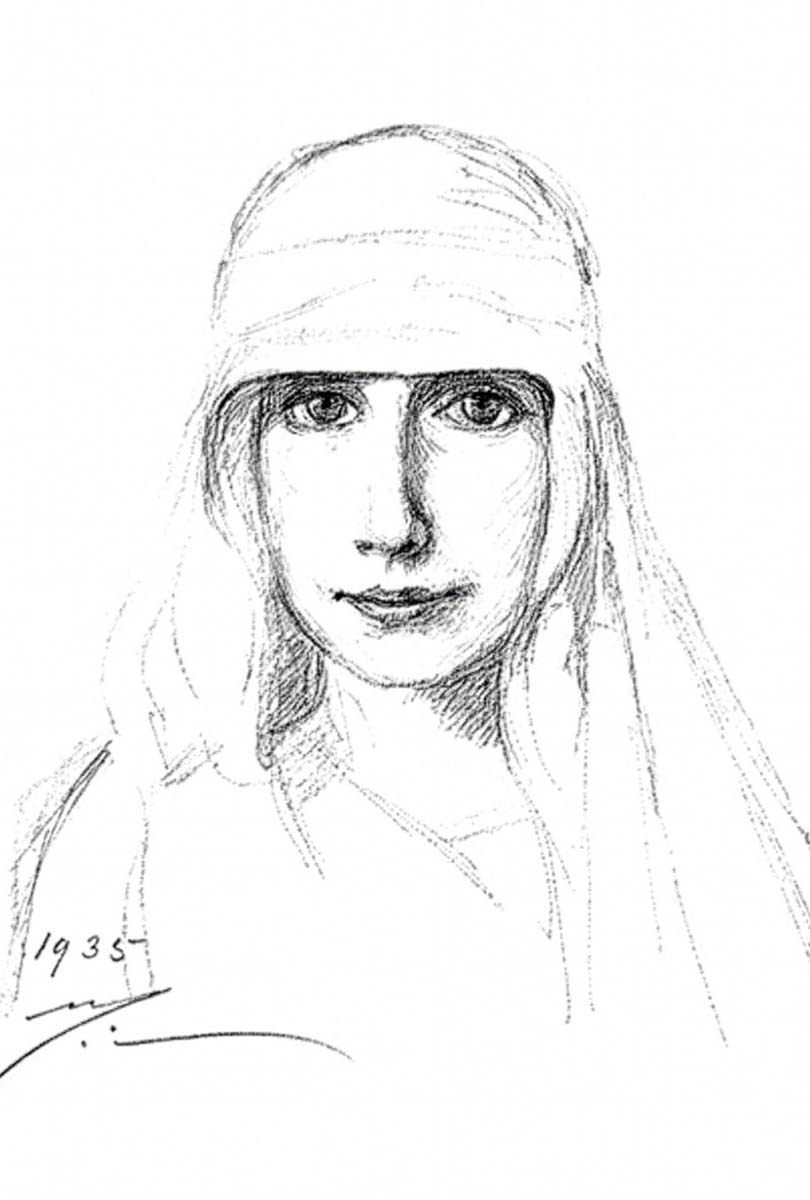
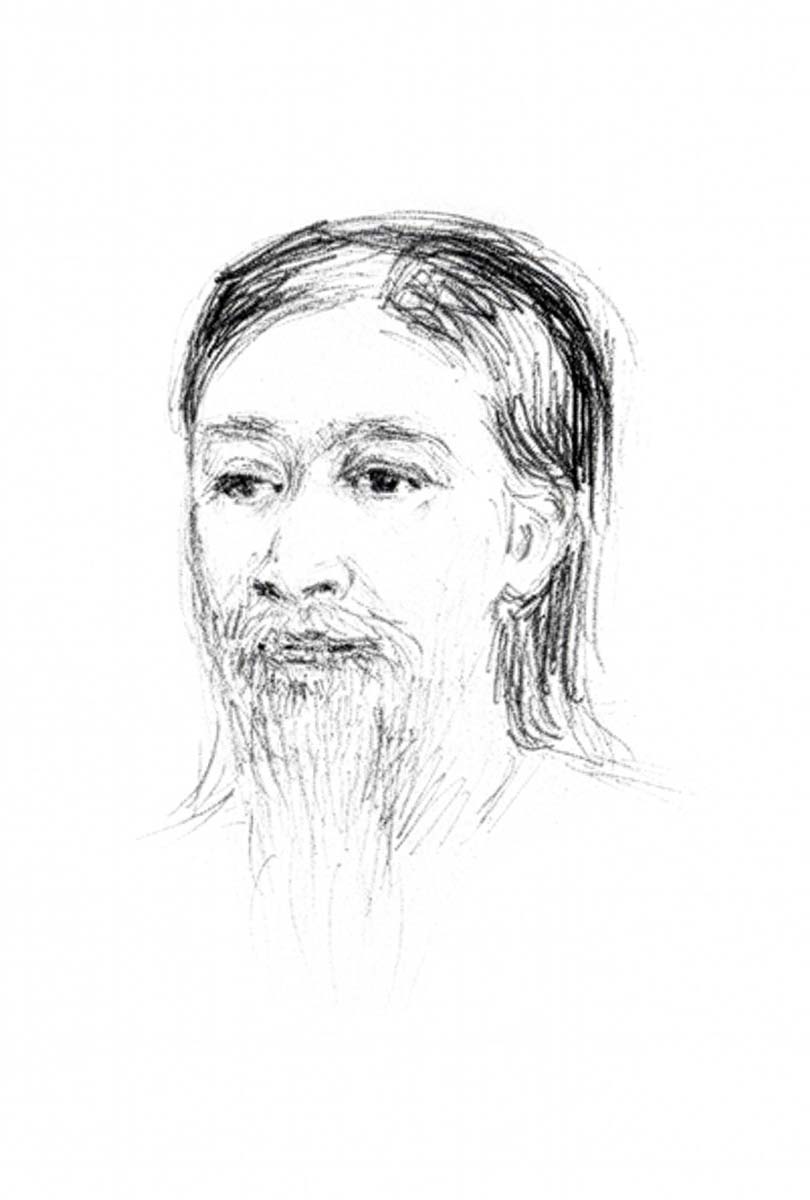
Self-portrait and Sri Aurobindo's sketch by The Mother
Pencil, 29.5 x 21 cm., 1935, Pondicherry
Pencil, 15 x 10 cm., 1935, Pondicherry
But beyond and above this intellectual utility of Art, there is a highest use, the noblest of all, its service to the growth of spirituality in the race. European critics have dwelt on the close connection of the highest developments of art with religion, and it is undoubtedly true that in Greece, in Italy, in India, the greatest efflorescence of a national Art has been associated with the employment of the artistic genius to illustrate or adorn the thoughts and fancies or the temples and instruments of the national religion. This was not because Art is necessarily associated with the outward forms of religion, but because it was in the religion that men's spiritual aspirations centered themselves. Spirituality is a wider thing than formal religion and it is in the service of spirituality that Art reaches its highest self-expression. Spirituality is a single word expressive of three lines of human aspiration towards divine knowledge, divine love and joy, divine strength, and that will be the highest and most perfect Art which, while satisfying the physical requirements of the aesthetic sense, the laws of formal beauty, the emotional demand of humanity, the portrayal of life and outward reality, as the best European Art satisfies these requirements, reaches beyond them and expresses inner spiritual truth, the deeper not obvious reality of things, the joy of God in the world and its beauty and desirableness and the manifestation of divine force and energy in phenomenal creation. This is what Indian Art alone attempted thoroughly and in the effort it often dispensed, either deliberately or from impatience, with the lower, yet not negligible perfections which the more material European demanded. Therefore Art has flowed in two separate streams in Europe and Asia, so diverse that it is only now that the European aesthetic sense has so far trained itself as to begin to appreciate the artistic conventions, aims and traditions of Asia. Asia's future development will unite these two streams in one deep and grandiose flood of artistic self-expression perfecting the aesthetic evolution of humanity.
Sri Aurobindo
There is a domain far above the mind which we could call the world of Harmony and, if you can reach there, you will find the root of all harmony that has been manifested in whatever form upon earth. . . .
If by Yoga you are capable of reaching this source of all art, then you are master, if you will, of all the arts. Those that may have gone there before, found it perhaps happier, more pleasant or full of a rapturous ease to remain and enjoy the Beauty and the Delight that are there, not manifesting it, not embodying it upon earth. But this abstention is not all the truth nor the true truth of Yoga; it is rather a deformation, a diminution of the dynamic freedom of Yoga by the more negative spirit of Sannyasa. The will of the Divine is to manifest, not to remain altogether withdrawn in inactivity and an absolute silence; if the Divine Consciousness were really an inaction of unmanifesting bliss, there would never have been any creation.
The Mother
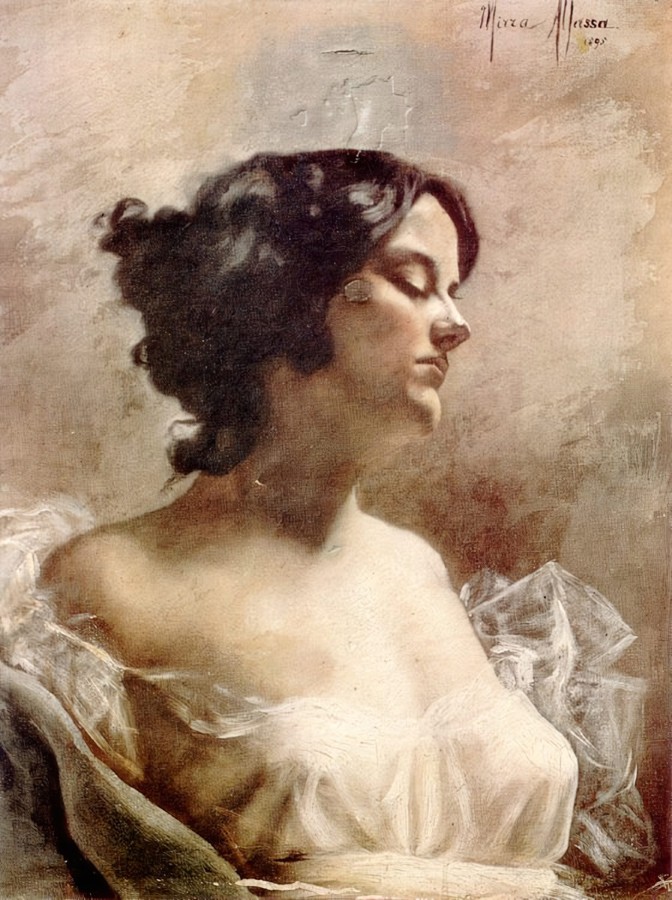
Early Study, France
Oil on canvas 1895
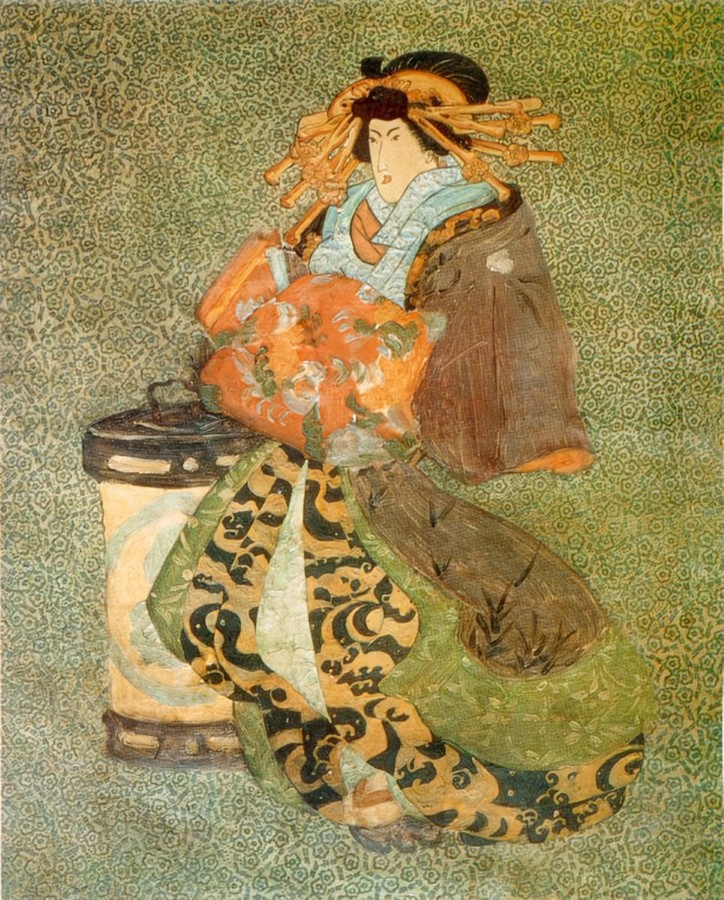
A Japanese Lady with a Lantern, France
Oil on board, (1893-1900)
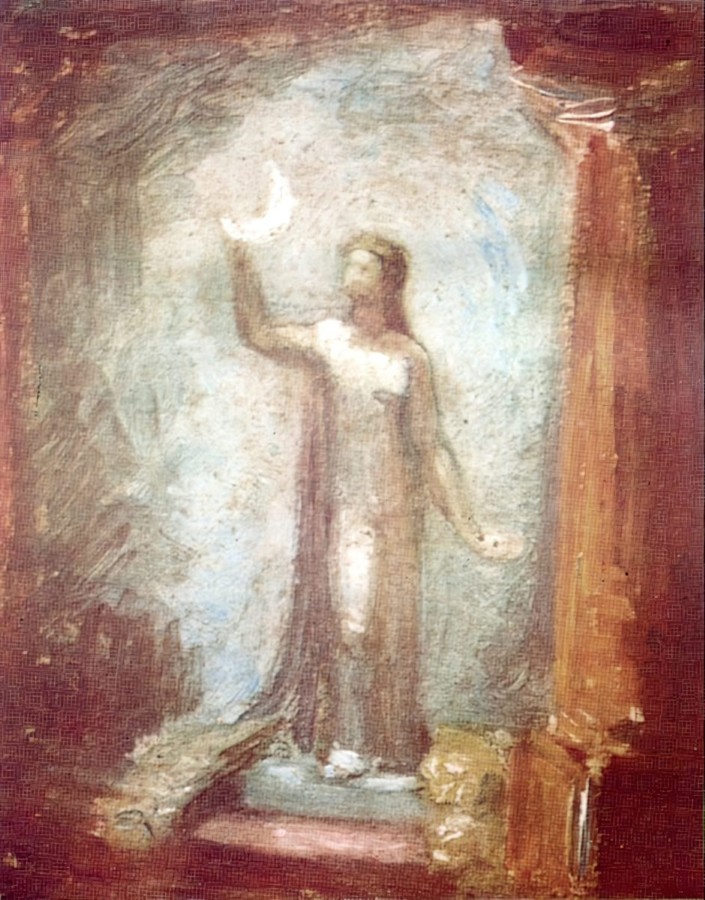
An Apparition
Oil on board,(1920-30), Pondicherry
The first and lowest use of Art is the purely aesthetic, the second is the intellectual or educative, the third and highest the spiritual. By speaking of the aesthetic use as the lowest, we do not wish to imply that it is not of immense value to humanity, but simply to assign to it its comparative value in relation to the higher uses.
Sri Aurobindo
We now come to the kernel of the subject, the place of art in the evolution of the race and its value in the education of and actual life of the nation. The first question is whether the sense of the beautiful has any effect on the life of the nation. It is obvious, from what we have already written, that the manners, the social culture and the restraint in action and expression which are so large a part of national prestige and dignity and make a nation admired like the French, loved like the Irish or respected like the higher-class English, are based essentially on the sense of form and beauty, of what is correct, symmetrical, well-adjusted and fair to the eye and pleasing to the imagination. The absence of these qualities is a source of national weakness...The mind is profoundly influenced by what it sees and, if the eye is trained from the days of childhood to the contemplation and understanding of beauty, harmony and just arrangement in line and colour, the tastes, habits and character will be insensibly trained to follow a similar law of beauty, harmony and just arrangement in the life of adult man. This was the great importance of the universal proficiency in the arts and crafts or the appreciation of them which was prevalent in ancient Greece, in certain European ages, in Japan and in the better days of our own history. Art galleries cannot be brought into every home, but, if all the appointments of our life and furniture of our homes are things of taste and beauty, it is inevitable that the habits, thoughts and feelings of the people should be raised, ennobled, harmonised, made more sweet and dignified.
Sri Aurobindo
I stretch it out to Thee with both arms
in a gesture of offering
and I ask of Thee:
If my understanding is limited, widen it;
if my knowledge is obscure, enlighten it;
if my heart is empty of ardour, set it aflame;
if my love is insignificant, make it intense;
if my feelings are ignorant and egoistic,
give them the full consciousness in the Truth'.
The Mother
Portrait of a Loving Friend
Oil on ivory, 9.5 x 6.5 cm.(1897) France
This portrait of Mme Valentine is done on a small piece of ivory. The Mother presented it to Ms. Maggi Lidchi, one of her disciples, in whom she recognised a reincarnation of her friend. Mme Valentine, a close friend of the Mother's during her days in the art studio, died in childbirth just before the Mother's son, Andre, was born.
"The Yogin's aim in the Arts should not be a mere aesthetic, mental or vital gratification, but, seeing the Divine everywhere, worshipping it with a revelation of the meaning of its works, to express that One Divine in gods and men and creatures and objects."
How can we "express that One Divine"?
It depends on the subject one wants to express: gods, men or things.
When one paints a picture or composes music or writes poetry, each one has his own way of expressing himself. Every painter, every musician, every poet, every sculptor has or ought to have a unique, personal contact with the Divine, and through the work which is his specialty, the art he has mastered, he must express this contact in his own way, with his own words, his own colours. Instead of copying the outer forms of Nature, he takes these forms as the covering of something else, of his relation with the realities which are behind, deeper, and he tries to make them express that. Instead of merely imitating what he sees, he tries to make them speak of what is behind them, and this is what makes the difference between a living art and just a flat copy of Nature.
-The Mother
Grapes
Oil on canvas (1893-97) France
Roof of Daiunji Temple
Oil on board (1918) Japan
Theon's House
Oil on board (1906-1907) Algeria
You have said: "if you surrender [to the Divine] you have to give up effort, but that does not mean that you have to abandon also all willed action." But if one wants to do something, it means personal effort, doesn't it? What then is the will?
There is a difference between the will and this feeling of tension, effort, of counting only on oneself, having recourse to oneself alone which personal effort means; this kind of tension, of something very acute and at times very painful; you count only on yourself and you have the feeling that if you do not make an effort at every minute, all will be lost. That is personal effort.
But the will is something altogether different. It is the capacity to concentrate on everything one does, to do it as best one can and not stop doing it unless one receives a very precise intimation that it is finished. It is difficult to explain to you. But suppose, for example, that through a combination of circumstances a work comes into your hands. Take an artist who has in one way or another received an inspiration and decided to paint a picture. He knows very well that if he has no inspiration and is not sustained by forces other than his own, he will do nothing much. It will look more like a daub than a painting. He knows this. But it has been settled, the painting is to be done; there may be many reasons for it, but the painting is to be done. Then if he had the passive attitude, well, he would get out his palette, his colours, his brushes, his canvas and then sit down in front of them and say to the Divine: "Now you are going to paint." But the Divine does not do things that way. The painter himself must take up everything and arrange everything, concentrate on his subject, find the forms, the colours that will express it and put his whole will for a more and more perfect execution. His will must be there all the time. But he will keep the sense that he must be open to the inspiration, he will not forget that in spite of all his knowledge of technique, in spite of the care he takes to arrange, organise and prepare his colours and the forms of his design, in spite of all that, if he has no inspiration, it will be one picture among a million others and it will not be very interesting. He does not forget. He attempts, he tries to see, to feel what he wants his painting to express and in what way it should be expressed. He has his colours, he has his brushes, he has his model, he has made his sketch which he will enlarge and make into a picture, he calls his inspiration. There are even some who manage to have a clear, precise vision of what is to be done. But then, day after day, hour after hour, they have this will to work, to study, to do with care all that must be done until they reproduce as perfectly as they can the first inspiration.... That person has worked for the Divine, in communion with Him, but not in a passive way, not with a passive surrender; it is with an active surrender, a dynamic will. The result generally is something very good. Well, the example of the painter is interesting, because a painter who is truly an artist is able to see what he is going to do, he is able to connect himself to the divine Power that is beyond expression and inspires all expression. For the poet, the writer, it is the same thing and for all people who do something, it is the same.
The Mother
Talk of 13 May 1953
How is it that in people occupied with scientific studies artistic imagination is lacking? Are these two things opposed to each other?
Not necessarily.
In general?
They do not belong to the same domain. It is exactly as though you had what is called in English a "torchlight", a small beacon in your head, at the place of observation. Scientists who want to do a certain work turn the beacon in a particular way, they always put it there and the beacon remains like that: they turn it towards matter, towards the details of matter. But imaginative people turn it upwards, because up above there is everything, all the inspirations for artistic and literary things: this comes from another domain. It comes from a much subtler domain, much less material. So these turn upwards and want to receive the light from above. But it is the same instrument. The others turn it downwards, and it is quite simply a lack of gymnastic skill. It is the same instrument. It is the same power of a luminous ray upon something. But because one has made a habit of concentrating it in a certain direction, one is no longer flexible, one loses the habit of doing things differently.
But you can at any moment do both things. When you are doing science, you turn it in one direction and when you do literature and art, you turn it in the other direction; but it is the same instrument: all depends on the orientation. If you have concentration, you can move this power of concentration from one place to another and in every case it will be effective. If you are occupied with science, you use it in a scientific way, and if you want to do art, you use it inan artistic way. But it is the same instrument and it is the same power of concentration. It is simply because people don't know this that they limit themselves. So the hinges get rusty, they don't turn any more. Otherwise, if one keeps the habit of turning them, they continue to turn. Moreover, even from the ordinary point of view, it is not rare to find a scientist having as his pastime some artistic occupation—and the reverse also. It is because they have discovered that the one was not harmful to the other and that it was the same faculty which could be applied in both cases.
Essentially, from a general point of view, particularly from the intellectual point of view, the capacity of attention and concentration is the most important thing, the thing one must work to develop. From the point of view of action (physical action), it is the will: you must work to build up an unshakable will. From the intellectual point of view, you must work to build up a power of concentration which nothing can shake. And if you have both, concentration and will, you will be a genius and nothing will resist you.
To a student who was thinking of leaving the Ashram to study art in Paris
I have seen your paintings—they are almost perfect. But what they lack is not technique—it is consciousness. If you develop your consciousness you will spontaneously discover how to express yourself. Nobody, and especially not the official teachers, can teach you that.
So to leave here and go anywhere else, to any of the "Art Academies", would be to leave the light and step into a pit of obscurity and unconsciousness.
You cannot learn to be an artist with tricks—it is as if you wanted to realize the Divine by imitating religious ceremonies.
Above all and always the most important thing is Sincerity.
Develop your inner being—find your soul, and at the same time you will find the true artistic expression.
The Mother
Divine Consciousness Emerging from the Inconscient
Oil on board, 13.5 x 8.5 cm, 1920-25, Pondicherry
The title was given by the Mother. During the early 1920s Sri Aurobindo's brother, Barin, was doing some oil painting under the Mother's guidance. As is the common practice of artists, a small board was kept for depositing the surplus paint left on the palette after each session. A random mixture of colours covered most of the surface of this board. One day when Barin had finished his work the Mother asked for the palette and, with the remaining paint, gave a few deft brush strokes to the centre of the board covered with old palette- scrapings. Thus the painting was completed.
Evidently, something had struck the Mother in the swirl of colours on the board. The suggestion of a face may have been already visible in the midst of it. In the finished painting, a face resembling Sri Aurobindo's emerges from the chaos of colours which appropriately represents 'the Inconscient', according to the Mother's title. The Mother herself confirmed that the face is Sri Aurobindo's. It is likely, as is reported in one version of the story, that Sri Aurobindo was present at the time of this incident and she took the opportunity to paint a quick portrait of him. The Mother liked the painting enough to have it printed along with the title she gave it.
But if Art is to reach towards the highest, the Indian tendency must dominate. The spirit is that in which all the rest of the human being reposes, towards which it returns and the final self-revelation of which is the goal of humanity. Man becomes God, and all human activity reaches its highest and noblest when it succeeds in bringing body, heart and mind into touch with spirit. Art can express eternal truth, it is not limited to the expression of form and appearance. So wonderfully has God made the world that a man using a simple combination of lines, an unpretentious harmony of colours, can raise this apparently insignificant medium to suggest absolute and profound truths with a perfection which language labours with difficulty to reach. What Nature is, what God is, what man is can be triumphantly revealed in stone or on canvas.
Sri Aurobindo
Art for art's sake? But what after all is meant by this slogan and what is the real issue behind it? It is meant, as I think it was when the slogan first came into use, that the technique, the artistry is all in all? The contention would then be that it does not matter what you write or paint or sculpt or what music you make or about what you make it so long as it is beautiful writing, competent painting, good sculpture, fine music. It is very evidently true in a certain sense, - in this sense that whatever is perfectly expressed or represented or interpreted under the conditions of a given art proves itself by that very fact to be legitimate material for the artist's labour...
But then the theory itself is true only up to a certain point. The technique is only a means of expression; one does not write merely to use beautiful words or paint for the sole sake of line and colour; there is something that one is trying through these means to express or to discover. What is that something? The first answer would be - it is the creation, it is the discovery of Beauty. Art is for that alone and can be judged only by its revelation or discovery of Beauty. Whatever is capable of being manifested as Beauty is the material of the artist. But there is not only physical beauty in the world - there is moral, intellectual, spiritual beauty also. Still one might say that Art for Art's sake means that only what is aesthetically beautiful must be expressed and all that contradicts the aesthetic sense of beauty must be avoided. Art has nothing to do with Life in itself, things in themselves, Good, Truth or the Divine for their own sake, but only in so far as they appeal to some aesthetic sense of beauty, and that would seem to be a sound basis for excluding the Five Years' Plan, a moral sermon or a philosophical treatise. But here, again, what after all is Beauty? How much is it in the thing itself and how much in the consciousness that perceives it? Is not the eye of the artist constantly catching some element of aesthetic value in the plain, the ugly, the sordid, the repellant and triumphantly conveying it through his material, - through the word, through line and colour, through the sculptured shape?...
What the artist sees, is there - his is a transmuting vision because it is a revealing vision; he discovers behind what the object appears to be, the something More it is. And so from this point of view of a realised supreme harmony all is or can be subject-matter for the artist because in all he can discover and reveal the Beauty that is everywhere. Again, we land ourselves in a devastating catholicity; for here too one cannot pull up short at any given line. It may be a hard saying that one must or may discover and reveal beauty in a pig or its poke or in a parish pump or an advertisement of somebody's pills, and yet something like that seems to be what modern Art and Literature are trying with vigour and conscientious labour to do. By extension one ought to be able to extract beauty equally well out of morality or social reform or a political caucus or allow at least that all these things can, if he wills, become legitimate subjects for the artist. Here, too, one cannot say that it is on condition he thinks of beauty only and does not make moralising or social reform or a political idea his main object. For if with that idea foremost in his mind he still produces a great work of art, discovering Beauty as he moves to his aim, proving himself in spite of his unaesthetic preoccupations a great artist, it is all we can justly ask from him, whatever his starting- point, to be a creator of Beauty. Art is discovery and reveleation of Beauty, and we can say nothing more by way of prohibitive or limiting rule.
But there is one thing more that can be said, and that makes a big difference. In the Yogin's vision of universal beauty, all becomes beautiful, but all is not reduced to a single level. There are gradations, there is a hierarchy in this All-Beauty and we see that it depends on the ascending power (Vibhuti) of Consciousness and Ananda that expresses itself in the object. All is the Divine, but somethings are more divine than others. In the artist's vision too there are or can be gradations, a hierarchy of values...
And that is because just as technique is not all, so even Beauty is not all in Art. Art is not only technique or form of Beauty, not only the discovery or the expression of Beauty - it is a self-expression of Consciousness under the conditions of aesthetic vision and a perfect execution. Or, to put it otherwise, there are not only aesthetic values, but life-values, mind-values, soul-values that enter into Art. The artist puts out into form not only the powers of his own consciousness, but the powers of the Consciousness that has made the worlds and their objects. And if that Consciousness according to the Vedantic view is fundamentally equal everywhere, it is still in manifestation not an equal power in all things...
There is something here that goes beyond any consideration of Art for Art's sake or Art for Beauty's sake; for while these stress usefully sometimes the indispensable first elements of artistic creation, they would limit too much the creation itself if they stood for the exclusion of the something More that compels Art to change always in its constant seeking for more and more that must be expressed of the concealed or the revealed Divine, of the individual and universal or the transcendent Spirit.
If we take these three elements as making the whole of Art, perfection of expressive form, discovery of beauty, revelation of the soul and essence of things and the powers of creative consciousness and Ananda of which they are the vehicles, then we shall get perhaps a solution which includes the two sides of the controversy and reconciles their difference. Art for Art's sake certainly; Art as a perfect form and discovery of Beauty; but also Art for the soul's sake, the spirit's sake and the expression of all that the soul, the spirit wants to seize through the medium of beauty. In that self-expression there are grades and hierarchies, widenings and steps that lead to the summits. And not only to enlarge Art towards the widest wideness but to ascend with it to the heights that climb towards the Highest is and must be part both of our aesthetic and our spiritual endeavour.
Sri Aurobindo
he story began with... Tthe man who used to do still-lifes and whose plates were never round... Cezanne! It was he who began it; he said that if you made round plates it was not living, that never, when one looks spontaneously a things, does one see plates as round: one sees them like this (gesture). I don't know why, but he said that it is only the mind that makes us see plates as round, because one knows they are round, otherwise one does not see them round. It is he who began.... He painted a still-life which was truly a very beautiful thing, note that; a very beautiful thing, with a truly striking impression of colour and form (I could show you reproductions one day, I must have them, but they are not colour reproductions unfortunately; the beauty is especially in the colour). But, of course, his plate was not round. He had friends who told him just this, "But after all, why don't you make your plate round?" He replied, "My deal fellow, you are altogether mental, you are not an artist, it is because you think that you make your plates round: if you only see, you will do it like this" (gesture). It is in accordance with the impression that the plate ought to be painted; it gives you an impact, you translate the impact, and it is this which is truly artistic. This is how modern art began. And note that he was right. His plates were not round, but he was right in principle.
What has made art what it is, do you want me to tell you, psychologically? It is photography. Photographers did not know their job and gave you hideous things, frightfully ugly, it was mechanical, it had no soul, it had no art, it was dreadful. All the first attempts of photography until... not very long ago, were like that. It is about fifty years ago that it became tolerable, and now with gradual improvement it has become something good; but it must be said that the process is absolutely different. In those days, when your portrait was taken, you sat in a comfortable chair, you had to sit leaning nicely and facing an enormous thing with a black cloth, which opened like this towards you. And the man ordered, "Don't move!" That was the end of the old painting. When the painter made something life-like, a life-like portrait, his friends said, "Why now, this is photography!"
It must be said that the art of the end of the last century, the art of the Second Empire, was bad. It was an age of businessmen, above all an age of bankers, of financiers, and taste, upon my word, had sunk very low. I don't think businessmen are people who are necessarily very competent in art, but when they wanted their portrait, they wanted a likeness! One could not leave out the least detail, it was quite comic: "But you know I have a little wrinkle there, don't forget to put it in!" and the lady who said, "You know, you must make my shoulders quite round", and so on. So the artists made portraits which indeed verged on photography. They were flat, cold, without soul and without vision. I can name a number of artists of that period, it was truly a shame for art. This lasted till towards the end of the last century, till about 1875. Afterwards, there started the reaction. Then there was an entire very beautiful period (I don't say this because I myself was painting) but all the artists I knew at that time were truly artists, they were serious and did admirable things which have remained admirable. It was the period of the impressionists; it was the period of Manet, it was a beautiful period, they did beautiful things. But people tire of beautiful things as they tire of bad ones. So there were those who wanted to found the "Salon d'Autornne". They wanted to surpass the others, to go more towards the new, towards the truly anti-photographic. And my goodness, they went a little beyond the limit (according to my taste). They began to depreciate Rembrandt—Rembrandt was a dauber, Titian was a dauber, all the great painters of the Italian Renaissance were daubers. You were not to pronounce the name of Raphael, it was a shame. And all the great age of the Italian Renaissance Was "not worth very much"; even the works of Leonardo da Vinci; "You know, you must take them or leave them." Then they went a little further; they wanted something entirely new, they became extravagant. . . .
This is the history of art as I knew it.
Now, to tell you the truth, we are on the ascending curve again. Truly, I think we have gone down to the depths of incoherence, absurdity, nastiness- of the taste for the sordid and ugly, the dirty, the outrageous. We have gone, I believe, to the very bottom.
Are we really going up again?
I think so. Recently I saw some pictures which truly showed something other than ugliness and indecency. It is not yet art, it is very far from being beautiful, but there are signs that we are going up again. You will see, fifty years hence we shall perhaps have beautiful things to see. I felt this some days ago, that truly we had come to the end of the descending curve—we are still very low down, but are beginning to climb up. There is a kind of anguish and there is still a complete lack of understanding of what beauty can and should be, but one finds an aspiration towards something which would not be sordidly material. For a time art had wanted to wallow in the mire, to be what they called "realistic". They had chosen as "real" what was most repulsive in the world, most ugly: all the deformities, all the filth, all the ugliness, all the horrors, all the incoherences of colour and form; well, I believe this is behind us now. I had this feeling very strongly these last few days (not through seeing pictures, for we do not have a chance to see much here, but by "sensing the atmosphere"). And even in the reproductions we are shown, there is some aspiration towards something which would be a little higher. It will need about fifty years; then... Unless there is another war, another catastrophe; because certainly, to a large extent, what is responsible for this taste for the sordid are the wars and the horrors of war. People are compelled to put aside all refined sensibility, the love of harmony, the need for beauty, to be able to undergo all that; otherwise, I believe, they would really have died of horror.