

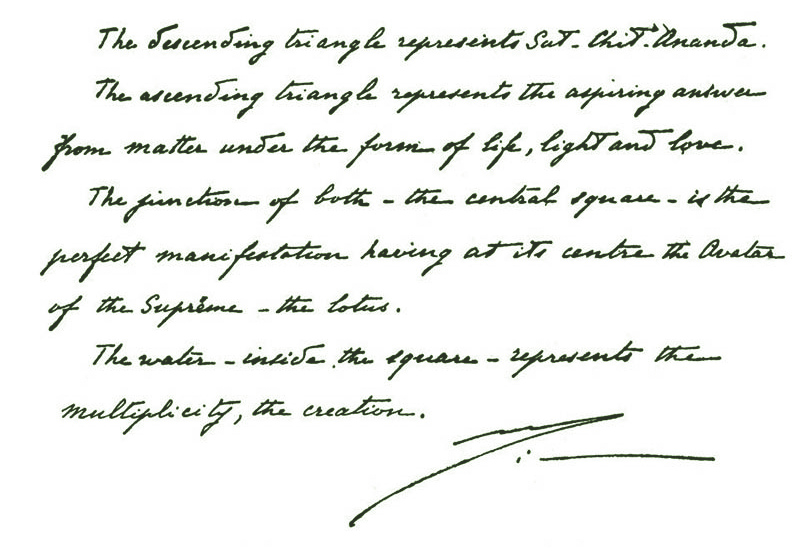
Explained by the Mother
"The descending triangle represents Sat-Chit-Ananda.
"The ascending triangle represents the aspiring answer from matter under the form of life, light and love.
"The junction of both — the central square — is the perfect manifestation having at its centre the Avatar of the Supreme — the lotus.
"The water — inside the square — represents the Multiplicity, the Creation."
December 1979
Archives and Research (1977-94)
The two triangles form a figure similar to the hexagram, the mystic symbol called by the Jews the Magen David or Seal of Solomon.
A symbol like Sri Aurobindo's as finally defined was used as early as 1902 by the "Cosmic Movement", a Paris-centred organisation which had as its head Max Theon, for some time the Mother's instructor in occultism. "Most of the cosmic writings [the various writings of the Movement] were unsigned," explains Pascal Themanlys, the son of a disciple of Theon. "The six-pointed star containing a lotus in its centre alone served to certify the authenticity of the texts. This sign evokes among other things the union of the active and passive principles and doubtless also the Wisdom of Chaldea, of Egypt and of Hindu India."
The Mother came into contact with the Cosmic Movement through the elder Themanlys, a friend of her brother Matteo, in 1904. Later she went to Algeria to study under Theon, and still later organised in Paris a centre of the "groupes cos-miques de France". She was also involved with the publication of their organ, the Review Cosmique. The Movement's symbol appeared on the cover of each issue of this journal [Figure 1].
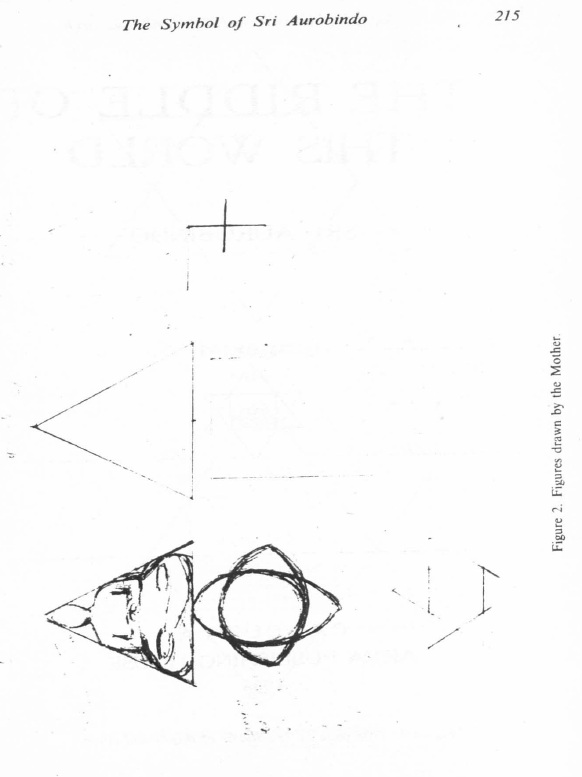
Among the Mother's manuscripts of the period 1909-12 is a sheet of paper on which she has drawn geometrical figures — some triangles and a square [Figure 2]. There is also a pattern composed of two ovals intersecting to form a sort of cross. Near this is written "croix ou came d'equilibre — realisation quaternaire parfaite" (cross or square of equilibriuin — perfect fourfold realisation). (It is interesting to note that in the 1930s Sri Aurobindo wrote that the square was the "symbol of complete creation" [SABCL 23:945].) Below the crossed oval pattern is a figure formed by two triangles within which is inscribed a square whose angles meet four of the points of the triangles' intersection — the symbol of Sri Aurobindo without the water and lotus. Above this figure is written "Sceau de Salomon" (Solomon's Seal).
It is apparent that the symbol we know as Sri Aurobindo's was familiar to the Mother before she met Sri Aurobindo in 1914 — even before she first heard of him in 1910, after her then husband Paul Richard had met him in Pondicherry. A story is told in connection with this meeting. It is said that when Richard left for India the Mother gave him a symbol — Solomon's Seal — saying that the man who would show Richard the same symbol or could explain to him its meaning would be the Master for whom they were looking. The best known version of this anecdote is the following one from Nolini Kanta Gupta's Reminiscences (page 75). "It was Sri Aurobindo himself who told us about a French lady from Paris who was a great initiate. She was desirous of establishing personal contact with Sri Aurobindo. That the Great Soid whom she meant was no other than Sri Aurobindo would be evidenced by a sign: she would be sending him something that he might recognise. That something was Sri Aurobindo's own symbol — in the form of a diagram, known as Solomon's Seal. Needless to add, after this proof of identity, steps were taken to facilitate her coming."
Some question surrounds this interesting story, particularly because of certain corrections the Mother made to a similar account in the manuscript of the first edition of A.B. Purani's Life of Sri Aurobindo. Purani had written, "Mother had given Richard some questions which he had to get solved by some spiritual person in India.... One of the questions which the Mother had asked related to the symbolic character of the 'Lotus'." The Mother wrote on Purani's manuscript in regard to the first statement: "Not correct. I never gave him any questions to be solved", and in regard to the second, "Not I, probably Richard himself." The Mother's corrections cast strong doubt on the whole symbol-recognition story, but, it should be noted, they do not directly contradict it. Its persistence and wide acceptance would suggest that it has some veracity; but unless persons who heard it directly from the Mother can recall exactly what she told them, it would probably be best to consider it apocryphal.
At any rate, sometime after the Mother's final arrival in Pondicherry in 1920, the six-pointed star enclosing a square containing water and a lotus became the symbol of Sri Aurobindo. It is not known exactly when the symbol was designed, but its first appearance seems to have been on the cover and title page of the 1933 edition of The Riddle of This World, published by the Arya Publishing House, Calcutta [Figure 3]. (The 1932 edition of Thoughts and Glimpses, published by the same house, does not have the symbol.) At this time the two main triangles are equilateral, like those of the true hexagram [Figure 4]. However, in the symbol in Figure 3 the six outer equilateral triangles surrounding the square are of different sizes, unlike those of the hexagram, which is formed by extending the sides of a regular hexagon to make six identical equilateral triangles. The hexagram is capable of being inscribed within a circle; but it is impossible to inscribe a square within it so that the square's angles meet four of the points of intersection of the two triangles.
It was apparently regretted that this earliest form of Sri Aurobindo's symbol, with its top and bottom outside triangles larger than the other four, did not have the harmony of proportion of a true hexagram. So in 1962 another design was made, in which the ascending and descending triangles form a true hexagram, but in which the angles of the central square do not touch any of the points of the triangles' intersection [Figure 5]. This figure could, of course, be inscribed within a circle. The new design, put in final form by Pavitra, a French disciple close to the Mother, was pretiented to her on 27 October 1962. At that time she approved of it, signing it and writing, "This is the correct symbol of Sri Aurobindo." Two months later, on 15 December 1962, the Mother spoke about the new symbol to another disciple. Showing him Theon's symbol on the cover of a publication of The Cosmic Movement [Figure 6], she said that she had designed Sri Aurobindo's symbol according to that (d'apres ca). The Mother went on to say that the square in Theon's symbol was very elongated, by which she meant apparently that the four outer triangles at the sides of the square with their very long bases give the entire figure an elongated look. Speaking then about the new Ashram design [Figure 5], the Mother said that this one was more correct, since Pavitra had made the triangles equal. The Mother added that Theon had told her that his symbol was the Seal of Solomon.