

Sri Aurobindo
“The Veda has a double aspect and that the two, though closely related, must be kept apart. The Rishis arranged/the Substance of their thought in a system of parallelism by which the same deities were at once internal and external Powers of universal Nature, and they managed its expression through a system of double values by which the same language served for their worship in both aspects. But the psychological sense predominates and is more pervading, close-knit and coherent than. the physical. The Veda is primarily intended to se-serve for spiritual enlightenment and self- culture.
Sri Aurobindo
Handwritten by Sri Aurobindo
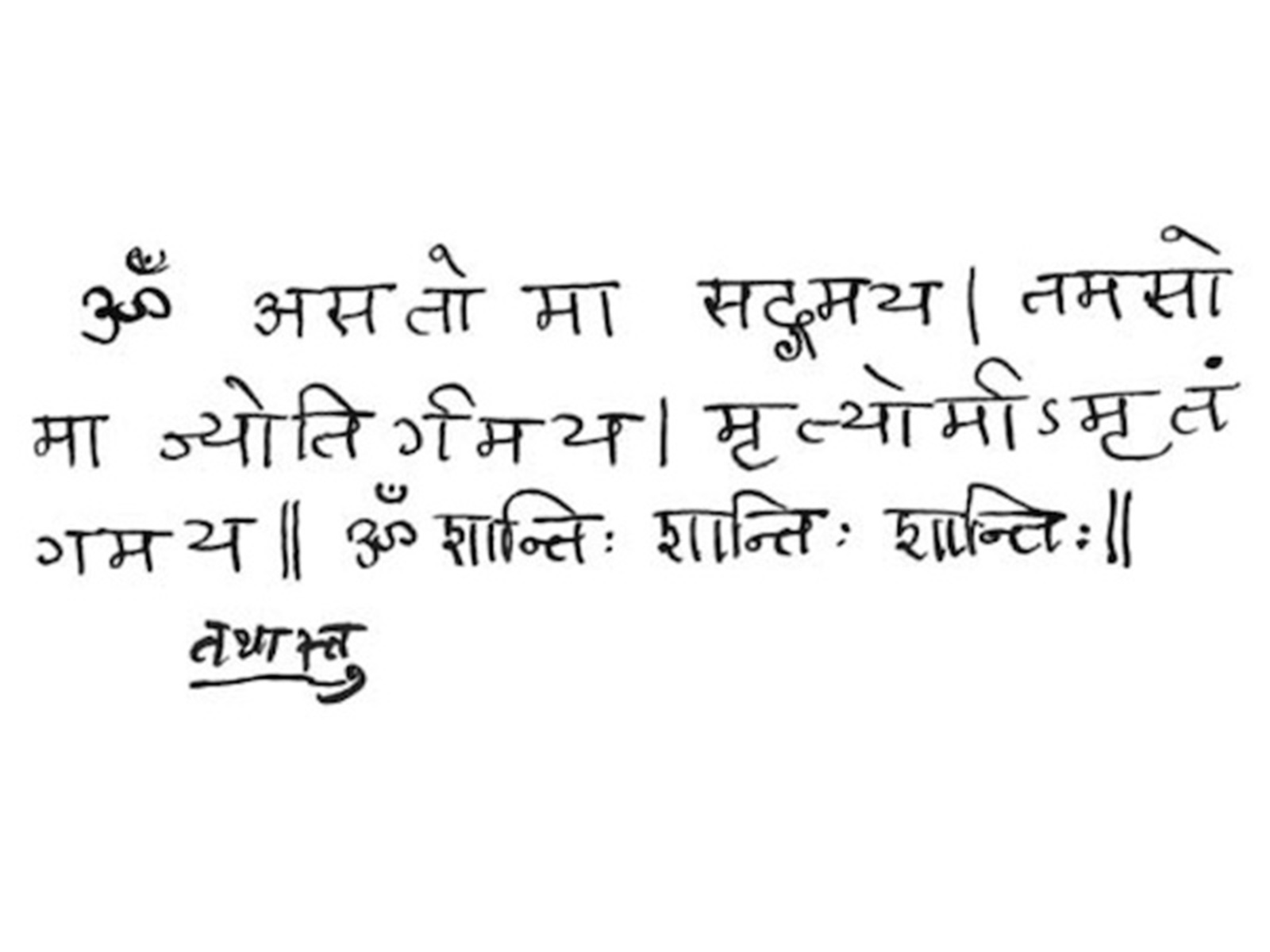
"Lead me from the unreal to the real.
Lead me from darkness to light.
Lead me from death to immortality."
So be it
- Brihadaranyaka Upanishad
First Adhyaya (Chapter),
Third Brahmana,
28th Verse (1.3.28).
“The Veda… stands out, apart from its interest as the world’s first yet extant Scripture, its earliest interpretation of man and the Divine and the universe, as a remarkable, a sublime and powerful poetic creation. It is in its form and speech no barbaric production. The Vedic poets are masters of a consummate technique, their rhythms are carved like chariots of the gods and borne on divine and ample wings of sound, and are at once concentrated and wide-waved, great in movement and subtle in modulation, their speech lyric by intensity and epic by elevation, an utterance of great power, pure and bold and grand in outline, a speech direct and brief in impact, full to overflowing in sense and suggestion so that each verse exists at once as strong and sufficient thing in itself and takes its place as a large step between what came before and what comes after. A sacred and hieratic tradition faithfully followed gave them both their form and substance, but this substance consisted of the deepest psychic and spiritual experiences of which the human soul is capable and the forms seldom or never degenerate into a convention, because what they are intended to convey was lived in himself by each poet and made new to his own mind expression by the subtleties or sublimities of his individual vision. The utterances of the greatest seers, Vishwamitra, Vamadeva, Dirghatamas and many others. touch the most extraordinary heights and amplitudes of a sublime and mystic poetry and there are poems like the Hymn of Creation that move in a powerful clarity on the summits of thought on which the Upanishads lived constantly with a more sustained breathing. The mind of ancient India did not err when it traced back all its philosophy, religion and essential things of its culture to these seer- poets, for all the future spirituality of her people is contained there in seed or in first expression.”
Sri Aurobindo
…It did not take long to see that the Vedic indications of a racial division between Aryans and Dasyus and the identification of the latter with the indigenous Indians were of a far flimsier character than I had supposed. But far more interesting to me was the discovery of a considerable body of profound psychological thought and experience lying neglected in these ancient hymns. And the importance of this element increased in my eyes when I found, first, that the mantras of the Veda illuminated with a clear and exact light, psychological experiences of my own for which I had found no sufficient explanation either in European psychology or in the teachings of Yoga or of Vedanta, so far as I was acquainted with them, and, secondly that they shed light on obscure passages and ideas of the Upanishads to which, previously, I could attach no exact meaning and gave at the same time a new sense to much in the Puranas.”
Sri Aurobindo

Mantra written by The Mother
From Upanishad
I seek not science, not religion, not Theosophy, but Veda—the truth about Brahman, not only about His essentiality, but about His manifestation, not a lamp on the way to the forest, but a light and a guide to joy and action in the world, the truth which is beyond opinion, the knowledge which all thought strives after — yasmin vijïate sarvam vijïatam . I believe that Veda to be the foundation of the Sanatan Dharma; I believe it to be the concealed divinity within Hinduism,—but a veil has to be drawn aside, a curtain has to be lifted. I believe it to be knowable and discoverable. I believe the future of India and the world to depend on its discovery and on its application, not to the renunciation of life, but to life in the world and among men.”
- Sri Aurobindo
I stretch it out to Thee with both arms
The Mother
in a gesture of offering
and I ask of Thee:
If my understanding is limited, widen it;
if my knowledge is obscure, enlighten it;
if my heart is empty of ardour, set it aflame;
if my love is insignificant, make it intense;
if my feelings are ignorant and egoistic,
give them the full consciousness in the Truth'.
“(Veda is) a Scripture not confused in thought or primitive in its substance, not a medley of heterogeneous or barbarous elements, but one, complete and self-conscious in its purpose and in its purport, veiled indeed by the cover, sometimes thick, sometimes trans-parent, of another and material sense but never losing sight even for a single moment of its high spiritual aim and tendency.”
Sri Aurobindo