

Selection From The Works of The Mother
- Prayers and Meditations
- Selection From Questions and Answers(1929 - 31) by The Mother
- Words of Long Ago - Selected Writings
- Notes on the Way
- Commentaries on the Dhammapada by The Mother
- On Education
- The Mother's Talks on "The Life Divine"
- The Mother's Talks on "The Mother" Book
- Drawings and Paintings
- On Music
- Spiritual Significance of The Flowers
- Parenting
- The Supreme Discovery
- Perfection of Body
- Six Visions of The Mother
- Stories and Plays by The Mother
- Tales of All Times
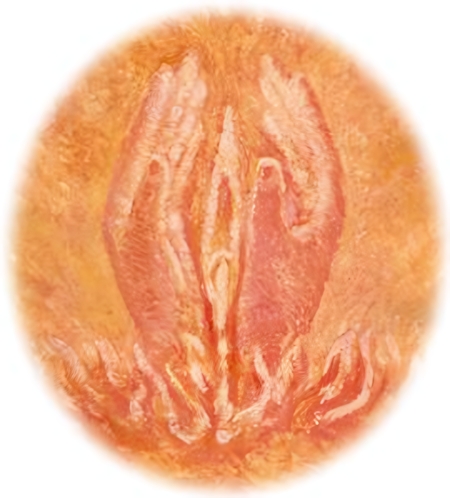
The prayers are mostly written in an identification with the earth-consciousness. It is the Mother in the lower nature addressing the Mother in the higher nature, the Mother herself carrying on the Sadhana of the earth-consciousness for the transformation praying to herself above from whom the forces of transformation come. This continues till the identification of the earth-consciousness and the higher consciousness is effected..... It is the Divine who is always referred to as Divine Maître and Seigneur. There is the Mother who is carrying on the sadhana and the Divine Mother, both being one but in different poises, and both turn to the Seigneur or Divine Master. Sri Aurobindo (On Prayers and Meditations)
Sri Aurobindo

Kobayashi in her Room
Prayers and Meditations
This book comprises extracts from a diary written during years of intensive yogic discipline. It may serve as a spiritual guide to three principal categories of seekers: those who have undertaken self-mastery, those who want to find the road leading to the Divine, those who aspire to consecrate themselves more and more to the Divine Work.
—The Mother
The Spiritual Significance of Flowers
"Flowers speak to us when we know how to listen to them," the Mother said. "It is a subtle and fragrant language." As if to provide a key to this language, she identified the significances of almost nine hundred flowers.
The Origin of the Significances
Mother, when flowers are brought to you, how do you give them a significance?
By entering into contact with the nature of the flower, its inner truth. Then one knows what it represents.
Mother, how do you give a significance to a flower?
By entering into contact with it and giving a meaning, more or less precise, to what I feel.
Mother, each flower has its own significance, doesn't it?
Not as we understand it mentally. There is a mental projection when one gives a precise significance to a flower. ... A flower does not have the equivalent of a mental consciousness. ... It is rather like the movement of a little baby, neither a sensation nor a feeling, but something of both; it is a spontaneous movement, a very special vibration. Well, if one is in contact with this vibration, if one feels it, one receives an impression which may be translated by a thought. This is how I give a significance to flowers and plants. There is a kind of identification with the vibration, a perception of the quality it represents, and gradually through a kind of approximation (sometimes it comes suddenly, occasionally it takes time) there is a convergence of these vibrations, which are of a vital-emotional order, and the vibration of mental thought, and if there is sufficient accord one has a direct perception of what the plant may signify.
- The Mother

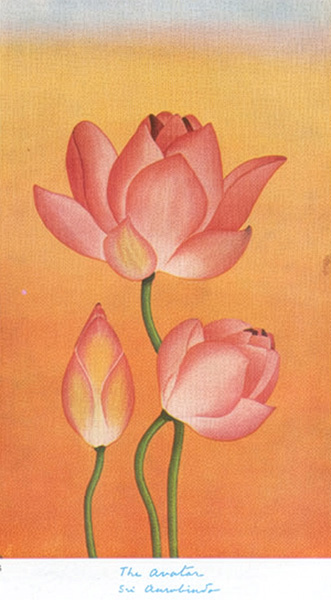
Paintings by Champaklal and Significance given by Sri Aurobindo himself
The red lotus represents Sri Aurobindo, the white one represents me. In a general way the lotus is the flower of the Divine Wisdom, whatever its colour. But red signifies the Avatar, the Divine incarnated in matter, and white signifies the Divine Consciousness manifested upon earth.
- The Mother
Notes on the Way
During the years 1961 to 1973 the Mother had frequent conversations with one of her disciples about the experiences she was having at the time. She called these conversations, which were in French, l’Agenda.
Selected transcripts of the tape-recorded conversations were seen, approved and occasionally revised by the Mother for publication in the Bulletin of Sri Aurobindo International Centre of Education; they appeared regularly from February 1965 to April 1973 under the titles “Notes on the Way” and “A Propos”. The English translations that accompanied the French text in the Bulletin were sometimes read out to the Mother for approval; the same translations, with minor revisions, are published in this volume, number eleven of the Collected Works of the Mother.
On Education
This volume is a compilation of the Mother’s articles, messages, letters and conversations on education. Three dramas, written for the annual dramatic performance of the Sri Aurobindo International Centre of Education, are also included.
In these articles I am trying to put into ordinary terms the whole yogic terminology, for these Bulletins are meant more for people who lead an ordinary life, though also for students of yoga — I mean people who are primarily interested in a purely physical material life but who try to attain more perfection in their physical life than is usual in ordinary conditions. It is a very difficult task but it is a kind of yoga. These people call themselves "materialists" and they are apt to get agitated or irritated if yogic terms are used, so one must speak their language avoiding terms likely to shock them. But I have known in my life persons who called themselves "materialists" and yet followed a much severer discipline than those who claim to do yoga.
What we want is that humanity should progress; whether it professes to lead a yogic life or not matters little, provided it makes the necessary effort for progress.
The Mother
The first thing a child must learn is to know himself and to master himself.
The Mother
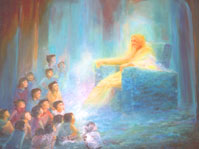 Humankind has always told stories. Through the years stories have been used to entertain, to reveal past history or to teach life's lessons. Complicated concepts taught with a story are more likely to be understood and remembered.
 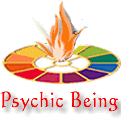 The psychic being is in the heart centre in the middle of the chest (not in the physical heart, for all the centres are in the middle of the body), but it is deep behind. When one is going away from the vital into the psychic, it is felt as if one is going deep deep down till one reaches that central place of the psychic. - Sri Aurobindo
  Physical culture is the best way of developing the consciousness of the body, and the more the body is conscious, the more it is capable of receiving the Divine Force that are at work to transform it and give birth to the New Race. - The Mother