 |
|
|
|
|
|
|
|
|
|
|
|
|
|
|
 |
 |
 |
|
|||||||||||
 |
 |
 |
 |
|
||||||||||
 |
 |
 |
 |
 |
 |
|
||||||||
 |
 |
 |
|
|||||||||||
 |
 |
 |
 |
|
||||||||||
 |
 |
 |
|
|||||||||||
 |
|
|||||||||||||
 |
|
|||||||||||||
 |
|
|||||||||||||
 |
 |
|
||||||||||||
 |
|
|||||||||||||
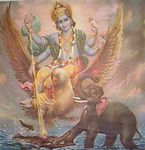
Sri Krishna, the Teacher of the Gita

All
existence is a manifestation of God because He is the only existence
and nothing can be except as either a real figuring or else a figment
of that one reality .Therefore every conscious being is in part or in
some way a descent of the Infinite into the apparent finiteness of name
and form. But it is a veiled manifestation and there is a gradation
between the supreme being of the Divine and the consciousness shrouded
partly or wholly by ignorance of self in the finite.
The inner Divinity is the eternal Avatar in
man; the human manifestation is its sign and development in the external
world.
It is ...the eternal Avatar, this God in man,
the divine Consciousness always present in the human being who manifested
in a visible form speaks to the human soul in the Gita, illumines the
meaning of life and the secret of divine action and gives it the light
of the divine knowledge and guidance and the assuring and fortifying
word of the Master of existence in the hour when it comes face to face
with the painful mystery of the world. This is what the Indian religious
consciousness seeks to make near to itself in whatever form, whether
in the symbolic human image it enshrines in its temples or in the worship
of its Avatars or in the devotion to the human Guru through whom the
voice of the one world-Teacher makes itself heard. Through these it
strives to awaken to that inner voice, unveil that form of the Formless
and stand face to face with that manifest divine Power, Love and Knowledge.Secondly,
there is the typical, almost the symbolic significance of the human
Krishna who stands behind the great action of the Mahabharata, not as
its hero, but as its secret centre and hidden guide. That action is
the action of a whole world of men and nations, some of whom have come
as helpers of an effort and result by which they do not personally profit,
and to these he is a leader, some as its opponents and to them he also
is an opponent, the baffler of their designs and their slayer and he
seems even to some of them an instigator of all evil and destroyer of
their old order and familiar world and secure conventions of virtue
and good;
some
are, representatives of that which has to be fulfilled and to them he
is counsellor, helper, friend. Where the action pursues its natural
course or the doers of the work have to suffer at the hands of its enemies
and undergo the ordeals which prepare them for mastery, the Avatar is
unseen or appears only for occasional comfort and aid, but at every
crisis his hand is felt, yet in such a way that all imagine themselves
to be the protagonists and even Arjuna, his nearest friend and chief
instrument, does not perceive that he is an instrument and has to confess
at last that all the while he did not really know his divine Friend.
He has received counsel from his wisdom, help from his power, has loved
and been loved, has even adored without understanding his divine nature;
but he has been guided like all others through his own egoism and the
counsel, help and direction have been given in the language and received
by the thoughts of the Ignorance. Until the moment when all has been
pushed to the terrible issue of the struggle on the field of Kurukshetra
and the Avatar stands at last, still not as fighter, but as the charioteer
in the battle car which carries the destiny of the fight, he has not
revealed Himself even to those whom he has chosen.
Thus the figure of Krishna becomes, as it were,
the symbol of the divine dealings with humanity .Through our egoism
and ignorance we are moved, thinking that we are the doers of the work,
vaunting of ourselves as the real cases of the result, and that which
moves us we see only occasionally as some vague or even some human and
earthly fountain of knowledge, aspiration, force, some Principle or
Light or Power which we acknowledge and adore without knowing what it
is until the occasion arises that forces us to stand arrested before
the Veil. And the action in which this divine figure moves is the whole
wide action of man in life, not merely the inner life, but all this
obscure course of the world which we can judge only by the twilight
of the human reason as it opens up dimly before our uncertain advance
the little span in front.
The symbolic companionship of Arjuna and Krishna,
the human and the divine soul, is expressed elsewhere in Indian thought,
in the heavenward journey of Indra and Kutsa seated in one chariot,
in the figure of the two birds upon one tree in the Upanishad, in the
twin figures of Nara and Narayana, the seers who do tapasya together
for the knowledge. But in all three it is the idea of the divine knowledge
in which, as the Gita says, all action culminates that is in view; here
it is instead the action which leads to that knowledge and in which
the divine Knower figures Himself. Arjuna and Krishna, this human and
this divine, stand together not as seers in the peaceful hermitage of
meditation, but as fighter and holder of the reins in the clamorous
field, in the midst of the hurtling shafts, in the chariot of battle.
The Teacher of the Gita is therefore not only the God in man who unveils
Himself in the world of knowledge, but the God in man who moves our
whole world of action, by and for whom all our humanity exists and struggles
and labours, towards whom all human life travels and progresses. He
is the secret Master of works and sacrifice and the friend of the human
peoples.
Such then is the divine Teacher of the Gita,
the eternal Avatar, the Divine who has descended into the human consciousness,
the Lord seated within the heart of all beings, He who guides from behind
the veil all our thought and action and heart's seeking even as He directs
from behind the veil of visible and sensible forms and forces and tendencies
the great universal action of the world which He has manifested in His
own being. All the strife of our upward endeavour and seeking finds
its culmination and ceases in a satisfied fulfilment when we can rend
the veil and get behind our apparent self to this real Self, can realise
our whole being in this true Lord of our being, can give up our personality
to and into this one real Person, merge our ever-dispersed and ever-
converging mental activities into His plenary light, offer up our errant
and struggling will and energies into His vast, luminous and undivided
Will, at once renounce and satisfy all our dissipated outward-moving
desires and emotions in the plenitude of His self-existent Bliss. This
is the world- Teacher of whose eternal knowledge all other highest teaching
is but the various reflection and partial word, this the Voice to which
the hearing of our soul has to awaken.

the Mother and Sri Aurobindo are copyright Sri Aurobindo Ashram Trust, Pondicherry -605002 India