 |
|
|
|
|
|
|
|
|
|
|
|
|
|
|
 |
 |
 |
|
|||||||||||
 |
 |
 |
 |
|
||||||||||
 |
 |
 |
 |
 |
 |
|
||||||||
 |
 |
 |
|
|||||||||||
 |
 |
 |
 |
|
||||||||||
 |
 |
 |
|
|||||||||||
 |
|
|||||||||||||
 |
|
|||||||||||||
 |
|
|||||||||||||
 |
 |
|
||||||||||||
 |
|
|||||||||||||
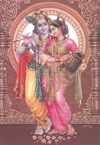
Sri Krishna and the Gopis

It is not the heart of the devotee but the mind of the observer that questions how it is that the Gopis were called and responded at once and others -the Brahmin women, for instance -were not called and did not respond at once. Once the mind puts the question, there are two possible answers: the mere will of Krishna without any reason, what the mind would call his absolute divine choice or his arbitrary divine caprice or else the readiness of the heart that is called and that amounts to adhikaribheda. .A third reply would be circumstances, as for instance, "the parking off the spiritual ground into close preserves" as X puts it. But then how can circumstances prevent the Grace from acting? In spite of parking off it works: Christians, Mahomedans do answer to the Grace of Krishna. Tigers, ghouls must love if they see him, hear his flute? Yes, but why do some hear it and see him, others not?
We are thrown back on two alternatives: Krishna's Grace calls whom it
wills to call without any determining reason for the choice or the rejection,
it is all his mercy or his withholding or at least delaying of his mercy,
or else he calls the hearts that are ready to vibrate and leap up at
his call -and even there he waits till the moment has come. To say that
it does not depend on outward merit or appearance of fitness is no doubt
true: the something that was ready to wake in spite, it may be, of many
hard layers in which it was enclosed, may be something visible to Krishna
and not to us.'
It was there perhaps long before the flute began to play, but Krishna
was busy melting the hard layers So that the heart in its leap might
not be pressed back by them when the awakening notes came. The Gopis
heard and rushed out into the forest, the others did not, or did they
think it was only some rustic music or some rude cowherd-lover fluting
to his sweetheart, not a call that learned and cultured or virtuous
ears could recognise as the call of the Divine? There is something to
be said after all for the adhikiiri-bheda. But, of course, it
must be understood in the large sense: some may have the adhikiira
for recognising Krishna's flute, some for the call of Christ, some
for the dance of Shiva -to each his own way and his nature's answer
to the Divine Call. Adhikiira cannot be stated in rigid mental
terms: it is something spiritual and subtle, something mystic and secret
between the called and the Caller .
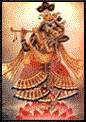
Do you remember the story of Sri Krishna and the 'Gopis,
how Narada found him differently occupied in each house to which he
went, present to each Gopi in a different body, yet always the same
Sri Krishna? Apart from the devotional meaning of the story , which
you know, it is a good image of his World-Lila. He is sarva, everyone,
each Purusha with his apparently different Prakriti and action is he,
and yet at the same time he is the Purushottama who is with Radha, the
Para Prakriti, and can withdraw all these into himself when he wills
and put them out again when he wills. From one point of view they are
one with him, from another one yet different, from yet another always
different because they always exist, latent in him or expressed at his
pleasure. There is no profit in disputing about these standpoints.
-
Wait until you see God and know yourself and him and then debate and
discussion will be unnecessary .
If we regard Vaikuntha or Goloka each as the world of a Divinity , Vishnu
or Krishna, we would be naturally led to seek its place or its origin
in the overmind plane. The overmind is the plane of the highest worlds
of the Gods. But Vaikuntha and Goloka are human conceptions of states
of being that are beyond humanity .Goloka is evidently a world of Love,
Beauty and Ananda full of spiritual radiances (the cow is the symbol
of spiritual Light) of which the souls there are keepers or possessors,
Gopas and Gopis. It is not necessary to assign any single plane to this
manifestation -in fact, there can be a reflection. or possession of
it or of its conditions on any plane of consciousness -the mental, vital
or even the subtle physical plane.
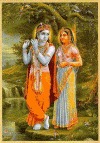
The story of Brindavan does not enter into the main story of the Mahabharata
and has a Puranic origin and it could be maintained that it was intended
all along to have a symbolic character. At one time I accepted that
explanation, but I had to abandon it afterwards; there is nothing in
the Puranas that betrays any such intention. It seems to me that it
is related as something that actually occurred or occurs somewhere.
The Gopis are to them realities and not symbols. It was for them at
the least an occult truth, and occult and symbolic are not the same
thing; the symbol may be only a significant mental construction or only
a fanciful invention, but the occult is a reality which is
actual somewhere, behind the material scene as it were and can have
its truth for the terrestrial life and its influence upon it may even
embody itself there. The Lila of the Gopis seems to be conceived as
something which is always going on in a divine Gokul and which projected
itself in an earthly Brindavan and can always be realised and its meaning
made actual in the soul. It is to be presumed that the writers of the
Puranas took it as having been actually projected on earth in the life
of the incarnate Krishna and it has been so accepted by the religious
mind of India.
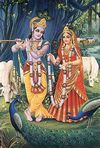
Some say
Krishna never lived, he is a myth. They mean on earth; for if Brindavan
existed nowhere, the Bhagavatt could not have been written.
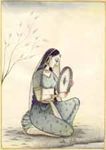
The Gopis
are not ordinary people in the proper sense of the word: they are embodiments
of a spiritual passion, extraordinary by their extremeness of love,
personal devotion, unreserved self-giving. Whoever has that, however
humble his or her position in other respects (learning, power of presentation,
scholarship, external sanctity, etc.) can easily follow after Krishna
and reach him: that seems to me the sense of the symbol of the Gopis.
There are many other significances, of course ; that is only
one among the many.

the Mother and Sri Aurobindo are copyright Sri Aurobindo Ashram Trust, Pondicherry -605002 India