|
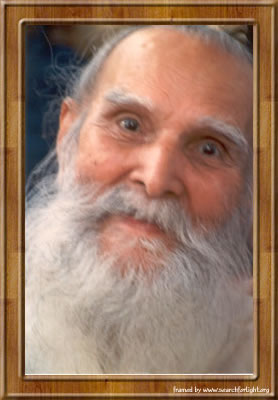
Champaklal was not only a respected
member of the Sri Aurobindo Ashram, but almost an institution
in himself. His devoted and meticulous personal service
to Sri Aurobindo and the Mother for over fifty years
was an inspiring example of selfless service. His helpfulness
to devotees who sought the Mother's blessings and advice
on personal questions made him a friend and well-wisher
of all. His impressive physical features -a big head,
with a flowing beard, a robust body -and a sense of
purity about him, lent awe to his unique personality
.The Mother called him her lion!
It is surprising that in spite of the rigorous of his
constant attendance upon Sri Aurobindo and the Mother
and his innumerable small but essential tasks, he could
still find time to develop his artistic interests. This
was only possible because of his deep urge to express
himself through form and colour. Apart from dedicated
service to the Master and the Mother, painting seems
to have been his second love. This was an inborn capacity
which grew in him and found scope for development in
the Ashram.
Here in this album we have gathered some of Champaklal's
representative works, beginning from his early period
(when he largely copied from printed pictures) to his
last works in the marbling technique. The works reproduced
here are not given as examples of high achievement,
but they certainly reveal his capacity to depict forms,
his meticulousness in drawing and his sensitive response
to colours; they also show how much he loved to express
himself through art.
Champaklal' s upbringing from early days sheds light
on many traits of his character, especially his simple
and deeply devotional nature. He was born in Patan on
2 February 1903. His father was Chhotalal and mother
Umiya. He was the second of four sons and one daughter.
Theirs was a Brahmin family serving the religious requirements
of the Hindu community of the town, as the surname Purani
indicates: Puranis were the traditional priests engaged
in reading out Puranas before Hindu audiences and conducting
religious rites for families and for the community at
large.
From his childhood Champaklal showed a character and
temperament quite out of the ordinary .He insisted on
having the best whenever he needed something, but he
always took good care of it. He was conscious in all
he did, so that his work was flawless and perfect. He
used to paint doors and windows and even helped his
mother in household work, generally a prerogative of
the daughter of the house. He was not interested in
studies and did not go beyond the fifth class in school.
Nor did he study the Puranas and other religious scriptures
as demanded by family tradition and the priestly profession.
What he learnt of the ancient lore was from the stories
he heard from his father in his childhood. His father
was a liberal man who did not impose anything on his
children. He knew that his son was a simple boy and
indulged him in his childish occupations.
Even as a child Champaklal aspired to live constantly
in the presence of someone like Sri Ramakrishna. He
was fascinated by Ramakrishna's life and the intensity
of his devotion to Kali, the Divine Mother. Champaklal
once observed: "I started my higher life after
reading Sri Ramakrishna. I liked him very much and on
reading him I lost all interest in ordinary life."
His aspiration to live in the presence of someone spiritually
great was, of course, later fulfilled.
At the age of fifteen Champaklal met a devotee of Sri
Aurobindo who asked him to follow the path of Sri Aurobindo.
His desire to see Sri Aurobindo grew very strong and
in 1921 he got the opportunity to visit Pondicherry
. On seeing Sri Aurobindo for the first time, Champaklal
prostrated himself before him arid remained in that
condition for almost one hour. During his stay of eight
days in Pondicherry , he met Sri Aurobindo every day.
In one of their conversations, he told Sri Aurobindo
that at times he felt peace and also saw light. Sri
Aurobindo explained to him: "You see, the Peace
which you feel shows that God is near you, and the Light
shows that you can meet Him in that Peace and gradually
you will be able to stay in This."
Champaklal's week-long stay in Pondicherry made a very
favourable impression on Sri Aurobindo; lie understood
the young man's sincerity and dedication to the spiritual
life. Later, when Champaklal wrote a beautiful letter
to him, Sri Aurobindo instructed one of his disciples
to bring Champaklal along when he visited Pondicherry
again.
Champaklal's diary of this period, written in Gujarati,
shows his inner conflict and his great yearning for
God. In one place he writes: "What have you done
about the practice of sadhana shown to you by Arvind
Babuji? Free yourself, free yourself from pride and
attachment. What a shallow life! Have you come here
for worldly attachments? Follow the straight path of
faith. ...O God, show me Thy mercy; give me Thy refuge!"
Champaklal' s aspiration to be with Sri Aurobindo was
fulfilled two years later. In 1923 he came back to Pondicherry
to offer himself in the service of the Divine, never
to return again to worldly life. His service of five
decades to Sri Aurobindo and the Mother was one-pointed
and constant. This was his supreme Sadhana. As a matter
of fact, he looked upon Sri Aurobindo and the Mother
as his real parents and they accepted him as their child.
Champaklal once admitted that he had not read many works
of Sri Aurobindo and the Mother other than Sri Aurobindo's
book, The Mother. During his first visit to Pondicherry
, he had asked Sri Aurobindo what he should read. Sri
Aurobindo recommended shandilya sutra and Prakriti Rahasya
in Gujarati; he even told him where to get them from.
Prakriti Rahasya (The Secret of Nature) deals with Apara
and Para Prakriti. The higher or Para Prakriti is known
as the Mother .
It is very difficult to summarise Champaklal's long
service, which passed through all the phases of the
developing life of the Ashram, reflecting many aspects
of the life of the community and the workings of the
Mother and Sri Aurobindo. When he came in 1923, the
Ashram was a group of only ten to fifteen persons; when
the Mother left her body in 1973, it had become a community
of nearly two thousand, humming like a beehive with
activity. The Mother's one or two serious illnesses
in the 1930s, the leg accident that Sri Aurobindo met
with in 1938 and the last days of Sri Aurobindo and
the Mother, were all traumatic experiences for Champaklal;
at the same time they greatly added to his duties and
resulted in a constant rescheduling of his other programmes.
But though the physical strain greatly increased over
the years, there was never any laxity in his work nor
any sagging of devotion. He had to cope with the frequent
change of the Mother's activities, especially after
the Ashram School was started in 1943, the Department
of Physical Education in 1945 and the Centre of Education
in 1952.
In 1950, when Sri Aurobindo left his body, Champaklal
suffered a tremendous emotional shock, but he never
wavered in his work. The Mother depended on him for
innumerable small services; he alone was able to do
them because he alone knew what the Mother needed at
any particular time. Whatever came under his charge,
he had to keep in order, because the Mother was an exacting
master as far as order was concerned; and she expected
that material things would be cared for well. All this
gave Champaklal a strict discipline, but also the rewarding
joy of faithful and sincere service. Nobody except the
Mother knew what this demanded in terms of vigilance
of spirit and tireless self-offering. The following
tribute she paid to him is perhaps the highest one could
think of for one whose whole aim was to serve Sri Aurobindo
and the Mother as Hanuman served Sri Rama:
I am very much pleased with your work.
I like your faithfulness.
I like your sincerity.
I like your steadfastness.
I like your regularity .
I like your courage .
Nirod says: "Champaklal was not a bhakta of the
traditional type, but one who has chosen service as
the means of self- expression and fundamental realisation.
..that is exactly the spirit
he maintained unflinchingly throughout the long decade
that we lived and worked together. "
After the Mother left her body in 1973, Champaklal had
to reorganise his life. He put in order everything he
had so far looked after and passed on many things to
the departments concerned. We now find that in his diaries,
he maintained voluminous records of Sri Aurobindo's
life, his daily engagements and activities, numbering
more than five thousand pages. Of those who served the
Mother and Sri Aurobindo, the two who kept such records
were Dyuman and Champaklal. Dyuman dealt with the physical
life of the Ashram, Champaklal with the personal life
of the Master and the Mother .
After a time Champaklal freed himself from most of his
duties, took the vow of silence and went out to see
the world, visiting various centres of Sri Aurobindo's
disciples. The vast natural beauty of God's wonderful
world now opened wide before him, particularly the snow
covered mountain ranges of the Himalayas with their
floral and faunal grandeurs, for which he had cherished
-, a subconscious attraction for long. He was received
with love and respect by all in the United States, France,
Germany, England, Singapore and many other parts of
the world and India in particular ." Around 1988
his health began to deteriorate seriously and no treatment
could give him relief. In 1992, while he was convalescing
at a health clinic in Jantral, near Baroda, Gujarat
State, he passed away; his departure occurred on May
9 at 8.15 p.m.
Champaklal had a rare capacity for visions and dreams.
This line of spiritual development began to flower from
1929. These dreams and visions reveal the cardinal principles
of the sadhana that he followed. They have been collected
in the book Visions of Champaklal, published in 1990,
with significances explained by his discerning friends.
Champaklal also rendered some of these visions in paintings
which are reproduced here.
Champaklal's two books, Champaklal Speaks and Champaklal's
Treasures, are valuable contributions to the literature
on Sri Aurobindo and the Mother. With Nirodbaran's Twelve
Years with Sri Aurobindo and Memorable Contacts with
the Mother, they give us an inside view of the daily
life of Sri Aurobindo and the Mother, a view which would
have otherwise remained unknown to us.
Champaklal had absolute trust in Divine Grace as reflected
in his "Prayers and Utterances" (Gujarati).
These utterances spring from authentic experiences and
total dedication. There is a constant flow of pure and
true feelings of a devoted heart and the fragrance of
Sat-Chit-Ananda.
Champaklal once showed the Mother one of his early attempts
at drawing and asked: "How is it? Will I be able
to learn?" The Mother replied, "To learn means
months and months of study before any picture can be
done; studies from nature, drawing first for a long
time, painting only after ."
Champaklal again asked her after some months, "Is
there any possibility in me of doing something creative
or original in drawing? If so, what should I do?"
"Go on doing," the Mother said, "and
it will come of itself at its own time. You are progressing
rapidly."
Sri Aurobindo also wrote of him once, "Champaklal
has a natural talent already developed to an unusual
degree. " Another time he wrote, "You have
the capacity .You have only to be steady in your endeavour."
All this was back in the 1930s when the Ashram was a
small community and there was leisure for sadhaks to
practise painting, poetry and music. This was the period
when Champaklal achieved all he could with the encouragement
of the Mother and Sri Aurobindo. He was aided by the
supportive atmosphere created by artists like Sanjiban
and Krishnalal, who continued their artistic activities
after joining the Ashram; he benefited much from their
company. Then came 1938 when Sri Aurobindo fractured
his leg. This brought a big change and kept Champaklal
very busy with personal service to Sri Aurobindo for
the next twelve years.
As a boy in Patan Champaklal often copied from copy
books - perhaps from the Foster Series, which was common
in those days. His copies of animal drawings from such
books are still with us. At the age of twelve he passed
a drawing examination conducted by the Government which
even older boys failed; this confirms his interest and
ability in drawing. Of his early copies, the most interesting
is one of Sri Ramakrishna with the image of Mother Kali
in the background. The entire drawing is very well executed,
though after starting to colour it, he did not finish,
perhaps for want of time. After coming to Pondicherry
also, he made copies of some Japanese prints in black
lines. It is only in the early thirties that he started
painting from nature. He began with flower studies and
everyday painted a new flower and offered it to the
Mother. These studies together with the significances
given by the Mother were gathered into three albums
and referred to for a long time. He later did still-life
and even attempted figure drawings. As we have already
mentioned, Champaklal' s best artistic period was in
the 1930s. During this decade he made great progress
in art. His beautiful paintings of lotuses and his fine
still- life drawings and paintings were done at this
time. His drawing of an earthen water jug and his painting
of the interior of the Library-room (reproduced here
in the album) are perhaps the best examples of this
period. The break that came in 1938 more or less put
a stop to his painting work. But he still kept his interest
in art alive. We find from his diaries that he used
to show reproductions of the Bengal School to the Mother
and note down her comments on them. During the 1938-50
period, many paintings by eminent artists were shown
to Sri Aurobindo for his comments; Champaklal was present
at these dialogues on art and other subjects which became
a veritable training ground in culture for those who
had the privilege of serving Sri Aurobindo.
The second and final phase of Champaklal' s artistic
work began in the 1950s. He saw an exhibition in the
Ashram of paintings made with bright colours by a foreign
visitor. They struck him as representing subtle realities
behind the world we know. He thought to himself, "This
is the type of pictures I have always wanted to paint.
I have been waiting for an opportunity to paint them."
Champaklal had attempted once before with some free
brush-work to realise his dream, but he had not succeeded.
Then, long after this exhibition of boldly coloured
paintings, he witnessed the technique of "marbling".
Here, he felt, was the method he had been waiting for,
the medium he had not found so far. He set about experimenting
with the technique by himself. After some trials on
small bits of paper he saw the possibility of expressing
his feelings and intuitions through marbling.
In this technique, one generally uses three or four
colours, either oil paints or varnish paints. The colours
are poured on water in a tray and while they float on
the surface, the water is gently stirred so that the
colours break up into different forms and movements.
When a piece of paper is placed over this surface and
then carefully lifted up, the colours sticking to it
make a surprising and fascinating design, an unexpected
pattern of colours and forms. One has very little control
over the shape and structure of the design, but this
is what gives it a character of its own.
Champaklal used this challenging technique not with
any fixed idea or superficial notion, but as a way of
expressing the emotions and intimations which sprang
from a deeper consciousness in him. He may not always
have been conscious of what he was trying to achieve,
but in some works at least he deliberately attempted
to produce something which corresponded to his feelings
or inner perceptions. In such cases he got the result
only after many trials. Choosing colours, mixing them
and giving movement to the water-surface was prompted
mainly by his consciousness at the time.
The Mother gave titles to many of these paintings after
looking into the movement of forces they suggested;
these revelatory captions focus on the hidden meaning
they represent. To those who are sensitive in their
imagination and can feel the inner impact of these pictures,
they bring a strong sense of the wondrous - an outburst
of light and delight taking mystic and dynamic colour-shapes
through the inspiration of an artist who has striven
to lose himself in the Unknown.
We may say that in one sense there is nothing in life
or art like accident, chance or fluke, even when the
result is most unexpected. Marbling is a fine field
of experimentation in which unpredictable, unimaginable
forces play through what is apparently accidental. It
is a new line of creative work far removed from the
traditional. Like surrealism and painting in trance
or a half-conscious condition, marbling can be a field
for the expression of hidden influences and occult movements
and realities. Certainly this should not be made a fetish;
to go beyond its suggestive limits would be to turn
it into a pseudo art-form, a decorative jugglery of
some sort.
At one stage Champaklal also did a number of graphic
designs with colour pencils or felt-pens. These interesting
designs have a spontaneity about them and are far from
being conventional patterns or mere decorative motifs.
There are also a few paintings in which Champaklal has
attempted to translate his visions into form and colour.
These have a boldness of colour and originality of conception
so natural to him!
There was one special artistic duty which Champaklal
had to perform, often on an urgent basis. On birthdays
and other occasions, the Mother used to send to sadhaks
and devotees , pictorial cards with her blessings and
sometimes a personal message. It was Champaklal's duty
to prepare these cards. It was his originality and artistic
skill which made them very often unique in design. It
became indeed a craft of skill in his hands and the
Mother complimented him on a number of occasions. She
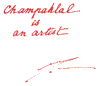
even wrote, "Champaklal is an artist." This
work was not as simple as it may appear. It took hours
of labour and ingenuity . At times, he had to make eight
or ten such cards in one day. Can one imagine that he
did this work, besides other things, for thirty years
or more? On Champaklal's birthday in 1964, the Mother
wrote:
To Champaklal
The great doer of cards
This card is to tell him my appreciation of all what
he has done and my expectation for still better things
to come .
Again, the next year the Mother asked: 2.2.1965
Champaklal, master of the " cards " , how
to prepare a card for you ?
|