The
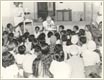
Mother taking
Class in playground
|
Vigilance
is the way that leads to immortality(or Nirvana).
Negligence is the way that leads to death. Those negligent
not die. Those who are who are vigilant do not die.
Those who are negligent are dead already.
|
In
these texts the word Nirvana is not used in the sense of
annihilation, as you see, but in the sense of an eternal
existence in opposition to life and death, as we know them
in the present earthly existence, and which are to contrary
to each other: life contrary to death, death contrary to
life. It is not that life which is spoken of, but the eternal
existence which is beyond life and death - the true existence.
Vigilance means to be awake, to be on ones guard, to
be sincere - never to be taken, by surprise. When you want
to do sadhana, at each moment Of your life, there is a choice
between taking a step that leads to the goal and falling
asleep or sometimes even going backwards, telling Yourself,
Oh, later on, not immediately" - sitting down on the
way.
To be vigilant is not merely resist what pulls you
downwards, but above all to be alert in order not to lose
any opportunity to progress, any opportunity to overcome
a weakness, to, resist a temptation, any opportunity to
learn something, to correct something, to master something.
If you are vigilant, you can do in a few days what would
otherwise take years. If you are vigilant, you change each
circumstance of your life, each action, each movement into
an occasion for coming nearer the goal.
There are two kinds of vigilance, active and passive.
There is a vigilance that gives you a warning if You are
about to make a wrong choice, if you are about to make a
mistake, if you are making a wrong choice, if you are being
weak or allowing yourself to be tempted, and there is the
active vigilance which seeks an opportunity to progress,
seeks to utilise every circumstance to advance quickly.
There is a difference between preventing yourself from
falling and advancing more quickly.
And both are absolutely necessary.
He who is not vigilant is already dead. He has lost
contact with the true purpose of existence and of life.
So the hours, circumstances, life pass in vain, bringing
nothing, and you awake from your somnolence in a hole from
which it is very difficult to escape.
17
January 1958
TOP

|
Having
fully understood what vigilance is, the sages delight
in it and take their pleasure in the presence of the
Great Ones.
|
Throughout
this teaching there is one thing to be noticed; it is this:
you are never told that to live well, to think well, is
the result of a struggle or of a sacrifice; on the contrary
it is a delightful state which cures all suffering. At that
time, the time of the Buddha, to live, a spiritual life
was a joy, a beatitude, the happiest state, which freed
you from all the troubles of the world, all the sufferings,
all the cares, making you, happy, satisfied, contented.
It is the materialism of modem times that has turned
spiritual effort into a hard struggle and a sacrifice, a
painful renunciation of all the so-called joys of life.
This insistence on the exclusive reality of the physical
world, of physical pleasures, physical joys, physical possessions,
is the result of the whole materialistic tendency of human
civilisation. It was unthinkable in ancient times. On the
contrary, withdrawal, concentration, liberation from all
material cares, consecration to the spiritual joy that was
happiness indeed.
From this point of view it is quite evident that humanity
is far from having progressed; and those who were born into
the world in the centres of materialistic civilisation have
in their subconscient
this horrible notion that only material realities are real
and that to be concerned with things that are not material
represents a wonderful spirit of sacrifice, an almost sublime
effort. Not to be preoccupied from dawn to dusk and from
dusk to dawn with all the little physical satisfactions,
Physical pleasures, physical sensations, physical preoccupations
is to bear evidence of a remarkable spirit. One is not aware
of it, but the whole of modern civilisation is built on
this conception: "'Ah, what you can touch, you are sure
that is true; what you can see, you are sure that is true;
what you have eaten, you are sure of having eaten it; but
all the rest - pooh ! We are not sure whether they are not
vain dreams and whether we are not giving up the real for
the unreal, the substance for the shadow. After all, what
are you going to gain ? A few dreams ! But when you have
some coins in your pocket, you are sure that they are
there !"
And that is everywhere, underneath everything. Scratch
a appearances just a little, it is there, within your consciousness;
and from time to time-you hear this thing whispering' within
you, "Take care, don't be taken in." Indeed, it is lamentable.
We have been told that evolution is progressive and
that it follows a spiral of ascending progression. I do
not doubt that what one calls comfort in modem cities is
a much higher degree of evolution than the comfort of the
cave-man, But in ancient narratives, they always spoke of
a power of foresight, of the prophetic spirit, the announcement
of future events through visions, life's intimacy with something
more subtle that had for the simple people of that age a
more concrete reality.
Now, in those beautiful cities that are so comfortable,
when one wants to condemn anything, what does one say ?
- "It’s a dream, it is imagination."
And precisely, if a person lives in an inner perception,
people look at him slightly askance and wonder whether he
is altogether mentally sound. One who does not pass his
time in striving for wealth or in trying to increase his
comforts and well-being, to
secure a good position and become an important person, a
man who is not like that is mistrusted, People wonder whether
he is in his right mind.
And all that is so much the stuff of the atmosphere,
the content of the air you breathe, the orientation of the
thoughts received from others that it seems absolutely natural.
You do not feel that it is a grotesque monstrosity.
To become a little more conscious of oneself, to enter
into relation with the life behind the appearances, does
not seem to you to be the greatest good. When you sit in
a comfortable chair, in front of a lavish meal, when you
fill your stomach with delicious dishes that certainly appears
to you much more concrete and much more interesting. And
if you look at the day that has passed, if you take stock
of your day, if you have had some material advantage, some
pleasure, a physical satisfaction, you s a good day; but
if you have received a good lesson from life, if it has
given you a knock on your nose to tell you that you are
a stupid fellow, you do not give thanks to the Grace, you
say, "Oh, life is not always fun !"
When I read these ancient texts, I really have the
impression that from the inner point of view, from the point
of view of the true life, we have fallen back terribly and-
that for the acquisition of a few ingenious mechanisms,
a few encouragements to physical laziness, the acquisition
of instruments and gadgets that lessen the effort of living,
we have renounced the reality of the inner life. It is that
sense which has been lost and it needs an effort for you
to think of learning the meaning of life, the purpose of
existence, the goal towards which we must advance, towards
which all life advances, whether you want it or not. One
step towards the goal, oh ! it needs so much effort to do
that. And generally one thinks of it only when the outer
circumstances are not pleasant.
How far we are from the times when the shepherd, who
did not go to school and kept watch over his flock at night
under the stars, could read in the stars what was going
to happen, commune expressed
itself through Nature, and moon with something, which had
the sense of the profound beauty and that peace which simple
life gives !
Its is very unfortunate that one has to give up one
thing in order to gain another. When I speak of the inner
life, I am far from opposing any modern inventions, far
from it, but hot much these inventions have made us artificial
and stupid! much we have lost the sense of true beauty,
how much we burden ourselves with useless needs !
Perhaps the time has come to continue the ascent in
the curve Of the spiral and now with all that this knowledge
matter has brought us, we shall be able to give to our spiritual
progress a more solid basis. Strong with what we have learnt
the secrets of material Nature, we shall be able to join
the two extremes and rediscover the supreme Reality in the
very heart of the atom.
24
January 1958
TOP
|
Those
who are intelligent, meditative, persevering, who
ceaselessly struggle with themselves, attain
to Nirvana, which is the supreme felicity.
Whosoever
can sustain his zeal, remain pure in his actions,
act wisely, restrain his passions, live according
to the Law ( or to morality), he shall see his renown
increase.
|
This
promise of a good name does not seem to quite worthy of
the e Buddhist teaching. It probably meant something else.
And to live according to morality, one must know which
mortality is intended, for if it is the usually recognised
social morality, that also does not seem to me a very
alluring promise. Those who have decided to abandon all
worldly weaknesses certainly do not care about satisfying
social morality nor about acquiring a good name!
To sustain one's zeal is an excellent thing, to remain
pure in one's actions is also indispensable, to act wisely
is also perfect, one cannot do it too often; to restrain
one's passions, that goes without saying, is the beginning...
but that conclusion !!
However I see "Dhamma" has been translated here as
"Law", and "Yasa" as "renown" whereas Dhamma should mean
rather the inner truth and Yasa the spiritual glory. So
we can interpret the text in this way: "Whosoever can
sustain his zeal, remain pure in his actions, act wisely,
restrain his passions, live according to the inner truth,
he shall see his spiritual glory ever growing.”
Thus understood, this text is quite excellent. One
cannot do better than to conform to it.
31
January 1958 and
7 February 1958
TOP
|
By
his effort, his vigilance, his discipline and
self-mastery, the intelligent man should create
for himself an island, which no flood can
submerge
The
fools, devoid of intelligence, give themselves
up to negligence. The true sage guards vigilance
as his most precious treasure.
Do
not let yourself fall into carelessness, nor into
the pleasures of the senses. He who, is
vigilant and given to meditation acquires
a great happiness.
The
intelligent man who by his vigilance has dispelled
negligence, mounts to the heights of wisdom
whence he looks upon the many afflicted as one
on a mountain looks down upon the people of the
plain.
Vigilant
among those who are negligent, perfectly awake
among those who sleep, the intelligent man advances
like a rapid steed leaving behind a weary horse.
Vigilance
is admired. Negligence is reproved. By vigilance,
Indra become the highest among the gods.
The
Bhikkhu who delights in vigilance and who shuns
negligence advances like a fire consuming all
bonds, both small and great.
The
Bhikkhu who takes pleasure in vigilance and who
shuns negligence can no longer fall. He draws
near to Nirvana.
|
I
have read out to you the whole chapter because it seemed
to me that it is the totality of the verses that creates
an atmosphere and that they are meant to be taken all
together and not each one separately. But I strongly
recommend to you not to take the words used here in
their usual literal sense.
Thus,
for example, I am quite convinced that the original
thought did not mean that you are to be vigilant in
order that you may be admired and that you must not
be negligent in order not to be reproved. Besides, the
example given proves it, for certainly it was not for
the sake of gaining admiration that Indra, the chief
of the overmental gods in the Hindu tradition, practised
vigilance. It is a very childish way of saying things.
Yet, if you take these verses all together, they have
by their repetition and insistence, a power that evokes
the thing which seeks expression; it puts you in relation
with a psychological attitude which is very useful and
has a very considerable effect, if you follow this discipline.
The
last two verses particularly are very evocative. The
Bhikku moves forward like a burning flame of aspiration
and he shuns negligence.
Negligence
truly means the relaxation of the will which makes
one forget his goal and pass his time in doing all kinds
of things which, far from contributing towards the goal
to be attained, stop you on the path and often turn
you away from it. Therefore the flame of aspiration
makes the Bhikku shun negligance. Every moment he remembers
that time is relatively short, that one must not waste
it on , the way, one must go quickly, as quickly
as possible, without losing a moment. And one who is
vigilant, who does not waste his time, sees his bonds
falling, every one, great and small; all his difficulties
vanish, because of his vigilance; and if he persists
in his attitude, finding in it entire satisfaction,
it happens after a time that the happiness he feels
in being vigilant becomes so strong that he would soon
feel very unhappy if he were to lose this vigilance.
It is a fact that when one has made an effort not to
lose time On the way, any time lost becomes a suffering
and one can find no pleasure of any kind in it. And once
you are in that state, once this effort for progress and
transformation becomes the most important thing in your
life, the thing to which you give constant thought, then
indeed you are on the way towards the eternal existence,
the truth of your being.
Certainly there is a moment in the course of the inner
growth when far from having to make an effort, to concentrate,
to become absorbed in the contemplation and the seeking
of the truth and its best statement - what the Buddhists
call meditation you feel, on the contrary, a kind of relief,
ease, rest,
joy, and to have to come out of that in order to deal
with things that are not essential, everything that may
seem like a waste of time, becomes terribly painful. External
activities get reduced to what is absolutely necessary,
to those that are done as service to the Divine. All that
is futile, useless, precisely those things which seem
like a waste of time and effort, all that, far from giving
the least satisfaction, creates a kind of discomfort and
fatigue; you feel happy only when you are concentrated
on your goal.
Then
you are really on the way.
14
February 1958
TOP
|



























 Search
Engine
-
Search
Engine
-