The
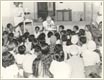
Mother taking
Class in playground
|
He
whose victory has never been surpassed nor even
equalled - which path can lead to Him, the Pathless,
the -Awakened One who dwells within the Infinite
?
One
in whom there is neither greed nor desire, how
can he be led astray ? Which path can lead to Him,
the Pathless, the Awakened One who dwells within
the Infinite ?
Even
the gods envy the sages given to meditation, the
Awakened Ones, the Vigilant who live with delight
in renunciation and solitude.
It
is difficult to attain to human birth. It is difficult
to live this mortal life. It is difficult to
obtain the good fortune of hearing the True
Doctrine. And difficult indeed is the advent
of the Awakened Ones.
Abstain
from evil,. cultivate good and purify your mind.
This is the leaching of the Awakened Ones.
Of
all ascetic practices patience is the best, of all
states the most perfect is Nirvana, say -the Awakened
Ones. He who harms others is not a monk. He who
oppresses others is not a true aycetic.
Neither
to offend, nor to do wrong to anyone, to practice
discipline according to the Law, to be moderate
in eating, to live in seclusion, and to merge oneself
in the higher consciousness, this is the teaching
of the Awakened Ones.
Even
a rain of gold would not be able to quench the
thirst of desire, for It is insatiable and the
origin of sorrows. This the sage knows.
Even
the pleasures of heaven are without savour for
the sage. The disciple of the Buddha, of the Perfectly
Awakened One, rejoices only in the, extinction
of all desire.
Impelled
by fear, men seek refuge in many places, in the
mountains, in the forests, in the groves, in sanctuaries.
But
this is not a safe refuge; this is not the supreme
refuge. Coming to this refuge does not save a man
from all sufferings.
One
who takes refuge in the Buddha, in the Dhamma l
and the Sangha 2 , with
perfect knowledge, perceives the Four Noble
Truths.
Suffering,
the origin of suffering, the cessation of suffering
and the Noble Eightfold Path which leads to cessation
of suffering.
In
truth, this is the sure refuge, this is the sovereign
refuge. To choose this refuge is to be liberated
from all suffering.
It
is difficult to meet the Perfectly Noble One.,
a
being is not born, everywhere. And where such a
sage is born, those around him live in happiness.
Happy
is the birth of the Buddhas, happy the teaching of
the true Law. Happy is the harmony of the Sangha,
happy the discipline of the United.
One
cannot measure the merit of the man who reveres
those who are worthy of reverence, whether the
Buddha or his disciples, those who are free from
all desire and all error, those who have overcome
all obstacles and who have crossed beyond suffering
and grief.
|
This
concerns the Four Truths and the Eightfold Path that lead
to the annihilation of suffering. Here are the details given
in the text:
The
Four Noble Truths are:
(1) Life - taken in the sense of ordinary life, the
life of ignorance and falsehood - is indissolubly linked
with suffering: suffering of the body and suffering of the
mind.
(2) The cause of suffering is desire, which is
caused by ignorance of the nature of separative life.
(3) There is a way to escape from suffering, to put
an end to pain.
(4) This liberation is obtained by following the discipline
of the Eightfold Path which gradually purifies the mind
from the Ignorance. The fourth Truth is called the method
of the Eight-fold Path.
The
Noble Path consists in a training in the following eight
stages:
(1) Correct seeing. To see things as they
are, that is to say, a pure, accurate vision, the best vision.
Three conditions characterise existence: pain, impermanence,
the absence of a fixed ego. So the Dhammapada says. But
it is not quite that, it is rather the absence of a fixed,
durable and separate personality in the psychological aggregate,
the lack of a true continuity in the personal consciousness.
It is for this reason that, for example, in the ordinary
state one cannot remember one's past lives nor have the
sense of a conscious continuity through all one's-lives.
The first point then is, to see correctly, and to see
correctly is to see that pain is associated with ordinary
life, that all things are impermanent and that there is
no continuity in the personal consciousness.
(2) Correct intention or desire. But the same
word "desire" should not have been used, because we have
just been told that we should not have desire. It is rather
"correct aspiration". The word "desire" should be replaced
by "aspiration".
"To be freed from attachments and to have kind thoughts
for everything that exists." To be constantly in a state
of kindness. To wish the best for all, always.
(3) Correct speech that hurts none. Never
speak uselessly and scrupulously avoid all malevolent speech.
(4) Correct behaviour - peaceful, honest. From
all points of view, not only materially, but morally, mentally.
Mental honesty is one of the most difficult things to achieve.
(5) Correct way of living. Not to cause harm or
danger to any creature. This is relatively easy
to understand. There are people who carry this principle
to the extreme, against all common sense. Those who put
a handkerchief to their mouths, for example, so as not to
swallow germs, who have the path in front of them swept
so as not to step on an insect. This seems to me a little
excessive, because the whole of life, as it is at present
is made up of destruction. But if you understand the text
correctly, it means that one must avoid all possibility
of doing harm, one must not deliberately endanger any creature.
You can include here all living creatures and if you extend
this care and this kindness to everything that lives in
the universe, it will be very favourable to your inner growth.
(6) Correct effort. Do not make useless efforts
for useless things, rather keep all the energy of your effort
to conquer ignorance and free yourself from falsehood. That
you can never do too much.
(7) The seventh principle comes to confirm the
sixth: correct vigilance. You must have an active
and vigilant mind. Do not live in a half-somnolence, half-unconsciousness
- usually in life you let yourself go, come what may I This
is what everyone does. Now and then you wake up and you
realise that you have wasted your time; then you make a
big effort only to fan back again, a minute later, into
indolence. It would be better to have something less vehement
but more constant.
(8) And finally, correct contemplation. Egoless
thought concentrated on the essence of things, on the inmost
truth and on the goal to be attained
How often there is a kind of emptiness in the course
of life, an unoccupied moment, a few minutes, sometimes
more. And what do you do ? immediately you try to distract
yourself, and you invent some foolishness or other to pass
your time. That is a common fact. All men, from the youngest
to the oldest, spend most of their time in trying not to
be bored. Their pet aversion is boredom and the way to escape
from boredom is to act foolishly.
Well,
there is a better way than that – to remember.
When you have a little time,- whether it is one hour
or a few minutes, tell yourself, "At last, I have some.
time to concentrate, to collect myself, to relive the purpose
of my life, to offer myself to the True and the Eternal."
If you took care to do this each time you are not harassed
by outer circumstances, you would find, out that you were
advancing very quickly on the path. Instead of wasting your
time in chattering, in doing useless things, reading things
that lower the consciousness - to choose only the best cases,
I am not speaking of other imbecilities which are much more
serious - instead of trying to make yourself giddy, to make
time, that is already so short, still shorter Only to realise
at the end of your life that you have lost three quarters
of your chance - then you want to put in double time, but
that does not work - it is better to be moderate, balanced,
patient, quiet, but never to lose an-opportunity that is
given to you,
that is to say, to utilise for the true purpose the unoccupied
moment before you.
When you have nothing to do, you become restless, you
run about, you meet friends, you take a walk, speak on of
the best; I am not referring to-things that are obviously
not to be done. Instead of that, sit down quietly before
the sky, before the sea or under trees, whatever is possible
(here you have all of them) and try to realise one of these
things to understand why you live, to learn how you must
live, to ponder over what you want to do and what should
be done, what is the best way of escaping from the ignorance
and falsehood and pain in which you live.
l
The True Doctrine.
2
The community; the order of the Great Ones and the order
of the monks.
16
May 1958
|



























 Search
Engine
-
Search
Engine
-