The
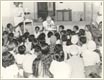
Mother taking
Class in playground
|
We
should seek the company of the sage who shows us our
faults, as if he were showing us a hidden treasure;
it is best to cultivate relations with such a man
because he cannot be harmful to us. He will bring
us only good.
One who exhorts us to good and dissuades us from doing
evil is appreciated, esteemed by the just man and
hated by the unjust.
Do not seek the company or friendship of men of base
character, but let us consort with men of worth and
let us seek friendship with the best among men.
He who drinks directly from the source of the Teaching
lives happy in serenity of mind. The sage delights
always in the Teaching imparted by the noble disciples
of the Buddha.
Those who build waterways lead the water where they
want; those who make arrows straighten them; carpenters
shape their wood; the sage controls himself.
No more than a mighty rock can be shaken by the wind,
can the sage be moved by praise or blame.
The sage who has steeped himself in the Teaching, becomes
perfectly peaceful like a deep lake, calm and clear.
Wherever he may be, the true sage renounces all pleasures.
Neither sorrow nor happiness can move him.
Neither
for his own sake, nor for the sake of others does
the sage desire children, riches or domains. He does
not aim for his own success by unjust ways. Such
a man is virtuous, wise and just.
Few
men cross to the other shore. Most men remain
and do no more than run up and down along shore.
But those who live according to the Teaching cross
beyond the realm of Death, however difficult may be
the passage.
The sage will leave behind the dark ways of but
he will following the way of light. He will his
home for the homeless life and in solitude will
seek the joy which is so difficult to find.
Having
renounced all desires and attachments of the senses,
the sage will cleanse himself of all the taints
of the mind.
One
whose mind is well established in all the degrees
of knowledge, who, detached from all things delights
in his renunciation, and who has mastered his appetites,
he is resplendent, and even in this world he
attains Nirvana.
|
There
is a sentence here, which is particularly felicitous. It
is the very first sentence we have read, "We should seek
the company of the sage who shows our faults, as if he were
showing us hidden treasure."
In all Scriptures meant to help mankind to progress
, it is always said that you must be very grateful to those
who shows you your faults and so you must seek their company;
but the form used here is particularly felicitous: if a
fault is shown to you
it is as if a treasure were shown to you; that is to say,
each time that you discover in yourself a fault, incapacity,
lack of understanding, weakness, insincerity,. all that
prevents you from making a progress, it is as if
you discovered a wonderful treasure.
Instead of growing sad and telling yourself, "Oh, there
is still another defect", you should, on the contrary, rejoice
as if you had made a wonderful acquisition, because you
have just caught hold of one of those things that prevented
you from progressing. And once you have caught hold of it,
pull it out ! For those who practice a yogic discipline
consider that the moment you know that a thing should not
be, you have the power to remove it, discard it, destroy
it.
To discover a fault is an acquisition. It is as though
a flood of light had come to replace the little speck of
obscurity, which has just been driven out.
When you follow a yogic discipline, you must not accept
this weakness, this baseness, this lack of will, which means
that knowledge is not immediately followed by power. To
know that a thing should not be and yet continue to allow
it to be is such a sign of weakness that it is not accepted
in any serious discipline, it is a lack of will, that verges
on insincerity. You know that a thing should not be and
the moment you know it, you are the one who decides that
it shall not be. For knowledge and power are essentially
the same thing - that is to say, you must not admit in any
part of your being this shadow of bad will which is in contradiction
to the central will for progress and which makes you impotent,
without courage, without strength in the face of an evil
that you must destroy.
To sin through ignorance is not a sin; that is part
of the general evil in the world as it is, but to sin when
you know, that is serious. It means that there is hidden
somewhere, like a worm in the fruit, an element of bad will
that must be hunted out and destroyed, at any cost, because
any weakness on such a point is the source of difficulties
that sometimes, later on, become irreparable.
So then the first thing is to be perfectly happy when
someone or some circumstance puts you in the conscious presence
of a fault in yourself, which you did not know. Instead
of lamenting, you must rejoice and in this joy must find
the strength to get rid of the thing, which should not be.
21
March 1958
|




























 Search
Engine
-
Search
Engine
-