The
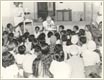
Mother taking
Class in playground
|
A
man is not just if he judges arbitrarily. The wise
man is one who distinguishes the just from the
unjust, who judges others in full knowledge
according to law and equity; this guardian
of the Law is called a just man.
The
sage is not the man who speaks most. The man who
is compassionate, friendly, fearless, is called a
sage,.
It is not by much speaking that the Doctrine
is upheld, but he who has studied the
Doctrine, even little, and mentally realised it, he
alone upholds it. He does not neglect it.
A
man is not a Thera1 because
his hair is grey. He is ripe in years but he has aged
fruitlessly.
But
one who possesses the truth, virtue, non-violence
and self-mastery, who is free from all impurity, who
is wise, is indeed a Thera.
Neither
eloquence nor a beautiful appearance grace a man who
is jealous, selfish, deceitful. But one in whom such
faults are completely uprooted and destroyed, that
wise man is fully graced by them.
As
for the man who is undisciplined and untruthful, his
shaven head does not make him an ascetic. Full of
desire and greed, how can he be a Samana ?
He
who is purged of all evil, both great and small, can
be called a Samana, for he is purified of all evil.
A
man is not a Bhikkhu simply because he takes alms
for his food. The observance of vows is not enough
to make him a Bhikkhu.
But
he who is above both good and evil, who leads a pure
life, who walks with understanding in this world,
he can be called a Bhikkhu.
One
who observes silence does not by that become a sage,
if he is ignorant and foolish, but he who can weigh
good and evil as in a balance and make his choice,
him one can call, a sage.
He
who by contemplation measures this world and the other,
he is a sage.
A
man who does harm to living creatures does not become
a Noble One. One who practises nonviolence towards
all creatures is called a Noble One.
It
is neither by moral precepts and observances, nor
by a wide knowledge, nor by practising meditation,
nor by a solitary life, nor by thinking, 'I have attained
the bliss of liberation which is unknown to those
who live in the world", that one can be called a Bhikkhu.
Be on your guard, 0 Bhikkhus, until you have attained
the extinction of all desire.
|
We
shall take the last text. It is an interesting one.
"It is neither by moral precepts and observances, nor
by a wide knowledge, nor by practising meditation, nor by
a solitary life, nor by thinking", that one attains the
true bliss; it is by getting rid of all desires. Certainly
it is not easy to get rid of all desires, it sometimes needs
a whole lifetime. But to tell the truth, it seems to be
a very negative way, although at a certain stage of development,
it is a discipline which it is very useful, even indispensable
to practice, if one does not want to deceive oneself. Because
at first you begin by getting rid of the major desires,
those that are most obvious and trouble you so much that
you cannot even have any illusions about them; then come
subtler desires that take the form of things that have to
be done that are necessary, even at times of commands from
within, and it requires time and much sincerity to discover
and overcome them; at last it seems as if you had done away
with these wretched desires in the material world, in external
things, in the world of feelings, in the emotions and sentiments,
in the mental world as regards ideas, and then you find
them again in the spiritual world, and there they are far
more dangerous, more subtle, more penetrating and much more
invisible and covered by such a saintly appearance that
one dare not call them desires.
And when one has succeeded in overcoming all that,
in discovering, dislodging and getting rid of them, even
then one has done only the negative side of the work.
The Buddha said or has been made to say that when one
is free from all desire, one necessarily enters into infinite
bliss. This bliss may be a little dry and anyway it does
not seem to me to be the quickest way.
If at the outset one were to seize the problem bodily,
jump into it with courage and determination and, instead
of undertaking a long, arduous, painful, disappointing hunt
after desires, one gives oneself simply, totally, unconditionally,
if one surrenders to the Supreme ' Reality, to the Supreme
Will, to the Supreme Being, putting oneself entirely in
His hands, in an upsurge of the whole being and all
the elements of the being, without calculating, that would
be the swiftest and the most radical way to get rid of the
ego. People will say that it is difficult to do it, but
at least warmth is there, an ardour, an enthusiasm, a light,
a
beauty, an ardent and creative life.
It is true that without desire nothing much remains
to sustain the ego and one has the impression that the consciousness
becomes so hardened that if the ego crumble into, dust,
then something of one's self also falls into, dust and one
is ready to enter into a Nirvana which is annihilation pure
and simple.
But what we consider here as the true Nirvana is the
disappearance of the ego into the splendour of the Supreme.
And this way is what I call the positive way, the self-giving
that is integral, total, perfect, without reserve, without
bargaining.
In the mere fact of not thinking of oneself, not existing
for oneself, referring nothing to oneself, thinking only
of what is supremely beautiful, luminous, delightful, powerful,
compassionate and infinite, there is such a profound delight
that nothing can be compared to it.
This is the only thing that deserves... that is worthy
of being attempted. All the, rest is only marking time.
The difference is between climbing a mountain by going
round and round, slowly, laboriously, step by step, for
hundreds of years, and spreading invisible wings and soaring
straight to the summit.
1 A senior monk.
20
June 1958
|


























 Search
Engine
-
Search
Engine
-