The
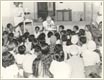
Mother taking
Class in playground
|
One
who speaks untruth goes to Hell like one who, when
he has done a thin , says: "I did not do it."
Both, after death, will share the same fate, for
these are men of evil.
Though
they wear the yellow robe, those who are dissolute
and evil-natured, their evil actions will cause
them to be reborn in Hell.
It
would be better to swallow a red-hot iron ball than
to live on alms while leading a dissolute life.
Four
punishments await the unscrupulous man who covets
the wife of another: shame, troubled sleep, condemnation
and Hell.
So
he acquires an evil reputation and an evil birth;
brief is the Pleasure of the anxious pair, heavy
the punishment of the lawgivers Let no man
therefore seek the wife of another.
Just,
as Kusa grass cuts the hand if wrongly handled,
so also asceticism wrongly understood leads to
Niraya.
A
duty carelessly fulfilled, a rule wrongly observed
and a virtuous life followed out of fear, none
of these will! bring good results.
If
a thing is to be done, do it
with zeal. An ascetic with lax habits will stir up
the dust (of the passions).
An
evil deed is better left undone, for he who does it
will be tormented by it. It is better, to do a good
deed, for he who does it will not have cause to repent
it.
As
a frontier city is well fortified both within and
without, so one should guard Oneself, so as not to
waste a single moment of wakefulness; for those who
lose this opportunity, even if only for a moment,
will suffer indeed for it when in Hell.
Those
who feel shame when there is no cause for, and those
who feel no shame when there is
cause
to be ashamed, the .se deluded ones are destined to
a painful state.
Those
who are afraid of what should not be feared, and those
who do not fear what is to be feared, these deluded
ones are destined to a painful state.
Those
who see evil, where there is none, and those who do
not see it where it is, these deluded ones are destined
to a painful state.
Those
who recognise evil to be evil, and good to he good,
these who have right judgment are bound to enjoy happiness.
|
As
in all these teachings there are always several ways of
understanding them. The external way is quite commonplace.
In all moral principles, the same thing is always said.
This Niraya for example, which some take as a kind of hell
where one is punished for one's sins, has also another sense.
The true sense Niraya is that particular kind of atmosphere
which one creates around oneself when one acts in contradiction,
not with out moral rules or social principles, but with
the inner law of one's being, the particular truth of each
one which ought to govern all the movements of our consciousness
and all the acts of our body. The inner law, the truth of
the being is the divine Presence in every human being, which
should be the master and guide of our life.
When you acquire the habit of listening to this inner
law, when you obey it, follow it, try more and more to let
it guide your life, you create around you an atmosphere
of truth and peace and harmony which naturally reacts upon
circumstances and forms, so to say, the atmosphere in which
you live. When you are a being of justice, truth, harmony,
compassion, understanding, of perfect goodwill, this inner
attitude, the more sincere it is, the more it reacts upon
the external and circumstances; not that it necessarily
diminishes the difficulties of life, but it gives these
difficulties a new meaning and that allows you to face them
with a new strength and a new wisdom; whereas the man, the
human being who follows his impulses, who obeys his desires,
who has no time for scruples, who comes to live in complete
cynicism, not caring for the effect that his life has upon
others or for the more or less harmful consequences of his
acts, creates for himself an atmosphere of ugliness, selfishness,
conflict and bad will which necessarily acts more and more
upon his consciousness and gives a bitterness to his life
that in the end becomes a perpetual torment.
Of course this does not mean that such a man will not
succeed in what he undertakes, that he will not be able
to possess what he desires; these external advantages disappear
only when there is within the inmost being a spark of sincerity,
which persists and makes him worthy of this misfortune.
If you see a bad man become unlucky and miserable,
you must immediately respect him. It means that the flame
of inner sincerity is not altogether extinguished and something
still reacts to his bad actions.
Finally, that leads us again to the observation that
you must never, never judge on appearances and that all
the judgments
you
make from outward circumstances are always, false judgments.
To have a glimpse of the Truth, one must take at least
one step back in one's consciousness, enter a little more
deeply into one’s being and try to perceive the play of
forces behind the appearances and the divine Presence behind
the play of forces.
25
JulY 1958
|




























 Search
Engine
-
Search
Engine
-