The
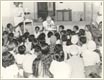
Mother taking
Class in playground
|
Among
those who hate, happy are
we to live without hatred. Among those
who. hate, let us live free from hatred.
Among
those who suffer, happy are we to live without
suffering. Among men who suffer, let us live free
from suffering.
Among
those who are full of greed, happy are we to live
without greed. Among the greedy, let us live free
from greed.
Happy
indeed are we who own nothing. We shall feed upon
delight like the radiant gods.
Victory
engenders enmity, and one who is vanquished lives
in distress. The man of peace lives in gladness,
disdaining both victory and defeat.
There
is no greater fire than lust, no greater misfortune
than hatred. There is no greater misery than existence,
no bliss greater than the Supreme Peace.
Hunger
is the worst malady; existence is the worst calamity.
One who has understood this realises that Nirvana
is the supreme Happiness.
Health
is the greatest acquisition, contentment the
greatest treasure. A faithful friend is the best
companion and Nirvana the Supreme Happiness.
Having
tasted the sweetness of solitude and the Supreme
Peace, a man is liberated from suffering and evil,
for he partakes of the sweetness of devotion to
the Truth.
It
is good to contemplate the Noble Ones,
to live near them is an endless happiness. One could
be always happy by avoiding the sight of fools.
One
who frequents fools is bound to suffer long; the
company of fools is as painful as that of enemies.
To live in the company of the sages is to share
the happiness of one who lives among his kinsmen.
Seek
therefore the company of the sage who is steadfast,
learned, wise, devoted and noble. Follow the example
of such a good and wise being, as the moon follows
the path of the stars.
|
One
of these verses is very beautiful. We could translate it
like this: "Happy is he who possesses nothing, he will partake
of the delight of the radiant gods." To possess nothing
does not at all mean not to make use of anything, not to
have anything at one's disposal. "Happy is he who possesses
nothing'.': he is someone who has no sense of possession,
who can make use of things when they come to him, knowing
that they are not his, that they belong to the Supreme,
and who, for the same reason, does not regret it when things
leave him; he finds it quite natural that the Lord who gave
him these things should take them away from him for others
to enjoy. Such a man finds equal joy in the use of things
as in the absence of things. When you have them at your
disposal, you receive them as a gift of Grace and when they
leave you, when they have been taken away from you, you
live in the joy of destitution. For it is the sense of ownership
that makes you cling to things, makes you their slave, otherwise
one could live in constant joy and in the ceaseless movement
of things that come and go and pass, that bring with
them both the sense of fullness when they are there and,
when they go, them, delight of detachment.
Delight ! Delight means to live in the Truth, to live
in communion with Eternity, with the true Life, the Light
that n( fails. Delight means to be free, free with the true
Freedom, Freedom of the constant, invariable union with
the Divine Will.
Gods are those that are immortal, who are not bound
to vicissitudes of material life in all its narrowness,
pettiness, reality and falsehood.
Gods are those who are turned to the Light, who live
in the Power and the Knowledge; that is what the Buddha
means, ho does not mean the gods of religion. They are beings
who have the divine nature, who may live in human bodies,
but free from ignorance and falsehood.
When you no longer possess anything, you can become
as vast as the universe.
23
May 1958
|


























 Search
Engine
-
Search
Engine
-