The
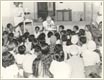
Mother taking
Class in playground
|
Hasten
towards the good, leave behind all evil thoughts,
for to do good without enthusiasm is to have a mind,
which delights in evil.
If
one does an evil action, he should not persist in
it, he should not delight in it. For full of suffering
is the accumulation of evil.
If
one does a good action, he should persist in it and
take delight in it- Full of happiness is the accumulation
of good.
As
long as his evil action has not yet ripened, an evildoer
may experience contentment. But when it ripens,
the Wrongdoer knows unhappiness.
As
long as his good action has not Yet ripened, one
who does good May experience unhappiness. But when
it ripens, the good man knows happiness.
Do
not treat evil lightly, saying, "That will not touch
me". A jar is filled drop by drop; even so the
fool fills himself little by little with wickedness.
Do
not treat good lightly, saying, "That will not touch
me". A jar is filled drop by drop; even so the
sage fills himself little by little with goodness.
The
merchant who is carrying many precious goods and
who has but few companions, avoids dangerous
roads,
and a man who loves his life is wary
of poison. Even so should one act regarding
evil.
A
hand that has no wound can carry poison with impunity,
act likewise, for evil cannot touch the righteous
man.
If
you offend one who is pure, innocent and defenceless,
the insult will fall back on you, as if you threw
dust against the wind.
Some
are reborn here on earth, evil-doers go to the
worlds of Niraya,l the
just go to the heavenly worlds, but those who
have freed themselves from all desire attain
Nirvana.
Neither
in the skies, nor in the depths of the ocean,
nor in the rocky caves, nowhere upon earth does
there exist a place where a man can find refuge
from his evil actions.
Neither
in the skies, nor in the depths of the ocean,
nor in the rocky caves, nowhere upon earth does
there exist a place where a man can hide from
death.
|
People
have the habit of dealing lightly with thoughts that come.
And the atmosphere is full of thoughts of all kinds which
do not in tact belong to anybody in particular, which move
perpetually from one person to another, very freely, much
too freely, because there are very few people who can keep
their thoughts under control.
When you take up the Buddhist discipline to learn how
to control your thoughts, you make very interesting discoveries.
You try to observe your thoughts. Instead of letting them
pass freely,
sometimes even letting them enter your head and establish
themselves in a quite inopportune way, you look at them,
observe them and you realise with stupefaction that in the
space of
a few seconds there passes through the head a series of
absolutely improbable thoughts that are altogether harmful.
You believe you are so good, so kind, so well disposed
and always full of good feelings. You wish no harm to anybody,
you wish only good - all that you tell yourself complacently.
But if you look at yourself sincerely as you are g, you
notice that you have in your head a collection of thoughts
which are sometimes frightful and of which you were not
at all aware.
For example, your reactions when something has not
pleased you: how eager you are to send your friends, relatives,
acquaintances, everyone, to the devil! How you wish them
all kinds of unpleasant things, without even being aware
of it'! And how you say, "Ah, that will teach him to be
like that!" And when you criticise, you say, "He must be
made aware, of his faults." And when someone has not acted
according to your ideas, you say, "He will be punished for
it!" and so on.
You do not know it because you do not look at yourself
in the act of g. Sometimes you know it, when it becomes
a little too strong. But when the thing simply passes through,
you hardly notice it -it comes, it enters, it leaves. Then
you find out that if you truly want to be pure and wholly
on the side of the Truth, then that requires a vigilance,
a sincerity, a self-observation, a self-control which are
not common. You begin to realise that it is difficult to
be truly sincere.
You flatter yourself that you have nothing but good
feelings and good intentions and that whatever you do, you
do for the sake of what is good -yes, so long as you are
conscious and have control, but the moment you are not very
attentive, all kinds of things happen within you of which
you are not at all conscious and which are not very pretty.
If you want to clean your house thoroughly, you must
be vigilant for a long time, for a very long time and especially
not believe that you have reached the goal, like that, at
one stroke, because one day you happened to decide that
you would be on the right side. That is of course a very
essential and important point, but it must be followed by
a good many other days when you have to keep a strict guard
on yourself so as not to belie your resolution.
1
Hell; the state of suffering.
4
April 1958
|




























 Search
Engine
-
Search
Engine
-