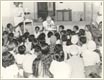
The
Mother taking
Class in playground
|
No
sorrow exists for one who has completed his journey,
who has let fall all cares, who is free in all his
parts,
who has cast off all bonds.
Those
who are heedful strive always and, like swans
leaving their lakes, leave one home after another.
Those
who amass nothing, who eat moderately, who have
Perceived the emptiness of all things and who
have attained unconditioned liberation, their path
is as difficult to trace as that of a bird in the
air.
One
for whom all desires have Passed away and who
has perceived the emptiness of all things, who
cares little for food, who has attained unconditioned
liberation, his path is as difficult as that of trace
as that of a bird in the air.
Even
the Gods esteem one whose senses are controlled
as horses by the Charioteer one who is purged of
a[, Pride and freed from all Corruption.
One
who fulfils his duty is as immovable as the earth
itself. He is as firm as a celestial pillar, pure
as an unmuddied lake. and for him the cycle
of births is completed.
Calm
are the thoughts, the words and the acts of one
who has, liberated himself by the true knowledge
and has achieved a perfect tranquillity.
The
greatest among men is he who is not credulous but
has the sense of the Uncreated, who has cut, an
ties, who has destroyed all occasion for rebirth.
Whether
village or forest, plain or mountain, wherever the
adepts may dwell, that place is always delightful.
Delightful
are the forests which are shunned by the multitude.
There, the adept who is free from passion, will find
happiness, for he seeks not after pleasure.
|
There
is a very interesting sentence here: "He who is not credulous
but has the sense of the Uncreated......"
One
who is not credulous -all kinds of things understood from
this word. The first impression is that it to one who does
not believe in invisible things without having an experience
of them as distinct from people who follow, for example,
a particular religion and have faith in dogmas because that
is what they have been taught. But he "has sense of the
Uncreated', that is to say, he is in contact with invisible
things and knows them as they are, by identity Dhammapada
has told us, to begin with, that the greatest of men is
he who has no faith in what is taught but has personal experience
of things that are not visible, he who is free from all
belief and has himself has the experience by identity.
Another explanation can also be given: one who is not
credulous is he who does not believe in the reality of appearances,
in things as we see them, who does not take them for the
truth, who knows that these are misleading appearances and
that behind them lies a truth that is to be found and known
by personal experience and by identity.
And this makes one reflect on the number of things,
the countless number of things that we believe without any
personal knowledge, simply because we have been taught they
are like that, or because we are accustomed to think like
that, or because we are surrounded by people who believe
that
things are like that. If we look at all the things that
we believe and not only believe but assert with an indisputable
authority, "This is like this", "That, but of course it
is like that",
"And
this thing, yes, it is so...... In truth, however, we nothing
about it, it is simply because we are in the habit of thinking
that they are like that. What are the things that you have
experienced personally, with which you have had a direct
contact, of which you can at least say with sincerity, "I
am convinced that it is like that, because I have experienced
it" ? Not many.
In reality, if you truly want to have knowledge, you
must begin by making a very important study: verify the
things that we have been taught, even the most common and
the. most insignificant. Then you will understand why the
text says"the greatest among men", because I do not think
that many have, made this experiment.
Just to find out the number of things we believe and
assert, simply because it is customary to believe and assert
them, is indeed a very interesting discovery.
Now go and look into your thought and consciousness
for all the things that you assert without proof. You will
see !
28
March 1958
|



























 Search
Engine
-
Search
Engine
-