The
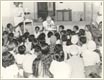
Mother taking
Class in playground
Every
Friday I shall read out to you a few verses of the Dhammapada,
then we shall meditate on that text. This is to teach you
mental control. If I think it necessary I shall give you
an explanation.
The Dhammapada begins with conjugate verses; here is
the first one:
|
In
all things the primordial element is mind. Mind
predominates. Everything proceeds from mind.
|
Naturally,
this concerns, the physical life, there is no question of
the universe.
|
If
a man speaks or acts with an evil mind, suffering
follows him as the wheel follows the hoof of the
bullock that pulls the cart.
|
That
is to say, ordinary hum an life, such as it is in the present
world is ruled by the mind; therefore the most important
thing is to control one's mind; so we shall follow a graded
or "conjugate" discipline, to use the Dhammapada's statement,
in order to develop and control our minds.
There are four movements which are usually consecutive,
but which in the end may be simultaneous: to observe one's
thoughts is the first, to watch over one's thoughts is the
second, to control one's thoughts is the third and to master
one's thoughts is the fourth. To observe, to watch over,
to control, to master. All that to get rid of an evil mind,
for we are told that the man who acts or speaks with an
evil mind is followed by suffering as closely as the wheel
follows the hoof of a bullock that ploughs or draws the
cart.
This is our first meditation.
30
August 1957
Top

|
Mind
predominates. Everything proceeds from mind. In all
things the primordial element is the mind. If a man
Speaks or acts with a purified mind, happiness accompanies
Him as closely as his inseparable shadow.
|
This is the counterpart of what we read last time.
The Dhammapada contrasts a purified mind with an evil mind.
We have already said that there are four successive stages
for the purification of the mind. A purified mind is naturally
a mind that does not admit any wrong thoughts and we have
seen that the complete mastery of thought, which is required
to gain this result, is the last achievement in the four
stages I have spoken of. The first is: to observe one's
mind.
Do not believe that it is such an easy thing, for to
observe your thoughts, you must first of all separate yourself
from them. In the ordinary state, the ordinary man does
not distinguish himself from his thoughts. He does not even
know that he thinks. He thinks by habit. And if he is asked
all of a sudden, "What are you thinking of?” he knows nothing
about it. That is to say, ninety-five times out of a hundred
he will answer, "I do not know”. There is a complete identification
between the movement of thought and the consciousness of
the being.
To observe the thought, the first movement then is
to step back and look at it, to separate yourself from your
thoughts so that the movement of the consciousness and that
of thought may not be confused. Thus when we say that one
must observe one's thoughts, do not believe that it is so
simple; it is the first step. I suggest that this evening
in our meditation we take up this first exercise which consists
in standing back from one's thought and looking at it.
6
September 1957
Top

|
"He
has insulted me, he has beaten me, he has humiliated
me he has robbed me." Those who nourish thoughts such
as these never appease their hatred.”
|
The Dhammapada tells us first of all that bad thoughts bring
about suffering and good thoughts bring about happiness.
Now it gives examples of what bad thoughts are and tells
us how to avoid suffering. Here is the first example, I
repeat- "He has insulted me, he has beaten me, he has humiliated
me, he has robbed me"; and it adds: "Those who nourish thoughts
such as these never appease -their hatred."
We have begun our mental discipline, basing ourselves
on the successive stages of mental development and we have
seen that this discipline consists of four consecutive movements,
which we have described in this way, as you surely remember:
to observe, to watch over, to control and to master; and
in the course of the last lesson we have learnt - I hope
- to separate ourselves from our thoughts so as to be able
to observe them as an attentive spectator.
Today we have to learn how to watch over these thoughts.
First you look at them and then you watch over them. Learn
to look at them as an enlightened judge so that you may
distinguish between the good and the bad, between thoughts
that are useful and those that are harmful, between constructive
thoughts that lead to victory and defeatist thoughts, which
turn us away from it. It is this power of discernment that
we must acquire now; that will be the subject of our meditation
tonight.
As I have told you, the Dhammapada will give us examples,
but examples are only examples. We must ourselves learn
how to distinguish thoughts that are good from those that
are not, and for that you must observe, as I have said,
like an enlightened judge - that is to say, as impartially
as possible; it is one of -the most indispensable conditions.
13 September 1957
Top
|
"He
has insulted me, he has beaten me, he has humiliated
me, he has robbed me”.
|
Those who do not nourish thoughts such as these foster
no hatred.
This is the counterpart of what we read the other day.
But note that this concerns only thoughts that generate
resentment. It is because rancour, along with jealousy,
is one of the most widespread causes of human misery.
But how to avoid having rancour ? A large and the best
means, but that is not within the reach of all. Controlling
one’s thoughts may be of more general use.
Thought control is the third step of our mental discipline.
Once the enlightened judge of our consciousness has distinguished
between useful and harmful thoughts, the inner guard will
come and allow to pass only approved thoughts, strictly
refusing admission to all undesirable elements.
With a commanding gesture the guard will refuse
entry bad thought and push it back as far as possible.
It is the movement of admission and refusal
that we call thought-control and this will be the subject
of our meditation tonight.
20 September 1957
Top
|
For,
in truth, in this world hatred is not appeased by
hatred; hatred is appeased by love alone. This is
the eternal law.
|
This is one of the most celebrated verses Of the Dhammapada,
one of the most often cited – I would have liked to be
able to say, "One Of the most obeyed in the world"; unfortunately
that would not be true. For people speak much of this
teaching but do not follow it.
Yet, there is one aspect of the problem which is less
spoken of but which seems perhaps more urgent still if you
want things to change in the world, something to which people
give very little thought.
I
am going to surprise you. It is this: if love must
be returned hatred in order that the world may change, would
it not be even more natural that love should be returned
for Love?
If one considers the life and action and heart of men
as they are, one would have every right to be surprised
at all the hatred, contempt, or at best, the indifference
which are returned for this immensity of Love which the
divine Grace pours upon the world, for this immensity of
Love which acts upon the world at every second to lead it
towards the divine delight and which finds so poor a response
in the human heart. But people have compassion only for
the wicked, the deficient, the misshapen, for the unsuccessful
ones and the failures - truly it is an encouragement to
wickedness and failure.
If one thought a little more of this aspect of the
problem, perhaps one would have less need to insist on the
necessity of returning love for hatred, because if the human
heart responded in all sincerity to the Love that is being
poured into it with the spontaneous gratitude of a love
which understands and appreciates, then things would, change
quickly in the world.
27 September 1957
Top
|
Many
are those who are not aware that one day we all
must die. And those who are aware of it appease
their quarrels.
|
When
you think you may die the next moment, immediately, automatically,
there occurs in you a detachment from all material things;
it is logical that from then on you think only of what does
not depend upon this physical life and which is the only
thing that will still belong to you once you have left this
body, that is to say, the eternal existence. The Buddha
did not use the word "Divine", but it is essentially the
same thing.
To think that one might die, the next moment was formerly,
in
the ancient initiations, a discipline that one had to follow
for a certain time, for the reason I have just In mentioned
and also in order to overcome all fear of death and accustom
oneself to it. In that age and at that time when the Buddha
spoke the Dhammapada, the possibility of an earthly immortality
was never mentioned because this possibility belonged to
such a far-off future that there would have been no point
in speaking of it.
Today Sri Aurobindo tells is that this possibility
is near at hand and that we have only to prepare for it.
But the essential condition even to prepare for it is to
completely abolish all fear of death.
You must neither dear it nor desire it.
Stand above it, in an absolute tranquility, neither
fear it nor desire it.
4 October 1957
Top
|
Just
as the string wind uproots a feeble tree, so Mara
Overwhelms the man who lives only in pursuit of pleasure,
Who does not control is senses, who knows not how
to Moderate his appetite, who is lazy and wastes
his energies.
|
In
Buddhist literature, Mara represents the Sprit of Evil,
all that is contrary or opposed to spiritual life; in certain
cases he represents death – not so much physical death as
death to truth, to the spiritual being.
Here it means that so long as one does not control
one’s senses and desires, and concerns oneself with the
external material satisfactions as the most important thing,
once has not the will necessary to resist the attack of
hostile forces and all that pulls us down and leads away
from the spiritual reality.
The Dhammapada does not take its stand so much on the
moral point of view; it is not
evil as men understand it with their blind justice and,
their arbitrary sense of good and bad. Evil, a certain time,
from the spiritual point of view, is truly that which leads
us away from the goal, which sometimes even tears us away
from the deepest purpose of our existence, from the truth
of our being and prevents us from realizing it.
This
is the way in which it should be understood.
11 October 1957
Top
|
Just
as the string wind uproots a feeble tree, so Mara
Overwhelms the man who lives only in pursuit of pleasure,
Who does not control is senses, who knows not how
to Moderate his appetite, who is lazy and wastes
his energies.
|
What
the Dhammapada means when it speaks of faith is not at all
the belief in a dogma or a religion it is not even faith
in the teaching of the Master; it’s faith in one’s possibilities,
the certitude, whatever the difficulties, whatever the obstacles,
whatever the imperfections, even the negations in the being,
one is born for the realisation and one will realise.
The will must never falter, the effort must be persevering
and the faith unshakable. Then instead of spending years
to realise what one has to realise, one can do it in a few
months, sometimes in a few days and, if there is sufficient
intensity, in a few hours. That is to say, you can take
a position within yourself and no bad will that attacks
the realisation will have any more power over you than the
storm has over a rock.
After that, the way is no longer difficult; it becomes
extraordinary interesting.
18
October 1957
Top
|
He
who puts on the, yellow robe while he is yet impure,
lacking in self-Control, and lacking in loyalty, truly
he is unworthy to wear the yellow robe of the
monk.
|
Of
course, the yellow robe in the literal sense is the robe
of the Buddhist monks; it became the robe of all who practiced
asceticism. But this is not what the Dhammapada truly
means to say, because there is no lack of men who wear
the yellow robe but not purified of their taints. The
yellow robe is taken as the symbol of consecration to
the spiritual life, the external sign on renunciation
of all that is not an exclusive concentration upon the
spiritual life.
What Buddhism means by “impurities”, is chiefly egoism
ignorance; because, from the Buddhist standpoint, the greatest
of all taints is ignorance, not ignorance of external things,
of the laws of Nature and of all that you learn at school,
but the ignorance of the deepest truth of things, of the
law of the being, of Dharma.
It is noteworthy that the two defects insisted upon
here are lack of self-control and lack of loyalty. Loyalty
means here sincerity, honesty; what dhammapada censures
most severely is hypocrisy: to pretend that you want to
live the spiritual life and not to do it, to pretend that
you want to seek the truth and not to do it, to display
the external signs of consecration to the divine life-here
symbolised by the yellow robe-but within to be concerned
only with oneself, one's selfishness and one’s own needs.
It is interesting to note that the insistence of the
Dhammapada on self-control, for according to the Buddhist
teaching, excess in all things is bad. The Buddha always
insisted in the Middle Path. You must not be too much on
one side nor too much on the other, exaggerate one thing
or the other. You must have measure, balance in all things,
the balance of moderation.’
Therefore the qualities that make you worthy of leading
the spiritual life are to have an inner balance, a balance
in your action,
and to be moderate in everything, to be sincere, honest,
loyal.
Balance, moderation, loyalty, honesty: this is the
subject of our meditation.
8
November 1957
Top
|
But
he who has discarded all impurity, who
is firmly attached to the precepts of morality,
who knows how to moderate his appetite and
who is loyal, he, truly is worthy to wear the
yellow robe.
|
I
would not like you to take this text as a moral catechism.
It certainly has a much deeper- and truer meaning, because
in all truly spiritual teachings, morality as it is - mentally
conceived is out of place.
So too the word "impurity". Pure, as it is understood
morally, has not at, all the meaning it is, given in a truly
spiritual teaching; and particularly from the Buddhist standpoint,
purity is absence of ignorance; as I have already told you
last time, and ignorance means ignoring the inner law, the
truth of the being. And loyalty means not to take the illusion
for the reality, the changing and fluctuating appearances
for the inner and real permanence of the being.
We can say then that self-control and self-mastery,
measure, absence of desire the search for the inner truth
of the being and the law of its se -manifestation are very
! necessary preoccupations for those, who want to practice
the, spiritual life.
To be true to oneself, to one's goal, not, to let oneself
be moved by disorderly impulses, not to take the changing
appearances for the Reality, these are the virtues that
one must have in order to progress on the way of spirituality.
15
November 1957
Top
|
Those
who take error for truth and the truth for error,
will never attain the supreme goal, for they, are
led astray by vain desires, and false views
|
A
comment could be added; for, if one were satisfied with
taking error for truth and truth for error, it should be
logically very easy to make one's choice as soon as one
found for some reason-or other or with some help, what is
truly the truth and what is truly the error; one adopts
the truth and rejects the errors. But unfortunately one
loves one’s error; somewhere in the being these is unwillingness
to recongnise what is true.
My experience is like this: whenever you sincerely
want to know the truth, you do know it. There is always
something to point out the error to you, to make you recognise
the truth. And if you observe yourself attentively you find
out that it is because your prefer error that you do not
find the truth.
Even in small details, the very smallest-not to speak
of big things of life, the big decisions that one has to
take even in the smallest things, whenever the aspiration
for the truth and the will to be true are wholly sincere,
the indication always comes. And precisely, with the method
of Buddhist discipline, if you follow up within yourself
the causes of your way of being, one always find out that
persistence in error comes form desire. It is because you
have the preference, the desire to feel, to act, to think
in a particular way, that you make the mistake. It is not
simply because you do not know what is true. You do not
know it precisely because you say in vague, general, imprecise
way, “Oh I want the truth.” In fact, if you take a detail,
each detail, and put your finger on it, you discover that
you are playing the ostrich in order not to see. You out
up something uncertain, something vague, a veil, in order
not to see behind it.
Whenever there is sincerity, you find that the help,
the guidance, the grace are always there to give you the
answer and you are not mistaken for long.
It
is this sincerity in the aspiration for progress, in the
will for truth, in the need to be truly pure - pure as it
is understood to in the spiritual life -it is this sincerity,
which is the key all progress. With it you know - and you
can.
There is always, somewhere in the being, something
which prefers to deceive itself, otherwise the light is
there, always ready to guide, but you shut your eyes in
order not to see it.
22
November 1957
Top
|
Those
who know the true to be true and the false
to be false, they attain the supreme goal, for they
pursue right desires and correct views.
|
We saw last time that it is not sufficient to be able
to distinguish what is right from what is wrong. At first
sight this seems to be the most difficult point. It is
quite obvious that if everyone had to find it out for himself,
it would be a very long work; you can pass your whole life
going through innumerable experiences, which little by little
will enlighten you, as to what is right and what is not.
Therefore it is easier to rely on someone who has done
the work before you and whom you have simply to: ask, "is
this true? Is that false?" Evidently, that offers a great,
advantage; but unfortunately it is not always sufficient;
for, if you have the desire that things should be in a certain
way and that what you prefer should be right, then you are
not always ready to listen to good advice.
The last sentence, "for they pursue right, desires",
which seems to be a commonplace, is perhaps the most difficult
part of the problem.
In this book, in this teaching, there are short sentences
that appear so simple. If you read without sufficient reflection,
you tell yourself, "But it is self-evident, you recognise
as true what is true and as false what is false, what does
that mean then?”
But
first of all it is not so easy to distinguish what is true
from what is not, then to recognise, that is to say to admit
that a certain thing is true; and above all it is
more difficult still perhaps to recognise that a certain
thing is false.
In reality, in order to discern exactly what is false
requires sincerity in the aspiration, such resolution in
the will to be true that even this little phrase “to know
the true to be true and the false to be false” ,means a
very considerable realisation. And the conclusion, they
attain the supreme goal” is a great promise.
There are teachings which say that one must have no
desire at all; they are the ones that aim at a complete
withdrawal from life in order to enter immobility of the
spirit, the absence of all activity, all movement, all form,
all external reality. To attain that one must have no desires
at all, that is to say, one must completely leave behind
all will for progress; progress itself becomes something
unreal and external. But if in your conception of yoga you
keep the idea of progress, and if you admit that the whole
universe follows a progression, then that you have to do
is to shift the objective of desire; instead of turning
it towards things that are external, artificial, superficial
and egoistical, you must join it as a force of realisation
to the aspiration directed to the truth.
These
few words, “they pursue right desires” are a proof that
the teaching of the Buddha, in its essence, did not turn
away from the realisation upon the earth, but only from
what is false in conception of the world and in activities
as they are carried on in the world. Thus when he teaches
that one must escape from life, it is not to escape from
a life that would be the statement of the truth but from
the illusory life as it is ordinarily lived in the world.
Sri Aurobindo tells us that in order to reach the
truth and to have the power of realising this truth you
must join the spiritual consciousness to a progressive mental
consciousness.
And these few words certainly prove that such was the
original conception of the Buddhist teaching.
6
December 1957
Top
|
Just
as the rain penetrates through the thatch of a leaking
root, so the passions penetrate an unbalanced mind.
|
There
are innumerable small Buddhist sects of all kinds, in China,
in Japan, in Burma, and each one follows its own methods;
but the most widespread among them are those whose sole
practice is to make the mind quiet.
They sit down for a few hours in the day and even at
night and quite their mind. This is for them the key to
all realisation – a quite mind that knows hoe to keep quite
for hours together without roving. You must not believe
however that it is a very easy to do, but they have no other
object. They do not concentrate upon any thought, they do
not try to understand better, to know more, nothing of the
kind; for them the only way is to have a quite mind and
sometimes they pass years and years of effort before they
arrive at this result – to silence the mind, to keep it
absolutely silent and still; for as it is said here in the
Dhammapada, of the mind is unbalance, then this constant
movement of ideas following one another, sometimes without
any order, ideas that speculate on things, all that jostles
about in the head, makes holes in the roof as were. So through
these holes all undesirable movements enter into the consciousness,
as water enter into a house with a leaky roof.
However that may be, I believe it is a practice to
be recommended: to keep a certain time every day for trying
to make the mind quite, even still. And it is undeniable
face that the more mentally developed one is the quicker
succeeds; and the more the mind is in a rudimentary state
the more difficult it is.
Those who are at the bottom of the scale, who have
never trained their minds, find it necessary to speak in
order to think. It happens even that it is the sound of
their voice, which enables them to associate ideas; if they
do not express them, they do not think.
At
a higher level there are those who still have to move words
about in their heads in order to think, even though they
do not utter them aloud. Those who truly begin to think
are those who are able to think without words, that is to
say, to be a in contact with the idea and express it through
a wide variety of words and phrases. There are higher degrees-many
higher degrees-but those who think without words truly begin
to reach an intellectual state and for them it is much easier
to make the mind quite, that is to say to stop the movement
of the associating words that constantly move about like
passers by in a public square, and to contemplate an idea
in silence.
I emphasise this fact because there are quite a few
people who, when mental silence has been transmitted to
them by occult means, are immediately alarmed and afraid
of losing their intelligence. Because they can no longer
think, they fear they may become stupid! But to cease thinking
is a much higher achievement than to be able to spin out
thoughts endlessly and it demands a much greater development.
So from every point of view, and not only form the
spiritual point of view, it is always very good to practice
silence for a few minutes, at least twice a day, but it
must be a true silence, not merely abstention from talking.
Now let us try to be completely silent for a few minutes.
(Meditation)
13
December 1957
Top
|
Just
as the rain cannot penetrate a house well covered
with thatch, so also the passions cannot penetrate
a balanced mind.
|
(It
beings to rain.)That’s it. The mind of the sky must
be out of balance.(Laughter)It is raining.
So
I think the sky has no balance and it is better for you to
go home.(It rains harder.)Well, there is nothing
to be done!.
The balance is not being restored. You should all go
home and meditate on the necessary of having a balanced
mind. That’s all.
20
December 1957
Top
|
In
the two worlds, in this world and in the other, one
who does evil grieves. He laments and suffers as he
recalls his evil deeds.
|
It
is quite evident that when you act in an ugly and mean way,
naturally you are unhappy; but to be unhappy you are consciousness
of the ugliness of your actions seems to me to be already
a very advanced stage, for one needs to be very consciousness
in order to be aware of the evil that one does, and to be
conscious of the evil one does is already a first step towards
not doing it any more.
Generally, people are altogether blind to the ugliness
of their own actions. They do wrong through ignorance, through
unconsciousness, through smallness, through that sort of
doubling back on oneself which comes from unconsciousness
and ignorance, that obscure instinct of self-preservation
which makes one ready to sacrifice the whole world for the
sake of one’s own well-being. And the smaller one is, the
more natural appears the sacrifice offered to one’s smallness.
One must be very much higher on the scale to see that
what ones does is ugly. One must already have at the core
of oneself a kind of fore knowledge of what beauty, nobility,
generosity are, to be able to suffer from the fact that
one doesn’t carry them within oneself.
I think the Dhammapada speaks here of those who already
know what is beautiful and noble and who do evil willfully,
deliberately. For them life becomes terribly painful indeed.
To do persistently what one knows should not be done, is
at the cost of all peace, all possible tranquillity, all
the well-being that one can have. He who lies is constantly
uneasy in the fear that his lie may be discovered; he who
has acted wrongly is in a constant anxiety at the idea that
perhaps he will be punished; he who tries to deceive has
no peace lest it should be found out that he deceives.
In reality, even for a purely egoistic reason, to do
good, to be just, straight, honest is the best means to
be quiet and peaceful, to reduce one's anxiety to a minimum.
And if, besides, one could be disinterested, free, from
personal motives and egoism, then it would be possible to
become truly happy.
You carry with you, around, you, in you, the, atmosphere
created by your actions, and if what you do is beautiful,
good and harmonious, your atmosphere is beautiful, good
and harmonious; an the other hand, if you live in a sordid
selfishness, unscrupulous self-interest, ruthless, bad will,
that is what you will breathe every moment of your life
and that means misery, constant uneasiness; it means ugliness
that despairs of, its own, ugliness.
And you must not believe that by leaving the body you
will free yourself of this atmosphere, on the contrary,
the body is kind of a veil of unconsciousness, which diminishes
the intensity of the suffering. If you are without the protection
of the body in the most material vital life, the suffering
becomes much more acute and you no longer have the opportunity
to change what is to be changed, to correct what is to be
corrected, to open yourself to a higher, happier and more
luminous life and consciousness.
You must make haste to do your work here, for it is
here that you can truly do it.
Expect nothing from death. Life is your salvation.
It is in life that you must transform yourself. it
upon earth that you realise. It is in the body that you
win the victory.
27 December 1957
Top
One,
who does good rejoices in the two worlds in this
world and in the other. He rejoices more and more
as he recalls his good deeds.
One who does evil suffers in the two worlds, in this
world and in the, other. "I have done wrong": this
thought torments him. And his torments increase
still more as he follows the way which leads to
the internal world.
One who does good rejoices in the two worlds, in this
world and in the other. "I have done good". the
thought rejoices him and his happiness increases
more and more as he follows the way that leads to
the celestial world.
|
It
would almost seem from these texts that Buddhism accepts
the idea of a hell and a heaven; but that is quite a superficial
way of understanding; for, in a deeper sense, this was not
the thought of the Buddha. The idea on which he always insisted
is that you create, by your conduct and the state of your
consciousness, the world in which You live. Everyone carries
in himself the world in which he lives and in which he will
continue to live even when he loses his body, because, according
to the Buddha’s teaching, there is, so to say, no difference
between life in the body and life outside the body.
psychological
ranges, particular states, of you consciousness when you
do wrong, that is to say, when you stray away from all that
is beautiful, pure, happy and you live in ugliness and wickedness.
Nothing is more disheartening than to live in an atmosphere
of wickedness.
What the Dhammapada says here in an almost puerile
way, is essentially true' Naturally, it does not refer to
those who think, "Oh, how good I am, how nice I am!" and
therefore feel happy. That is childishness. But when you
are good, when, you are generous, noble, disinterested,
kind, you create in you, around you, a particular atmosphere
and this atmosphere is
a
sort of luminous release. You breathe, you blossom like
a flower in the sun; there is no painful recoil on yourself
no bitterness, no revolt, no miseries spontaneously, naturally,
the atmosphere becomes luminous and the
air
you breathe is full of happiness. And this is the air that
you breathe, in your body and out of your body, in the waking
state and in the state of sleep, in life and in the passage
beyond life, outside earthly life until your new life.
Every wrong action produces on the consciousness the
effect, of a wind that withers, of a cold that freezes or
of burning flames that consume.
Every good and kind deed brings light, restfulness,
joy - the sunshine in which flowers bloom.
3
January 1959
Top
Even
though he may, recite a great number of sacred
texts, if he does not act accordingly, the foolish
one will be like the cowherd who counts the cows
of others. He cannot share in the life of the
disciples of the Blessed One.
Though
he may recite only a tiny portion of the scared
texts, if he puts into practice. Their teaching,
having rejected all passion, all ill-will and
all delusion, he possesses the true wisdom; his
mind completely freed, no longer attached to anything,
belonging neither to this world nor to any other,
he shares in the life of the disciples of the
Blessed One.
|
The
thing has been so often said and repeated that it seems
quite unnecessary to insist on the fact that a mite of practice
is infinitely more precious than mountains of talk. Surely,
all the energy that one spends in explaining a theory would
be much better utilised in overcoming in oneself a weakness
or defect.
Therefore to conform to the wisdom of this teaching,
we shall consider the best means of rejecting all passion
and ill-will and delusion.
The delusion consists in, taking-the appearance for
the reality and transient things for the only thing worthy
of pursuit, the everlasting Truth.
It is rather interesting to note that the Dhammapada
clearly underlines that it is not enough to be free from
the bonds of this world only, but of all the worlds.
For the true and zealous Buddhists tell you that ordinary
religions captivate you by enticing yow with the glittering
advantages that you will find after death in their Paradise,
if you practice their principles. Buddhism, on the other
hand as; neither hell nor heaven. It does not terrify you
with eternal punishment nor does it tempt you with celestial
felicities.
It is in the pure Truth that you will find your satisfaction
and the reward of all your efforts.
10
January 1958
Top
|