To
pursue an integral education that leads to the supramental
realisation, four austerities are necessary, and with them
four liberations.
Austerity
is usually confused with self-mortification, and when someone
speaks of austerities, we think of the discipline of the ascetic
who, in order to avoid the arduous task of spiritualising
the physical, vital and mental life, declares it incapable
of transformation and casts it away ruthlessly as a useless
encumbrance, as a bondage and an impediment to all spiritual
progress, in any case as something incorrigible, as a load
that has to be borne more or less cheerfully until Nature,
or divine Grace, delivers you from it by death. At best, life
on earth is a field for progress and one should take advantage
of it as best one can in order to reach as soon as possible
the degree of perfection which will put an end to the ordeal
by making it unnecessary.
For
us the problem is quite different. Life on earth is not a
passage or a means; by transformation it must become a goal
and a realisation. Consequently, when we speak of austerities,
it is not out of contempt for the body nor to detach ourselves
from it, but because of the need for control and mastery.
For there is an austerity which is far greater, far more complete
and far more difficult than all the austerities of the ascetic:
it is the austerity which is necessary for the integral transformation,
the fourfold austerity which prepares the individual for the
manifestation of the supramental truth. For example, one can
say that few austerities are as strict as those which physical
culture demands for the perfection of the body. But we shall
return to this point in due time.
Before
starting to describe the four kinds of austerity required,
it is necessary to clarify one question which is a source
of much misunderstanding and confusion in the minds of most
people. It is the question of ascetic practices, which they
mistake for spiritual disciplines. These practices, which
consist of ill-treating the body in order, so they say, to
liberate the spirit from it, are in fact a sensuous distortion
of spiritual discipline; it is a kind of perverse need for
suffering which drives the ascetic to self-mortification.
The sadhu's recourse to the bed of nails or the Christian
anchorite's resort to the whip and the hairshirt are the result
of a more or less veiled sadistic tendency, unavowed and unavowable;
it is an unhealthy seeking or a subconscious need for violent
sensations. In reality, these things are very far removed
from all spiritual life, for they are ugly and base, dark
and diseased; whereas spiritual life, on the contrary, is
a life of light and balance, beauty and joy. They are invented
and extolled by a sort of mental and vital cruelty towards
the body. But cruelty, even with regard to one's own body,
is nonetheless cruelty, and all cruelty is a sign of great
unconsciousness. Unconscious natures need very strong sensations,
for without them they can feel nothing; and cruelty, which
is one form of sadism, brings very strong sensations. The
avowed purpose of such practices is to abolish all sensation
so that the body may no longer stand in the way of one's flight
towards the spirit; but the effectiveness of this method is
open to doubt. It is a recognised fact that in order to progress
rapidly, one must not be afraid of difficulties; on the contrary,
by choosing to do the difficult thing at every opportunity,
one increases the will-power and strengthens the nerves. Now,
it is much more difficult to lead a life of moderation and
balance, in equanimity and serenity, than to try to contend
with over-indulgence in pleasure and the obscuration it entails,
by over-indulgence in asceticism and the disintegration it
causes. It is much more difficult to achieve the harmonious
and progressive development of one's physical being in calm
and simplicity than to ill-treat it to the point of annihilation.
It is much more difficult to live soberly and without desire
than to deprive the body of its indispensable nourishment
and cleanliness and boast proudly of one's abstinence. It
is much more difficult to avoid or to surmount and conquer
illness by an inner and outer harmony, purity and balance,
than to disregard and ignore it and leave it free to do its
work of destruction. And the most difficult thing of all is
to maintain the consciousness constantly at the height of
its capacity, never allowing the body to act under the influence
of a lower impulse.
This
is why we shall have recourse to the four austerities which
will result in four liberations within us. The practice of
these austerities will constitute a fourfold discipline or
tapasya which can be defined as follows:
- Tapasya
of love
- Tapasya
of knowledge
- Tapasya
of power
- Tapasya
of beauty
These
terms have been listed from top to bottom, so to say, but
their order should not be taken to indicate anything superior
or inferior, or more or less difficult, or the order in which
these disciplines can and ought to be practiced. The order,
importance and difficulty vary with each individual and no
absolute rule can be formulated. Each one must find and work
out his own system according to his personal needs and capacities.
Accordingly,
only an overall view will be given here, presenting an ideal
procedure that is as complete as possible. Each one will then
have to apply as much of it as he can in the best possible
way.
The
tapasya or discipline of beauty will lead us, through austerity
in physical life, to freedom in action. Its basic programme
will be to build a body that is beautiful in form, harmonious
in posture, supple and agile in its movements, powerful in
its activities and robust in its health and organic functioning.
To
achieve these results, it will be good, as a general rule,
to make use of habit as a help in organising one's material
life, for the body functions more easily within the framework
of a regular routine. But one must know how to avoid becoming
a slave to one's habits, however good they may be; the greatest
flexibility must be maintained so that one may change them
each time it becomes necessary to do so.
One
must build up nerves of steel in powerful and elastic muscles
in order to be able to endure anything whenever it is indispensable.
But at the same time great care must be taken not to demand
more from the body than the effort which is strictly necessary,
the expenditure of energy that fosters growth and progress,
while categorically excluding everything that causes exhaustion
and leads in the end to physical decline and disintegration.
A
physical culture which aims at building a body capable of
serving as a fit instrument for a higher consciousness demands
very austere habits: a great regularity in sleep, food, exercise
and every activity. By a scrupulous study of one's own bodily
needs - for they vary with each individual - a general programme
will be established; and once this has been done well, it
must be followed rigorously, without any fantasy or slackness.
There must be no little exceptions to the rule that are indulged
in "just for once" but which are repeated very often - for
as soon as one yields to temptation, even "just for once",
one lessens the resistance of the will-power and opens the
door to every failure. One must therefore forgo all weakness:
no more nightly escapades from which one comes back exhausted,
no more feasting and carousing which upset the normal functioning
of the stomach, no more distractions, amusements and pleasures
that only waste energy and leave one without the strength
to do the daily practice. One must submit to the austerity
of a sensible and regular life, concentrating all one's physical
attention on building a body that comes as close to perfection
as possible. To reach this ideal goal, one must strictly shun
all excess and every vice, great or small; one must deny oneself
the use of such slow poisons as tobacco, alcohol, etc., which
men have a habit of developing into indispensable needs that
gradually destroy the will and the memory. The all-absorbing
interest which nearly all human beings, even the most intellectual,
have in food, its preparation and its consumption, should
be replaced by an almost chemical knowledge of the needs of
the body and a very scientific austerity in satisfying them.
Another austerity must be added to that of food, the austerity
of sleep. It does not consist in going without sleep but in
knowing how to sleep. Sleep must not be a fall into unconsciousness
which makes the body heavy instead of refreshing it. Eating
with moderation and abstaining from all excess greatly reduces
the need to spend many hours in sleep; however, the quality
of sleep is much more important than its quantity. In order
to have a truly effective rest and relaxation during sleep,
it is good as a rule to drink something before going to bed,
a cup of milk or soup or fruit juice, for instance. Light
food brings a quiet sleep. One should, however, abstain from
all copious meals, for then the sleep becomes agitated and
is disturbed by nightmares, or else is dense, heavy and dulling.
But the most important thing of all is to make the mind clear,
to quieten the emotions and calm the effervescence of desires
and the preoccupations which accompany them. If before retiring
to bed one has talked a lot or had a lively discussion, if
one has read an exciting or intensely interesting book, one
should rest a little without sleeping in order to quieten
the mental activity, so that the brain does not engage in
disorderly movements while the other parts of the body alone
are asleep. Those who practice meditation will do well to
concentrate for a few minutes on a lofty and restful idea,
in an aspiration towards a higher and vaster consciousness.
Their sleep will benefit greatly from this and they will largely
be spared the risk of falling into unconsciousness while they
sleep.
After
the austerity of a night spent wholly in resting in a calm
and peaceful sleep comes the austerity of a day which is sensibly
organised; its activities will be divided between the progressive
and skillfully graded exercises required for the culture of
the body, and work of some kind or other. For both can and
ought to form part of the physical tapasya. With regard to
exercises, each one will choose the ones best suited to his
body and, if possible, take guidance from an expert on the
subject, who knows how to combine and grade the exercises
to obtain a maximum effect. Neither the choice nor the execution
of these exercises should be governed by fancy. One must not
do this or that because it seems easier or more amusing; there
should be no change of training until the instructor considers
it necessary. The self-perfection or even simply the self-improvement
of each individual body is a problem to be solved, and its
solution demands much patience, perseverance and regularity.
In spite of what many people think, the athlete's life is
not a life of amusement or distraction; on the contrary, it
is a life of methodical efforts and austere habits, which
leave no room for useless fancies that go against the result
one wants to achieve.
In
work too there is an austerity. It consists in not having
any preferences and in doing everything one does with interest.
For one who wants to grow in self-perfection, there are no
great or small tasks, none that are important or unimportant;
all are equally useful for one who aspires for progress and
self-mastery. It is said that one only does well what one
is interested in doing. This is true, but it is truer still
that one can learn to find interest in everything one does,
even in what appear to be the most insignificant chores. The
secret of this attainment lies in the urge towards self-perfection.
Whatever occupation or task falls to your lot, you must do
it with a will to progress; whatever one does, one must not
only do it as best one can but strive to do it better and
better in a constant effort for perfection. In this way everything
without exception becomes interesting, from the most material
chore to the most artistic and intellectual work. The scope
for progress is infinite and can be applied to the smallest
thing.
This
leads us quite naturally to liberation in action. For, in
one's action, one must be free from all social conventions,
all moral prejudices. However, this does not mean that one
should lead a life of license and dissoluteness. On the contrary,
one imposes on oneself a rule that is far stricter than all
social rules, for it tolerates no hypocrisy and demands a
perfect sincerity. One's entire physical activity should be
organised to help the body to grow in balance and strength
and beauty. For this purpose, one must abstain from all pleasure-seeking,
including sexual pleasure. For every sexual act is a step
towards death. That is why from the most ancient times, in
the most sacred and secret schools, this act was prohibited
to every aspirant towards immortality. The sexual act is always
followed by a longer or shorter period of unconsciousness
that opens the door to all kinds of influences and causes
a fall in consciousness. But if one wants to prepare oneself
for the supramental life, one must never allow one's consciousness
to slip into laxity and inconscience under the pretext of
pleasure or even of rest and relaxation. One should find relaxation
in force and light, not in darkness and weakness. Continence
is therefore the rule for all those who aspire for progress.
But especially for those who want to prepare themselves for
the supramental manifestation, this continence must be replaced
by a total abstinence, achieved not by coercion and suppression
but by a kind of inner alchemy, as a result of which the energies
that are normally used in the act of procreation are transmuted
into energies for progress and integral transformation. It
is obvious that for the result to be total and truly beneficial,
all sexual impulses and desires must be eliminated from the
mental and vital consciousness as well as from the physical
will. All radical and durable transformation proceeds from
within outwards, so that the external transformation is the
normal, almost inevitable result of this process.
A
decisive choice has to be made between lending the body to
Nature's ends in obedience to her demand to perpetuate the
race as it is, and preparing this same body to become a step
towards the creation of the new race. For it is not possible
to do both at the same time; at every moment one has to decide
whether one wants to remain part of the humanity of yesterday
or to belong to the superhumanity of tomorrow.
One
must renounce being adapted to life as it is and succeeding
in it if one wants to prepare for life as it will be and to
become an active and efficient part of it.
One
must refuse pleasure if one wants to open to the delight of
existence, in a total beauty and harmony.
This
brings us quite naturally to vital austerity, the austerity
of the sensations, the tapasya of power. For the vital being
is the seat of power, of effective enthusiasm. It is in the
vital that thought is transformed into will and becomes a
dynamism for action. It is also true that the vital is the
seat of desires and passions, of violent impulses and equally
violent reactions, of revolt and depression. The normal remedy
is to strangle and starve the vital by depriving it of all
sensation; sensations are indeed its main sustenance and without
them it falls asleep, grows sluggish and starves to death.
In
fact, the vital has three sources of subsistence. The one
most easily accessible to it comes from below, from the physical
energies through the sensations.
The
second is on its own plane, when it is sufficiently vast and
receptive, by contact with the universal vital forces.
The
third, to which it usually opens only in a great aspiration
for progress, comes to it from above by the infusion and absorption
of spiritual forces and inspiration.
To
these sources men always strive more or less to add another,
which is for them at the same time the source of most of their
torments and misfortunes. It is the interchange of vital forces
with their fellows, usually in groups of two, which they most
often mistake for love, but which is only the attraction between
two forces that take pleasure in mutual interchange.
Thus,
if we do not wish to starve our vital, sensations must not
be rejected or diminished in number and intensity. Neither
should we avoid them; rather we must make use of them with
wisdom and discernment. Sensations are an excellent instrument
of knowledge and education, but to make them serve these ends,
they must not be used egoistically for the sake of enjoyment,
in a blind and ignorant search for pleasure and self-satisfaction.
The
senses should be capable of enduring everything without disgust
or displeasure, but at the same time they must acquire and
develop more and more the power of discerning the quality,
origin and effect of the various vital vibrations in order
to know whether they are favourable to harmony, beauty and
good health or whether they are harmful to the balance and
progress of the physical being and the vital. Moreover, the
senses should be used as instruments to approach and study
the physical and vital worlds in all their complexity; in
this way they will take their true place in the great endeavour
towards transformation.
It
is by enlightening, strengthening and purifying the vital,
and not by weakening it, that one can contribute to the true
progress of the being. To deprive oneself of sensations is
therefore as harmful as depriving oneself of food. But just
as the choice of food must be made wisely and solely for the
growth and proper functioning of the body, so too the choice
of sensations and their control should be made with a very
scientific austerity and solely for the growth and perfection
of the vital, of this highly dynamic instrument, which is
as essential for progress as all the other parts of the being.
It
is by educating the vital, by making it more refined, more
sensitive, more subtle and, one should almost say, more elegant,
in the best sense of the word, that one can overcome its violence
and brutality, which are in fact a form of crudity and ignorance,
of lack of taste.
In
truth, a cultivated and illumined vital can be as noble and
heroic and disinterested as it is now spontaneously vulgar,
egoistic and perverted when it is left to itself without education.
It is enough for each one to know how to transform in himself
the search for pleasure into an aspiration for the supramental
plenitude. If the education of the vital is carried far enough,
with perseverance and sincerity, there comes a time when,
convinced of the greatness and beauty of the goal, the vital
gives up petty and illusory censorial satisfactions in order
to win the divine delight.
The
question of mental austerity immediately brings to mind long
meditations leading to control of thought and culminating
in inner silence. This aspect of yogic discipline is too well
known to need dwelling upon. But there is another aspect of
the subject which is usually given less attention, and that
is control of speech. Apart from a very few exceptions, only
absolute silence is set in opposition to loose talk. And yet
it is a far greater and far more fruitful austerity to control
one's speech than to abolish it altogether.
Man
is the first animal on earth to be able to use articulate
sounds. Indeed, he is very proud of this capacity and exercises
it without moderation or discernment. The world is deafened
with the sound of his words and sometimes one almost misses
the harmonious silence of the plant kingdom.
Besides,
it is a well-known fact that the weaker the mental power,
the greater is the need to use speech. Thus there are primitive
and uneducated people who cannot think at all unless they
speak, and they can be heard muttering sounds more or less
loudly to themselves, because this is the only way they can
follow a train of thought, which would not be formulated in
them but for the spoken word.
There
are also a great many people, even among those who are educated
but whose mental power is weak, who do not know what they
want to say until they say it. This makes their speech interminable
and tedious. For as they speak, their thought becomes clearer
and more precise, and so they have to repeat the same thing
several times in order to say it more and more exactly.
Some
need to prepare beforehand what they have to say, and splutter
when they are obliged to improvise, because they have not
had time to elaborate step by step the exact terms of what
they want to say.
Lastly,
there are born orators who are masters of the spoken word;
they spontaneously find all the words they need to say what
they want to say and say it well.
None
of this, however, from the point of view of mental austerity,
goes beyond the category of idle talk. For by idle talk I
mean every word that is spoken without being absolutely indispensable.
One may ask, how can one judge? For this, one must first make
a general classification of the various categories of spoken
words.
First,
in the physical domain, we have all the words that are spoken
for material reasons. They are by far the most numerous and
most probably also the most useful in ordinary life.
A
constant babble of words seems to be the indispensable accompaniment
to daily work. And yet as soon as one makes an effort to reduce
the noise to a minimum, one realises that many things are
done better and faster in silence and that this helps to maintain
one's inner peace and concentration.
If
you are not alone and live with others, cultivate the habit
of not externalising yourself constantly by speaking aloud,
and you will notice that little by little an inner understanding
is established between yourself and others; you will then
be able to communicate among yourselves with a minimum of
words or even without any words at all. This outer silence
is most favourable to inner peace, and with goodwill and a
steadfast aspiration, you will be able to create a harmonious
atmosphere which is very conducive to progress.
Next
The
Mother
from "On Education"

























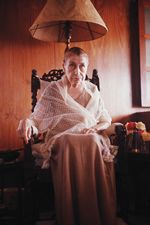
 The Four Austerities and the Four Liberations
