
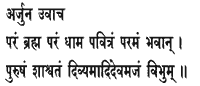
Arjuna said: Thou art the supreme Brahman, the supreme Abode, the supreme Purity, the one permanent, the divine Purusha, the original Godhead, the Unborn, the all-pervading Lord.
Works and Sacrifice
Sri Aurobindo
THE YOGA of the intelligent will and its culmination in the Brahmic status, which occupies all the close of the second chapter, contains the seed of much of the teaching of the Gita,—its doctrine of desireless works, of equality, of the rejection of outward renunciation, of devotion to the Divine; but as yet all this is slight and obscure. What is most strongly emphasised as yet is the withdrawal of the will from the ordinary motive of human activities, desire, from man’s normal temperament of the sense-seeking thought and will with its passions and ignorance, and from its customary habit of troubled manybranching ideas and wishes to the desireless calm unity and passionless serenity of the Brahmic poise. So much Arjuna has understood. He is not unfamiliar with all this; it is the substance of the current teaching which points man to the path of knowledge and to the renunciation of life and works as his way of perfection. The intelligence withdrawing from sense and desire and human action and turning to the Highest, to the One, to the actionless Purusha, to the immobile, to the featureless Brahman, that surely is the eternal seed of knowledge. There is no room here for works, since works belong to the Ignorance; action is the very opposite of knowledge; its seed is desire and its fruit is bondage. That is the orthodox philosophical doctrine, and Krishna seems quite to admit it when he says that works are far inferior to the Yoga of the intelligence. And yet works are insisted upon as part of the Yoga; so that there seems to be in this teaching a radical inconsistency. Not only so; for some kind of work no doubt may persist for a while, the minimum, the most inoffensive; but here is a work wholly inconsistent with knowledge, with serenity and with the motionless peace of the self-delighted soul,—a work terrible, even monstrous, a bloody strife, a ruthless battle, a giant massacre. Yet it is this that is enjoined, this that it is sought to justify by the teaching of inner peace and desireless equality and status in the Brahman! Here then is an unreconciled contradiction. Arjuna complains that he has been given a contradictory and confusing doctrine, not the clear, strenuously single road by which the human intelligence can move straight and trenchantly to the supreme good. It is in answer to this objection that the Gita begins at once to develop more clearly its positive and imperative doctrine of Works. The Teacher first makes a distinction between the two means of salvation on which in this world men can concentrate separately, the Yoga of knowledge, the Yoga of works, the one implying, it is usually supposed, renunciation of works as an obstacle to salvation, the other accepting works as a means of salvation. He does not yet insist strongly on any fusion of them, on any reconciliation of the thought that divides them, but begins by showing that the renunciation of the Sankhyas, the physical renunciation, Sannyasa, is neither the only way, nor at all the better way. Nais.karmya, a calm voidness from works, is no doubt that to which the soul, the Purusha has to attain; for it is Prakriti which does the work and the soul has to rise above involution in the activities of the being and attain to a free serenity and poise watching over the operations of Prakriti, but not affected by them. That, and not cessation of the works of Prakriti, is what is really meant by the soul’s nais.karmya. Therefore it is an error to think that by not engaging in any kind of action this actionless state of the soul can be attained and enjoyed. Mere renunciation of works is not a sufficient, not even quite a proper means for salvation. “Not by abstention from works does a man enjoy actionlessness, nor by mere renunciation (of works) does he attain to his perfection,”—to siddhi, the accomplishment of the aims of his self-discipline by Yoga. But at least it must be one necessary means, indispensable, imperative? For how, if the works of Prakriti continue, can the soul help being involved in them? How can I fight and yet in my soul not think or feel that I the individual am fighting, not desire victory nor be inwardly touched by defeat? This is the teaching of the Sankhyas that the intelligence of the man who engages in the activities of Nature, is entangled in egoism, ignorance and desire and therefore drawn to action; on the contrary, if the intelligence draws back, then the action must cease with the cessation of the desire and the ignorance. Therefore the giving up of life and works is a necessary part, an inevitable circumstance and an indispensable last means of the movement to liberation. This objection of a current logic,—it is not expressed by Arjuna, but it is in his mind as the turn of his subsequent utterances shows,—the Teacher immediately anticipates. No, he says, such renunciation, far from being indispensable, is not even possible. “For none stands even for a moment not doing work; everyone is made to do action helplessly by the modes born of Prakriti.” The strong perception of the great cosmic action and the eternal activity and power of the cosmic energy which was so much emphasised afterwards by the teaching of the Tantric Shaktas who even made Prakriti or Shakti superior to Purusha, is a very remarkable feature of the Gita. Although here an undertone, it is still strong enough, coupled with what we might call the theistic and devotional elements of its thought, to bring in that activism which so strongly modifies in its scheme of Yoga the quietistic tendencies of the old metaphysical Vedanta. Man embodied in the natural world cannot cease from action, not for a moment, not for a second; his very existence here is an action; the whole universe is an act of God, mere living even is His movement. Our physical life, its maintenance, its continuance is a journey, a pilgrimage of the body, ´sar¯ıra-y ¯ atr ¯a, and that cannot be effected without action. But even if a man could leave his body unmaintained, otiose, if he could stand still always like a tree or sit inert like a stone, tis.t.hati, that vegetable or material immobility would not save him from the hands of Nature; he would not be liberated from her workings. For it is not our physical movements and activities alone which are meant by works, by karma; our mental existence also is a great complex action, it is even the greater and more important part of the works of the unresting energy,—subjective cause and determinant of the physical. We have gained nothing if we repress the effect but retain the activity of the subjective cause. The objects of sense are only an occasion for our bondage, the mind’s insistence on them is the means, the instrumental cause. A man may control his organs of action and refuse to give them their natural play, but he has gained nothing if hismind continues to remember and dwell upon the objects of sense. Such a man has bewildered himself with false notions of self-discipline; he has not understood its object or its truth, nor the first principles of his subjective existence; therefore all hismethods of self-discipline are false and null.1 The body’s actions, even the mind’s actions are nothing in themselves, neither a bondage, nor the first cause of bondage. What is vital is the mighty energy of Nature which will have her way and her play in her great field of mind and life and body; what is dangerous in her, is the power of her three gun. as, modes or qualities to confuse and bewilder the intelligence and so obscure the soul. That, as we shall see later, is the whole crux of action and liberation for the Gita. Be free from obscuration and bewilderment by the three gun. as and action can continue, as it must continue, and even the largest, richest or most enormous and violent action; it does not matter, for nothing then touches the Purusha, the soul has nais.karmya. But at present the Gita does not proceed to that larger point. Since the mind is the instrumental cause, since inaction is impossible, what is rational, necessary, the right way is a controlled action of the subjective and objective organism. The mind must bring the senses under its control as an instrument of the intelligent will and then the organs of action must be used for their proper office, for action, but for action done as Yoga. But what is the essence of this self-control, what is meant by action done as Yoga, Karmayoga? It is non-attachment, it is to do works without clinging with the mind to the objects of sense and the fruit of the works. Not complete inaction, which is an error, a confusion, a self-delusion, an impossibility, but action full and
free done without subjection to sense and passion, desireless and unattached works, are the first secret of perfection. Do action thus self-controlled, says Krishna, niyatam˙ kuru karma tvam: I have said that knowledge, the intelligence, is greater than works, jy ¯ayas¯ı karman. o buddhih. , but I did not mean that inaction is greater than action; the contrary is the truth, karma jy ¯ayo akarman. ah. . For knowledge does not mean renunciation of works, it means equality and non-attachment to desire and the objects of sense; and it means the poise of the intelligent will in the Soul free and high-uplifted above the lower instrumentation of Prakriti and controlling the works of the mind and the senses and body in the power of self-knowledge and the pure objectless self-delight of spiritual realisation, niyatam˙ karma.2 Buddhiyoga is fulfilled by karmayoga; the Yoga of the self-liberating intelligent will finds its full meaning by the Yoga of desireless works. Thus the Gita founds its teaching of the necessity of desireless works, nis.k¯ama karma, and unites the subjective practice of the Sankhyas—rejecting their merely physical rule—with the practice of Yoga. But still there is an essential difficulty unsolved. Desire is the ordinary motive of all human actions, and if the soul is free from desire, then there is no farther rationale for action. We may be compelled to do certain works for the maintenance of the body, but even that is a subjection to the desire of the body which we ought to get rid of if we are to attain perfection. But granting that this cannot be done, the only way is to fix a rule for action outside ourselves, not dictated by anything in our subjectivity, the nityakarma of the Vedic rule, the routine
of ceremonial sacrifice, daily conduct and social duty, which the man who seeks liberation may do simply because it is enjoined upon him, without any personal purpose or subjective interest in them, with an absolute indifference to the doing, not because he is compelled by his nature but because it is enjoined by the Shastra. But if the principle of the action is not to be external to the nature but subjective, if the actions even of the liberated and the sage are to be controlled and determined by his nature, svabh¯ava-niyatam, then the only subjective principle of action is desire of whatever kind, lust of the flesh or emotion of the heart or base or noble aim of the mind, but all subject to the gun. as of Prakriti. Let us then interpret the niyata karma of the Gita as the nityakarma of the Vedic rule, its kartavya karma or work that has to be done as the Aryan rule of social duty and let us take too its work done as a sacrifice to mean simply these Vedic sacrifices and this fixed social duty performed disinterestedly and without any personal object. This is how the Gita’s doctrine of desireless work is often interpreted. But it seems to me that the Gita’s teaching is not so crude and simple, not so local and temporal and narrow as all that. It is large, free, subtle and profound; it is for all time and for all men, not for a particular age and country. Especially, it is always breaking free from external forms, details, dogmatic notions and going back to principles and the great facts of our nature and our being. It is a work of large philosophic truth and spiritual practicality, not of constrained religious and philosophical formulas and stereotyped dogmas. The difficulty is this, how, our nature being what it is and desire the common principle of its action, is it possible to institute a really desireless action? For what we call ordinarily disinterested action is not really desireless; it is simply a replacement of certain smaller personal interests by other larger desires which have only the appearance of being impersonal, virtue, country, mankind. All action, moreover, as Krishna insists, is done by the gun. as of Prakriti, by our nature; in acting according to the Shastra we are still acting according to our nature,—even if this Shastric action is not, as it usually is, a mere cover for our desires, prejudices, passions, egoisms, our personal, national, sectarian vanities, sentiments and preferences; but even otherwise, even at the purest, still we obey a choice of our nature, and if our nature were different and the gun. as acted on our intelligence and will in some other combination, we would not accept the Shastra, but live according to our pleasure or our intellectual notions or else break free from the social law to live the life of the solitary or the ascetic.We cannot become impersonal by obeying something outside ourselves, for we cannot so get outside ourselves; we can only do it by rising to the highest in ourselves, into our free Soul and Self which is the same and one in all and has therefore no personal interests, to the Divine in our being who possesses Himself transcendent of cosmos and is therefore not bound by His cosmic works or His individual action. That is what the Gita teaches and desirelessness is only a means to this end, not an aim in itself. Yes, but how is it to be brought about? By doing all works with sacrifice as the only object, is the reply of the divine Teacher. “By doing works otherwise than for sacrifice, this world of men is in bondage to works; for sacrifice practise works, O son of Kunti, becoming free from all attachment.” It is evident that all works and not merely sacrifice and social duties can be done in this spirit; any action may be done either from the ego-sense narrow or enlarged or for the sake of the Divine. All being and all action of Prakriti exist only for the sake of the Divine; from that it proceeds, by that it endures, to that it is directed. But so long as we are dominated by the ego-sense we cannot perceive or act in the spirit of this truth, but act for the satisfaction of the ego and in the spirit of the ego, otherwise than for sacrifice. Egoism is the knot of the bondage. By acting Godwards, without any thought of ego, we loosen this knot and finally arrive at freedom. At first, however, the Gita takes up the Vedic statement of the idea of sacrifice and phrases the law of sacrifice in its current terms. This it does with a definite object. We have seen that the quarrel between renunciation and works has two forms, the opposition of Sankhya and Yoga which is already in principle reconciled and the opposition of Vedism and Vedantism which the Teacher has yet to reconcile. The first is a larger statement of the opposition in which the idea of works is general and wide. The Sankhya starts from the notion of the divine status as that of the immutable and inactive Purusha which each soul is in reality and makes an opposition between inactivity of Purusha and activity of Prakriti; so its logical culmination is cessation of all works. Yoga starts from the notion of the Divine as Ishwara, lord of the operations of Prakriti and therefore superior to them, and its logical culmination is not cessation of works but the soul’s superiority to them and freedom even though doing all works. In the opposition of Vedism and Vedantism works, karma, are restricted to Vedic works and sometimes even to Vedic sacrifice and ritualised works, all else being excluded as not useful to salvation. Vedism of the Mimansakas insisted on them as the means, Vedantism taking its stand on the Upanishads looked on them as only a preliminary belonging to the state of ignorance and in the end to be overpassed and rejected, an obstacle to the seeker of liberation. Vedism worshipped the Devas, the gods, with sacrifice and held them to be the powers who assist our salvation. Vedantism was inclined to regard them as powers of the mental and material world opposed to our salvation (men, says the Upanishad, are the cattle of the gods, who do not desire man to know and be free); it saw the Divine as the immutable Brahman who has to be attained not by works of sacrifice and worship but by knowledge. Works only lead to material results and to an inferior Paradise; therefore they have to be renounced. The Gita resolves this opposition by insisting that the Devas are only forms of the one Deva, the Ishwara, the Lord of all Yoga and worship and sacrifice and austerity, and if it is true that sacrifice offered to the Devas leads only to material results and to Paradise, it is also true that sacrifice offered to the Ishwara leads beyond them to the great liberation. For the Lord and the immutable Brahman are not two different beings, but one and the same Being, and whoever strives towards either, is striving towards that one divine Existence. All works in their totality find their culmination and completeness in the knowledge of the Divine, sarvam˙ karma¯khilam˙ pa¯rtha jn˜ a¯ne parisama¯pyate. They are not an obstacle, but the way to the supreme knowledge. Thus this opposition too is reconciled with the help of a large elucidation of the meaning of sacrifice. In fact its conflict is only a restricted form of the larger opposition between Yoga and Sankhya. Vedism is a specialised and narrow form of Yoga; the principle of the Vedantists is identical with that of the Sankhyas, for to both the movement of salvation is the recoil of the intelligence, the buddhi, from the differentiating powers of Nature, from ego, mind, senses, from the subjective and the objective, and its return to the undifferentiated and the immutable. It is with this object of reconciliation in his mind that the Teacher first approaches his statement of the doctrine of sacrifice; but throughout, even from the very beginning, he keeps his eye not on the restricted Vedic sense of sacrifice and works, but on their larger and universal application,—that widening of narrow and formal notions to admit the great general truths they unduly restrict which is always the method of the Gita.
Sri Aurobindo
 About Us | ©1999 - 2009 searchforlight.org
All extracts and quotations from the written works of Sri Aurobindo and the Mother and the Photographs of
the Mother and Sri Aurobindo are copyright Sri Aurobindo Ashram Trust, Pondicherry -605002 India.