
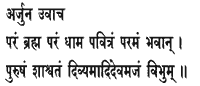
Arjuna said: Thou art the supreme Brahman, the supreme Abode, the supreme Purity, the one permanent, the divine Purusha, the original Godhead, the Unborn, the all-pervading Lord.
The Two Natures
Sri Aurobindo
THE FIRST six chapters of the Gita have been treated as a single block of teachings, its primary basis of practice and knowledge; the remaining twelve may be similarly treated as two closely connected blocks which develop the rest of the doctrine from this primary basis. The seventh to the twelfth chapters lay down a large metaphysical statement of the nature of the Divine Being and on that foundation closely relate and synthetise knowledge and devotion, just as the first part of the Gita related and synthetised works and knowledge. The vision of the World-Purusha intervenes in the eleventh chapter, gives a dynamic turn to this stage of the synthesis and relates it vividly to works and life. Thus again all is brought powerfully back to the original question of Arjuna round which the whole exposition revolves and completes its cycle. Afterwards the Gita proceeds by the differentiation of the Purusha and Prakriti to work out its ideas of the action of the gunas, of the ascension beyond the gunas and of the culmination of desireless works with knowledge where that coalesces with Bhakti,—knowledge, works and love made one,—and it rises thence to its great finale, the supreme secret of self-surrender to the Master of Existence. In this second part of the Gita we come to a more concise and easy manner of statement than we have yet had. In the first six chapters the definitions have not yet been made which give the key to the underlying truth; difficulties are being met and solved; the progress is a little laboured and moves through several involutions and returns; much is implied the bearing of which is not yet clear. Here we seem to get on to clearer ground and to lay hold of a more compact and pointed expression. But because of this very conciseness we have to be careful always
of our steps in order to avoid error and a missing of the real sense. For we are here no longer steadily on the safe ground of psychological and spiritual experience, but have to deal with intellectual statements of spiritual and often of supracosmic truth. Metaphysical statement has always this peril and uncertainty about it that it is an attempt to define to our minds what is really infinite, an attempt which has to be made, but can never be quite satisfactory, quite final or ultimate. The highest spiritual truth can be lived, can be seen, but can only be partially stated. The deeper method and language of the Upanishads with its free resort to image and symbol, its intuitive form of speech in which the hard limiting definiteness of intellectual utterance is broken down and the implications of words are allowed to roll out into an illimitable wave of suggestion, is in these realms the only right method and language. But the Gita cannot resort to this form, because it is designed to satisfy an intellectual difficulty, answers a state of mind in which the reason, the arbiter to which we refer the conflicts of our impulses and sentiments, is at war with itself and impotent to arrive at a conclusion. The reason has to be led to a truth beyond itself, but by its own means and in its own manner. Offered a spiritually psychological solution, of the data of which it has no experience, it can only be assured of its validity if it is satisfied by an intellectual statement of the truths of being upon which the solution rests. So far the justifying truths that have been offered to it are those with which it is already familiar, and they are only sufficient as a starting-point. There is first the distinction between the Self and the individual being in Nature. The distinction has been used to point out that this individual being in Nature is necessarily subject, so long as he lives shut up within the action of the ego, to the workings of the three gunas which make up by their unstable movements the whole scope and method of the reason, the mind and the life and senses in the body. And within this circle there is no solution. Therefore the solution has to be found by an ascent out of the circle, above this nature of the gunas, to the one immutable Self and silent Spirit, because then one gets beyond that action of the ego and desire which is the whole root of the difficulty. But since this by itself seems to lead straight towards inaction, as beyond Nature there is no instrumentality of action and no cause or determinant of action,—for the immutable self is inactive, impartial and equal to all things, all workings and all happenings,—the Yoga idea is brought in of the Ishwara, the Divine as master of works and sacrifice, and it is hinted but not yet expressly stated that this Divine exceeds even the immutable self and that in him lies the key to cosmic existence. Therefore by rising to him through the Self it is possible to have spiritual freedom from our works and yet to continue in the works of Nature. But it has not yet been stated who is this Supreme, incarnate here in the divine teacher and charioteer of works, or what are his relations to the Self and to the individual being in Nature. Nor is it clear how theWill to works coming from him can be other than the will in the nature of the three gunas. And if it is only that, then the soul obeying it can hardly fail to be in subjection to the gunas in its action, if not in its spirit, and if so, at once the freedom promised becomes either illusory or incomplete. Will seems to be an aspect of the executive part of being, to be power and active force of nature, Shakti, Prakriti. Is there then a higher Nature than that of the three gunas? Is there a power of pragmatic creation, will, action other than that of ego, desire, mind, sense, reason and the vital impulse? Therefore, in this uncertainty, what has now to be done is to give more completely the knowledge on which divine works are to be founded. And this can only be the complete, the integral knowledge of theDivine who is the source of works and in whose being the worker becomes by knowledge free; for he knows the free Spirit from whom all works proceed and participates in his freedom. Moreover this knowledge must bring a light that justifies the assertion with which the first part of the Gita closes. It must ground the supremacy of bhakti over all other motives and powers of spiritual consciousness and action; it must be a knowledge of the supreme Lord of all creatures to whom alone the soul can offer itself in the perfect self-surrender which is the highest height of all love and devotion. This is what the Teacher proposes to give in the opening verses of the seventh chapter which initiate the development that occupies all the rest of the book. “Hear,” he says, “how by practising Yoga with a mind attached to me and with me as ¯a´sraya (the whole basis, lodgment, point of resort of the conscious being and action) thou shalt know me without any remainder of doubt, integrally, samagram˙ ma¯m. I will speak to theewithout omission or remainder, a´ses.atah. ,” (for otherwise a ground of doubt may remain), “the essential knowledge, attended with all the comprehensive knowledge, by knowing which there shall be no other thing here left to be known.” The implication of the phrase is that the Divine Being is all, v¯asudevah. sarvam, and therefore if he is known integrally in all his powers and principles, then all is known, not only the pure Self, but the world and action and Nature. There is then nothing else here left to be known, because all is that Divine Existence. It is only because our view here is not thus integral, because it rests on the dividing mind and reason and the separative idea of the ego, that our mental perception of things is an ignorance.We have to get away from thismental and egoistic view to the true unifying knowledge, and that has two aspects, the essential, jn˜ a¯na, and the comprehensive, vijn˜ a¯na, the direct spiritual awareness of the supreme Being and the right intimate knowledge of the principles of his existence, Prakriti, Purusha and the rest, by which all that is can be known in its divine origin and in the supreme truth of its nature. That integral knowledge, says the Gita, is a rare and difficult thing; “among thousands of men one here and there strives after perfection, and of those who strive and attain to perfection one here and there knows me in all the principles of my existence, tattvatah. .” Then, to start with and in order to found this integral knowledge, the Gita makes that deep and momentous distinction which is the practical basis of all itsYoga, the distinction between the two Natures, the phenomenal and the spiritual Nature. “The five elements (conditions of material being), mind, reason, ego, this is my eightfold divided Nature. But know my other Nature different from this, the supreme which becomes the Jiva and by which this world is upheld.” Here is the first new metaphysical idea of the Gita which helps it to start from the notions of the Sankhya philosophy and yet exceed them and give to their terms, which it keeps and extends, a Vedantic significance. An eightfold Nature constituted of the five bhu¯ tas,—elements, as it is rendered, but rather elemental or essential conditions of material being to which are given the concrete names of earth, water, fire, air and ether,—the mind with its various senses and organs, the reason-will and the ego, is the Sankhya description of Prakriti. The Sankhya stops there, and because it stops there, it has to set up an unbridgeable division between the soul and Nature; it has to posit them as two quite distinct primary entities. The Gita also, if it stopped there, would have to make the same incurable antinomy between the Self and cosmic Nature which would then be only the Maya of the three gunas and all this cosmic existence would be simply the result of this Maya; it could be nothing else. But there is something else, there is a higher principle, a nature of spirit, par¯a prakr. tir me. There is a supreme nature of the Divine which is the real source of cosmic existence and its fundamental creative force and effective energy and of which the other lower and ignorant Nature is only a derivation and a dark shadow. In this highest dynamis Purusha and Prakriti are one. Prakriti there is only the will and the executive power of the Purusha, his activity of being,—not a separate entity, but himself in Power. This supreme Prakriti is not merely a presence of the power of spiritual being immanent in cosmic activities. For then it might be only the inactive presence of the all-pervading Self, immanent in all things or containing them, compelling in a way the world action but not itself active. Nor is this highest Prakriti the avyakta of the Sankhyas, the primary unmanifest seed-state of the manifest active eightfold nature of things, the one productive original force of Prakriti out of which hermany instrumental and executive powers evolve. Nor is it sufficient to interpret that idea of avyakta in the Vedantic sense and say that this supreme Nature is the power involved and inherent in unmanifest Spirit or Self out of which cosmos comes and into which it returns. It is that, but it is much more; for that is only one of its spiritual states. It is the integral conscious-power of the supreme Being, cit-´sakti, which is behind the self and cosmos. In the immutable Self it is involved in the Spirit; it is there, but in nivr.tti or a holding back from action: in the mutable self and the cosmos it comes out into action, pravr.tti. There by its dynamic presence it evolves in the Spirit all existences and appears in them as their essential spiritual nature, the persistent truth behind their play of subjective and objective phenomena. It is the essential quality and force, svabh¯ava, the self-principle of all their becoming, the inherent principle and divine power behind their phenomenal existence. The balance of the gunas is only a quantitative and quite derivative play evolved out of this supreme Principle. All this activity of forms, all this mental, sensuous, intelligential striving of the lower nature is only a phenomenon, which could not be at all except for this spiritual force and this power of being; it comes from that and it exists in that and by that solely. If we dwell in the phenomenal nature only and see things only by the notions it impresses on us, we shall not get at the real truth of our active existence. The real truth is this spiritual power, this divine force of being, this essential quality of the spirit in things or rather of the spirit in which things are and from which they draw all their potencies and the seeds of their movements. Get at that truth, power, quality and we shall get at the real law of our becoming and the divine principle of our living, its source and sanction in the Knowledge and not only its process in the Ignorance. This is to throw the sense of the Gita into language suited to our modern way of thinking; but if we look at its description of the Para Prakriti, we shall find that this is practically the substance of what it says. For first, this other higher Prakriti is, says Krishna, my supreme nature, prakr.tim˙ me para¯m. And this “I” here is the Purushottama, the supreme Being, the supreme Soul, the transcendent and universal Spirit. The original and eternal nature of the Spirit and its transcendent and originating Shakti is what is meant by the Para Prakriti. For speaking first of the origin of the world from the point of view of the active power of hisNature, Krishna assevers, “This is the womb of all beings,” etad-yonı¯ni bhu¯ ta¯ni. And in the next line of the couplet, again stating the same fact from the point of view of the originating Soul, he continues, “I am the birth of the whole world and so too its dissolution; there is nothing else supreme beyond Me.” Here then the supreme Soul, Purushottama, and the supreme Nature, Para Prakriti, are identified: they are put as two ways of looking at one and the same reality. For when Krishna declares, I am the birth of the world and its dissolution, it is evident that it is this Para Prakriti, supreme Nature, of his being which is both these things. The Spirit is the supreme Being in his infinite consciousness and the supreme Nature is the infinity of power or will of being of the Spirit,—it is his infinite consciousness in its inherent divine energy and its supernal divine action. The birth is the movement of evolution of this conscious Energy out of the Spirit, par¯a prakr. tir jı¯vabhu¯ ta¯ , its activity in the mutable universe; the dissolution is the withdrawing of that activity by involution of the Energy into the immutable existence and selfgathered power of the Spirit. That then is what is initially meant by the supreme Nature. The supreme Nature, par¯a prakr. tih. , is then the infinite timeless conscious power of the self-existent Being out of which all existences in the cosmos are manifested and come out of timelessness into Time. But in order to provide a spiritual basis for this manifold universal becoming in the cosmos the supreme Nature formulates itself as the Jiva. To put it otherwise, the eternal multiple soul of the Purushottama appears as individual spiritual existence in all the forms of the cosmos. All existences are instinct with the life of the one indivisible Spirit; all are supported in their personality, actions and forms by the eternal multiplicity of the one Purusha.We must be careful not to make themistake of thinking that this supremeNature is identical with the Jiva manifested in Time in the sense that there is nothing else or that it is only nature of becoming and not at all nature of being: that could not be the supreme nature of the Spirit. Even in Time it is something more; for otherwise the only truth of it in the cosmos would be nature of multiplicity and there would be no nature of unity in the world. That is not what the Gita says: it does not say that the supreme Prakriti is in its essence the Jiva, jı¯va¯tmika¯m, but that it has become the Jiva, jı¯vabhu¯ ta¯m; and it is implied in that expression that behind its manifestation as the Jiva here it is originally something else and higher, it is nature of the one supreme spirit. The Jiva, as we are told later on, is the Lord, ¯ı´svara, but in his partial manifestation, mamaiva¯m˙ s´ah. ; even all the multiplicity of beings in the universe or in numberless universes could not be in their becoming the integral Divine, but only a partial manifestation of the infinite One. In them Brahman the one indivisible existence resides as if divided, avibhaktam˙ ca bhu¯tes.u vibhaktam iva ca sthitam. The unity is the greater truth, the multiplicity is the lesser truth, though both are a truth and neither of them is an illusion. It is by the unity of this spiritual nature that the world is sustained, yayedam˙ dha¯ryate jagat, even as it is that fromwhich it is bornwith all its becomings, etad-yonı¯ni bhu¯ ta¯ni sarva¯n. i, and that also which withdraws the whole world and its existences into itself in the hour of dissolution, aha ˙ m kr. tsnasya jagatah. prabhavah. pralayas tath ¯a. But in the manifestation which is thus put forth in the Spirit, upheld in its action, withdrawn in its periodical rest from action, the Jiva is the basis of the multiple existence; it is the multiple soul, if we may so call it, or, if we prefer, the soul of the multiplicity we experience here. It is one always with the Divine in its being, different from it only in the power of its being,—different not in the sense that it is not at all the same power, but in this sense that it only supports the one power in a partial multiply individualised action. Therefore all things are initially, ultimately and in the principle of their continuance too the Spirit. The fundamental nature of all is nature of the Spirit, and only in their lower differential phenomena do they seem to be something else, to be nature of body, life, mind, reason, ego and the senses. But these are phenomenal derivatives, they are not the essential truth of our nature and our existence. The supreme nature of spiritual being gives us then both an original truth and power of existence beyond cosmos and a first basis of spiritual truth for the manifestation in the cosmos. But where is the link between this supreme nature and the lower phenomenal nature? On me, says Krishna, all this, all that is here—sarvam idam, the common phrase in the Upanishads for the totality of phenomena in the mobility of the universe—is strung like pearls upon a thread. But this is only an image which we cannot press very far; for the pearls are only kept in relation to each other by the thread and have no other oneness or relation with the pearl-string except their dependence on it for this mutual connection. Let us go then from the image to that which it images. It is the supreme nature of Spirit, the infinite conscious power of its being, self-conscient, all-conscient, all-wise, which maintains these phenomenal existences in relation to each other, penetrates them, abides in and supports them and weaves them into the system of its manifestation. This one supreme power manifests not only in all as the One, but in each as the Jiva, the individual spiritual presence; it manifests also as the essence of all quality of Nature. These are therefore the concealed spiritual powers behind all phenomena. This highest quality is not the working of the three gunas, which is phenomenon of quality and not its spiritual essence. It is rather the inherent, one, yet variable inner power of all these superficial variations. It is a fundamental truth of the Becoming, a truth that supports and gives a spiritual and divine significance to all its appearances. The workings of the gunas are only the superficial unstable becomings of reason, mind, sense, ego, life and matter, s ¯ attvik ¯a bh¯av¯a r¯ajas ¯ as t ¯amas¯a´s ca; but this is rather the essential stable original intimate power of the becoming, svabh¯ava. It is that which determines the primary law of all becoming and of each Jiva; it constitutes the essence and develops the movement of the nature. It is a principle in each creature that derives from and is immediately related to a transcendent divine Becoming, that of the Ishwara, madbh¯avah. . In this relation of the divine bh¯ava to the svabh¯ava and of the svabh¯ava to the superficial bh¯av¯ah. , of the divine Nature to the individual self-nature and of the self-nature in its pure and original quality to the phenomenal nature in all its mixed and confused play of qualities, we find the link between that supreme and this lower existence. The degraded powers and values of the inferior Prakriti derive from the absolute powers and values of the supreme Shakti and must go back to them to find their own source and truth and the essential law of their operation and movement. So too the soul or Jiva involved here in the shackled, poor and inferior play of the phenomenal qualities, if he would escape from it and be divine and perfect, must by resort to the pure action of his essential quality of Swabhava go back to that higher law of his own being in which he can discover the will, the power, the dynamic principle, the highest working of his divine nature. This is clear from the immediately subsequent passage in which the Gita gives a number of instances to show how the Divine in the power of his supreme nature manifests and acts within the animate and so-called inanimate existences of the universe.We may disentangle them from the loose and free order which the exigence of the poetical form imposes and put them in their proper philosophical series. First, the divine Power and Presence works within the five elemental conditions of matter. “I am taste in the waters, sound in ether, scent in earth, energy of light in fire,” and, it may be added for more completeness, touch or contact in air. That is to say, the Divine himself in his Para Prakriti is the energy at the basis of the various sensory relations of which, according to the ancient Sankhya system, the ethereal, the radiant, electric and gaseous, the liquid and the other elemental conditions of matter are the physical medium. The five elemental conditions of matter are the quantitative or material element in the lower nature and are the basis of material forms. The five Tanmatras—taste, touch, scent, and the others—are the qualitative element. These Tanmatras are the subtle energies whose action puts the sensory consciousness in relation to the gross forms of matter,—they are the basis of all phenomenal knowledge. From the material point of view matter is the reality and the sensory relations are derivative; but from the spiritual point of view the truth is the opposite.Matter and the material media are themselves derivative powers and at bottom are only concrete ways or conditions in which the workings of the quality of Nature in things manifest themselves to the sensory consciousness of the Jiva. The one original and eternal fact is the energy of Nature, the power and quality of being which so manifests itself to the soul through the senses. And what is essential in the senses, most spiritual, most subtle is itself stuff of that eternal quality and power. But energy or power of being in Nature is the Divine himself in his Prakriti; each sense in its purity is therefore that Prakriti, each sense is the Divine in his dynamic conscious force. This we gather better from the other terms of the series. “I am the light of sun and moon, the manhood in man, the intelligence of the intelligent, the energy of the energetic, the strength of the strong, the ascetic force of those who do askesis, tapasy¯a.” “I am life in all existences.” In each case it is the energy of the essential quality on which each of these becomings depends for what it has become, that is given as the characteristic sign indicating the presence of the divine Power in their nature. Again, “I am pranava in all the Vedas,” that is to say, the basic syllable OM, which is the foundation of all the potent creative sounds of the revealed word; OM is the one universal formulation of the energy of sound and speech, that which contains and sums up, synthetises and releases all the spiritual power and all the potentiality of Vak and Shabda and of which the other sounds, out of whose stuff words of speech are woven, are supposed to be the developed evolutions. That makes it quite clear. It is not the phenomenal developments of the senses or of life or of light, intelligence, energy, strength, manhood, ascetic force that are proper to the supreme Prakriti. It is the essential quality in its spiritual power that constitutes the Swabhava. It is the force of spirit so manifesting, it is the light of its consciousness and the power of its energy in things revealed in a pure original sign that is the self-nature. That force, light, power is the eternal seed from which all other things are the developments and derivations and variabilities and plastic circumstances. Therefore the Gita throws in as the most general statement in the series, “Know me to be the eternal seed of all existences, O son of Pritha.” This eternal seed is the power of spiritual being, the conscious will in the being, the seed which, as is said elsewhere, the Divine casts into the great Brahman, into the supramental vastness, and from that all are born into phenomenal existence. It is that seed of spirit which manifests itself as the essential quality in all becomings and constitutes their swabhava. The practical distinction between this original power of essential quality and the phenomenal derivations of the lower nature, between the thing itself in its purity and the thing in its lower appearances, is indicated very clearly at the close of the series. “I am the strength of the strong devoid of desire and liking,” stripped of all attachment to the phenomenal pleasure of things. “I am in beings the desire which is not contrary to their dharma.” And as for the secondary subjective becomings of Nature, bh¯av¯ah. (states of mind, affections of desire, movements of passion, the reactions of the senses, the limited and dual play of reason, the turns of the feeling and moral sense), which are sattwic, rajasic and tamasic, as for the working of the three gunas, they are, says the Gita, not themselves the pure action of the supreme spiritual nature, but are derivations from it; “they are verily from me,” matta eva, they have no other origin, “but I am not in them, it is they that are in me.” Here is indeed a strong and yet subtle distinction. “I am” says the Divine “the essential light, strength, desire, power, intelligence, but these derivations from them I am not in my essence, nor am I in them, yet are they all of them from me and they are all in my being.” It is then upon the basis of these statements that we have to view the transition of things from the higher to the lower and again from the lower back to the higher nature. The first statement offers no difficulty. The strong man in spite of the divine nature of the principle of strength in him falls into subjection to desire and to attachment, stumbles into sin, struggles towards virtue. But that is because he descends in all his derivative action into the grasp of the three gunas and does not govern that action from above, from his essential divine nature. The divine nature of his strength is not affected by these derivations, it remains the same in its essence in spite of every obscuration and every lapse. The Divine is there in that nature and supports him by its strength through the confusions of his lower existence till he is able to recover the light, illumine wholly his life with the true sun of his being and govern his will and its acts by the pure power of the divine will in his higher nature. But how can the Divine be desire, k¯ama? for this desire, this k¯ama has been declared to be our one great enemy who has to be slain. But that desire was the desire of the lower nature of the gunas which has its native point of origin in the rajasic being, rajogun. a-samudbhavah. ; for this is what we usually mean when we speak of desire. This other, the spiritual, is a will not contrary to the dharma. Is it meant that the spiritual k¯ama is a virtuous desire, ethical in its nature, a sattwic desire,—for virtue is always sattwic in its origin and motive force? But then there would be here an obvious contradiction,—since in the very next line all sattwic affections are declared to be not the Divine, but only lower derivations. Undoubtedly sin has to be abandoned if one is to get anywhere near the Godhead; but so too has virtue to be overpassed if we are to enter into the Divine Being. The sattwic nature has to be attained, but it has then to be exceeded. Ethical action is only a means of purification by which we can rise towards the divine nature, but that nature itself is lifted beyond the dualities,— and indeed there could otherwise be no pure divine presence or divine strength in the strong man who is subjected to the rajasic passions. Dharma in the spiritual sense is not morality or ethics. Dharma, says the Gita elsewhere, is action governed by the swabhava, the essential law of one’s nature. And this swabhava is at its core the pure quality of the spirit in its inherent power of conscious will and in its characteristic force of action. The desire meant here is therefore the purposeful will of the Divine in us searching for and discovering not the pleasure of the lower Prakriti, but the Ananda of its own play and self-fulfilling; it is the desire of the divine Delight of existence unrolling its own conscious force of action in accordance with the law of the swabhava. But what again is meant by saying that the Divine is not in the becomings, the forms and affections of the lower nature, even the sattwic, though they all are in his being? In a sense he must evidently be in them, otherwise they could not exist. But what is meant is that the true and supreme spiritual nature of the Divine is not imprisoned there; they are only phenomena in his being created out of it by the action of the ego and the ignorance. The ignorance presents everything to us in an inverted vision and at least a partially falsified experience. We imagine that the soul is in the body, almost a result and derivation from the body; even we so feel it: but it is the body that is in the soul and a result and derivation from the soul. We think of the spirit as a small part of us—the Purusha who is no bigger than the thumb—in this great mass of material and mental phenomena: in reality, the latter for all its imposing appearance is a very small thing in the infinity of the being of the spirit. So it is here; in much the same sense these things are in the Divine rather than the Divine in these things. This lower nature of the three gunas which creates so false a view of things and imparts to them an inferior character is a Maya, a power of illusion, by which it is not meant that it is all non-existent or deals with unrealities, but that it bewilders our knowledge, creates false values, envelops us in ego, mentality, sense, physicality, limited intelligence and there conceals from us the supreme truth of our existence. This illusive Maya hides from us the Divine that we are, the infinite and imperishable spirit. “By these three kinds of becoming which are of the nature of the gunas, this whole world is bewildered and does not recogniseMe supreme beyond them and imperishable.” If we could see that that Divine is the real truth of our existence, all else also would change to our vision, assume its true character and our life and action acquire the divine values and move in the law of the divine nature. But why then, since the Divine is there after all and the divine nature at the root even of these bewildering derivations, since we are the Jiva and the Jiva is that, is this Maya so hard to overcome, m¯ay¯a duratyay¯a? Because it is still the Maya of the Divine, daiv¯ı hyes. ¯a gun. amay¯ı mama m¯ay¯a; “this is my divine Maya of the gunas.” It is itself divine and a development from the nature of the Divine, but the Divine in the nature of the gods; it is daiv¯ı, of the godheads or, if you will, of the Godhead, but of the Godhead in its divided subjective and lower cosmic aspects, sattwic, rajasic and tamasic. It is a cosmic veil which the Godhead has spun around our understanding; Brahma, Vishnu and Rudra have woven its complex threads; the Shakti, the Supreme Nature is there at its base and is hidden in its every tissue. We have to work out this web in ourselves and turn through it and from it leaving it behind us when its use is finished, turn from the gods to the original and supreme Godhead in whom we shall discover at the same time the last sense of the gods and their works and the inmost spiritual verities of our own imperishable existence. “To Me who turn and come, they alone cross over beyond this Maya.”
Sri Aurobindo
 About Us| ©1999 - 2009 searchforlight.org
All extracts and quotations from the written works of Sri Aurobindo and the Mother and the Photographs of
the Mother and Sri Aurobindo are copyright Sri Aurobindo Ashram Trust, Pondicherry -605002 India.