
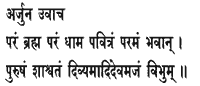
Arjuna said: Thou art the supreme Brahman, the supreme Abode, the supreme Purity, the one permanent, the divine Purusha, the original Godhead, the Unborn, the all-pervading Lord.
The Synthesis of Devotion and Knowledge
Sri Aurobindo
THE GITA is not a treatise of metaphysical philosophy, in spite of the great mass of metaphysical ideas which arise incidentally in its pages; for here no metaphysical truth is brought into expression solely for its own sake. It seeks the highest truth for the highest practical utility, not for intellectual or even for spiritual satisfaction, but as the truth that saves and opens to us the passage from our present mortal imperfection to an immortal perfection. Therefore after giving us in the first fourteen verses of this chapter a leading philosophical truth of which we stand in need, it hastens in the next sixteen verses to make an immediate application of it. It turns it into a first starting-point for the unification of works, knowledge and devotion,— for the preliminary synthesis of works and knowledge by themselves has already been accomplished. We have before us three powers, the Purushottama as the supreme truth of that into which we have to grow, the Self and the Jiva. Or, as we may put it, there is the Supreme, there is the impersonal spirit, and there is the multiple soul, timeless foundation of our spiritual personality, the true and eternal individual, mamaiva¯m˙ s´ah. sana¯tanah. . All these three are divine, all three are the Divine. The supreme spiritual nature of being, the Para Prakriti free from any limitation by the conditioning Ignorance, is the nature of the Purushottama. In the impersonal Self there is the same divine nature, but here it is in its state of eternal rest, equilibrium, inactivity, nivritti. Finally, for activity, for pravritti, the Para Prakriti becomes the multiple spiritual personality, the Jiva. But the intrinsic activity of this supreme
Nature is always a spiritual, a divine working. It is force of the supreme divine Nature, it is the conscious will of the being of the Supreme that throws itself out in various essential and spiritual power of quality in the Jiva: that essential power is the swabhava of the Jiva. All act and becoming which proceed directly from this spiritual force are a divine becoming and a pure and spiritual action. Therefore it follows that in action the effort of the human individual must be to get back to his true spiritual personality and to make all his works flow from the power of its supernal Shakti, to develop action through the soul and the inmost intrinsic being, not through the mental idea and vital desire, and to turn all his acts into a pure outflowing of the will of the Supreme, all his life into a dynamic symbol of the Divine Nature. But there is also this lower nature of the three gunas whose character is the character of the ignorance and whose action is the action of the ignorance, mixed, confused, perverted; it is the action of the lower personality, of the ego, of the natural and not of the spiritual individual. It is in order to recede from that false personality that we have to resort to the impersonal Self and make ourselves one with it. Then, freed so from the ego personality, we can find the relation of the true individual to the Purushottama. It is one with him in being, even though necessarily partial and determinative, because individual, in action and temporal manifestation of nature. Freed too from the lower nature we can realise the higher, the divine, the spiritual. Therefore to act from the soul does not mean to act from the desire soul; for that is not the high intrinsic being, but only the lower natural and superficial appearance. To act in accordance with the intrinsic nature, the swabhava, does not mean to act out of the passions of the ego, to enact with indifference or with desire sin and virtue according to the natural impulses and the unstable play of the gunas. Yielding to passion, an active or an inert indulgence of sin is no way either to the spiritual quietism of the highest impersonality or to the spiritual activity of the divine individual who is to be a channel for the will of the supreme Person, a direct power and visible becoming of the Purushottama. The Gita has laid it down from the beginning that the very first precondition of the divine birth, the higher existence is the slaying of rajasic desire and its children, and that means the exclusion of sin. Sin is the working of the lower nature for the crude satisfaction of its own ignorant, dull or violent rajasic and tamasic propensities in revolt against any high self-control and self-mastery of the nature by the spirit. And in order to get rid of this crude compulsion of the being by the lower Prakriti in its inferior modeswe must have recourse to the highest mode of that Prakriti, the sattwic, which is seeking always for a harmonious light of knowledge and for a right rule of action. The Purusha, the soul within us which assents in Nature to the varying impulse of the gunas, has to give its sanction to that sattwic impulse and that sattwic will and temperament in our being which seeks after such a rule. The sattwic will in our nature has to govern us and not the rajasic and tamasic will. This is the meaning of all high reason in action as of all true ethical culture; it is the law of Nature in us striving to evolve from her lower and disorderly to her higher and orderly action, to act not in passion and ignorance with the result of grief and unquiet, but in knowledge and enlightened will with the result of inner happiness, poise and peace. We cannot get beyond the three gunas, if we do not first develop within ourselves the rule of the highest guna, sattwa. “The evil-doers attain not to me,” says the Purushottama, “souls bewildered, low in the human scale; for their knowledge is reft away from them by Maya and they resort to the nature of being of the Asura.” This bewilderment is a befooling of the soul in Nature by the deceptive ego. The evil-doer cannot attain to the Supreme because he is for ever trying to satisfy the idol ego on the lowest scale of human nature; his real God is this ego. His mind and will, hurried away in the activities of the Maya of the three gunas, are not instruments of the spirit, but willing slaves or self-deceived tools of his desires. He sees this lower nature only and not his supreme self and highest being or the Godhead within himself and in the world: he explains all existence to his will in the terms of ego and desire and serves only ego and desire. To serve ego and desire without aspiration to a higher nature and a higher law is to have the mind and the temperament of the Asura. A first necessary step upward is to aspire to a higher nature and a higher law, to obey a better rule than the rule of desire, to perceive and worship a nobler godhead than the ego or than anymagnified image of the ego, to become a right thinker and a right doer. This too is not in itself enough; for even the sattwic man is subject to the bewilderment of the gunas, because he is still governed by wish and disliking, icch ¯ a-dves.a. He moves within the circle of the forms of Nature and has not the highest, not the transcendental and integral knowledge. Still by the constant upward aspiration in his ethical aim he in the end gets rid of the obscuration of sin which is the obscuration of rajasic desire and passion and acquires a purified nature capable of deliverance from the rule of the triple Maya. By virtue alone man cannot attain to the highest, but by virtue2 he can develop a first capacity for attaining to it, adhik¯ara. For the crude rajasic or the dull tamasic ego is difficult to shake off and put below us; the sattwic ego is less difficult and at last, when it sufficiently subtilises and enlightens itself, becomes even easy to transcend, transmute or annihilate. Man, therefore, has first of all to become ethical, sukr.t¯ı, and then to rise to heights beyond any mere ethical rule of living, to the light, largeness and power of the spiritual nature, where he gets beyond the grasp of the dualities and its delusion, dvandvamoha. There he no longer seeks his personal good or pleasure or shuns his personal suffering or pain, for by these things he is no longer affected, nor says any longer, “I am virtuous,” “I am sinful,” but acts in his own high spiritual nature by the will of the Divine for the universal good. We have already seen that for this end self-knowledge, equality, impersonality are the first necessities, and that that is the way of reconciliation between knowledge and works, between spirituality and activity in the world, between the ever immobile quietism of the timeless self and the eternal play of the pragmatic energy of Nature. But
the Gita now lays down another and greater necessity for the Karmayogin who has unified his Yoga of works with the Yoga of knowledge. Not knowledge and works alone are demanded of him now, but bhakti also, devotion to the Divine, love and adoration and the soul’s desire of the Highest. This demand, not expressly made until now, had yet been prepared when the Teacher laid down as the necessary turn of his Yoga the conversion of all works into a sacrifice to the Lord of our being and fixed as its culmination the giving up of all works, not only into our impersonal Self, but through impersonality into the Being from whom all our will and power originate. What was there implied is now brought out and we begin to see more fully the Gita’s purpose. We have now set before us three interdependent movements of our release out of the normal nature and our growth into the divine and spiritual being. “By the delusion of the dualities which arises from wish and disliking, all existences in the creation are led into bewilderment,” says the Gita. That is the ignorance, the egoism which fails to see and lay hold on the Divine everywhere, because it sees only the dualities of Nature and is constantly occupied with its own separate personality and its seekings and shrinkings. For escape from this circle the first necessity in our works is to get clear of the sin of the vital ego, the fire of passion, the tumult of desire of the rajasic nature, and this has to be done by the steadying sattwic impulse of the ethical being. When that is done, yes.a¯m˙ tvantagatam˙ pa¯pam˙ jana¯na¯m˙ pun. yakarman.a¯m, —or rather as it is being done, for after a certain point all growth in the sattwic nature brings an increasing capacity for a high quietude, equality and transcendence,—it is necessary to rise above the dualities and to become impersonal, equal, one self with the Immutable, one self with all existences. This process of growing into the spirit completes our purification. But while this is being done, while the soul is enlarging into self-knowledge, it has also to increase in devotion. For it has not only to act in a large spirit of equality, but to do also sacrifice to the Lord, to that Godhead in all beings which it does not yet know perfectly, but which it will be able so to know, integrally, samagram˙ ma¯m, when it has firmly the vision of the one self everywhere and in all existences. Equality and vision of unity once perfectly gained, te dvandva-moha-nirmukt¯ah. , a supreme bhakti, an all-embracing devotion to the Divine, becomes the whole and the sole law of the being. All other law of conduct merges into that surrender, sarva-dharm¯an parityajya. The soul then becomes firm in this bhakti and in the vow of self-consecration of all its being, knowledge, works; for it has now for its sure base, its absolute foundation of existence and action the perfect, the integral, the unifying knowledge of the all-originating Godhead, te bhajante m¯a ˙ m dr. d. ha-vrat ¯ah. . From the ordinary point of view any return towards bhakti or continuation of the heart’s activities after knowledge and impersonality have been gained, might seem to be a relapse. For in bhakti there is always the element, the foundation even of personality, since its motive-power is the love and adoration of the individual soul, the Jiva, turned towards the supreme and universal Being. But from the standpoint of the Gita, where the aim is not inaction and immergence in the eternal Impersonal, but a union with the Purushottama through the integrality of our being, this objection cannot at all intervene. In this Yoga the soul escapes indeed its lower personality by the sense of its impersonal and immutable self-being; but it still acts and all action belongs to the multiple soul in the mutability of Nature. If we do not bring in as a corrective to an excessive quietism the idea of sacrifice to the Highest, we have to regard this element of action as something not at all ourselves, some remnant of the play of the gunas without any divine reality behind it, a last dissolving form of ego, of I-ness, a continued impetus of the lower Nature for which we are not responsible since our knowledge rejects it and aims at escape from it into pure inaction. But by combining the tranquil impersonality of the one self with the stress of the works of Nature done as a sacrifice to the Lord, we by this double key escape from the lower egoistic personality and grow into the purity of our true spiritual person. Then are we no longer the bound and ignorant ego in the lower, but the free Jiva in the supreme Nature. Then we no longer live in the knowledge of the one immutable and impersonal self and this mutable multiple Nature as two opposite entities, but rise to the very embrace of the Purushottama discovered simultaneously through both of these powers of our being. All three are the spirit, and the two which are apparent opposites prove to be only confronting faces of the third which is the highest. “There is the immutable and impersonal spiritual being (Purusha),” says Krishna later on, “and there is the mutable and personal spiritual being. But there is too another Highest (uttama purus.a) called the supreme self, Paramatman, he who has entered into this whole world and upbears it, the Lord, the imperishable. I am this Purushottama who am beyond the mutable and am greater and higher even than the immutable. He who has knowledge of me as the Purushottama, adores me (has bhakti for me, bhajati), with all-knowledge and in every way of his natural being.” And it is this bhakti of an integral knowledge and integral self-giving which the Gita now begins to develop. For note that it is bhakti with knowledge which the Gita demands from the disciple and it regards all other forms of devotion as good in themselves but still inferior; they may do well by the way, but they are not the thing at which it aims in the soul’s culmination. Among those who have put away the sin of the rajasic egoism and are moving towards the Divine, the Gita distinguishes between four kinds of bhaktas. There are those who turn to him as a refuge from sorrow and suffering in the world, ¯ arta. There are those who seek him as the giver of good in the world, arth ¯ arth¯ı. There are those who come to him in the desire for knowledge, jijn˜ a¯su. And lastly there are those who adore him with knowledge, jn˜ a¯nı¯. All are approved by the Gita, but only on the last does it lay the seal of its complete sanction. All these movements without exception are high and good, ud¯ ar ¯ah. sarva evaite, but the bhakti with knowledge excels them all, vi´sis.yate.We may say that these forms are successively the bhakti of the vital-emotional and affective nature,3 that of the
practical and dynamic nature, that of the reasoning intellectual nature, and that of the highest intuitive being which takes up all the rest of the nature into unity with the Divine. Practically, however, the others may be regarded as preparatory movements. For the Gita itself here says that it is only at the end of many existences that one can, after possession of the integral knowledge and after working that out in oneself through many lives, attain at the long last to the Transcendent. For the knowledge of the Divine as all things that are is difficult to attain and rare on earth is the great soul, mah¯atm¯a, who is capable of fully so seeing him and of entering into him with his whole being, in every way of his nature, by the wide power of this all-embracing knowledge, sarvavit sarvabh¯avena. It may be asked how is that devotion high and noble, ud¯ara, which seeks God only for the worldly boons he can give or as a refuge in sorrow and suffering, and not the Divine for its own sake? Do not egoism, weakness, desire reign in such an adoration and does it not belong to the lower nature? Moreover, where there is not knowledge, the devotee does not approach the Divine in his integral all-embracing truth, v¯asudevah. sarvam iti, but constructs imperfect names and images of the Godhead which are only reflections of his own need, temperament and nature, and he worships them to help or appease his natural longings. He constructs for the Godhead the name and form of Indra or Agni, of Vishnu or Shiva, of a divinised Christ or Buddha, or else some composite of natural qualities, an indulgent God of love and mercy, or a severe God of righteousness and justice, or an awe-inspiring God of wrath and terror and flaming punishments, or some amalgam of any of these, and to that he raises his altars without and in his heart and mind and falls down before it to demand from it worldly good and joy or healing of his wounds or a sectarian sanction for an erring, dogmatic, intellectual, intolerent knowledge. All this up to a certain point is true enough. Very rare is the great soul who knows that Vasudeva the omnipresent Being is all that is, v¯asudevah. sarvam iti sa mah¯atm¯a sudurlabhah. . Men are led away by various outer desires which take from them the working of the inner knowledge, ka¯mais tais tair hr.tajn˜ a¯na¯h. . Ignorant, they resort to other godheads, imperfect forms of the deity which correspond to their desire, prapadyante ’nyadevat¯ah. . Limited, they set up this or that rule and cult, tam˙ tam˙ niyamam a¯stha¯ya, which satisfies the need of their nature. And in all this it is a compelling personal determination, it is this narrow need of their own nature that they follow and take for the highest truth, —incapable yet of the infinite and its largeness. The Godhead in these forms gives them their desires if their faith is whole; but these fruits and gratifications are temporary and it is a petty intelligence and unformed reason which makes the pursuit of them its principle of religion and life. And so far as there is a spiritual attainment by this way, it is only to the gods; it is only the Divine in formations of mutable nature and as the giver of her results that they realise. But those who adore the transcendent and integral Godhead embrace all this and transform it all, exalt the gods to their highest, Nature to her summits, and go beyond them to the very Godhead, realise and attain to the Transcendent. Dev¯an deva-yajo y¯ anti mad-bhakt¯a y¯anti m¯am api. Still the supreme Godhead does not at all reject these devotees because of their imperfect vision. For the Divine in his supreme transcendent being, unborn, imminuable and superior to all these partial manifestations, cannot be easily known to any living creature. He is self-enveloped in this immense cloak of Maya, that Maya of his Yoga, by which he is one with the world and yet beyond it, immanent but hidden, seated in all hearts but not revealed to any and every being. Man in Nature thinks that these manifestations in Nature are all the Divine, when they are only his works and his powers and his veils. He knows all past and all present and future existences, but him none yet knoweth. If then after thus bewildering them with his workings in Nature, he were not to meet them in these at all, there would be no divine hope for man or for any soul in Maya. Therefore according to their nature, as they approach him, he accepts their bhakti and answers to it with the reply of divine love and compassion. These forms are after all a certain kind of manifestation through which the imperfect human intelligence can touch him, these desires are first means by which our souls turn towards him: nor is any devotion worthless or ineffective, whatever its limitations. It has the one grand necessity, faith. “Whatever form ofme any devoteewith faith desires to worship, I make that faith of his firm and undeviating.” By the force of that faith in his cult and worship he gets his desire and the spiritual realisation for which he is at the moment fitted. By seeking all his good from the Divine, he shall come in the end to seek in the Divine all his good. By depending for his joys on the Divine, he shall learn to fix in the Divine all his joy. By knowing the Divine in his forms and qualities, he shall come to know him as the All and the Transcendent who is the source of all things.4 Thus by spiritual development devotion becomes one with knowledge. The Jiva comes to delight in the one Godhead,— in the Divine known as all being and consciousness and delight and as all things and beings and happenings, known in Nature, known in the self, known for that which exceeds self and Nature. He is ever in constant union with him, nityayukta; his whole life and being are an eternal Yoga with the Transcendent than whom there is nothing higher, with the Universal besides whom there is none else and nothing else. On him is concentred all his bhakti, ekabhaktih. , not on any partial godhead, rule or cult. This single devotion is his whole law of living and he has gone beyond all creeds of religious belief, rules of conduct, personal aims of life. He has no griefs to be healed, for he is in possession of the Allblissful. He has no desires to hunger after, for he possesses the highest and the All and is close to the All-Power that brings all fulfilment. He has no doubts or baffled seekings left, for all knowledge streams upon him from the Light in which he lives. He loves perfectly the Divine and is his beloved; for as he takes joy in the Divine, so too the Divine takes joy in him. This is
the God-lover who has the knowledge, jn˜ a¯nı¯ bhakta. And this knower, says the Godhead in the Gita, is my self; the others seize only motives and aspects in Nature, but he the very self-being and all-being of the Purushottama with which he is in union. His is the divine birth in the supreme Nature, integral in being, completed in will, absolute in love, perfected in knowledge. In him the Jiva’s cosmic existence is justified because it has exceeded itself and so found its own whole and highest truth of being.
Sri Aurobindo
 About Us | ©1999 - 2009 searchforlight.org
All extracts and quotations from the written works of Sri Aurobindo and the Mother and the Photographs of
the Mother and Sri Aurobindo are copyright Sri Aurobindo Ashram Trust, Pondicherry -605002 India.