
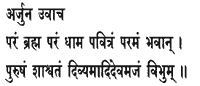
Arjuna said: Thou art the supreme Brahman, the supreme Abode, the supreme Purity, the one permanent, the divine Purusha, the original Godhead, the Unborn, the all-pervading Lord.
The Supreme Word of the Gita
Sri Aurobindo
WE HAVE now got to the inmost kernel of the Gita’s Yoga, the whole living and breathing centre of its teaching.We can see now quite clearly that the ascent of the limited human soul when it withdraws from the ego and the lower nature into the immutable Self calm, silent and stable, was only a first step, an initial change. And now too we can see why the Gita from the first insisted on the Ishwara, the Godhead in the human form, who speaks always of himself, “aham, m¯am,” as of some great secret and omnipresent Being, lord of all the worlds and master of the human soul, one who is greater even than that immutable self-existence which is still and unmoved for ever and abides for ever untouched by the subjective and objective appearances of the natural universe. All Yoga is a seeking after the Divine, a turn towards union with the Eternal. According to the adequacy of our perception of the Divine and the Eternal will be the way of the seeking, the depth and fullness of the union and the integrality of the realisation. Man, the mental being, approaches the Infinite through his finite mind and has to open some near gate of this finite upon that Infinite. He seeks for some conception on which his mind is able to seize, selects some power of his nature which by force of an absolute self-heightening can reach out and lay its touch on the infinite Truth that in itself is beyond his mental comprehension. Some face of that infinite Truth—for, because it is infinite, it has numberless faces, words of its meaning, self-suggestions— he attempts to see, so that by attaching himself to it he can arrive through direct experience to the immeasurable reality it figures. However narrow the gate may be, he is satisfied if it offers some prospect into the wideness which attracts him, if it sets him on the way to the fathomless profundity and unreachable heights of that which calls to his spirit. And as he approaches it, so it receives him, ye yatha¯ ma¯m˙ prapadyante. Philosophic mind attempts to attain to the Eternal by an abstractive knowledge. The business of knowledge is to comprehend and for the finite intellect that means to define and determine. But the only way to determine the indeterminable is by some kind of universal negation, neti neti. Therefore the mind proceeds to exclude from the conception of the Eternal all that offers itself as limitable by the senses and the heart and the understanding. An entire opposition is made between the Self and the not-self, between an eternal, immutable, indefinable self-existence and all forms of existence,—between Brahman andMaya, between the ineffable Reality and all that undertakes to express, but cannot express the Ineffable,—between Karma andNirvana, between the ever continuous but ever impermanent action and conception of the universal Energy and some absolute ineffable supreme Negation of its action and conception which is empty of all life and mentality and dynamic significance. That strong drive of knowledge towards the Eternal leads away from everything that is transient. It negates life in order to return to its source, cuts away from us all that we seem to be in order to get from it to the nameless and impersonal reality of our being. The desires of the heart, the works of the will and the conceptions of the mind are rejected; even in the end knowledge itself is negated and abolished in the Identical and Unknowable. By the way of an increasing quietude ending in an absolute passivity theMayacreated soul or the bundle of associations we call ourselves enters into annihilation of its idea of personality, makes an end of the lie of living, disappears into Nirvana. But this difficult abstractive method of self-negation, however it may draw to it some exceptional natures, cannot satisfy universally the embodied soul in man, because it does not give an outlet to all the straining of his complex nature towards the perfect Eternal. Not only his abstracting contemplative intellect but his yearning heart, his active will, his positive mind in search of some Truth to which his existence and the existence of the world is a manifold key, have their straining towards the Eternal and Infinite and seek to find in it their divine Source and the jus tification of their being and their nature. From this need arise the religions of love and works, whose strength is that they satisfy and lead Godwards the most active and developed powers of our humanity,—for only by starting from these can knowledge be effective. Even Buddhism with its austere and uncompromising negation both of subjective self and objective things had still to found itself initially on a divine discipline of works and to admit as a substitute for bhakti the spiritualised emotionalism of a universal love and compassion, since so only could it become an effective way for mankind, a truly liberating religion. Even illusionist Mayavada with its ultralogical intolerance of action and the creations of mentality had to allow a provisional and practical reality to man and the universe and to God in the world in order to have a first foothold and a feasible starting-point; it had to affirm what it denied in order to give some reality to man’s bondage and to his effort for liberation. But the weakness of the kinetic and the emotional religions is that they are too much absorbed in some divine Personality and in the divine values of the finite. And, even when they have a conception of the infinite Godhead, they do not give us the full satisfaction of knowledge because they do not follow it out into its most ultimate and supernal tendencies. These religions fall short of a complete absorption in the Eternal and the perfect union by identity,—and yet to that identity in some other way, if not in the abstractive, since there all oneness has its basis, the spirit that is in man must one day arrive. On the other hand, the weakness of a contemplative quietistic spirituality is that it arrives at this result by a too absolute abstraction and in the end it turns into a nothing or a fiction the human soul whose aspiration was yet all the time the whole sense of this attempt at union; for without the soul and its aspiration liberation and union could have no meaning. The little that this way of thinking recognises of his other powers of existence, it relegates to an inferior preliminary action which never arrives at any full or satisfying realisation in the Eternal and Infinite. Yet these things too which it restricts unduly, the potent will, the strong yearning of love, the positive light and all-embracing intuition of the conscious mental being are from the Divine, represent essential powers of him and must have some justification in their Source and some dynamic way of self-fulfilment in him. No God-knowledge can be integral, perfect or universally satisfying which leaves unfulfilled their absolute claim, no wisdom utterly wise which in its intolerant asceticism of search negates or in the pride of pure knowledge belittles the spiritual reality behind these ways of the Godhead. The greatness of the central thought of the Gita in which all its threads are gathered up and united, consists in the synthetic value of a conception which recognises the whole nature of the soul of man in the universe and validates by a large and wise unification its many-sided need of the supreme and infinite Truth, Power, Love, Being to which our humanity turns in its search for perfection and immortality and some highest joy and power and peace. There is a strong and wide endeavour towards a comprehensive spiritual view of God and man and universal existence. Not indeed that everything without any exception is seized in these eighteen chapters, no spiritual problem left for solution; but still so large a scheme is laid out that we have only to fill in, to develop, to modify, to stress, to follow out points, to work out hint and illuminate adumbration in order to find a clue to any further claim of our intelligence and need of our spirit. The Gita itself does not evolve any quite novel solution out of its own questionings. To arrive at the comprehensiveness at which it aims, it goes back behind the great philosophical systems to the original Vedanta of the Upanishads; for there we have the widest and profoundest extant synthetic vision of spirit and man and cosmos. But what is in the Upanishads undeveloped to the intelligence becausewrapped up in a luminous kernel of intuitive vision and symbolic utterance, the Gita brings out in the light of a later intellectual thinking and distinctive experience. In the frame of its synthesis it admits the seeking of the abstractive thinkers for the Indefinable, anirde´syam, the ever unmanifest Immutable, avyaktam aks.aram. Those who devote themselves to this search, find, they also, the Purushottama, the supreme Divine Person, m¯am, the Spirit and highest Soul and Lord of things. For his utmost self-existent way of being is indeed an unthinkable, acintyaru¯pam, an unimaginable positive, an absolute quintessence of all absolutes far beyond the determination of the intelligence. The method of negative passivity, quietude, renunciation of life and works by which men feel after this intangible Absolute is admitted and ratified in the Gita’s philosophy, but only with a minor permissive sanction. This negating knowledge approaches the Eternal by one side only of the truth and that side the most difficult to reach and follow for the embodied soul in Nature, duh. kham˙ dehavadbhir ava¯pyate; it proceeds by a highly specialised, even an unnecessarily arduous way, “narrow and difficult to tread as a razor’s edge.” Not by denying all relations, but through all relations is the Divine Infinite naturally approachable to man and most easily, widely, intimately seizable. This seeing is not after all the largest or the truest truth that the Supreme is without any relations with the mental, vital, physical existence of man in the universe, avyavah¯aryam, nor that what is described as the empirical truth of things, the truth of relations, vyavah¯ara, is altogether the opposite of the highest spiritual truth, param¯artha.On the contrary there are a thousand relations by which the supreme Eternal is secretly in contact and union with our human existence and by all essential ways of our nature and of the world’s nature, sarvabh ¯avena, can that contact be made sensible and that union made real to our soul, heart, will, intelligence, spirit. Therefore is this other way natural and easy for man, sukham ¯aptum. God does not make himself difficult of approach to us: only one thing is needed, one demand made on us, the single indomitable will to break through the veil of our ignorance and the whole, the persistent seeking of the mind and heart and life for that which is all the time near to it, within it, its own soul of being and spiritual essence and the secret of its personality and its impersonality, its self and its nature. This is our one difficulty; the rest the Master of our existence will himself see to and accomplish, aham˙ tva¯m˙ moks.ayis.y¯ami m¯a ´sucah. . In the very part of its teaching in which the Gita’s synthesis leans most towards the side of pure knowledge, we have seen that it constantly prepares for this fuller truth and more pregnant experience. Indeed, it is implied in the very form the Gita gives to the realisation of the self-existent Immutable. That immutable Self of all existences seems indeed to stand back from any active intervention in the workings of Nature; but it is not void of all relation whatever and remote from all connection. It is our witness and supporter; it gives a silent and impersonal sanction; it has even an impassive enjoyment. The many-sided action of Nature is still possible even when the soul is poised in that calm self-existence: for the witness soul is the immutable Purusha, and Purusha has always some relation with Prakriti. But now the reason of this double aspect of silence and of activity is revealed in its entire significance,—because the silent all-pervading Self is only one side of the truth of the divine Being. He who pervades the world as the one unchanging self that supports all its mutations, is equally the Godhead in man, the Lord in the heart of every creature, the conscient Cause and Master of all our subjective becoming and all our inwardtaking and outward-going objectivised action. The Ishwara of the Yogins is one with the Brahman of the seeker of knowledge, one supreme and universal Spirit, one supreme and universal Godhead. This Godhead is not the limited personal God of so many exoteric religions; for those are all only partial and outward formations of this other, this creative and directive, this personal side of his complete truth of existence. This is the one supreme Person, Soul, Being, Purusha of whom all godheads are aspects, all individual personality a limited development in cosmic Nature. This Godhead is not a particularised name and form of Divinity, is.t. a-devat¯a, constructed by the intelligence or embodying the special aspiration of the worshipper. All such names and forms are only powers and faces of the one Deva who is the universal Lord of all worshippers and all religions: but this is itself that universal Deity, deva-deva. This Ishwara is not a reflection of the impersonal and indeterminable Brahman in illusive Maya: for from beyond all cosmos as well as within it he rules and is the Lord of the worlds and their creatures. He is Parabrahman who is Parameshwara, supreme Lord because he is the supreme Self and Spirit, and from his highest original existence he originates and governs the universe, not self-deceived, but with an all-knowing omnipotence. Nor is the working of his divine Nature in the cosmos an illusion whether of his or our consciousness. The only illusive Maya is the ignorance of the lower Prakriti which is not a creator of non-existent things on the impalpable background of theOne and Absolute, but because of its blind encumbered and limited working misrepresents to the human mind by the figure of ego and other inadequate figures of mind, life and matter the greater sense, the deeper realities of existence. There is a supreme, a divine Nature which is the true creatrix of the universe. All creatures and all objects are becomings of the one divine Being; all life is a working of the power of the one Lord; all nature is a manifestation of the one Infinite. He is the Godhead in man; the Jiva is spirit of his Spirit. He is the Godhead in the universe; this world in Space and Time is his phenomenal self-extension. In the unrolling of this comprehensive vision of existence and super-existence the Yoga of the Gita finds its unified significance and unexampled amplitude. This supreme Godhead is the one unchanging imperishable Self in all that is; therefore to the spiritual sense of this unchanging imperishable self man has to awake and to unify with it his inner impersonal being. He is the Godhead in man who originates and directs all his workings; therefore man has to awake to the Godhead within himself, to know the divinity he houses, to rise out of all that veils and obscures it and to become united with this inmost Self of his self, this greater consciousness of his consciousness, this hidden Master of all his will and works, this Being within him who is the fount and object of all his various becoming. He is the Godhead whose divine nature, origin of all that we are, is thickly veiled by these lower natural derivations; therefore man has to get back from his lower apparent existence, imperfect and mortal, to his essential divine nature of immortality and perfection. This Godhead is one in all things that are, the self who lives in all and the self in whom all live and move; therefore man has to discover his spiritual unity with all creatures, to see all in the self and the self in all beings, even to see all things and creatures as himself, ¯atmaupamyena sarvatra, and accordingly think, feel and act in all his mind, will and living. This Godhead is the origin of all that is here or elsewhere and by his Nature he has become all these innumerable existences, abhu¯ t sarva¯n.i bhu¯ ta¯ni; therefore man has to see and adore the One in all things animate and inanimate, to worship the manifestation in sun and star and flower, in man and every living creature, in the forms and forces, qualities and powers of Nature, v¯asudevah. sarvam iti. He has to make himself by divine vision and divine sympathy and finally by a strong inner identity one universality with the universe. A passive relationless identity excludes love and action, but this larger and richer oneness fulfils itself by works and by a pure emotion: it becomes the source and continent and substance and motive and divine purpose of all our acts and feelings. Kasmai dev¯aya havis. ¯a vidhema, to what Godhead shall we give all our life and activities as an offering? This is that Godhead, this the Lord who claims our sacrifice. A passive relationless identity excludes the joy of adoration and devotion; but bhakti is the very soul and heart and summit of this richer, completer, more intimate union. This Godhead is the fulfilment of all relations, father, mother, lover, friend and refuge of the soul of every creature. He is the one supreme and universal Deva, Atman, Purusha, Brahman, Ishwara of the secret wisdom. He has manifested the world in himself in all these ways by his divine Yoga: its multitudinous existences are one in him and he is one in them in many aspects. To awaken to the revelation of him in all these ways together is man’s side of the same divine Yoga. To make it perfectly and indisputably clear that this is the supreme and entire truth of his teaching, this the integral knowledge which he had promised to reveal, the divine Avatar declares, in a brief reiteration of the upshot of all that he has been saying, that this and no other is his supreme word, paramam˙ vacah. . “Again hearken to my supreme word,” bh¯ uya eva ´sr.n. u me paramam˙ vacah. . This supreme word of the Gita is, we find, first the explicit and unmistakable declaration that the highest worship and highest knowledge of the Eternal are the knowledge and the adoration of him as the supreme and divine Origin of all that is in existence and the mighty Lord of the world and its peoples of whose being all things are the becomings. It is, secondly, the declaration of a unified knowledge and bhakti as the supreme Yoga; that is the destined and the natural way given to man to arrive at union with the eternal Godhead. And to make more significant this definition of the way, to give an illuminating point to this highest importance of bhakti founded upon and opening to knowledge and made the basis and motivepower for divinely appointed works, the acceptance of it by the heart and mind of the disciple is put as a condition for the farther development by which the final command to action comes at last to be given to the human instrument, Arjuna. “I will speak this supreme word to thee” says the Godhead “from my will for thy soul’s good, now that thy heart is taking delight in me,” te pr¯ıyam¯an. ¯aya vaks.y¯ami. For this delight of the heart in God is the whole constituent and essence of true bhakti, bhajanti pr¯ıtipu ¯rvakam. As soon as the supreme word is given, Arjuna is made to utter his acceptance of it and to ask for a practical way of seeing God in all things in Nature, and from that question immediately and naturally there develops the vision of the Divine as the Spirit of the universe and there arises the tremendous command to the world-action.1 The idea of the Divine on which the Gita insists as the secret of the whole mystery of existence, the knowledge that leads to liberation, is one that bridges the opposition between the cosmic procession in Time and a supracosmic eternity without denying either of them or taking anything from the reality of either. It harmonises the pantheistic, the theistic and the highest transcendental terms of our spiritual conception and spiritual experience. The Divine is the unborn Eternal who has no origin; there is and can be nothing before him from which he proceeds, because he is one and timeless and absolute. “Neither the gods nor the great Rishis know any birth of me. . . . He who knows
me as the unborn without origin . . . ” are the opening utterances of this supreme word. And it gives the high promise that this knowledge, not limiting, not intellectual, but pure and spiritual, —for the form and nature, if we can use such language, of this transcendental Being, his svaru¯ pa, are necessarily unthinkable by the mind, acintyaru¯ pa,—liberates mortal man from all confusion of ignorance and from all bondage of sin, suffering and evil, yo vetti asammu¯d. hah. sa martyes.u sarva-pa¯paih. pramucyate. The human soul that can dwell in the light of this supreme spiritual knowledge is lifted by it beyond the ideative or sensible formulations of the universe. It rises into the ineffable power of an all-exceeding, yet all-fulfilling identity, the same beyond and here. This spiritual experience of the transcendental Infinite breaks down the limitations of the pantheistic conception of existence. The infinite of a cosmic monism which makes God and the universe one, tries to imprison the Divine in his world manifestation and leaves us that as our sole possible means of knowing him; but this experience liberates us into the timeless and spaceless Eternal. “Neither the Gods nor the Titans know thy manifestation” cries Arjuna in his reply: the whole universe or even numberless universes cannot manifest him, cannot contain his ineffable light and infinite greatness. All other lesser God-knowledge has its truth only by dependence on the ever unmanifested and ineffable reality of the transcendent Godhead. But at the same time the divine Transcendence is not a negation, nor is it an Absolute empty of all relation to the universe. It is a supreme positive, it is an absolute of all absolutes. All cosmic relations derive from this Supreme; all cosmic existences return to it and find in it alone their true and immeasurable existence. “For I am altogether and in every way the origin of the gods and the great Rishis.” The gods are the great undying Powers and immortal Personalities who consciously inform, constitute, preside over the subjective and objective forces of the cosmos. The gods are spiritual forms of the eternal and original Deity who descend from him into the many processes of the world. Multitudinous, universal, the gods weave out of the primary principles of being and its thousand complexities the whole web of this diversified existence of the One. All their own existence, nature, power, process proceeds in every way, in every principle, in its every strand from the truth of the transcendent Ineffable. Nothing is independently created here, nothing is caused selfsufficiently by these divine agents; everything finds its origin, cause, first spiritual reason for being and will to be in the absolute and supreme Godhead,—aham ¯adih. sarva´sah. . Nothing in the universe has its real cause in the universe; all proceeds from this supernal Existence. The great Rishis, called here as in the Veda the seven original Seers, mahars.ayah. sapta pu¯ rve, the seven Ancients of the world, are intelligence-powers of that divineWisdom which has evolved all things out of its own self-conscious infinitude, prajn˜ a¯ pura¯n. ı¯, —developed them down the range of the seven principles of its own essence. These Rishis embody the all-upholding, allillumining, all-manifesting seven Thoughts of the Veda, sapta dhiyah. ,—the Upanishad speaks of all things as being arranged in septettes, sapta sapta. Along with these are coupled the four eternal Manus, fathers of man,—for the active nature of the Godhead is fourfold and humanity expresses this nature in its fourfold character. These also, as their name implies, are mental beings. Creators of all this life that depends on manifest or latent mind for its action, from them are all these living creatures in the world; all are their children and offspring, yes.a¯m˙ loka ima¯h. praj ¯ah. . And these great Rishis and these Manus are themselves perpetual mental becomings of the supreme Soul2 and born out of his spiritual transcendence into cosmicNature,—originators, but he the origin of all that originates in the universe. Spirit of all spirits, Soul of all souls, Mind of all mind, Life of all life, Substance of all form, this transcendent Absolute is no complete opposite of all we are, but on the contrary the originating and illuminating Absolute of all the principles and powers of our and the world’s being and nature. This transcendent Origin of our existence is not separated
from us by any unbridgeable gulf and does not disown the creatures that derive from him or condemn them to be only the figments of an illusion. He is the Being, all are his becomings. He does not create out of a void, out of a Nihil or out of an unsubstantial matrix of dream. Out of himself he creates, in himself he becomes; all are in his being and all is of his being. This truth admits and exceeds the pantheistic seeing of things. Vasudeva is all, v¯asudevah. sarvam; but Vasudeva is all that appears in the cosmos because he is too all that does not appear in it, all that is never manifested. His being is in no way limited by his becoming; he is in no degree bound by this world of relations. Even in becoming all he is still a Transcendence; even in assuming finite forms he is always the Infinite. Nature, Prakriti, is in her essence his spiritual power, self-power, ¯atma´sakti; this spiritual self-power develops infinite primal qualities of becoming in the inwardness of things and turns them into an external surface of form and action. For in her essential, secret and divine order the spiritual truth of each and all comes first, a thing of her deep identities; their psychological truth of quality and nature is dependent on the spiritual for all in it that is authentic, it derives from the spirit; least in necessity, last in order the objective truth of form and action derives from inner quality of nature and depends on it for all these variable presentations of existence here in the external order. Or in other words, the objective fact is only an expression of a sum of soul factors and these go back always to a spiritual cause of their appearance. This finite outward becoming is an expressive phenomenon of the divine Infinite. Nature is, secondarily, the lower Nature, a subordinate variable development of a few selective combinations out of the many possibilities of the Infinite. Evolved out of essential and psychological quality of being and becoming, svabh¯ava, these combinations of form and energy, action and movement exist for a quite limited relation and mutual experience in the cosmic oneness. And in this lower, outward and apparent order of things Nature as an expressive power of the Godhead is disfigured by the perversions of an obscure cosmic Ignorance and her divine significances lost in the materialised, separative and egoistic mechanism of our mental and vital experience. But still here also all is from the supreme Godhead, a birth, a becoming, an evolution,3 a process of development through action of Nature out of the Transcendent. Aham˙ sarvasya prabhavo mattah. sarvam˙ pravartate; “I am the birth of everything and from me all proceeds into development of action and movement.” Not only is this true of all that we call good or praise and recognise as divine, all that is luminous, sattwic, ethical, peace-giving, spiritually joy-giving, “understanding and knowledge and freedom from the bewilderment of the Ignorance, forgiveness and truth and self-government and calm of inner control, non-injuring and equality, contentment and austerity and giving.” It is true also of the oppositions that perplex the mortal mind and bring in ignorance and its bewilderment, “grief and pleasure, coming into being and destruction, fear and fearlessness, glory and ingloriousness” with all the rest of the interplay of light and darkness, all the myriad mixed threads that quiver so painfully and yet with a constant stimulation through the entanglement of our nervous mind and its ignorant subjectivities. All here in their separate diversities are subjective becomings of existences in the one great Becoming and they get their birth and being from Him who transcends them. The Transcendent knows and originates these things, but is not caught as in a web in that diversified knowledge and is not overcome by his creation. We must observe here the emphatic collocation of the three words from the verb bhu¯ , to become, bhavanti, bha¯va¯h. , bhu¯ ta¯na¯m. All existences are becomings of the Divine, bhu¯ ta¯ni; all subjective states and movements are his and their psychological becomings, bh¯av¯ah. . These even, our lesser subjective conditions and their apparent results no less than the highest spiritual states, are all becomings from the supreme Being,4 bhavanti matta eva. The Gita recognises and stresses the distinction between Being and becoming, but does
not turn it into an opposition. For that would be to abrogate the universal oneness. The Godhead is one in his transcendence, one all-supporting Self of things, one in the unity of his cosmic nature. These three are one Godhead; all derives from him, all becomes from his being, all is eternal portion or temporal expression of the Eternal. In the Transcendence, in the Absolute, if we are to follow the Gita, we must look, not for a supreme negation of all things, but for the positive key of their mystery, the reconciling secret of their existence. But there is another supreme reality of the Infinite that must also be recognised as an indispensable element of the liberating knowledge. This reality is that of the transcendent downlook as well as the close immanent presence of the divine government of the universe. The Supreme who becomes all creation, yet infinitely transcends it, is not a will-less cause aloof from his creation. He is not an involuntary originator who disowns all responsibility for these results of his universal Power or casts them upon an illusive consciousness entirely different from his own or leaves them to a mechanical Law or to a Demiurge or to a Manichean conflict of Principles. He is not an aloof and indifferentWitness who waits impassively for all to abolish itself or return to its unmoved original principle. He is the mighty lord of the worlds and peoples, loka-mahe´svara, and governs all not only from within but from above, from his supreme transcendence. Cosmos cannot be governed by a Power that does not transcend cosmos. A divine government implies the free mastery of an omnipotent Ruler and not an automatic force or mechanical law of determinative becoming limited by the apparent nature of the cosmos. This is the theistic seeing of the universe, but it is no shrinking and gingerly theism afraid of the world’s contradictions, but one which sees God as the omniscient and omnipotent, the sole original Being who manifests in himself all, whatever it may be, good and evil, pain and pleasure, light and darkness as stuff of his own existence and governs himself what in himself he has manifested. Unaffected by its oppositions, unbound by his creation, exceeding, yet intimately related to this Nature and closely one with her creatures, their Spirit, Self, highest Soul, Lord, Lover, Friend, Refuge, he is ever leading them from within them and from above through the mortal appearances of ignorance and suffering and sin and evil, ever leading each through his nature and all through universal Nature towards a supreme light and bliss and immortality and transcendence. This is the fullness of the liberating knowledge. It is a knowledge of the Divine within us and in the world as at the same time a transcendent Infinite. An Absolute who has become all that is by his divine Nature, his effective power of Spirit, he governs all from his transcendence. He is intimately present within every creature and the cause, ruler, director of all cosmic happenings and yet is he far too great, mighty and infinite to be limited by his creation. This character of the knowledge is emphasised in three separate verses of promise. “Whosoever knows me,” says the Godhead, “as the unborn who is without origin, mighty lord of the worlds and peoples, lives unbewildered among mortals and is delivered from all sin and evil. . . . Whosoever knows in its right principles this my pervading lordship and this my Yoga (the divine Yoga, ai´svara yoga, by which the Transcendent is one with all existences, even while more than them all, and dwells in them and contains them as becomings of his own Nature), unites himself tome by an untrembling Yoga. . . . The wise holdme for the birth of each and all, hold each and all as developing from me its action and movement, and so holding they love and adore me . . . and I give them the Yoga of the understanding by which they come to me and I destroy for them the darkness which is born of the ignorance.” These results must arise inevitably from the very nature of the knowledge and from the very nature of the Yoga which converts that knowledge into spiritual growth and spiritual experience. For all the perplexity of man’smind and action, all the stumbling, insecurity and affliction of his mind, his will, his ethical turn, his emotional, sensational and vital urgings can be traced back to the groping and bewildered cognition and volition natural to his sense-obscured mortal mind in the body, sammoha. But when he sees the divine Origin of all things, when he looks steadily from the cosmic appearance to its transcendent Reality and back from that Reality to the appearance, he is then delivered from this bewilderment of the mind, will, heart and senses, he walks enlightened and free, asammu¯d. hah. martyes.u. Assigning to everything its supernal and real and not any longer only its present and apparent value, he finds the hidden links and connections; he consciously directs all life and act to their high and true object and governs them by the light and power which comes to him from the Godhead within him. Thus he escapes from the wrong cognition, the wrong mental and volitional reaction, the wrong sensational reception and impulse which here originate sin and error and suffering, sarva-p¯apaih. pramucyate. For living thus in the transcendent and universal he sees his own and every other individuality in their greater values and is released from the falsehood and ignorance of his separative and egoistic will and knowledge. That is always the essence of the spiritual liberation. The wisdom of the liberated man is not then, in the view of the Gita, a consciousness of abstracted and unrelated impersonality, a do-nothing quietude. For the mind and soul of the liberated man are firmly settled in a constant sense, an integral feeling of the pervasion of the world by the actuating and directing presence of the divineMaster of the universe, eta¯m˙ vibhu¯ tim˙ mama yo vetti. He is aware of his spirit’s transcendence of the cosmic order, but he is aware also of his oneness with it by the divine Yoga, yogam˙ ca mama. And he sees each aspect of the transcendent, the cosmic and the individual existence in its right relation to the supreme Truth and puts all in their right place in the unity of the divine Yoga. He no longer sees each thing in its separateness,—the separate seeing that leaves all either unexplained or one-sided to the experiencing consciousness. Nor does he see all confusedly together,—the confused seeing that gives a wrong light and a chaotic action. Secure in the transcendence, he is not affected by the cosmic stress and the turmoil of Time and circumstance. Untroubled in the midst of all this creation and destruction of things, his spirit adheres to an unshaken and untrembling, an unvacillating Yoga of union with the eternal and spiritual in the universe. He watches through it all the divine persistence of the Master of the Yoga and acts out of a tranquil universality and oneness with all things and creatures. And this close contact with all things implies no involution of soul and mind in the separative lower nature, because his basis of spiritual experience is not the inferior phenomenal form and movement but the inner All and the supreme Transcendence. He becomes of like nature and law of being with the Divine, s ¯adharmyam ¯agatah. , transcendent even in universality of spirit, universal even in the individuality of mind, life and body. By this Yoga once perfected, undeviating and fixed, avikampena yogena yujyate, he is able to take up whatever poise of nature, assume whatever human condition, do whatever world-action without any fall from his oneness with the divine Self, without any loss of his constant communion with the Master of existence.5 This knowledge translated into the affective, emotional, temperamental plane becomes a calm love and intense adoration of the original and transcendental Godhead above us, the everpresent Master of all things here, God in man, God in Nature. It is at first a wisdom of the intelligence, the buddhi; but that is accompanied by a moved spiritualised state of the affective nature,6 bh¯ava. This change of the heart and mind is the beginning of a total change of all the nature. A new inner birth and becoming prepares us for oneness with the supreme object of our love and adoration, madbh¯av¯aya. There is an intense delight of love in the greatness and beauty and perfection of this divine Being now seen everywhere in the world and above it, pr¯ıti. That deeper ecstasy assumes the place of the scattered and external pleasure of the mind in existence or rather it draws all other delight into it and transforms by a marvellous alchemy the mind’s and the heart’s feelings and all sense movements. The whole consciousness becomes full of the Godhead and replete with his answering consciousness; the whole life flows into one sea of bliss-experience. All the speech and thought of such Godlovers becomes a mutual utterance and understanding of the
Divine. In that one joy is concentrated all the contentment of the being, all the play and pleasure of the nature. There is a continual union from moment to moment in the thought and memory, there is an unbroken continuity of the experience of oneness in the spirit. And from the moment that this inner state begins, even in the stage of imperfection, the Divine confirms it by the perfect Yoga of the will and intelligence. He uplifts the blazing lamp of knowledge within us, he destroys the ignorance of the separative mind and will, he stands revealed in the human spirit. By the Yoga of the will and intelligence founded on an illumined union of works and knowledge the transition was effected from our lower troubled mind-ranges to the immutable calm of the witnessing Soul above the active nature. But now by this greater yoga of the Buddhi founded on an illumined union of love and adoration with an all-comprehending knowledge the soul rises in a vast ecstasy to the whole transcendental truth of the absolute and all-originating Godhead. The Eternal is fulfilled in the individual spirit and individual nature; the individual spirit is exalted from birth in time to the infinitudes of the Eternal.
Sri Aurobindo
 About Us | ©1999 - 2009 searchforlight.org
All extracts and quotations from the written works of Sri Aurobindo and the Mother and the Photographs of
the Mother and Sri Aurobindo are copyright Sri Aurobindo Ashram Trust, Pondicherry -605002 India.