
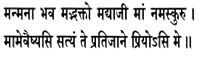
Become my-minded, my lover and adorer, a sacrificer to me, bow thyself to Me, to Me thou shalt come, this is my pledge and promise to thee, for dear art thou to Me.
The Supreme Secret
Part1 | Part 2
Part 2
This mystery of our being implies necessarily a similar supreme mystery of the being of the Purushottama, rahasyam uttamam. It is not an exclusive impersonality of the Absolute that is the highest secret. This highest secret is the miracle of a supreme Person and apparent vast Impersonal that are one, an immutable transcendent Self of all things and a Spirit that manifests itself here at the very foundation of cosmos as an infinite and multiple personality acting everywhere,—a Self and Spirit revealed to our last, closest, profoundest experience as an illimitable Being who accepts us and takes us to him, not into a blank of featureless existence, but most positively, deeply, wonderfully into all Himself and in all the ways of his and our conscious existence. This highest experience and this largest way of seeing open a profound, moving and endless significance to our parts of nature, our knowledge, will, heart's love and adoration, which is lost or diminished if we put an exclusive stress on the impersonal, because that stress suppresses or minimises or does not allow of the intensest fulfilment of movements and powers that are a portion of our deepest nature, intensities and luminosities that are attached to the closest essential fibres of our self-experience. It is not the austerity of knowledge alone that can help us; there is room and infinite room for the heart's love and aspiration illumined and uplifted by knowledge, a more mystically clear, a greater calmly passionate knowledge. It is by the perpetual unified closeness of our heart-consciousness, mind-consciousness, all consciousness, satatam maccittah, that we get the widest, the deepest, the most integral experience of our oneness with the Eternal. A nearest oneness in all the being, profoundly individual in a divine passion even in the midst of universality, even at the top of transcendence is here enjoined on the human soul as its way to reach the Highest and its way to possess the perfection and the divine consciousness to which it is called by its nature as a spirit. The intelligence and will have to turn the whole existence in all its parts to the Ishwara, to the divine Self and Master of that whole existence, buddhi-yogam upasritya. The heart has to cast all other emotion into the delight of oneness with him and the love of Him in all creatures. The sense spiritualised has to see and hear and feel him everywhere. The life has to be utterly his life in the Jiva. All the actions have to proceed from his sole power and sole initiation in the will, knowledge, organs of action, senses, vital parts, body. This way is deeply impersonal because the separateness of ego is abolished for the soul universalised and restored to transcendence. And yet it is intimately personal because it soars to a transcendent passion and power of indwelling and oneness. A featureless extinction may be a rigorous demand of the mind's logic of self-annulment; it is not the last word of the supreme mystery, rahasyam uttamam.
The refusal of Arjuna to persevere in his divinely appointed work proceeded from the ego sense in him, ahanmkara. Behind it was a mixture and confusion and tangled error of ideas and impulsions of the sattwic, rajasic, tamasic ego, the vital nature's fear of sin and its personal consequences, the heart's recoil from individual grief and suffering, the clouded reason's covering of egoistic impulses by self-deceptive specious pleas of right and virtue, our nature's ignorant shrinking from the ways of God because they seem other than the ways of man and impose things terrible and unpleasant on his nervous and emotional parts and his intelligence. The spiritual consequences will be infinitely worse now than before, now that a higher truth and a greater way and spirit of action have been revealed to him, if yet persisting in his egoism he perseveres in a vain and impossible refusal. For it is a vain resolution, a futile recoil, since it springs only from a temporary failure of strength, a strong but passing deviation from the principle of energy of his inmost character, and is not the true will and way of his nature. If now he casts down his arms, he will yet be compelled by that nature to resume them when he sees the battle and slaughter go on without him, his abstention a defeat of all for which he has lived, the cause for whose service he was born weakened and bewildered by the absence or inactivity of its protagonist, vanquished and afflicted by the cynical and unscrupulous strength of the champions of a self-regarding unrighteousness and injustice. And in this return there will be no spiritual virtue. It was a confusion of the ideas and feelings of the ego mind that impelled his refusal; it will be his nature working through a restoration of the characteristic ideas and feelings of the ego mind that will compel him to annul his refusal. But whatever the direction, this continued subjection to the ego will mean a worse, a more fatal spiritual refusal, a perdition, vinasti; for it will be a definite falling away from a greater truth of his being than that which he has followed in the ignorance of the lower nature. He has been admitted to a higher consciousness, a new self-realisation, he has been shown the possibility of a divine instead of an egoistic action; the gates have been opened before him of a divine and spiritual in place of a merely intellectual, emotional, sensuous and vital life. He is called to be no longer a great blind instrument, but a conscious soul and an enlightened power and vessel of the Godhead.
For there is this possibility within us: there is open to us even at our human highest this consummation and transcendence. The ordinary mind and life of man is a half-enlightened and mostly an ignorant development and a partial uncompleted manifestation of something concealed within him. There is a godhead there concealed from himself, subliminal to his consciousness, immobilised behind the obscure veil of a working that is not wholly his own and the secret of which he has not yet mastered. He finds himself in the world thinking and willing and feeling and acting and he takes himself instinctively or intellectually conceives of himself or at least conducts his life as a separate self-existent being who has the freedom of his thought and will and feeling and action. He bears the burden of his sin and error and suffering and takes the responsibility and merit of his knowledge and virtue; he claims the right to satisfy his sattwic, rajasic or tamasic ego and arrogates the power to shape his own destiny and to turn the world to his own uses. It is this idea of himself through which Nature works in him, and she deals with him according to his own conception, but fulfils all the time the will of the greater Spirit within her. The error of this self-view of man is like most of his errors the distortion of a truth, a distortion that creates a whole system of erroneous and yet effective values. What is true of his spirit he attributes to his ego-personality and gives it a false application, a false form and a mass of ignorant consequences. The ignorance lies in this fundamental deficiency of his surface consciousness that he identifies himself only with the outward mechanical part of him which is a convenience of Nature and with so much only of the soul as reflects and is reflected in these workings. He misses the greater inner spirit within which gives to all his mind and life and creation and action an unfulfilled promise and a hidden significance. A universal Nature here obeys the power of the Spirit who is the master of the universe, shapes each creature and determines its action according to the law of its own nature, Swabhava, shapes man too and determines his action according to the general law of nature of his kind, the law of a mental being emmeshed and ignorant in the life and the body, shapes too each man and determines his individual action according to the law of his own distinct type and the variations of his own original swabhava. It is this universal Nature that forms and directs the mechanical workings of the body and the instinctive operations of our vital and nervous parts; and there our subjection to her is very obvious. And she has formed and directs the action too, hardly less mechanical as things now are, of our sense-mind and will and intelligence. Only, while in the animal the mind workings are a wholly mechanical obedience to Prakriti, man has this distinction that he embodies a conscious development in which the soul more actively participates, and that gives to his outward mentality the sense, useful to him, indispensable, but very largely a misleading sense, of a certain freedom and increasing mastery of his instrumental nature. And it is especially misleading because it blinds him to the hard fact of his bondage and his false idea of freedom prevents him from finding a true liberty and lordship. For the freedom and mastery of man over his nature are hardly even real and cannot be complete until he becomes aware of the Divinity within him and is in possession of his own real self and spirit other than the ego, atmavan. It is that which Nature is labouring to express in mind and life and body; it is that which imposes on her this or that law of being and working, Swabhava; it is that which shapes the outward destiny and the evolution of the soul within us. It is therefore only when he is in possession of his real self and spirit that his nature can become a conscious instrument and enlightened power of the godhead.
For then, when we enter into that inmost self of our existence, we come to know that in us and in all is the one Spirit and Godhead whom all Nature serves and manifests and we ourselves are soul of this Soul, spirit of this Spirit, our body his delegated image, our life a movement of the rhythm of his life, our mind a sheath of his consciousness, our senses his instruments, our emotions and sensations the seekings of his delight of being, our actions a means of his purpose, our freedom only a shadow, suggestion or glimpse while we are ignorant, but when we know him and ourselves a prolongation and effective channel of his immortal freedom. Our masteries are a reflection of his power at work, our best knowledge a partial light of his knowledge, the highest most potent will of our spirit a projection and delegation of the will of this Spirit in all things who is the Master and Soul of the universe. It is the Lord seated in the heart of every creature who has been turning us in all our inner and outer action during the ignorance as if mounted on a machine on the wheel of this Maya of the lower Nature. And whether obscure in the Ignorance or luminous in the Knowledge, it is for him in us and him in the world that we have our existence. To live consciously and integrally in this knowledge and this truth is to escape from ego and break out of Maya. All other highest dharmas are only a preparation for this Dharma, and all Yoga is only a means by which we can come first to some kind of union and finally, if we have the full light, to an integral union with the Master and supreme Soul and Self of our existence. The greatest Yoga is to take refuge from all the perplexities and difficulties of our nature with this indwelling Lord of all Nature, to turn to him with our whole being, with the life and body and sense and mind and heart and understanding, with our whole dedicated knowledge and will and action, sarva-bhavena, in every way of our conscious self and our instrumental nature. And when we can at all times and entirely do this, then the divine Light and Love and Power takes hold of us, fills both self and instruments and leads us safe through all the doubts and difficulties and perplexities and perils that beset our soul and our life, leads us to a supreme peace and the spiritual freedom of our immortal and eternal status, param santim, sthanam sasvatam.
For after giving out all the laws, the dharmas, and the deepest essence of its Yoga, after saying that beyond all the first secrets revealed to the mind of man by the transforming light of spiritual knowledge, guhyat, this is a still deeper more secret truth, guhyataram, the Gita suddenly declares that there is yet a supreme word that it has to speak, paramam vacah, and a most secret truth of all, sarva-guhyatamam. This secret of secrets the Teacher will tell to Arjuna as his highest good because he is the chosen and beloved soul, ista. For evidently, as had already been declared by the Upanishad, it is only the rare soul chosen by the Spirit for the revelation of his very body, tanum svam, who can be admitted to this mystery, because he alone is near enough in heart and mind and life to the Godhead to respond truly to it in all his being and to make it a living practice. The last, the closing supreme word of the Gita expressing the highest mystery is spoken in two brief, direct and simple slokas and these are left without farther comment or enlargement to sink into the mind and reveal their own fullness of meaning in the soul's experience. For it is alone this inner incessantly extending experience that can make evident the infinite deal of meaning with which are for ever pregnant these words in themselves apparently so slight and simple. And we feel, as they are being uttered, that it was this for which the soul of the disciple was being prepared all the time and the rest was only an enlightening and enabling discipline and doctrine. Thus runs this secret of secrets, the highest most direct message of the Ishwara. “Become my-minded, my lover and adorer, a sacrificer to me, bow thyself to me, to me thou shalt come, this is my pledge and promise to thee, for dear art thou to me. Abandon all dharmas and take refuge in me alone. I will deliver thee from all sin and evil, do not grieve.”
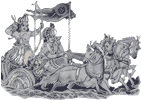
The Gita throughout has been insisting on a great and well-built discipline of Yoga, a large and clearly traced philosophical system, on the Swabhava and the Swadharma, on the sattwic law of life as leading out of itself by a self-exceeding exaltation to a free spiritual dharma of immortal existence utterly wide in its spaces and high-lifted beyond the limitation of even this highest guna, on many rules and means and injunctions and conditions of perfection, and now suddenly it seems to break out of its own structure and says to the human soul, “Abandon all dharmas, give thyself to the Divine alone, to the supreme Godhead above and around and within thee: that is all that thou needest, that is the truest and greatest way, that is the real deliverance.” The Master of the worlds in the form of the divine Charioteer and Teacher of Kurukshetra has revealed to man the magnificent realities of God and Self and Spirit and the nature of the complex world and the relation of man's mind and life and heart and senses to the Spirit and the victorious means by which through his own spiritual self-discipline and effort he can rise out of mortality into immortality and out of his limited mental into his infinite spiritual existence. And now speaking as the Spirit and Godhead in man and in all things he says to him, “All this personal effort and self-discipline will not in the end be needed, all following and limitation of rule and dharma can at last be thrown away as hampering encumbrances if thou canst make a complete surrender to Me, depend alone on the Spirit and Godhead within thee and all things and trust to his sole guidance. Turn all thy mind to me and fill it with the thought of me and my presence. Turn all thy heart to me, make thy every action, whatever it be, a sacrifice and offering to me. That done, leave me to do my will with thy life and soul and action; do not be grieved or perplexed by my dealings with thy mind and heart and life and works or troubled because they do not seem to follow the laws and dharmas man imposes on himself to guide his limited will and intelligence. My ways are the ways of a perfect wisdom and power and love that knows all things and combines all its movements in view of a perfect eventual result; for it is refining and weaving together the many threads of an integral perfection. I am here with thee in thy chariot of battle revealed as the Master of Existence within and without thee and I repeat the absolute assurance, the infallible promise that I will lead thee to myself through and beyond all sorrow and evil. Whatever difficulties and perplexities arise, be sure of this that I am leading thee to a complete divine life in the universal and an immortal existence in the transcendent Spirit.”
The secret thing, guhyam, that all deep spiritual knowledge reveals to us, mirrored in various teachings and justified in the soul's experience, is for the Gita the secret of the spiritual self hidden within us of which mind and external Nature are only manifestations or figures. It is the secret of the constant relations between soul and Nature, Purusha and Prakriti, the secret of an indwelling Godhead who is the lord of all existence and veiled from us in its forms and movements. These are the truths taught in many ways by Vedanta and Sankhya and Yoga and synthetised in the earlier chapters of the Gita. And amidst all their apparent distinctions they are one truth and all the different ways of Yoga are various means of spiritual self-discipline by which our unquiet mind and blinded life are stilled and turned towards this many-aspected One and the secret truth of self and God made so real to us and intimate that we can either consciously live and dwell in it or lose our separate selves in the Eternal and no longer be compelled at all by the mental Ignorance.
The more secret thing, guhyataram, developed by the Gita is the profound reconciling truth of the divine Purushottama, at once self and Purusha, supreme Brahman and a sole, intimate, mysterious, ineffable Godhead. That gives to the thought a larger and more deeply understanding foundation for an ultimate knowledge and to the spiritual experience a greater and more fully comprehending and comprehensive Yoga. This deeper mystery is founded on the secret of the supreme spiritual Prakriti and of the Jiva, an eternal portion of the Divine in that eternal and this manifested Nature and of one spirit and essence with him in his immutable self-existence. This profounder knowledge escapes from the elementary distinction of spiritual experience between the Beyond and what is here. For the Transcendent beyond the worlds is at the same time Vasudeva who is all things in all worlds; he is the Lord standing in the heart of every creature and the self of all existences and the origin and supernal meaning of everything that he has put forth in his Prakriti. He is manifested in his Vibhutis and he is the Spirit in Time who compels the action of the world and the Sun of all knowledge and the Lover and Beloved of the soul and the Master of all works and sacrifice. The result of an inmost opening to this deeper, truer, more secret mystery is the Gita's Yoga of integral knowledge, integral works and integral bhakti. It is the simultaneous experience of spiritual universality and a free and perfected spiritual individuality, of an entire union with God and an entire dwelling in him as at once the frame of the soul's immortality and the support and power of our liberated action in the world and the body.
And now there comes the supreme word and most secret thing of all, guhyatamam, that the Spirit and Godhead is an Infinite free from all dharmas and though he conducts the world according to fixed laws and leads man through his dharmas of ignorance and knowledge, sin and virtue, right and wrong, liking and disliking and indifference, pleasure and pain, joy and sorrow and the rejection of these opposites, through his physical and vital, intellectual, emotional, ethical and spiritual forms and rules and standards, yet the Spirit and Godhead transcends all these things, and if we too can cast away all dependence on dharmas, surrender ourselves to this free and eternal Spirit and, taking care only to keep ourselves absolutely and exclusively open to him, trust to the light and power and delight of the Divine in us and, unafraid and ungrieving, accept only his guidance, then that is the truest, the greatest release and that brings the absolute and inevitable perfection of our self and nature. This is the way offered to the chosen of the Spirit,—to those only in whom he takes the greatest delight because they are nearest to him and most capable of oneness and of being even as he, freely consenting and concordant with Nature in her highest power and movement, universal in soul consciousness, transcendent in the spirit.
For a time comes in spiritual development when we become aware that all our effort and action are only our mental and vital reactions to the silent and secret insistence of a greater Presence in and around us. It is borne in upon us that all our Yoga, our aspiration and our endeavour are imperfect or narrow forms, because disfigured or at least limited by the mind's associations, demands, prejudgments, predilections, mistranslations or half translations of a vaster truth. Our ideas and experiences and efforts are mental images only of greatest things which would be done more perfectly, directly, freely, largely, more in harmony with the universal and eternal will by that Power itself in us if we could only put ourselves passively as instruments in the hands of a supreme and absolute strength and wisdom. That Power is not separate from us; it is our own self one with the self of all others and at the same time a transcendent Being and an immanent Person. Our existence, our action taken up into this greatest Existence would be no longer, as it seems to us now, individually our own in a mental separation. It would be the vast movement of an Infinity and an intimate ineffable Presence; it would be the constant spontaneity of formation and expression in us of this deep universal self and this transcendent Spirit. The Gita indicates that in order that that may wholly be, the surrender must be without reservations; our Yoga, our life, our state of inner being must be determined freely by this living Infinite, not predetermined by our mind's insistence on this or that dharma or any dharma. The divine Master of the Yoga, yogesvarah krsnah, will then himself take up our Yoga and raise us to our utmost possible perfection, not the perfection of any external or mental standard or limiting rule, but vast and comprehensive, to the mind incalculable. It will be a perfection developed by an all-seeing Wisdom according to the whole truth, first indeed of our human swabhava, but afterwards of a greater thing into which it will open, a spirit and power illimitable, immortal, free and all-transmuting, the light and splendour of a divine and infinite nature.
All must be given as material of that transmutation. An omniscient consciousness will take up our knowledge and our ignorance, our truth and our error, cast away their forms of insufficiency, sarva-dharman parityajya, and transform all into its infinite light. An almighty Power will take up our virtue and sin, our right and wrong, our strength and our weakness, cast away their tangled figures, sarva-dharman parityajya, and transform all into its transcendent purity and universal good and infallible force. An ineffable Ananda will take up our petty joy and sorrow, our struggling pleasure and pain, cast away their discordances and imperfect rhythms, sarva-dharm\=an parityajya, and transform all into its transcendent and universal unimaginable delight. All that all the Yogas can do will be done and more; but it will be done in a greater seeing way, with a greater wisdom and truth than any human teacher, saint or sage can give us. The inner spiritual state to which this supreme Yoga will take us, will be above all that is here and yet comprehensive of all things in this and other worlds, but with a spiritual transformation of all, without limitation, without bondage, sarva-dharman parityajya. The infinite existence, consciousness and delight of the Godhead in its calm silence and bright boundless activity will be there, will be its essential, fundamental, universal stuff, mould and character. And in that mould of infinity the Divine made manifest will overtly dwell, no longer concealed by his Yogamaya, and whenever and as he wills build in us whatever shapes of the Infinite, translucent forms of knowledge, thought, love, spiritual joy, power and action according to his self-fulfilling will and immortal pleasure. And there will be no binding effect on the free soul and the unaffected nature, no unescapable crystallising into this or that inferior formula. For all the action will be executed by the power of the Spirit in a divine freedom, sarva-dharman parityajya. An unfallen abiding in the transcendent Spirit, paramatama, will be the foundation and the assurance of this spiritual state. An intimate understanding oneness with universal being and all creatures, released from the evil and suffering of the separative mind but wisely regardful of true distinctions, will be the conditioning power. A constant delight, oneness and harmony of the eternal individual here with the Divine and all that he is will be the effect of this integral liberation. The baffling problems of our human existence of which Arjuna's difficulty stands as an acute example, are created by our separative personality in the Ignorance. This Yoga because it puts the soul of man into its right relation with God and world-existence and makes our action God's, the knowledge and will shaping and moving it his and our life the harmony of a divine self-expression, is the way to their total disappearance.
The whole Yoga is revealed, the great word of the teaching is given, and Arjuna the chosen human soul is once more turned, no longer in his egoistic mind but in this greatest self-knowledge, to the divine action. The Vibhuti is ready for the divine life in the human, his conscious spirit for the works of the liberated soul, muktasya karma. Destroyed is the illusion of the mind; the soul's memory of its self and its truth concealed so long by the misleading shows and forms of our life has returned to it and become its normal consciousness: all doubt and perplexity gone, it can turn to the execution of the command and do faithfully whatever work for God and the world may be appointed and apportioned to it by the Master of our being, the Spirit and Godhead self-fulfilled in Time and universe.
Sri Aurobindo
 About Us | ©1999 - 2009 searchforlight.org
All extracts and quotations from the written works of Sri Aurobindo and the Mother and the Photographs of
the Mother and Sri Aurobindo are copyright Sri Aurobindo Ashram Trust, Pondicherry -605002 India.