
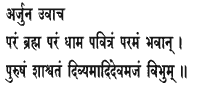
Arjuna said: Thou art the supreme Brahman, the supreme Abode, the supreme Purity, the one permanent, the divine Purusha, the original Godhead, the Unborn, the all-pervading Lord.
The Supreme Divine
Sri Aurobindo
ALREADY what has been said in the seventh chapter provides us with the starting-point of our new and fuller position and fixes it with sufficient precision. Substantially it comes to this that we are to move inwardly towards a greater consciousness and a supreme existence, not by a total exclusion of our cosmic nature, but by a higher, a spiritual fulfilment of all that we now essentially are. Only there is to be a change from our mortal imperfection to a divine perfection of being. The first idea on which this possibility is founded, is the conception of the individual soul in man as in its eternal essence and its original power a ray of the supreme Soul and Godhead, here a veiled manifestation of him, a being of his being, a consciousness of his consciousness, a nature of his nature, but in the obscurity of this mental and physical existence self-forgetful of its source, its reality, its true character. The second idea is that of the double nature of the Soul in manifestation,—the original nature in which it is one with its own true spiritual being, and the derived in which it is subject to the confusions of egoism and ignorance. The latter has to be cast away and the spiritual has to be inwardly recovered, fulfilled, made dynamic and active. Through an inner self-fulfilment, the opening of a new status, our birth into a new power, we return to the nature of the Spirit and re-become a portion of the Godhead from whom we have descended into this mortal figure of being. There is here at once a departure from the general contemporarymind of Indian thought, a less negating attitude, a greater affirmation. In place of its obsessing idea of a self-annulment of Nature we get the glimpse of an ampler solution, the principle of a self-fulfilment in divine Nature. There is, even, at least
a foreshadowing of the later developments of the religions of Bhakti. Our first experience of what is beyond our normal status, concealed behind the egoistic being in which we live, is still for the Gita the calm of a vast impersonal immutable self in whose equality and oneness we lose our petty egoistic personality and cast off in its tranquil purity all our narrow motives of desire and passion. But our second completer vision reveals to us a living Infinite, a divine immeasurable Being from whom all that we are proceeds and to which all that we are belongs, self and nature, world and spirit. When we are one with him in self and spirit, we do not lose ourselves, but rather recover our true selves in him poised in the supremacy of this Infinite. And this is done at one and the same time by three simultaneous movements,— an integral self-finding through works founded in his and our spiritual nature, an integral self-becoming through knowledge of the Divine Being in whom all exists and who is all, and— most sovereign and decisive movement of all—an integral selfgiving through love and devotion of our whole being to this All and this Supreme, attracted to the Master of our works, to the Inhabitant of our hearts, to the continent of all our conscious existence. To him who is the source of all that we are, we give all that we are. Our persistent consecration turns into knowledge of him all our knowing and into light of his power all our action. The passion of love in our self-giving carries us up to him and opens the mystery of his deepest heart of being. Love completes the triple cord of the sacrifice, perfects the triune key of the highest secret, uttamam˙ rahasyam. An integral knowledge in our self-giving is the first condition of its effective force. And therefore we have first of all to know this Purusha in all the powers and principles of his divine existence, tattvatah. , in the whole harmony of it, in its eternal essence and living process. But to the ancient thought all the value of this knowledge, tattvajn˜ a¯na, lay in its power for release out of our mortal birth into the immortality of a supreme existence. The Gita therefore proceeds next to show how this liberation too in the highest degree is a final outcome of its own movement of spiritual self-fulfilment. The knowledge of the Purushottama, it says in effect, is the perfect knowledge of the Brahman. Those who have resort to Me as their refuge, m¯am ¯a´sritya, their divine light, their deliverer, receiver and harbourer of their souls, those who turn to Me in their spiritual effort towards release from age and death, from the mortal being and its limitations, says Krishna, come to know that Brahman and all the integrality of the spiritual nature and the entirety of Karma. And because they know Me and know at the same time the material and the divine nature of being and the truth of the Master of sacrifice, they keep knowledge of Me also in the critical moment of their departure from physical existence and have at that moment their whole consciousness in union with Me. Therefore they attain to Me. No longer bound to the mortal existence, they reach the very highest status of the Divine quite as effectively as those who lose their separate personality in the impersonal and immutable Brahman. Thus the Gita closes this important and decisive seventh chapter. Here we have certain expressions which give us in their brief sum the chief essential truths of the manifestation of the supreme Divine in the cosmos. All the originative and effective aspects of it are there, all that concerns the soul in its return to integral self-knowledge. First there is that Brahman, tad brahma; adhya¯tma, second, the principle of the self in Nature; adhibhu¯ ta and adhidaiva next, the objective phenomenon and subjective phenomenon of being; adhiyajn˜ a last, the secret of the cosmic principle of works and sacrifice. I, the Purushottama (ma¯m˙ viduh. ), says in effect Krishna, I who am above all these things, must yet be sought and known through all together and by means of their relations,—that is the only complete way for the human consciousness which is seeking its path back towards Me. But these terms in themselves are not at first quite clear or at least they are open to different interpretations, they have to be made precise in their connotation, and Arjuna the disciple at once asks for their elucidation. Krishna answers very briefly,— nowhere does the Gita linger very long upon any purely metaphysical explanation; it gives only so much and in such a way as will make their truth just seizable for the soul to proceed on to experience. By that Brahman, a phrase which in the Upanishads is more than once used for the self-existent as opposed to the phenomenal being, the Gita intends, it appears, the immutable self-existence which is the highest self-expression of the Divine and on whose unalterable eternity all the rest, all that moves and evolves, is founded, aks.aram˙ paramam. By adhya¯tma it means svabh¯ava, the spiritual way and law of being of the soul in the supremeNature. Karma, it says, is the name given to the creative impulse and energy, visargah. , which looses out things from this first essential self-becoming, this Swabhava, and effects, creates, works out under its influence the cosmic becoming of existences in Prakriti. By adhibhu¯ ta is to be understood all the result of mutable becoming, ks.aro bh¯avah.. By adhidaiva is intended the Purusha, the soul in Nature, the subjective being who observes and enjoys as the object of his consciousness all that is this mutable becoming of his essential existence worked out here by Karma in Nature. By adhiyajn˜ a, the Lord of works and sacrifice, I mean, says Krishna, myself, the Divine, the Godhead, the Purushottama here secret in the body of all these embodied existences. All that is, therefore, falls within this formula. The Gita immediately proceeds from this brief statement to work out the idea of the final release by knowledge which it has suggested in the last verse of the preceding chapter. It will return indeed upon its thought hereafter to give such ulterior light as is needed for action and inner realisation, and we may wait till then for a fuller knowledge of all that these terms indicate. But before we proceed farther, it is necessary to bring out as much of the connection between these things as we are justified in understanding from this passage itself and from what has gone before. For here is indicated the Gita’s idea of the process of the cosmos. First there is the Brahman, the highest immutable self-existent being which all existences are behind the play of cosmic Nature in time and space and causality, de´sak ¯ ala-nimitta. For by that self-existence alone time and space and causality are able to exist, and without that unchanging support omnipresent, yet indivisible they could not proceed to their divisions and results and measures. But of itself the immutable Brahman does nothing, causes nothing, determines nothing; it is impartial, equal, all-supporting, but does not select or originate. What then originates, what determines, what gives the divine impulsion of the Supreme? what is it that governs Karma and actively unrolls the cosmic becoming in Time out of the eternal being? It is Nature as Swabhava. The Supreme, the Godhead, the Purushottama is there and supports on his eternal immutability the action of his higher spiritual Shakti. He displays the divine Being, Consciousness, Will or Power, yayedam˙ dha¯ryate jagat: that is the Para Prakriti. The self-awareness of the Spirit in this supreme Nature perceives in the light of self-knowledge the dynamic idea, the authentic truth of whatever he separates in his own being and expresses it in the Swabhava, the spiritual nature of the Jiva. The inherent truth and principle of the self of each Jiva, that which works itself out in manifestation, the essential divine nature in all which remains constant behind all conversions, perversions, reversions, that is the Swabhava. All that is in the Swabhava is loosed out into cosmic Nature for her to do what she can with it under the inner eye of the Purushottama. Out of the constant svabh¯ava, out of the essential nature and self-principle of being of each becoming, she creates the varied mutations by which she strives to express it, unrolls all her changes in name and form, in time and space and those successions of condition developed one out of the other in time and space which we call causality, nimitta. All this bringing out and continual change from state to state is Karma, is action of Nature, is the energy of Prakriti, the worker, the goddess of processes. It is first a loosing forth of the svabh¯ava into its creative action, visargah. . The creation is of existences in the becoming, bhu¯ ta-karah. , and of all that they subjectively or otherwise become, bh¯ava-karah. . All taken together, it is a constant birth of things in Time, udbhava, of which the creative energy of Karma is the principle. All this mutable becoming emerges by a combination of the powers and energies of Nature, adhibhu¯ ta, which constitutes the world and is the object of the soul’s consciousness. In it all the soul is the enjoying and observing Deity in Nature; the divine powers of mind and will and sense, all the powers of its conscious being by which it reflects this working of Prakriti are its godheads, adhidaiva. This soul in Nature is therefore the ks.ara purus.a, it is the mutable soul, the eternal activity of the Godhead: the same soul in the Brahman drawn back from her is the aks.ara purus.a, the immutable self, the eternal silence of the Godhead. But in the form and body of the mutable being inhabits the supreme Godhead. Possessing at once the calm of the immutable existence and the enjoyment of the mutable action there dwells in man the Purushottama. He is not only remote from us in some supreme status beyond, but he is here too in the body of every being, in the heart of man and in Nature. There he receives the works of Nature as a sacrifice and awaits the conscious self-giving of the human soul: but always even in the human creature’s ignorance and egoism he is the Lord of his swabhava and the Master of all his works, who presides over the law of Prakriti and Karma. From him the soul came forth into the play of Nature’s mutations; to him the soul returns through immutable self-existence to the highest status of the Divine, param˙ dha¯ma. Man, born into the world, revolves between world and world in the action of Prakriti and Karma. Purusha in Prakriti is his formula: what the soul in him thinks, contemplates and acts, that always he becomes. All that he had been, determined his present birth; and all that he is, thinks, does in this life up to the moment of his death, determines what he will become in the worlds beyond and in lives yet to be. If birth is a becoming, death also is a becoming, not by any means a cessation. The body is abandoned, but the soul goes on its way, tyaktv ¯a kalevaram. Much then depends on what he is at the critical moment of his departure. For whatever form of becoming his consciousness is fixed on at the time of death and has been full of that always in his mind and thought before death, to that form he must attain, since the Prakriti by Karma works out the soul’s thoughts and energies and that is in real fact her whole business. Therefore, if the soul in the human being desires to attain to the status of the Purushottama, there are two necessities, two conditions which must be satisfied before that can be possible. He must have moulded towards that ideal his whole inner life in his earthly living; and he must be faithful to his aspiration and will in his departing. “Whoever leaves his body and departs” says Krishna “remembering me at his time of end, comes to my bh¯ava,” that of the Purushottama, my status of being. He is united with the original being of the Divine and that is the ultimate becoming of the soul, paro bh¯avah. , the last result of Karma in its return upon itself and towards its source. The soul which has followed the play of cosmic evolution that veils here its essential spiritual nature, its original form of becoming, svabh¯ava, and has passed through all these other ways of becoming of its consciousness which are only its phenomena, tam˙ tam˙ bha¯vam, returns to that essential nature and, finding through this return its true self and spirit, comes to the original status of being which is from the point of view of the return a highest becoming, mad-bh¯avam. In a certain sense we may say that it becomes God, since it unites itself with nature of the Divine in a last transformation of its own phenomenal nature and existence. The Gita here lays a great stress on the thought and state of mind at the time of death, a stress which will with difficulty be understood if we do not recognise what may be called the selfcreative power of the consciousness. What the thought, the inner regard, the faith, ´sraddh¯a, settles itself upon with a complete and definite insistence, into that our inner being tends to change. This tendency becomes a decisive force when we go to those higher spiritual and self-evolved experiences which are less dependent on external things than is our ordinary psychology, enslaved as that is to outward Nature. There we can see ourselves steadily becoming that on which we keep our minds fixed and to which we constantly aspire. Therefore there any lapse of the thought, any infidelity of the memory means always a retardation of the change or some fall in its process and a going back towards what we were before,—at least so long as we have not substantially and irrevocably fixed our new becoming. When we have done that, when we have made it normal to our experience, the memory of it remains self-existently because that now is the natural form of our consciousness. In the critical moment of passing from the mortal plane of living, the importance of our then state of consciousness becomes evident. But it is not a deathbed remembrance at variance with or insufficiently prepared by the whole tenor of our life and our past subjectivity that can have this saving power. The thought of the Gita here is not on a par with the indulgences and facilities of popular religion; it has nothing in common with the crude fancies that make the absolution and last unction of the priest, an edifying “Christian” death after an unedifying profane life or the precaution or accident of a death in sacred Benares or holy Ganges a sufficient machinery of salvation. The divine subjective becoming on which the mind has to be fixed firmly in the moment of the physical death, yam˙ smaran bha¯vam˙ tyajati ante kalevaram, must have been one into which the soul was at each moment growing inwardly during the physical life, sad¯a tad-bh¯ava-bh¯ avitah. . “Therefore,” says the divine Teacher, “at all times remember me and fight; for if thy mind and thy understanding are always fixed on and given up to Me, mayi arpita-mano-buddhih. , to Me thou shalt surely come. For it is by thinking always of him with a consciousness united with him in an undeviating Yoga of constant practice that one comes to the divine and supreme Purusha.” We arrive here at the first description of this supreme Purusha,— the Godhead who is even more and greater than the Immutable and to whom the Gita gives subsequently the name of Purushottama. He too in his timeless eternity is immutable and far beyond all this manifestation and here in Time there dawn on us only faint glimpses of his being conveyed through many varied symbols and disguises, avyakto aks.arah. . Still he is not merely a featureless or indiscernible existence, anirde´syam; or he is indiscernible only because he is subtler than the last subtlety of which the mind is aware and because the form of the Divine is beyond our thought, an. or an. ı¯ya¯m˙ sam acintya-ru¯pam. This supreme Soul and Self is the Seer, the Ancient of Days and in his eternal self-vision and wisdom theMaster and Ruler of all existence who sets in their place in his being all things that are, kavim˙ pura¯n.am anus´a¯ sita¯ram˙ sarvasya dha¯ ta¯ram. This supreme Soul is the immutable self-existent Brahman of whom the Veda knowers speak, and this is that into which the doers of askesis enter when they have passed beyond the affections of the mind of mortality and for the desire of which they practise the control of the bodily passions.2 That eternal reality is the highest step, place, foothold of being (padam); therefore is it the supreme goal of the soul’s movement in Time, itself no movement but a status original, sempiternal and supreme, param˙ stha¯nam a¯dyam. The Gita describes the last state of the mind of the Yogin in which he passes from life through death to this supreme divine existence. A motionless mind, a soul armed with the strength of Yoga, a union with God in bhakti,—the union by love is not here superseded by the featureless unification through knowledge, it remains to the end a part of the supreme force of the Yoga,—and the life-force entirely drawn up and set between the brows in the seat of mystic vision. All the doors of the sense are closed, the mind is shut in into the heart, the life-force taken up out of its diffused movement into the head, the intelligence concentrated in the utterance of the sacred syllable OM and its conceptive thought in the remembrance of the supreme Godhead, m¯am anusmaran. That is the established Yogic way of going, a last offering up of the whole being to the Eternal, the Transcendent. But still that is only a process; the essential condition is the constant undeviating memory of the Divine in life, even in action and battle—m¯am anusmara yudhya ca— and the turning of the whole act of living into an uninterrupted Yoga, nitya-yoga. Whoever does that, finds Me easy to attain, says the Godhead; he is the great soul who reaches the supreme perfection. The condition to which the soul arrives when it thus departs from life is supracosmic. The highest heavens of the cosmic plan are subject to a return to rebirth; but there is no rebirth imposed on the soul that departs to the Purushottama. Therefore whatever fruit can be had from the aspiration of knowledge to the indefinable Brahman, is acquired also by this other and comprehensive aspiration through knowledge, works and love to the
self-existent Godhead who is theMaster of works and the Friend of mankind and of all beings. To know him so and so to seek him does not bind to rebirth or to the chain of Karma; the soul can satisfy its desire to escape permanently from the transient and painful condition of our mortal being. And the Gita here, in order to make more precise to the mind this circling round of births and the escape from it, adopts the ancient theory of the cosmic cycles which became a fixed part of Indian cosmological notions. There is an eternal cycle of alternating periods of cosmic manifestation and non-manifestation, each period called respectively a day and a night of the creator Brahma, each of equal length in Time, the long aeon of his working which endures for a thousand ages, the long aeon of his sleep of another thousand silent ages. At the coming of the Day all manifestations are born into being out of the unmanifest, at the coming of the Night all vanish or are dissolved into it. Thus all these existences alternate helplessly in the cycle of becoming and non-becoming; they come into the becoming again and again, bhu¯ tva¯ bhu¯tva¯ , and they go back constantly into the unmanifest. But this unmanifest is not the original divinity of the Being; there is another status of his existence, bh¯avo ’nyo, a supracosmic unmanifest beyond this cosmic non-manifestation, which is eternally self-seated, is not an opposite of this cosmic status of manifestation but far above and unlike it, changeless, eternal, not forced to perish with the perishing of all these existences. “He is called the unmanifest immutable, him they speak of as the supreme soul and status, and those who attain to him return not; that is my supreme place of being, paramam˙ dha¯ma.” For the soul attaining to it has escaped out of the cycle of cosmic manifestation and non-manifestation. Whether we entertain or we dismiss this cosmological notion,— which depends on the value we are inclined to assign to the knowledge of “the knowers of day and night,”—the important thing is the turn the Gita gives to it. One might easily imagine that this eternally unmanifested Being whose status seems to have nothing to do with the manifestation or the non-manifestation, must be the ever undefined and indefinable Absolute, and the proper way to reach him is to get rid of all that we have become in the manifestation, not to carry up to it our whole inner consciousness in a combined concentration of the mind’s knowledge, the heart’s love, the Yogic will, the vital life-force. Especially, bhakti seems inapplicable to the Absolute who is void of every relation, avyavah¯arya. “But” insists the Gita,—although this condition is supracosmic and although it is eternally unmanifest,—still “that supreme Purusha has to be won by a bhakti which turns to him alone in whom all beings exist and by whom all this world has been extended in space.” In other words, the supreme Purusha is not an entirely relationless Absolute aloof from our illusions, but he is the Seer, Creator and Ruler of the worlds, kavim anu´s ¯ asit ¯aram, dh¯ at ¯aram, and it is by knowing and by loving Him as the One and the All, v¯asudevah. sarvam iti, that we ought by a union with him of our whole conscious being in all things, all energies, all actions to seek the supreme consummation, the perfect perfection, the absolute release. Then there comes a more curious thought which theGita has adopted from the mystics of the early Vedanta. It gives the different times at which the Yogin has to leave his body according as he wills to seek rebirth or to avoid it. Fire and light and smoke or mist, the day and the night, the bright fortnight of the lunar month and the dark, the northern solstice and the southern, these are the opposites. By the first in each pair the knowers of the Brahman go to the Brahman; but by the second the Yogin reaches the “lunar light” and returns subsequently to human birth. These are the bright and the dark paths, called the path of the gods and the path of the fathers in the Upanishads, and the Yogin who knows them is not misled into any error. Whatever psycho-physical fact or else symbolism there may be behind this notion,3—it comes down from the age of the mystics who saw in every physical thing an effective symbol of the psychological
and who traced everywhere an interaction and a sort of identity of the outward with the inward, light and knowledge, the fiery principle and the spiritual energy,—we need observe only the turn by which the Gita closes the passage: “Therefore at all times be in Yoga.” For that is after all the essential, to make the whole being one with the Divine, so entirely and in all ways one as to be naturally and constantly fixed in union, and thus to make all living, not only thought and meditation, but action, labour, battle, a remembering of God. “Remember me and fight,” means not to lose the ever-present thought of the Eternal for one single moment in the clash of the temporal which normally absorbs our minds, and that seems sufficiently difficult, almost impossible. It is entirely possible indeed only if the other conditions are satisfied. If we have become in our consciousness one self with all, one self which is always to our thought the Divine, and even our eyes and our other senses see and sense the Divine Being everywhere so that it is impossible for us at any time at all to feel or think of anything as that merely which the unenlightened sense perceives, but only as the Godhead at once concealed and manifested in that form, and if our will is one in consciousness with a supreme will and every act of will, of mind, of body is felt to come from it, to be its movement, instinct with it or identical, then what the Gita demands can be integrally done. The remembrance of the Divine Being becomes no longer an intermittent act of the mind, but the natural condition of our activities and in a way the very substance of the consciousness. The Jiva has become possessed of its right and natural, its spiritual relation to the Purushottama and all our life is a Yoga, an accomplished and yet an eternally self-accomplishing oneness.
Sri Aurobindo
 About Us | ©1999 - 2009 searchforlight.org
All extracts and quotations from the written works of Sri Aurobindo and the Mother and the Photographs of
the Mother and Sri Aurobindo are copyright Sri Aurobindo Ashram Trust, Pondicherry -605002 India.