
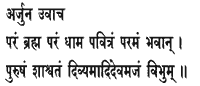
Arjuna said: Thou art the supreme Brahman, the supreme Abode, the supreme Purity, the one permanent, the divine Purusha, the original Godhead, the Unborn, the all-pervading Lord.
The Secret of Secrets
Sri Aurobindo
ALL THE truth that has developed itself at this length step by step, each bringing forward a fresh aspect of the integral knowledge and founding on it some result of spiritual state and action, has now to take a turn of immense importance. The Teacher therefore takes care first to draw attention to the decisive character of what he is about to say, so that the mind of Arjuna may be awakened and attentive. For he is going to open his mind to the knowledge and sight of the integral Divinity and lead up to the vision of the eleventh book, by which the warrior of Kurukshetra becomes conscious of the author and upholder of his being and action and mission, the Godhead in man and the world, whom nothing in man and the world limits or binds, because all proceeds from him, is a movement in his infinite being, continues and is supported by his will, is justified in his divine self-knowledge, has him always for its origin, substance and end. Arjuna is to become aware of himself as existing only in God and as acting only by the power within him, his workings only an instrumentality of the divine action, his egoistic consciousness only a veil and to his ignorance amisrepresentation of the real being within him which is an immortal spark and portion of the supreme Godhead. This vision is to remove whatever doubt may still remain within his mind; it is to make him strong for the action from which he has shrunk, but to which he is irrevocably commanded and can no more recoil from it,—for to recoil would be the negation and denial of the divine will and sanction within him already expressed in his individual consciousness but soon to assume the appearance of the greater cosmic sanction. For now the world Being appears to him as the body of God ensouled by the eternal Time-spirit and with its majestic and dreadful voice missions him to the crash of the battle. He is called by it to the liberation of his spirit, to the fulfilment of his action in the cosmic mystery, and the two—liberation and action—are to be one movement. His intellectual doubts are clearing away as a greater light of self-knowledge and the knowledge of God and Nature is being unfolded before him. But intellectual clarity is not enough; he must see with the inner sight illumining his blind outward human vision, so that he may act with the consent of his whole being, with a perfect faith in all his members, ´sraddh¯a, with a perfect devotion to the Self of his self and the Master of his being and to the same Self of the world and Master of all being in the universe. All that has gone before laid the foundations of the knowledge or prepared its first necessary materials or scaffolding, but now the full frame of the structure is to be placed before his unsealed vision. All that is to come after will have its great importance because it will analyse parts of this frame, show in what this or that in it consists; but in substance the integral knowledge of the Being who is speaking to him is to be now unveiled to his eyes so that he cannot choose but see. What has gone before showed him that he is not bound fatally to the knot of the ignorance and egoistic action in which he had hitherto remained contented till its partial solutions sufficed no longer to satisfy his mind bewildered by the conflict of opposite appearances that make up the action of the world and his heart troubled by the entanglement of his works from which he feels himself unable to escape except by renunciation of life and works. He has been shown that there are two opposed ways of working and living, one in the ignorance of the ego, one in the clear self-knowledge of a divine being. He may act with desire, with passion, an ego driven by the qualities of the lower Nature, subject to the balance of virtue and sin, joy and sorrow, preoccupied with the fruits and consequences of his works, success and defeat, good result and evil result, bound on the world machine, caught up in a great tangle of action and inaction and perverse action which perplex the heart and mind and soul of man with their changing and contrary masks and appearances. But he is not utterly tied down to the works of the ignorance; he may do if he will the works of knowledge. He may act here as the higher thinker, the knower, the Yogin, the seeker of freedom first and afterwards the liberated spirit. To perceive that great possibility and to keep his will and intelligence fixed on the knowledge and self-vision which will realise and make it effectual, is the path of escape from his sorrow and bewilderment, the way out of the human riddle. There is a spirit within us calm, superior to works, equal, not bound in this external tangle, surveying it as its supporter, source, immanent witness, but not involved in it. Infinite, containing all, one self in all, it surveys impartially the whole action of nature and it sees that it is only the action of Nature, not its own action. It sees that the ego and its will and its intelligence are all a machinery of Nature and that all their activities are determined by the complexity of her triple modes and qualities. The eternal spirit itself is free from these things. It is free from them because it knows; it knows that Nature and ego and the personal being of all these creatures do not make up the whole of existence. For existence is not merely a glorious or a vain, a wonderful or a dismal panorama of a constant mutation of becoming. There is something eternal, immutable, imperishable, a timeless self-existence; that is not affected by the mutations of Nature. It is their impartial witness, neither affecting nor affected, neither acting nor acted upon, neither virtuous nor sinful, but always pure, complete, great and unwounded. Neither grieving nor rejoicing at all that afflicts and attracts the egoistic being, it is the friend of none, the enemy of none, but one equal self of all. Man is not now conscious of this self, because he is wrapped up in his outward-going mind, because he will not learn or has not learned to live within; he does not detach himself, draw back from his action and observe it as the work of Nature. Ego is the obstacle, the linch-pin of the wheel of delusion, the loss of the ego in the soul’s self the first condition of freedom. To become spirit, no longer merely a mind and ego, is the opening word of this message of liberation. Arjuna has been therefore called upon first to give up all desire of the fruits of his works and become simply the desireless impartial doer of whatever has to be done,—leaving the fruit to whatever power may be the master of the cosmic workings. For he very evidently is not the master; it is not for the satisfaction of his personal ego that Nature was set upon her ways, not for the fulfilment of his desires and preferences that the universal Life is living, not for the justification of his intellectual opinions, judgments and standards that the universal Mind is working, nor is it to that petty tribunal that it has to refer its cosmic aims or its terrestrial method and purposes. These claims can only be made by the ignorant souls who live in their personality and see everything from that poor and narrow standpoint. He must stand back first from his egoistic demand on the world and work only as one among the millions who contributes his share of effort and labour to a result determined not by himself, but by the universal action and purpose. But he has to do yet more, he has to give up the idea of being the doer and to see, freed from all personality, that it is the universal intelligence, will, mind, life that is at work in him and in all others. Nature is the universal worker; his works are hers, even as the fruits of her works in him are part of the grand sum of result guided by a greater Power than his own. If he can do these two things spiritually, then the tangle and bondage of his works will fall far away from him; for the whole knot of that bondage lay in his egoistic demand and participation. Passion and sin and personal joy and grief will fade away from his soul, which will now live within, pure, large, calm, equal to all persons and all things. Action will produce no subjective reaction and will leave no stain nor any mark on his spirit’s purity and peace. He will have the inner joy, rest, ease and inalienable bliss of a free unaffected being. Neither within nor without will he have any more the old little personality, for he will feel consciously one self and spirit with all, even as his outer nature will have become to his consciousness an inseparable part of the universal mind, life and will. His separative egoistic personality will have been taken up and extinguished in the impersonality of spiritual being; his separative egoistic nature will be unified with the action of cosmic Nature. But this liberation is dependent on two simultaneous, but not yet reconciled perceptions, the clear vision of spirit and the clear vision of Nature. This is not the scientific and intelligent detachment which is quite possible even to the materialistic philosopher who has some clear vision of Nature alone, but not the perception of his own soul and self-being. Nor is it the intellectual detachment of the idealistic sage who escapes from the more limiting and disturbing forms of his ego by a luminous use of the reason. This is a larger, more living, more perfect spiritual detachment which comes by a vision of the Supreme who is more than Nature and greater than mind and reason. But even this detachment is only the initial secret of freedom and of the clear vision of knowledge, it is not the whole clue to the divinemystery,—for by itself it would leave Nature unexplained and the natural active part of being isolated from the spiritual and quietistic self-existence. The divine detachment must be the foundation for a divine participation in Nature which will replace the old egoistic participation, the divine quietism must support a divine activism and kinetism. This truth which the Teacher has had in view all along and therefore insisted on the sacrifice of works, the recognition of the Supreme as the master of our works and the doctrine of the Avatar and the divine birth, has yet been at first kept subordinate to the primary necessity of a quietistic liberation. Only the truths which lead to spiritual calm, detachment, equality and oneness, in a word, to the perception and becoming of the immutable self, have been fully developed and given their largest amplitude of power and significance. The other great and necessary truth, its complement, has been left in a certain obscurity of a lesser or relative light; it has been hinted at constantly, but not as yet developed. Now in these successive chapters it is being rapidly released into expression. Throughout Krishna, the Avatar, the Teacher, the charioteer of the human soul in the world-action, has been preparing the revelation of the secret of himself, Nature’s deepest secret. He has kept one note always sounding across his preparatory strain and insistently coming in as a warning and prelude of the larger ultimate harmony of his integral Truth. That note was the idea of a supreme Godhead which dwells within man and Nature, but is greater than man and Nature, is found by impersonality of the self, but of which impersonal self is not the whole significance. We now see the meaning of that strong recurring insistence. It was this one Godhead, the same in universal self and man and Nature who through the voice of the Teacher in the chariot was preparing for his absolute claim to the whole being of the awakened seer of things and doer of works. “I who am within thee,” he was saying, “I who am here in this human body, I for whom all exists, acts, strives, am at once the secret of the self-existent spirit and of the cosmic action. This ‘I’ is the greater I of whom the largest human personality is only a partial and fragmentary manifestation, Nature itself only an inferior working. Master of the soul, master of all the works of the cosmos, I am the one Light, the sole Power, the only Being. This Godhead within thee is the Teacher, the Sun, the lifter of the clear blaze of knowledge in which thou becomest aware of the difference between thy immutable self and thy mutable nature. But look beyond the light itself to its source; then shalt thou know the supreme Soul in which is recovered the spiritual truth of personality and Nature. See then the one self in all beings that thou mayst see me in all beings; see all beings in one spiritual self and reality, because that is the way to see all beings in me; know one Brahman in all that thou mayst see God who is the supreme Brahman. Know thyself, be thyself that thou mayst be united with me of whom this timeless self is the clear light or the transparent curtain. I the Godhead am the highest truth of self and spirit.” Arjuna has to see that the same Godhead is the higher truth too not only of self and spirit but of Nature and his own personality, the secret at once of the individual and the universe. That was the Will universal in Nature, greater than the acts of Nature which proceed from him, to whom belong her actions and man’s and the fruits of them. Therefore has he to do works as a sacrifice, because that is the truth of his works and of all works. Nature is the worker and not ego, but Nature is only a power of the Being who is the sole master of all her works and energisms and of all the aeons of the cosmic sacrifice. Therefore since his works are that Being’s, he has to give up all his actions to the Godhead in him and the world by whom they are done in the divine mystery of Nature. This is the double condition of the divine birth of the soul, of its release from the mortality of the ego and the body into the spiritual and eternal,—knowledge first of one’s timeless immutable self and union through it with the timeless Godhead, but knowledge too of that which lives behind the riddle of cosmos, the Godhead in all existences and their workings. Thus only can we aspire through the offering of all our nature and being to a living union with the One who has become in Time and Space all that is. Here is the place of bhakti in the scheme of the Yoga of an integral self-liberation. It is an adoration and aspiration towards that which is greater than imperishable self or changing Nature. All knowledge then becomes an adoration and aspiration, but all works too become an adoration and aspiration. Works of nature and freedom of soul are unified in this adoration and become one self-uplifting to the one Godhead. The final release, a passing away from the lower nature to the source of the higher spiritual becoming, is not an extinction of the soul,—only its form of ego becomes extinct, —but a departure of our whole self of knowledge, will and love to dwell no longer in his universal, but in his supracosmic reality, a fulfilment, not an annullation. Necessarily, to make this knowledge clear to the mind of Arjuna, the divine Teacher sets out by removing the source of two remaining difficulties, the antinomy between the impersonal self and the human personality and the antinomy between the self and Nature. While these two antinomies last, the Godhead in Nature andman remains obscure, irrational and unbelievable. Nature has been represented as the mechanical bondage of the gunas, the soul as the egoistic being subject to that bondage. But if that be all their truth, they are not and cannot be divine. Nature, ignorant and mechanical, cannot be a power of God; for divine Power must be free in its workings, spiritual in its origin, spiritual in its greatness. The soul bound and egoistic in Nature, mental, vital, physical only, cannot be a portion of the Divine and itself a divine being; for such a divine being must be itself of the very nature of the Divine, free, spiritual, self-developing, selfexistent, superior to mind, life and body. Both these difficulties and the obscurities they bring in are removed by one illumining ray of truth. Mechanical Nature is only a lower truth; it is the formula of an inferior phenomenal action. There is a higher which is the spiritual and that is the nature of our spiritual personality, our true person. God is at once impersonal and personal. His impersonality is to our psychological realisation an infinite of timeless being, consciousness, bliss of existence; his personality represents itself here as a conscious power of being, a conscious centre of knowledge and will and the joy of multiple self-manifestation.We are that one impersonality in the static essence of our being; we are each of us the multitude of that essential power in our spiritual person. But the distinction is only for the purposes of self-manifestation; the divine impersonality is, when one goes behind it, at the same time infinite He, a supreme soul and spirit. It is the great “I”—so aham, I am He, from which all personality and nature proceed and disport themselves here diversely in the appearance of an impersonal world. Brahman is all this that is, says the Upanishad, for Brahman is one self which sees itself in four successive positions of consciousness. Vasudeva, the eternal Being, is all, says the Gita. He is the Brahman, consciously supports and originates all from his higher spiritual nature, consciously here becomes all things in a nature of intelligence, mind, life and sense and objective phenomenon of material existence. The Jiva is he in that spiritual nature of the Eternal, his eternal multiplicity, his self-vision from many centres of conscious self-power. God, Nature and Jiva are the three terms of existence, and these three are one being. How does this Being manifest himself in cosmos? First as the immutable timeless self omnipresent and all-supporting which is in its eternity being and not becoming. Then, held in that being there is an essential power or spiritual principle of selfbecoming, svabh¯ava, through which by spiritual self-vision it determines and expresses, creates by liberation all that is latent or contained in its own existence. The power or the energy of that self-becoming looses forth into universal action, Karma, all that is thus determined in the spirit. All creation is this action, is this working of the essential nature, is Karma. But it is developed here in a mutable Nature of intelligence, mind, life, sense and form-objectivity of material phenomenon actually cut off from the absolute light and limited by the Ignorance. All its workings become there a sacrifice of the soul in Nature to the supreme Soul secret within her, and the supreme Godhead dwells therefore in all as the Master of their sacrifice, whose presence and power govern it and whose self-knowledge and delight of being receive it. To know this is to have the right knowledge of the universe and the vision of God in the cosmos and to find out the door of escape from the Ignorance. For this knowledge, made effective for man by the offering up of his works and all his consciousness to the Godhead in all, enables him to return to his spiritual existence and through it to the supracosmic Reality eternal and luminous above this mutable Nature. This truth is the secret of being which the Gita is now going to apply in its amplitude of result for our inner life and our outer works. What it is going to say is the most secret thing of all.1 It is the knowledge of the whole Godhead, samagram˙ ma¯m, which the Master of his being has promised to Arjuna, that essential knowledge attended with the complete knowledge of it in all its principles which will leave nothing yet to be known. The whole knot of the ignorance which has bewildered his human mind and has made his will recoil from his divinely appointed work, will have been cut entirely asunder. This is the wisdom of all wisdoms, the secret of all secrets, the king-knowledge, the kingsecret. It is a pure and supreme light which one can verify by direct spiritual experience and see in oneself as the truth: it is the right and just knowledge, the very law of being. It is easy to practise when one gets hold of it, sees it, tries faithfully to live in it. But faith is necessary; if faith is absent, if one trusts to the critical intelligence which goes by outward facts and jealously questions the revelatory knowledge because that does not square
with the divisions and imperfections of the apparent nature and seems to exceed it and state something which carries us beyond the first practical facts of our present existence, its grief, its pain, evil, defect, undivine error and stumbling, a´subham, then there is no possibility of living out that greater knowledge. The soul that fails to get faith in the higher truth and law, must return into the path of ordinary mortal living subject to death and error and evil: it cannot grow into the Godhead which it denies. For this is a truth which has to be lived,—and lived in the soul’s growing light, not argued out in the mind’s darkness. One has to grow into it, one has to become it,—that is the only way to verify it. It is only by an exceeding of the lower self that one can become the real divine self and live the truth of our spiritual existence. All the apparent truths one can oppose to it are appearances of the lower Nature. The release from the evil and the defect of the lower Nature, a´subham, can only come by accepting a higher knowledge in which all this apparent evil becomes convinced of ultimate unreality, is shown to be a creation of our darkness. But to grow thus into the freedom of the divine Nature one must accept and believe in the Godhead secret within our present limited nature. For the reason why the practice of this Yoga becomes possible and easy is that in doing it we give up the whole working of all that we naturally are into the hands of that inner divine Purusha. The Godhead works out the divine birth in us progressively, simply, infallibly, by taking up our being into his and by filling it with his own knowledge and power, jn˜ a¯nadı¯pena bha¯svata¯ ; he lays hands on our obscure ignorant nature and transforms it into his own light and wideness. What with entire faith and without egoism we believe in and impelled by him will to be, the God within will surely accomplish. But the egoistic mind and life we now and apparently are, must first surrender itself for transmutation into the hands of that inmost secret Divinity within us.
Sri Aurobindo
 About Us | ©1999 - 2009 searchforlight.org
All extracts and quotations from the written works of Sri Aurobindo and the Mother and the Photographs of
the Mother and Sri Aurobindo are copyright Sri Aurobindo Ashram Trust, Pondicherry -605002 India.