
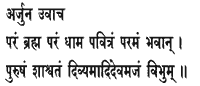
Arjuna said: Thou art the supreme Brahman, the supreme Abode, the supreme Purity, the one permanent, the divine Purusha, the original Godhead, the Unborn, the all-pervading Lord.
The Principle of Divine Works
Sri Aurobindo
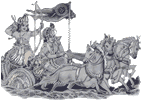
THIS THEN is the sense of the Gita’s doctrine of sacrifice. Its full significance depends on the idea of the Purushottama which as yet is not developed,—we find it set forth clearly only much later in the eighteen chapters,— and therefore we have had to anticipate, at whatever cost of infidelity to the progressive method of the Gita’s exposition, that central teaching. At present the Teacher simply gives a hint, merely adumbrates this supreme presence of the Purushottama and his relation to the immobile Self in whom it is our first business, our pressing spiritual need to find our poise of perfect peace and equality by attainment to the Brahmic condition. He speaks as yet not at all in set terms of the Purushottama, but of himself,—“I”, Krishna, Narayana, the Avatar, the God in man who is also the Lord in the universe incarnated in the figure of the divine charioteer of Kurukshetra. “In the Self, then in Me,” is the formula he gives, implying that the transcendence of the individual personality by seeing it as a “becoming” in the impersonal self-existent Being is simply a means of arriving at that great secret impersonal Personality, which is thus silent, calm and uplifted above Nature in the impersonal Being, but also present and active in Nature in all these million becomings. Losing our lower individual personality in the Impersonal, we arrive finally at union with that supreme Personality which is not separate and individual, but yet assumes all individualities. Transcending the lower nature of the three gunas and seating the soul in the immobile Purusha beyond the three gunas, we can ascend finally into the higher nature of the infinite Godhead which is not bound by the three gunas even when it acts through Nature. Reaching the inner actionlessness of the silent Purusha, nais.karmya, and leaving Prakriti to do her works, we can attain supremely beyond to the status of the divine Mastery which is able to do all works and yet be bound by none. The idea of the Purushottama, seen here as the incarnate Narayana, Krishna, is therefore the key. Without it the withdrawal from the lower nature to the Brahmic condition leads necessarily to inaction of the liberated man, his indifference to the works of the world; with it the same withdrawal becomes a step by which the works of the world are taken up in the spirit, with the nature and in the freedom of the Divine. See the silent Brahman as the goal and the world with all its activities has to be forsaken; see God, the Divine, the Purushottama as the goal, superior to action yet its inner spiritual cause and object and original will, and the world with all its activities is conquered and possessed in a divine transcendence of the world. It can become instead of a prison-house an opulent kingdom, r ¯ ajya ˙ m samr. ddham, which we have conquered for the spiritual life by slaying the limitation of the tyrant ego and overcoming the bondage of our gaoler desires and breaking the prison of our individualistic possession and enjoyment. The liberated universalised soul becomes svar ¯ at. samr¯ at., self-ruler and emperor. The works of sacrifice are thus vindicated as a means of liberation and absolute spiritual perfection, sam˙ siddhi. So Janaka and other great Karmayogins of the mighty ancient Yoga attained to perfection, by equal and desireless works done as a sacrifice, without the least egoistic aim or attachment— karman. aiva hi sam˙ siddhim a¯ sthita¯ janaka¯dayah. . So too andwith the same desirelessness, after liberation and perfection, works can and have to be continued by us in a large divine spirit, with the calm high nature of a spiritual royalty. “Thou shouldst do works regarding also the holding together of the peoples, lokasan˙graham eva¯pi sampas´yan kartum arhasi.Whatsoever the Best doeth, that the lower kind of man puts into practice; the standard he creates, the people follows. O son of Pritha, I have no work that I need to do in all the three worlds, I have nothing that I have not gained and have yet to gain, and I abide verily in the paths of action,” varta eva ca karman. i,—eva implying, I abide in it and do not leave it as the Sannyasin thinks himself bound to abandon works. “For if I did not abide sleeplessly in the paths of action, men follow in every way my path, these peoples would sink to destruction if I did not works and I should be the creator of confusion and slay these creatures. As those who know not act with attachment to the action, he who knows should act without attachment, having for his motive to hold together the peoples. He should not create a division of their understanding in the ignorant who are attached to their works; he should set them to all actions, doing them himself with knowledge and in Yoga.” There are few more important passages in the Gita than these seven striking couplets. But let us clearly understand that they must not be interpreted, as the modern pragmatic tendency concerned much more with the present affairs of the world than with any high and far-off spiritual possibility seeks to interpret them, as no more than a philosophical and religious justification of social service, patriotic, cosmopolitan and humanitarian effort and attachment to the hundred eager social schemes and dreams which attract the modern intellect. It is not the rule of a large moral and intellectual altruism which is here announced, but that of a spiritual unity with God and with this world of beings who dwell in him and in whom he dwells. It is not an injunction to subordinate the individual to society and humanity or immolate egoism on the altar of the human collectivity, but to fulfil the individual in God and to sacrifice the ego on the one true altar of the allembracing Divinity. The Gita moves on a plane of ideas and experiences higher than those of the modern mind which is at the stage indeed of a struggle to shake off the coils of egoism, but is still mundane in its outlook and intellectual and moral rather than spiritual in its temperament. Patriotism, cosmopolitanism, service of society, collectivism, humanitarianism, the ideal or religion of humanity are admirable aids towards our escape from our primary condition of individual, family, social, national egoism into a secondary stage in which the individual realises, as far as it can be done on the intellectual, moral and emotional level,—on that level he cannot do it entirely in the right and perfect way, the way of the integral truth of his being,—the oneness of his existence with the existence of other beings. But the thought of the Gita reaches beyond to a tertiary condition of our developing self-consciousness towards which the secondary is only a partial stage of advance. The Indian social tendency has been to subordinate the individual to the claims of society, but Indian religious thought and spiritual seeking have been always loftily individualistic in their aims. An Indian system of thought like the Gita’s cannot possibly fail to put first the development of the individual, the highest need of the individual, his claim to discover and exercise his largest spiritual freedom, greatness, splendour, royalty,—his aim to develop into the illumined seer and king in the spiritual sense of seerdom and kingship, which was the first great charter of the ideal humanity promulgated by the ancient Vedic sages. To exceed himself was their goal for the individual, not by losing all his personal aims in the aims of an organised human society, but by enlarging, heightening, aggrandising himself into the consciousness of the Godhead. The rule given here by the Gita is the rule for the master man, the superman, the divinised human being, the Best, not in the sense of any Nietzschean, any onesided and lopsided, any Olympian, Apollonian or Dionysian, any angelic or demoniac supermanhood, but in that of the man whose whole personality has been offered up into the being, nature and consciousness of the one transcendent and universal Divinity and by loss of the smaller self has found its greater self, has been divinised. To exalt oneself out of the lower imperfect Prakriti, traigun. yamay¯ı m¯ay¯a, into unity with the divine being, consciousness and nature,1 madbh¯avam ¯ agat¯ah. , is the object of the Yoga. But when this object is fulfilled, when the man is in the Brahmic status and sees no longer with the false egoistic vision himself and the world, but sees all beings in the Self, in God, and the Self in all beings, God in all beings, what shall be the action, —since action there still is,—which results from that seeing, and what shall be the cosmic or individual motive of all his
works? It is the question of Arjuna,2 but answered from a standpoint other than that from which Arjuna had put it. The motive cannot be personal desire on the intellectual, moral, emotional level, for that has been abandoned,—even the moral motive has been abandoned, since the liberated man has passed beyond the lower distinction of sin and virtue, lives in a glorified purity beyond good and evil. It cannot be the spiritual call to his perfect self-development by means of disinterested works, for the call has been answered, the development is perfect and fulfilled. His motive of action can only be the holding together of the peoples, cikı¯rs.ur lokasan˙graham. This great march of the peoples towards a far-off divine ideal has to be held together, prevented from falling into the bewilderment, confusion and utter discord of the understanding which would lead to dissolution and destruction and to which the world moving forward in the night or dark twilight of ignorance would be too easily prone if it were not held together, conducted, kept to the great lines of its discipline by the illumination, by the strength, by the rule and example, by the visible standard and the invisible influence of its Best. The best, the individuals who are in advance of the general line and above the general level of the collectivity, are the natural leaders of mankind, for it is they who can point to the race both the way they must follow and the standard or ideal they have to keep to or to attain. But the divinised man is the Best in no ordinary sense of the word and his influence, his example must have a power which that of no ordinarily superior man can exercise. What example then shall he give? What rule or standard shall he uphold? In order to indicate more perfectly his meaning, the divine Teacher, the Avatar gives his own example, his own standard to Arjuna. “I abide in the path of action,” he seems to say, “the path that all men follow; thou too must abide in action. In the way I act, in that way thou too must act. I am above the necessity of works, for I have nothing to gain by them; I am the Divine who possess all things and all beings in the world and I am myself
beyond the world as well as in it and I do not depend upon anything or anyone in all the three worlds for any object; yet I act. This too must be thy manner and spirit of working. I, the Divine, am the rule and the standard; it is I who make the path in which men tread; I am the way and the goal. But I do all this largely, universally, visibly in part, but far more invisibly; and men do not really know the way of my workings. Thou, when thou knowest and seest, when thou hast become the divinised man, must be the individual power of God, the human yet divine example, even as I am in my avatars. Most men dwell in the ignorance, the God-seer dwells in the knowledge; but let him not confuse the minds of men by a dangerous example, rejecting in his superiority the works of the world; let him not cut short the thread of action before it is spun out, let him not perplex and falsify the stages and gradations of the ways I have hewn. The whole range of human action has been decreed by me with a view to the progress of man from the lower to the higher nature, from the apparent undivine to the conscious Divine. The whole range of human works must be that in which the God-knower shall move. All individual, all social action, all the works of the intellect, the heart and the body are still his, not any longer for his own separate sake, but for the sake of God in the world, of God in all beings and that all those beings may move forward, as he has moved, by the path of works towards the discovery of the Divine in themselves. Outwardly his actions may not seem to differ essentially from theirs; battle and rule as well as teaching and thought, all the various commerce of man with man may fall in his range; but the spirit in which he does them must be very different, and it is that spirit which by its influence shall be the great attraction drawing men upwards to his own level, the great lever lifting the mass of men higher in their ascent.” The giving of the example of God himself to the liberated man is profoundly significant; for it reveals the whole basis of the Gita’s philosophy of divine works. The liberated man is he who has exalted himself into the divine nature and according to that divine nature must be his actions. But what is the divine nature? It is not entirely and solely that of the Akshara, the immobile, inactive, impersonal self; for that by itself would lead the liberated man to actionless immobility. It is not characteristically that of the Kshara, the multitudinous, the personal, the Purusha self-subjected to Prakriti; for that by itself would lead him back into subjection to his personality and to the lower nature and its qualities. It is the nature of the Purushottama who holds both these together and by his supreme divinity reconciles them in a divine reconciliation which is the highest secret of his being, rahasyam˙ hyetad uttamam. He is not the doer of works in the personal sense of our action involved in Prakriti; for God works through his power, conscious nature, effective force,—Shakti, Maya, Prakriti,—but yet above it, not involved in it, not subject to it, not unable to lift himself beyond the laws, workings, habits of action it creates, not affected or bound by them, not unable to distinguish himself, as we are unable, from the workings of life, mind and body. He is the doer of works who acts not, kart¯aram akart¯aram. “Know me,” says Krishna, “for the doer of this (the fourfold law of human workings) who am yet the imperishable non-doer. Works fix not themselves on me (na limpanti), nor have I desire for the fruits of action.” But neither is he the inactive, impassive, unpuissant Witness and nothing else; for it is he who works in the steps and measures of his power; every movement of it, every particle of the world of beings it forms is instinct with his presence, full of his consciousness, impelled by his will, shaped by his knowledge. He is, besides, the Supreme without qualities who is possessed of all qualities, nirgun.o gun. ¯ı.3 He is not bound by any mode of nature or action, nor consists, as our personality consists, of a sum of qualities, modes of nature, characteristic operations of the mental, moral, emotional, vital, physical being, but is the source of all modes and qualities, capable of developing any he wills in whatever way and to whatever degree he wills; he is the infinite being of which they are ways of becoming, the immeasurable quantity and unbound ineffable of which they are measures, numbers and figures, which they seem to rhythmise
and arithmise in the standards of the universe. Yet neither is he merely an impersonal indeterminate, nor a mere stuff of conscious existence for all determinations and personalisings to draw upon for their material, but a supreme Being, the one original conscious Existent, the perfect Personality capable of all relations even to the most human, concrete and intimate; for he is friend, comrade, lover, playmate, guide, teacher, master, ministrant of knowledge or ministrant of joy, yet in all relations unbound, free and absolute. This too the divinised man becomes in the measure of his attainment, impersonal in his personality, unbound by quality or action even when maintaining the most personal and intimate relations with men, unbound by any dharma even when following in appearance this or that dharma. Neither the dynamism of the kinetic man nor the actionless light of the ascetic or quietist, neither the vehement personality of theman of action nor the indifferent impersonality of the philosophic sage is the complete divine ideal. These are the two conflicting standards of the man of this world and the ascetic or the quietist philosopher, one immersed in the action of the Kshara, the other striving to dwell entirely in the peace of the Akshara; but the complete divine ideal proceeds from the nature of the Purushottama which transcends this conflict and reconciles all divine possibilities. The kinetic man is not satisfied with any ideal which does not depend upon the fulfilment of this cosmic nature, this play of the three qualities of that nature, this human activity of mind and heart and body. The highest fulfilment of that activity, he might say, is my idea of human perfection, of the divine possibility in man; some ideal that satisfies the intellect, the heart, the moral being, some ideal of our human nature in its action can alone satisfy the human being; he must have something that he can seek in the workings of his mind and life and body. For that is his nature, his dharma, and how can he be fulfilled in something outside his nature? For to his nature each being is bound and within it he must seek for his perfection. According to our human nature must be our human perfection; and each man must strive for it according to the line of his personality, his svadharma, but in life, in action, not outside life and action. Yes, there is a truth in that, replies the Gita; the fulfilment of God in man, the play of the Divine in life is part of the ideal perfection. But if you seek it only in the external, in life, in the principle of action, you will never find it; for you will then not only act according to your nature, which is in itself a rule of perfection, but you will be—and this is a rule of the imperfection—eternally subject to its modes, its dualities of liking and dislike, pain and pleasure and especially to the rajasic mode with its principle of desire and its snare of wrath and grief and longing,—the restless, alldevouring principle of desire, the insatiable fire which besieges your worldly action, the eternal enemy of knowledge by which it is covered over here in your nature as is a fire by smoke or a mirror by dust and which you must slay in order to live in the calm, clear, luminous truth of the spirit. The senses, mind and intellect are the seat of this eternal cause of imperfection and yet it is within this sense, mind and intellect, this play of the lower nature that you would limit your search for perfection! The effort is vain. The kinetic side of your nature must first seek to add to itself the quietistic; you must uplift yourself beyond this lower nature to that which is above the three gunas, that which is founded in the highest principle, in the soul. Only when you have attained to peace of soul, can you become capable of a free and divine action. The quietist, the ascetic, on the other hand cannot see any possibility of perfection into which life and action enter. Are they not the very seat of bondage and imperfection? Is not all action imperfect in its nature, like a fire that must produce smoke, is not the principle of action itself rajasic, the father of desire, a cause that must have its effect of obscuration of knowledge, its round of longing and success and failure, its oscillations of joy and grief, its duality of virtue and sin? God may be in the world, but he is not of the world; he is a God of renunciation and not the Master or cause of our works; the master of our works is desire and the cause of works is ignorance. If the world, the Kshara is in a sense a manifestation or a l¯ıl ¯a of the Divine, it is an imperfect play with the ignorance of Nature, an obscuration rather than a manifestation. That is surely evident from our very first glance at the nature of the world and does not the fullest experience of the world teach us always the same truth? is it not a wheel of the ignorance binding the soul to continual birth by the impulse of desire and action until at last that is exhausted or cast away? Not only desire, but action also must be flung away; seated in the silent self the soul will then pass away into the motionless, actionless, imperturbable, absolute Brahman. To this objection of the impersonalising quietist the Gita is at more pains to answer than to that of the man of the world, the kinetic individual. For this quietism having hold of a higher and more powerful truth which is yet not the whole or the highest truth, its promulgation as the universal, complete, highest ideal of human life is likely to be more confusing and disastrous to the advance of the human race towards its goal than the error of an exclusive kinetism. A strong one-sided truth, when set forth as the whole truth, creates a strong light but also a strong confusion; for the very strength of its element of truth increases the strength of its element of error. The error of the kinetic ideal can only prolong the ignorance and retard the human advance by setting it in search of perfection where perfection cannot be found; but the error of the quietistic ideal contains in itself the very principle of world-destruction. Were I to act upon it, says Krishna, I should destroy the peoples and be the author of confusion; and though the error of an individual human being, even though a nearly divine man, cannot destroy the whole race, it may produce a widespread confusion which may be in its nature destructive of the principle of human life and disturbing to the settled line of its advance. Therefore the quietistic tendency in man must be got to recognise its own incompleteness and admit on an equality with itself the truth which lies behind the kinetic tendency,—the fulfilment of God in man and the presence of the Divine in all the action of the human race. God is there not only in the silence, but in the action; the quietism of the impassive soul unaffected by Nature and the kinetism of the soul giving itself to Nature so that the great world-sacrifice, the Purusha-Yajna, may be effected, are not a reality and a falsehood in perpetual struggle nor yet two hostile realities, one superior, the other inferior, each fatal to the other; they are the double term of the divine manifestation. The Akshara alone is not the whole key of their fulfilment, not the very highest secret. The double fulfilment, the reconciliation is to be sought in the Purushottama represented here by Krishna, at once supreme Being, Lord of the worlds and Avatar. The divinised man entering into his divine nature will act even as he acts; he will not give himself up to inaction. The Divine is at work in man in the ignorance and at work in man in the knowledge. To know Him is our soul’s highest welfare and the condition of its perfection, but to know and realise Him as a transcendent peace and silence is not all; the secret that has to be learned is at once the secret of the eternal and unborn Divine and the secret of the divine birth and works, janma karma ca me divyam. The action which proceeds from that knowledge, will be free from all bondage; “he who so knoweth me,” says the Teacher, “is not bound by works.” If the escape from the obligation of works and desire and from the wheel of rebirth is to be the aim and the ideal, then this knowledge is to be taken as the true, the broad way of escape; for, says the Gita, “he who knows in their right principles my divine birth and works, comes when he leaves his body, not to rebirth, but to Me, O Arjuna.” Through the knowledge and possession of the divine birth he comes to the unborn and imperishable Divine who is the self of all beings, ajo avyaya ¯atm¯a; through the knowledge and execution of divine works to the Master of works, the lord of all beings, bhu¯ ta¯na¯m ı¯s´vara. He lives in that unborn being; his works are those of that universal Mastery.
Sri Aurobindo
 About Us| ©1999 - 2009 searchforlight.org
All extracts and quotations from the written works of Sri Aurobindo and the Mother and the Photographs of
the Mother and Sri Aurobindo are copyright Sri Aurobindo Ashram Trust, Pondicherry -605002 India.