
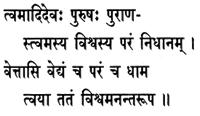
Thou art the ancient Soul and the first and original Godhead and the supreme resting-place of this All; Thou art the knower and that which is to be known and the hightest status; O infinite in form, by Thee was extended the universe.
The Message Of The Gita
Part 1
“The secret of action,” so we might summarise the message of the Gita, the word of its divine Teacher, “is one with the secret of all life and existence. Existence is not merely a machinery of Nature, a wheel of law in which the soul is entangled for a moment or for ages; it is a constant manifestation of the Spirit. Life is not for the sake of life alone, but for God, and the living soul of man is an eternal portion of the Godhead. Action is for self-finding, for self-fulfilment, for self-realisation and not only for its own external and apparent fruits of the moment or the future. There is an inner law and meaning of all things dependent on the supreme as well as the manifested nature of the self; the true truth of works lies there and can be represented only incidentally, imperfectly and disguised by ignorance in the outer appearances of the mind and its action. The supreme, the faultless largest law of action is therefore to find out the truth of your own highest and inmost existence and live in it and not to follow any outer standard and dharma. All life and action must be till then an imperfection, a difficulty, a struggle and a problem. It is only by discovering your true self and living according to its true truth, its real reality that the problem can be finally solved, the difficulty and struggle overpassed and your doings perfected in the security of the discovered self and spirit turn into a divinely authentic action. Know then your self; know your true self to be God and one with the self of all others; know your soul to be a portion of God. Live in what you know; live in the self, live in your supreme spiritual nature, be united with God and Godlike. Offer, first, all your actions as a sacrifice to the Highest and the One in you and to the Highest and the One in the world; deliver last all you are and do into his hands for the supreme and universal spirit to do through you his own will and works in the world. This is the solution that I present to you and in the end you will find that there is no other.”
Here it is necessary to state the Gita's view of the fundamental opposition on which like all Indian teaching it takes its position. This finding of the true self, this knowledge of the Godhead within us and all is not an easy thing; nor is it an easy thing either to turn this knowledge, even though seen by the mind, into the stuff of our consciousness and the whole condition of our action. All action is determined by the effective state of our being, and the effective state of our being is determined by the state of our constant self-seeing will and active consciousness and by its basis of kinetic movement. It is what we see and believe with our whole active nature ourselves to be and our relations with the world to mean, it is our faith, our sraddha, that makes us what we are. But the consciousness of man is of a double kind and corresponds to a double truth of existence; for there is a truth of the inner reality and a truth of the outer appearance. According as he lives in one or the other, he will be a mind dwelling in human ignorance or a soul founded in divine knowledge.
In its outer appearance the truth of existence is solely what we call Nature or Prakriti, a Force that operates as the whole law and mechanism of being, creates the world which is the object of our mind and senses and creates too the mind and senses as a means of relation between the creature and the objective world in which he lives. In this outer appearance man in his soul, his mind, his life, his body seems to be a creature of Nature differentiated from others by a separation of his body, life and mind and especially by his ego-sense—that subtle mechanism constructed for him that he may confirm and centralise his consciousness of all this strong separateness and difference. All in him, his soul of mind and its action as well as the functioning of his life and body, is very evidently determined by the law of his nature, cannot get outside of it, cannot operate otherwise. He attributes indeed a certain freedom to his personal will, the will of his ego; but that in reality amounts to nothing, since his ego is only a sense which makes him identify himself with the creation that Nature has made of him, with the varying mind and life and body she has constructed. His ego is itself a product of her workings, and as is the nature of his ego, so will be the nature of its will and according to that he must act and he can no other.
This then is man's ordinary consciousness of himself, this his faith in his own being, that he is a creature of Nature, a separate ego establishing whatever relations with others and with the world, making whatever development of himself, satisfying whatever will, desire, idea of his mind may be permissible in her circle and consonant with her intention or law in his existence.
There is, however, something in man's consciousness which does not fall in with the rigidity of this formula; he has a faith, which grows greater as his soul develops, in another and an inner reality of existence. In this inner reality the truth of existence is no longer Nature but Soul and Spirit, Purusha rather than Prakriti. Nature herself is only a power of Spirit, Prakriti the force of the Purusha. A Spirit, a Self, a Being one in all is the master of this world which is only his partial manifestation. That Spirit is the upholder of Nature and her action and the giver of the sanction by which alone her law becomes imperative and her force and its ways operative. That Spirit within her is the Knower who illuminates her and makes her conscient in us; his is the immanent and superconscient Will that inspires and motives her workings. The soul in man, a portion of this Divinity, shares his nature. Our nature is our soul's manifestation, operates by its sanction and embodies its secret self-knowledge and self-consciousness and its will of being in her motions and forms and changes.
The real soul and self of us is hidden from our intelligence by its ignorance of inner things, by a false identification, by an absorption in our outward mechanism of mind, life and body. But if the active soul of man can once draw back from this identification with its natural instruments, if it can see and live in the entire faith of its inner reality, then all is changed to it, life and existence take on another appearance, action a different meaning and character. Our being then becomes no longer this little egoistic creation of Nature, but the largeness of a divine, immortal and spiritual Power. Our consciousness becomes no longer that of this limited and struggling mental and vital creature, but an infinite, divine and spiritual consciousness. And our will and action too are no longer that of this bounded personality and its ego, but a divine and spiritual will and action, the will and power of the Universal, the Supreme, the All-Self and Spirit acting freely through the human figure
. “This is the great change and transfiguration,” runs the message of the Godhead in man, the Avatar, the divine Teacher, “to which I call the elect, and the elect are all who can turn their will away from the ignorance of the natural instruments to the soul's deepest experience, its knowledge of the inner self and spirit, its contact with the Godhead, its power to enter into the Divine. The elect are all who can accept this faith and this greater law. It is difficult indeed to accept for the human intellect attached always to its own cloud-forms and half lights of ignorance and to the yet obscurer habits of man's mental, nervous and physical parts; but once received it is a great and sure and saving way, because it is identical with the true truth of man's being and it is the authentic movement of his inmost and supreme nature.
“But the change is a very great one, an enormous transformation, and it cannot be done without an entire turning and conversion of your whole being and nature. There will be needed a complete consecration of your self and your nature and your life to the Highest and to nothing else but the Highest; for all must be held only for the sake of the Highest, nothing accepted except as it is in God and a form of God and for the sake of the Divine. There will be needed an admission of new truth, an entire turn and giving of your mind to a new knowledge of self and others and world and God and soul and Nature, a knowledge of oneness, a knowledge of universal Divinity, which will be at first an acceptance by the understanding but must become in the end a vision, a consciousness, a permanent state of the soul and the frame of its movements.
“There will be needed a will that shall make this new knowledge, vision, consciousness a motive of action and the sole motive. And it must be the motive not of an action grudging, limited, confined to a few necessary operations of Nature or to the few things that seem helpful to a formal perfection, apposite to a religious turn or to an individual salvation, but rather all action of human life taken up by the equal spirit and done for the sake of God and the good of all creatures. There will be needed an uplifting of the heart in a single aspiration to the Highest, a single love of the Divine Being, a single God-adoration. And there must be a widening too of the calmed and enlightened heart to embrace God in all beings. There will be needed a change of the habitual and normal nature of man as he is now to a supreme and divine spiritual nature. There will be needed in a word a Yoga which shall be at once a Yoga of integral knowledge, a Yoga of the integral will and its works, a Yoga of integral love, adoration and devotion and a Yoga of an integral spiritual perfection of the whole being and of all its parts and states and powers and motions.
“What then is this knowledge that will have to be admitted by the understanding, supported by the soul's faith and made real and living to the mind, heart and life? It is the knowledge of the supreme Soul and Spirit in its oneness and its wholeness. It is the knowledge of One who is for ever, beyond Time and Space and name and form and world, high beyond his own personal and impersonal levels and yet from whom all this proceeds, One whom all manifests in manifold Nature and her multitude of figures. It is the knowledge of him as an impersonal eternal immutable Spirit, the calm and limitless thing we call Self, infinite, equal and always the same, unaffected and unmodified and unchanged amid all this constant changing and all this multitude of individual personalities and soul powers and Nature powers and the forms and forces and eventualities of this transitory and apparent existence. It is the knowledge of him at the same time as the Spirit and Power who seems ever mutable in Nature, the Inhabitant who shapes himself to every form and modifies himself to every grade and degree and activity of his power, the Spirit who, becoming all that is even while he is for ever infinitely more than all that is, dwells in man and animal and thing, subject and object, soul and mind and life and matter, every existence and every force and every creature.
“It is not by insisting on this or that side only of the truth that you can practise this Yoga. The Divine whom you have to seek, the Self whom you have to discover, the supreme Soul of whom your soul is an eternal portion, is simultaneously all these things; you have to know them simultaneously in a supreme oneness, enter into all of them at once and in all states and all things see Him alone. If he were solely the Spirit mutable in Nature, there would be only an eternal and universal becoming. If you limit your faith and knowledge to that one aspect, you will never go beyond your personality and its constant changeful figures; on such a foundation you would be bound altogether in the revolutions of Nature. But you are not merely a succession of soul moments in Time. There is an impersonal self in you which supports the stream of your personality and is one with God's vast and impersonal spirit. And incalculable beyond this impersonality and personality, dominating these two constant poles of what you are here, you are eternal and transcendent in the Eternal Transcendence.
“If, again, there were only the truth of an eternal impersonal self that neither acts nor creates, then the world and your soul would be illusions without any real basis. If you limit your faith and knowledge to this one lonely aspect, the renunciation of life and action is your only resource. But God in the world and you in the world are realities; the world and you are true and actual powers and manifestations of the Supreme. Therefore accept life and action and do not reject them. One with God in your impersonal self and essence, an eternal portion of the Godhead turned to him by the love and adoration of your spiritual personality for its own Infinite, make of your natural being what it is intended to be, an instrument of works, a channel, a power of the Divine. That it always is in its truth, but now unconsciously and imperfectly, through the lower nature, doomed to a disfigurement of the Godhead by your ego. Make it consciously and perfectly and without any distortion by ego a power of the Divine in his supreme spiritual nature and a vehicle of his will and his works. In this way you will live in the integral truth of your own being and you will possess the integral God-union, the whole and flawless Yoga.
“The Supreme is the Purushottama, eternal beyond all manifestation, infinite beyond all limitation by Time or Space or Causality or any of his numberless qualities and features. But this does not mean that in his supreme eternity he is unconnected with all that happens here, cut off from world and Nature, aloof from all these beings. He is the supreme ineffable Brahman, he is impersonal self, he is all personal existences. Spirit here and life and matter, soul and Nature and the works of Nature are aspects and movements of his infinite and eternal existence. He is the supreme transcendent Spirit and all comes into manifestation from him and are his forms and his self-powers. As the one self he is here all-pervasive and equal and impersonal in man and animal and thing and object and every force of Nature. He is the supreme Soul and all souls are tireless flames of this one Soul. All living beings are in their spiritual personality deathless portions of the one Person or Purusha. He is the eternal Master of all manifested existence, Lord of the worlds and their creatures. He is the omnipotent originator of all actions, not bound by his works, and to him go all action and effort and sacrifice. He is in all and all are in him; he has become all and yet too he is above all and not limited by his creations. He is the transcendent Divine; he descends as the Avatar; he is manifest by his power in the Vibhuti; he is the Godhead secret in every human being. All the gods whom men worship are only personalities and forms and names and mental bodies of the one Divine Existence.
“The Supreme has manifested the world from his spiritual essence and in his own infinite existence and manifested himself too variously in the world. All things are his powers and figures and to the powers and figures of him there is no end, because he himself is infinite. As a pervading and containing impersonal self-existence he informs and sustains equally and without any partiality, preference or attachment to any person or thing or happening or feature all this infinite manifestation in Time and the universe. This pure and equal Self does not act, but supports impartially all the action of things. And yet it is the Supreme, but as the cosmic Spirit and the Time Spirit, who wills and conducts and determines the action of the world through his multitudinous power-to-be, that power of the Spirit which we call Nature. He creates, sustains and destroys his creations. He is seated too in the heart of every living creature and from there as a secret Power in the individual, no less than from his universal presence in the Cosmos, he originates by force of Nature, manifests some line of his mystery in quality of nature and in executive energy of nature, shapes each thing and being separately according to its kind and initiates and upholds all action. It is this transcendent first origination from the Supreme and this constant universal and individual manifestation of Him in things and beings which makes the complex character of the cosmos.
“There are always these three eternal states of the Divine Being. There is always and for ever this one eternal immutable self-existence which is the basis and support of existent things. There is always and for ever this Spirit mutable in Nature manifested by her as all these existences. There is always and for ever this transcendent Divine who can be both of these others at once, can be a pure and silent Spirit and at the same time the active soul and life of the cycles of the universe, because he is something other and more than these two whether taken separately or together. In us is the Jiva, a spirit of this Spirit, a conscious power of the Supreme. He is one who carries in his deepest self the whole of the immanent Divine and in Nature lives in the universal Divine,—no temporary creation but an eternal soul acting and moving in the eternal Self, in the eternal Infinite.
“This conscient soul in us can adopt either of these three states of the Spirit. Man can live here in the mutability of Nature and in that alone. Ignorant of his real self, ignorant of the Godhead within him, he knows only Nature: he sees her as a mechanical executive and creative Force and sees himself and others as her creations,—egos, separated existences in her universe. It is thus, superficially, that he now lives and, while it is so and until he exceeds this outer consciousness and knows what is within him, all his thought and science can only be a shadow of light thrown upon screens and surfaces. This ignorance is possible, is even imposed, because the Godhead within is hidden by the veil of his own power. His greater reality is lost to our view by the completeness with which he has identified himself in a partial appearance with his creations and images and absorbed the created mind in the deceptive workings of his own Nature. And it is possible also because the real, the eternal, the spiritual Nature which is the secret of things in themselves is not manifest in their outward phenomena. The Nature which we see when we look outwards, the Nature which acts in our mind and body and senses is a lower Force, a derivation, a Magician who creates figures of the Spirit but hides the Spirit in its figures, conceals the truth and makes men look upon masks, a Force which is only capable of a sum of secondary and depressed values, not of the full power and glory and ecstasy and sweetness of the manifestation of the Divine. This Nature in us is a Maya of the ego, a tangle of the dualities, a web of ignorance and the three gunas. And so long as the soul of man lives in the surface fact of mind and life and body and not in his self and spirit, he cannot see God and himself and the world as they really are, cannot overcome this Maya, but must do what he can with its terms and figures.
“It is possible by drawing back from the lower turn of his nature in which man now lives, to awake from this light that is darkness and live in the luminous truth of the eternal and immutable self-existence. Man then is no longer bound up in his narrow prison of personality, no longer sees himself as this little I that thinks and acts and feels and struggles and labours for a little. He is merged in the vast and free impersonality of the pure spirit; he becomes the Brahman; he knows himself as one with the one self in all things. He is no longer aware of ego, no longer troubled by the dualities, no longer feels anguish of grief or disturbance of joy, is no longer shaken by desire, is no longer troubled by sin or limited by virtue. Or if the shadows of these things remain, he sees and knows them only as Nature working in her own qualities and does not feel them to be the truth of himself in which he lives. Nature alone acts and works out her mechanical figures: but the pure spirit is silent, inactive and free. Calm, untouched by her workings, it regards them with a perfect equality and knows itself to be other than these things. This spiritual state brings with it a still peace and freedom but not the dynamic divinity, not the integral perfection; it is a great step, but it is not the integral God-knowledge and self-knowledge.
“A perfect perfection comes only by living in the supreme and the whole Divine. Then the soul of man is united with the Godhead of which it is a portion; then it is one with all beings in the self and spirit, one with them both in God and in Nature; then it is not only free but complete, plunged in the supreme felicity, ready for its ultimate perfection. He still sees the self as an eternal and changeless Spirit silently supporting all things; but he sees also Nature no longer as a mere mechanical force that works out things according to the mechanism of the gunas, but as a power of the Spirit and the force of God in manifestation. He sees that the lower Nature is not the inmost truth of the spirit's action; he becomes aware of a highest spiritual nature of the Divine in which is contained the source and the yet to be realised greater truth of all that is imperfectly figured now in mind, life and body. Arisen from the lower mental to this supreme spiritual nature, he is delivered there from all ego. He knows himself as a spiritual being, in his essence one with all existences and in his active nature a power of the one Godhead and an eternal soul of the transcendent Infinite. He sees all in God and God in all; he sees all things as Vasudeva. He is delivered from the dualities of joy and grief, from the pleasant and the unpleasant, from desire and disappointment, from sin and virtue. All henceforth is to his conscious sight and sense the will and working of the Divine. He lives and acts as a soul and portion of the universal consciousness and power; he is filled with the transcendent divine delight, a spiritual Ananda. His action becomes the divine action and his status the highest spiritual status.
* * *
“This however is not all the truth of the Yoga and this end and way of departure, though a great end and a great way, is not the thing I propose to you. For I am the eternal Worker within you and I ask of you works. I demand of you not a passive consent to a mechanical movement of Nature from which in your self you are wholly separated, indifferent and aloof, but action complete and divine, done as the willing and understanding instrument of the Divine, done for God in you and others and for the good of the world. This action I propose to you, first no doubt as a means of perfection in the supreme spiritual Nature, but as a part too of that perfection. Action is a part of the integral knowledge of God, of his greater mysterious truth and of an entire living in the Divine; action can and should be continued even after perfection and freedom are won. I ask of you the action of the Jivanmukta, the works of the Siddha. Something has to be added to the Yoga already described,—for that was only a first Yoga of knowledge. There is also a Yoga of action in the illumination of God-experience; works can be made one spirit with knowledge. For works done in a total self-vision and God-vision, a vision of God in the world and of the world in God are themselves a movement of knowledge, a movement of light, an indispensable means and an intimate part of spiritual perfection.
“Therefore now to the experience of a high impersonality add too this knowledge that the Supreme whom one meets as the pure silent Self can be met also as a vast dynamic Spirit who originates all works and is Lord of the worlds and the Master of man's action and endeavour and sacrifice. This apparently self-acting mechanism of Nature conceals an immanent divine Will that compels and guides it and shapes its purposes. But you cannot feel or know that Will while you are shut up in your narrow cell of personality, blinded and chained to your viewpoint of the ego and its desires. For you can wholly respond to it only when you are impersonalised by knowledge and widened to see all things in the self and in God and the self and God in all things. All becomes here by the power of the Spirit; all do their works by the immanence of God in things and his presence in the heart of every creature. The Creator of the worlds is not limited by his creations; the Lord of works is not bound by his works; the divine Will is not attached to its labour and the results of its labour: for it is omnipotent, all-possessing and all-blissful. But still the Lord looks down on his creations from his transcendence; he descends as the Avatar; he is here in you; he rules from within all things in the steps of their nature. And you too must do works in him, after the way and in the steps of the divine nature, untouched by limitation, attachment or bondage. Act for the best good of all, act for the maintenance of the march of the world, for the support or the leading of its peoples. The action asked of you is the action of the liberated Yogin; it is the spontaneous output of a free and God-held energy, it is an equal-minded movement, it is a selfless and desireless labour.
“The first step on this free, this equal, this divine way of action is to put from you attachment to fruit and recompense and to labour only for the sake of the work itself that has to be done. For you must deeply feel that the fruits belong not to you but to the Master of the world. Consecrate your labour and leave its returns to the Spirit who manifests and fulfils himself in the universal movement. The outcome of your action is determined by his will alone and whatever it be, good or evil fortune, success or failure, it is turned by him to the accomplishment of his world purpose. An entirely desireless and disinterested working of the personal will and the whole instrumental nature is the first rule of Karmayoga. Demand no fruit, accept whatever result is given to you; accept it with equality and a calm gladness: successful or foiled, prosperous or afflicted, continue unafraid, untroubled and unwavering on the steep path of the divine action.
“This is no more than the first step on the path. For you must be not only unattached to results, but unattached also to your labour. Cease to regard your works as your own; as you have abandoned the fruits of your work, so you must surrender the work also to the Lord of action and sacrifice. Recognise that your nature determines your action; your nature rules the immediate motion of your Swabhava and decides the expressive turn and development of your spirit in the paths of the executive force of Prakriti. Bring in no longer any self-will to confuse the steps of your mind in following the Godward way. Accept the action proper to your nature. Make of all you do from the greatest and most unusual effort to the smallest daily act, make of each act of your mind, each act of your heart, each act of your body, of every inner and outer turn, of every thought and will and feeling, of every step and pause and movement, a sacrifice to the Master of all sacrifice and Tapasya.
“Next know that you are an eternal portion of the Eternal and the powers of your nature are nothing without him, nothing if not his partial self-expression. It is the Divine Infinite that is being progressively fulfilled in your nature. It is the supreme power-to-be, it is the Shakti of the Lord that shapes and takes shape in your swabhava. Give up then all sense that you are the doer; see the Eternal alone as the doer of the action. Let your natural being be an occasion, an instrument, a channel of power, a means of manifestation. Offer up your will to him and make it one with his eternal will: surrender all your actions in the silence of your self and spirit to the transcendent Master of your nature. This cannot be really done or done perfectly so long as there is any ego sense in you or any mental claim or vital clamour. Action done in the least degree for the sake of the ego or tinged with the desire and will of the ego is not a perfect sacrifice. Nor can this great thing be well and truly done so long as there is inequality anywhere or any stamp of ignorant shrinking and preference. But when there is a perfect equality to all works, results, things and persons, a surrender to the Highest and not to desire or ego, then the divine Will determines without stumbling or deflection and the divine Power executes freely without any nether interference or perverting reaction all works in the purity and safety of your transmuted nature. To allow your every act to be shaped through you by the divine Will in its immaculate sovereignty is the highest degree of the perfection that comes by doing works in Yoga. That done, your nature will follow its cosmic walk in a complete and constant union with the Supreme, express the highest Self, obey the Ishwara.
“This way of divine works is a far better release and a more perfect way and solution than the physical renunciation of life and works. A physical abstention is not entirely possible and is not in the measure of its possibility indispensable to the spirit's freedom; it is besides a dangerous example, for it exerts a misleading influence on ordinary men. The best, the greatest set the standard which the rest of humanity strive to follow. Then since action is the nature of the embodied spirit, since works are the will of the eternal Worker, the great spirits, the master minds should set this example. World-workers should they be, doing all works of the world without reservation, God-workers free, glad and desireless, liberated souls and natures.
Sri Aurobindo
 About Us| ©1999 - 2009 searchforlight.org
All extracts and quotations from the written works of Sri Aurobindo and the Mother and the Photographs of
the Mother and Sri Aurobindo are copyright Sri Aurobindo Ashram Trust, Pondicherry -605002 India.