
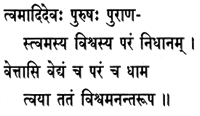
Thou art the ancient Soul and the first and original Godhead and the supreme resting-place of this All; Thou art the knower and that which is to be known and the hightest status; O infinite in form, by Thee was extended the universe.
The Message Of The Gita
Part 3
“The mind of knowledge and the will of action are not all; there is within you a heart whose demand is for delight. Here too in the heart's power and illumination, in its demand for delight, for the soul's satisfaction your nature must be turned, transformed and lifted to one conscious ecstasy with the Divine. The knowledge of the impersonal self brings its own Ananda; there is a joy of impersonality, a singleness of joy of the pure spirit. But an integral knowledge brings a greater triple delight. It opens the gates of the Transcendent's bliss; it releases into the limitless delight of a universal impersonality; it discovers the rapture of all this multitudinous manifestation: for there is a joy of the Eternal in Nature. This Ananda in the Jiva, a portion here of the Divine, takes the form of an ecstasy founded in the Godhead who is his source, in his supreme self, in the Master of his existence. An entire God-love and adoration extends to a love of the world and all its forms and powers and creatures; in all the Divine is seen, is found, is adored, is served or is felt in oneness. Add to knowledge and works this crown of the eternal triune delight; admit this love, learn this worship; make it one spirit with works and knowledge. That is the apex of the perfect perfection.
“This Yoga of love will give you a highest potential force for spiritual largeness and unity and freedom. But it must be a love which is one with God-knowledge. There is a devotion which seeks God in suffering for consolation and succour and deliverance; there is a devotion which seeks him for his gifts, for divine aid and protection and as a fountain of the satisfaction of desire; there is a devotion that, still ignorant, turns to him for light and knowledge. And so long as one is limited to these forms, there may persist even in their highest and noblest Godward turn a working of the three gunas. But when the God-lover is also the God-knower, the lover becomes one self with the Beloved; for he is the chosen of the Most High and the elect of the Spirit. Develop in yourself this God-engrossed love; the heart spiritualised and lifted beyond the limitations of its lower nature will reveal to you most intimately the secrets of God's immeasurable being, bring into you the whole touch and influx and glory of his divine Power and open to you the mysteries of an eternal rapture. It is perfect love that is the key to a perfect knowledge.
“This integral God-love demands too an integral work for the sake of the Divine in yourself and in all creatures. The ordinary man does works in obedience to some desire sinful or virtuous, some vital impulse low or high, some mental choice common or exalted or from some mixed mind and life motive. But the work done by you must be free and desireless; work done without desire creates no reaction and imposes no bondage. Done in a perfect equality and an unmoved calm and peace, but without any divine passion, it is at first the fine yoke of a spiritual obligation, kartavyam karma, then the uplifting of a divine sacrifice; at its highest it can be the expression of a calm and glad acquiescence in active oneness. The oneness in love will do much more: it will replace the first impassive calm by a strong and deep rapture, not the petty ardour of egoistic desire but the ocean of an infinite Ananda. It will bring the moving sense and the pure and divine passion of the presence of the Beloved into your works; there will be an insistent joy of labour for God in yourself and for God in all beings. Love is the crown of works and the crown of knowledge.
“This love that is knowledge, this love that can be the deep heart of your action, will be your most effective force for an utter consecration and complete perfection. An integral union of the individual's being with the Divine Being is the condition of a perfect spiritual life. Turn then altogether towards the Divine; make one with him by knowledge, love and works all your nature. Turn utterly towards him and give up ungrudgingly into his hands your mind and your heart and your will, all your consciousness and even your very senses and body. Let your consciousness be sovereignly moulded by him into a flawless mould of his divine consciousness. Let your heart become a lucid or flaming heart of the Divine. Let your will be an impeccable action of his will. Let your very sense and body be the rapturous sensation and body of the Divine. Adore and sacrifice to him with all you are; remember him in every thought and feeling, every impulsion and act. Persevere until all these things are wholly his and he has taken up even in most common and outward things as in the inmost sacred chamber of your spirit his constant transmuting presence.
* * *
“This triune way is the means by which you can rise entirely out of your lower into your supreme spiritual nature. That is the hidden superconscient nature in which the Jiva, a portion of the high Infinite and Divine and intimately one in law of being with him, dwells in his Truth and not any longer in an externalised Maya. This perfection, this unity can be enjoyed in its own native status, aloof in a supreme supracosmic existence: but here also you may and should realise it, here in the human body and physical world. It is not enough for this end to be calm, inactive and free from the gunas in the inner self and to watch and allow indifferently their mechanical action in the outer members. For the active nature as well as the self has to be given to the Divine and to become divine. All that you are must grow into one law of being with the Purushottama, sadharmya; all must be changed into my conscious spiritual becoming, mad-bhava. A completest surrender must be there. Take refuge with Me in all the many ways and along all the living lines of your nature; for that alone will bring about this great change and perfection.
“This high consummation of the Yoga will at once solve or rather it will wholly remove and destroy at its roots the problem of action. Human action is a thing full of difficulties and perplexities, tangled and confused like a forest with a few more or less obscure paths cut into it rather than through it; but all this difficulty and entanglement arises from the single fact that man lives imprisoned in the ignorance of his mental, vital and physical nature. He is compelled by its qualities and yet afflicted with responsibility in his will because something in him feels that he is a soul who ought to be what now he is not at all or very little, master and ruler of his nature. All his laws of living, all his dharmas must be under these conditions imperfect, temporary and provisional and at best only partly right or true. His imperfections can cease only when he knows himself, knows the real nature of the world in which he lives and, most of all, knows the Eternal from whom he comes and in whom and by whom he exists. When he has once achieved a true consciousness and knowledge, there is no longer any problem; for then he acts freely out of himself and lives spontaneously in accordance with the truth of his spirit and his highest nature. At its fullest, at the highest height of this knowledge it is not he who acts but the Divine, the One eternal and infinite who acts in him and through him in his liberated wisdom and power and perfection.
“Man in his natural being is a sattwic, rajasic and tamasic creature of Nature. According as one or other of her qualities predominates in him, he makes and follows this or that law of his life and action. His tamasic, material, sensational mind subject to inertia and fear and ignorance either obeys partly the compulsion of its environment and partly the spasmodic impulses of its desires or finds a protection in the routine following of a dull customary intelligence. The rajasic mind of desire struggles with the world in which it lives and tries to possess always new things, to command, battle, conquer, create, destroy, accumulate. Always it goes forward tossed between success and failure, joy and sorrow, exultation or despair. But in all, whatever law it may seem to admit, it follows really only the law of the lower self and ego, the restless, untired, self-devouring and all-devouring mind of the Asuric and Rakshasic nature. The sattwic intelligence surmounts partly this state, sees that a better law than that of desire and ego must be followed and erects and imposes on itself a social, an ethical, a religious rule, a Dharma, a Shastra. This is as high as the ordinary mind of man can go, to erect an ideal or practical rule for the guidance of the mind and will and as faithfully as possible observe it in life and conduct. This sattwic mind must be developed to its highest point where it succeeds in putting away the mixture of ego motive altogether and observes the Dharma for its own sake as an impersonal social, ethical or religious ideal, the thing disinterestedly to be done solely because it is right, kartavyam karma.
“The real truth of all this action of Prakriti is, however, less outwardly mental and more inwardly subjective. It is this that man is an embodied soul involved in material and mental nature, and he follows in it a progressive law of his development determined by an inner law of his being; his cast of spirit makes out his cast of mind and life, his swabhava. Each man has a swadharma, a law of his inner being which he must observe, find out and follow. The action determined by his inner nature, that is his real Dharma. To follow it is the true law of his development; to deviate from it is to bring in confusion, retardation and error. That social, ethical, religious or other law and ideal is best for him always which helps him to observe and follow out his Swadharma.
“All this action however is even at its best subject to the ignorance of the mind and the play of the gunas. It is only when the soul of man finds itself that he can overpass and erase from his consciousness the ignorance and the confusion of the gunas. It is true that even when you have found yourself and live in your self, your nature will still continue on its old lines and act for a time according to its inferior modes. But now you can follow that action with a perfect self-knowledge and can make of it a sacrifice to the Master of your existence. Follow then the law of your Swadharma, do the action that is demanded by your Swabhava whatever it may be. Reject all motive of egoism, all initiation by self-will, all rule of desire, until you can make the complete surrender of all the ways of your being to the Supreme.
“And when you are once able to do that sincerely, that will be the moment to renounce the initiation of your acts without exception into the hands of the supreme Godhead within you. Then you will be released from all laws of conduct, liberated from all dharmas. The Divine Power and Presence within you will free you from sin and evil and lift you far above human standards of virtue. For you will live and act in the absolute and spontaneous right and purity of the spiritual being and the immaculate force of the divine nature. The Divine and not you will enact his own will and works through you, not for your lower personal pleasure and desire, but for the world-purpose and for your divine good and the manifest or secret good of all. Inundated with light, you will see the form of the Godhead in the world and in the works of Time, know his purpose and hear his command. Your nature will receive as an instrument his will only whatever it may be and do it without question, because there will come with each initiation of your acts from above and within you an imperative knowledge and an illumined assent to the divine wisdom and its significance. The battle will be his, his the victory, his the empire.
“This will be your perfection in the world and the body, and beyond these worlds of temporal birth the supreme eternal superconsciousness will be yours and you will dwell for ever in the highest status of the Supreme Spirit. The cycles of incarnation and the fear of mortality will not distress you; for here in life you will have accomplished the expression of the Godhead, and your soul, even though it has descended into mind and body, will already be living in the vast eternity of the Spirit.
“This then is the supreme movement, this complete surrender of your whole self and nature, this abandonment of all dharmas to the Divine who is your highest Self, this absolute aspiration of all your members to the supreme spiritual nature. If you can once achieve it, whether at the outset or much later on the way, then whatever you are or were in your outward nature, your way is sure and your perfection inevitable. A supreme Presence within you will take up your Yoga and carry it swiftly along the lines of your swabhava to its consummate completion. And afterwards whatever your way of life and mode of action, you will be consciously living, acting and moving in him and the Divine Power will act through you in your every inner and outer motion. This is the supreme way because it is the highest secret and mystery and yet an inner movement progressively realisable by all. This is the deepest and most intimate truth of your real, your spiritual existence.”
Sri Aurobindo
 About Us| ©1999 - 2009 searchforlight.org
All extracts and quotations from the written works of Sri Aurobindo and the Mother and the Photographs of
the Mother and Sri Aurobindo are copyright Sri Aurobindo Ashram Trust, Pondicherry -605002 India.