
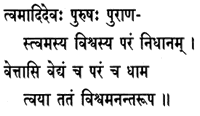
Thou art the ancient Soul and the first and original Godhead and the supreme resting-place of this All; Thou art the knower and that which is to be known and the hightest status; O infinite in form, by Thee was extended the universe.
The Message Of The Gita
Part 2
“This is the solution, this the salvation, this the perfection that I offer to all those who can listen to a divine voice within them and are capable of this faith and knowledge. But to climb to this pre-eminent condition the first necessity, the original radical step is to turn away from all that belongs to your lower Nature and fix yourself by concentration of the will and intelligence on that which is higher than either will or intelligence, higher than mind and heart and sense and body. And first of all you must turn to your own eternal and immutable self, impersonal and the same in all creatures. So long as you live in ego and mental personality, you will always spin endlessly in the same rounds and there can be no real issue. Turn your will inward beyond the heart and its desires and the sense and its attractions; lift it upward beyond the mind and its associations and attachments and its bounded wish and thought and impulse. Arrive at something within you that is eternal, ever unchanged, calm, unperturbed, equal, impartial to all things and persons and happenings, not affected by any action, not altered by the figures of Nature. Be that, be the eternal self, be the Brahman. If you can become that by a permanent spiritual experience, you will have an assured basis on which you can stand delivered from the limitations of your mind-created personality, secure against any fall from peace and knowledge, free from ego.
“Thus to impersonalise your being is not possible so long as you nurse and cherish and cling to your ego or anything that belongs to it. Desire and the passions that arise from desire are the principal sign and knot of ego. It is desire that makes you go on saying I and mine and subjects you through a persistent egoism to satisfaction and dissatisfaction, liking and disliking, hope and despair, joy and grief, to your petty loves and hatreds, to wrath and passion, to your attachment to success and things pleasant and to the sorrow and suffering of failure and of things unpleasant. Desire brings always confusion of mind and limitation of the will, an egoistic and distorted view of things, a failure and clouding of knowledge. Desire and its preferences and violences are the first strong root of sin and error. There can be while you cherish desire no assured stainless tranquillity, no settled light, no calm pure knowledge. There can be no right being—for desire is a perversion of the spirit—and no firm foundation for right thought, action and feeling. Desire, if permitted to remain under whatever colour, is a perpetual menace even to the wisest and can at any moment subtly or violently cast down the mind from even its firmest and most surely acquired foundation. Desire is the chief enemy of spiritual perfection.
“Slay then desire; put away attachment to the possession and enjoyment of the outwardness of things. Separate yourself from all that comes to you as outward touches and solicitations, as objects of the mind and senses. Learn to bear and reject all the rush of the passions and to remain securely seated in your inner self even while they rage in your members, until at last they cease to affect any part of your nature. Bear and put away similarly the forceful attacks and even the slightest insinuating touches of joy and sorrow. Cast away liking and disliking, destroy preference and hatred, root out shrinking and repugnance. Let there be a calm indifference to these things and to all the objects of desire in all your nature. Look on them with the silent and tranquil regard of an impersonal spirit.
“The result will be an absolute equality and the power of unshakable calm that the universal spirit maintains in front of its creations, facing ever the manifold action of Nature. Look with equal eyes; receive with an equal heart and mind all that comes to you, success and failure, honour and dishonour, the esteem and love of men and their scorn and persecution and hatred, every happening that would be to others a cause of joy and every happening that would be to others a cause of sorrow. Look with equal eyes on all persons, on the good and the wicked, on the wise and the foolish, on the Brahmin and the outcaste, on man at his highest and every pettiest creature. Meet equally all men whatever their relations to you, friend and ally, neutral and indifferent, opponent and enemy, lover and hater. These things touch the ego and you are called to be free from ego. These are personal relations and you have to observe all with the deep regard of the impersonal spirit. These are temporal and personal differences which you have to see but not be influenced by them; for you must fix not on these differences but on that which is the same in all, on the one self which all are, on the Divine in every creature and on the one working of Nature which is the equal will of God in men and things and energies and happenings and in all endeavour and result and whatever outcome of the world's labour.
“Action will still be done in you because Nature is always at work; but you must learn and feel that your self is not the doer of the action. Observe simply, observe unmoved the working of Nature and the play of her qualities and the magic of the gunas. Observe unmoved this action in yourself; look on all that is being done around you and see that it is the same working in others. Observe that the result of your works and theirs is constantly other than you or they desired or intended, not theirs, not yours, but omnipotently fixed by a greater Power that wills and acts here in universal Nature. Observe too that even the will in your works is not yours but Nature's. It is the will of the ego sense in you and is determined by the predominant quality in your composition which she has developed in the past or else brings forward at the moment. It depends on the play of your natural personality and that formation of Nature is not your true person. Draw back from this external formation to your inner silent self; you will see that you the Purusha are inactive, but Nature continues to do always her works according to her gunas. Fix yourself in this inner inactivity and stillness: no longer regard yourself as the doer. Remain seated in yourself above the play, free from the perturbed action of the gunas. Live secure in the purity of an impersonal spirit, live untroubled by the mortal waves that persist in your members.
“If you can do this, then you will find yourself uplifted into a great release, a wide freedom and a deep peace. Then you will be aware of God and immortal, possessed of your dateless self-existence, independent of mind and life and body, sure of your spiritual being, untouched by the reactions of Nature, unstained by passion and sin and pain and sorrow. Then you will depend for your joy and desire on no mortal or outward or worldly thing, but will possess inalienably the self-sufficient delight of a calm and eternal spirit. Then you will have ceased to be a mental creature and will have become spirit illimitable, the Brahman. And into this eternity of the silent self, rejecting from your mind all seed of thought and all root of desire, rejecting the figure of birth in the body, you can pass at your end by concentration in the pure Eternal and a mighty transference of your consciousness to the Infinite, the Absolute.
Sri Aurobindo
 About Us | ©1999 - 2009 searchforlight.org
All extracts and quotations from the written works of Sri Aurobindo and the Mother and the Photographs of
the Mother and Sri Aurobindo are copyright Sri Aurobindo Ashram Trust, Pondicherry -605002 India.