
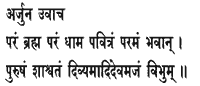
Arjuna said: Thou art the supreme Brahman, the supreme Abode, the supreme Purity, the one permanent, the divine Purusha, the original Godhead, the Unborn, the all-pervading Lord.
The Gunas, Faith and Works
Sri Aurobindo
THE GITA has made a distinction between action according to the licence of personal desire and action done according to the Shastra. We must understand by the latter the recognised science and art of life which is the outcome of mankind’s collective living, its culture, religion, science, its progressive discovery of the best rule of life,—but mankind still walking in the ignorance and proceeding in a half light towards knowledge. The action of personal desire belongs to the unregenerated state of our nature and is dictated by ignorance or false knowledge and an unregulated or ill-regulated kinetic or rajasic egoism. The action controlled by Shastra is an outcome of intellectual, ethical, aesthetic, social and religious culture; it embodies an attempt at a certain right living, harmony and right order and is evidently an effort, more or less advanced according to circumstances, of the sattwic element in man to overtop, regulate and control or guide, where it must be admitted, his rajasic and tamasic egoism. It is the means to a step in advance, and therefore mankind must first proceed through it and make this Shastra its law of action rather than obey the impulsion of its personal desires. This is a general rule which humanity has always recognised wherever it has arrived at any kind of established and developed society; it has an idea of an order, a law, a standard of its perfection, something other than the guidance of its desires or the crude direction of its raw impulses. This greater rule the individual finds usually outside himself in some more or less fixed outcome of the experience and wisdom of the race, which he accepts, to which his mind and the leading parts of his being give their assent or sanction and which he tries to make his own by living it in his mind, will and action.
And this assent of the being, its conscious acceptance and will to believe and realise, may be called by the name which the Gita gives to it, his faith, ´sraddh¯a. The religion, the philosophy, the ethical law, the social idea, the cultural idea in which I put my faith, gives me a law for my nature and its works, an idea of relative right or an idea of relative or absolute perfection and in proportion as I have a sincerity and completeness of faith in it and an intensity of will to live according to that faith, I can become what it proposes to me, I can shape myself into an image of that right or an exemplar of that perfection. But we see also that there is a freer tendency in man other than the leading of his desires and other than his will to accept the Law, the fixed idea, the safe governing rule of the Shastra. The individual frequently enough, the community at any moment of its life is seen to turn away from the Shastra, becomes impatient of it, loses that form of its will and faith and goes in search of another law which it is now more disposed to accept as the right rule of living and regard as a more vital or higher truth of existence. This may happen when the established Shastra ceases to be a living thing and degenerates or stiffens into a mass of customs and conventions. Or it may come because it is found that the Shastra is imperfect or no longer useful for the progress demanded; a new truth, a more perfect law of living has become imperative. If that does not exist, it has to be discovered by the effort of the race or by some great and illumined individual mind who embodies the desire and seeking of the race. The Vedic law becomes a convention and a Buddha appears with his new rule of the eightfold path and the goal of Nirvana; and it may be remarked that he propounds it not as a personal invention, but as the true rule of Aryan living constantly rediscovered by the Buddha, the enlightened mind, the awakened spirit. But this practically means that there is an ideal, an eternal Dharma which religion, philosophy, ethics and all other powers in man that strive after truth and perfection are constantly endeavouring to embody in new statements of the science and art of the inner and outer life, a new Shastra. The Mosaic law of religious, ethical and social righteousness is convicted of narrowness and imperfection and is now besides a convention; the law of Christ comes to replace it and claims at once to abrogate and to fulfil, to abrogate the imperfect form and fulfil in a deeper and broader light and power the spirit of the thing which it aimed at, the divine rule of living. And the human search does not stop there, but leaves these formulations too, goes back to some past truth it had rejected or breaks forward to some new truth and power, but is always in search of the same thing, the law of its perfection, its rule of right living, its complete, highest and essential self and nature. This movement begins with the individual, who is no longer satisfied with the law because he finds that it no longer corresponds to his idea and largest or intensest experience of himself and existence and therefore he can no longer bring to it the will to believe and practise. It does not correspond to his inner way of being, it is not to him sat, the thing that truly is, the right, the highest or best or real good; it is not the truth and law of his or of all being. The Shastra is something impersonal to the individual, and that gives it its authority over the narrow personal law of his members; but at the same time it is personal to the collectivity and is the outcome of its experience, its culture or its nature. It is not in all its form and spirit the ideal rule of fulfilment of the Self or the eternal law of the Master of our nature, although it may contain in itself in small or larger measure indications, preparations, illuminating glimpses of that far greater thing. And the individual may have gone beyond the collectivity and be ready for a greater truth, a wider walk, a deeper intention of the Life-Spirit. The leading in him that departs from the Shastra may not indeed be always a higher movement; it may take the form of a revolt of the egoistic or rajasic nature seeking freedom from the yoke of something which it feels to be cramping to its liberty of self-fulfilment and self-finding. But even then it is often justified by some narrowness or imperfection of the Shastra or by the degradation of the current rule of living into a merely restricting or lifeless convention. And so far it is legitimate, it appeals to a truth, it has a good and just reason for existence: for though it misses the right path, yet the free action of the rajasic ego, because it has more in it of liberty and life, is better than the dead and hidebound tamasic following of a convention. The rajasic is always stronger, always more forcefully inspired and has more possibilities in it than the tamasic nature. But also this leading may be sattwic at its heart; it may be a turn to a larger and greater ideal which will carry us nearer to a more complete and ample truth of our self and universal existence than has yet been seen and nearer therefore to that highest law which is one with the divine freedom. And in effect this movement is usually an attempt to lay hold on some forgotten truth or to move on to a yet undiscovered or unlived truth of our being. It is not a mere licentious movement of the unregulated nature; it has its spiritual justification and is a necessity of our spiritual progress. And even if the Shastra is still a living thing and the best rule for the human average, the exceptional man, spiritual, inwardly developed, is not bound by that standard. He is called upon to go beyond the fixed line of the Shastra. For this is a rule for the guidance, control and relative perfection of the normal imperfect man and he has to go on to a more absolute perfection: this is a system of fixed dharmas and he has to learn to live in the liberty of the Spirit. But what then shall be the secure base of an action which departs both from the guidance of desire and from the normal law? For the rule of desire has an authority of its own, no longer safe or satisfactory to us as it is to the animal or as it might have been to a primitive humanity, but still, so far as it goes, founded on a very living part of our nature and fortified by its strong indications; and the law, the Shastra has behind it all the authority of long established rule, old successful sanctions and a secure past experience. But this new movement is of the nature of a powerful adventure into the unknown or partly known, a daring development and a new conquest, and what then is the clue to be followed, the guiding light on which it can depend or its strong basis in our being? The answer is that the clue and support is to be found in man’s ´sraddh¯a, his faith, his will to believe, to live what he sees or thinks to be the truth of himself and of existence. In other words this movement is man’s appeal to himself or to something potent and compelling in himself or in universal existence for the discovery of his truth, his law of living, his way to fullness and perfection. And everything depends on the nature of his faith, the thing in himself or in the universal soul—of which he is a portion or manifestation—to which he directs it and on how near he gets by it to his real self and the Self or true being of the universe. If he is tamasic, obscure, clouded, if he has an ignorant faith, an inept will, he will reach nothing true and will fall away to his lower nature. If he is lured by false rajasic lights, he can be carried away by self-will into bypaths that may lead to morass or precipice. In either case his only chance of salvation lies in a return of sattwa upon him to impose a new enlightened order and rule upon his members which will liberate him from the violent error of his self-will or the dull error of his clouded ignorance. If on the other hand he has the sattwic nature and a sattwic faith and direction for his steps, he will arrive in sight of a higher yet unachieved ideal rule which may lead him even in rare instances beyond the sattwic light some way at least towards a highest divine illumination and divine way of being and living. For if the sattwic light is so strong in him as to bring him to its own culminating point, then he will be able advancing from that point to make out his gate of entrance into some first ray of that which is divine, transcendent and absolute. In all effort at self-finding these possibilities are there; they are the conditions of this spiritual adventure. Nowwe have to see how the Gita deals with this question on its own line of spiritual teaching and self-discipline. For Arjuna puts immediately a suggestive query from which the problem or one aspect of it arises. When men, he says, sacrifice to God or the gods with faith, ´sraddh¯a, but abandon the rule of the Shastra, what is that concentrated will of devotion in them, nis.t. h¯a, which gives them this faith and moves them to this kind of action? Is it sattwa, rajas or tamas? to which strand of our nature does it belong? The answer of the Gita first states the principle that the faith in us is of a triple kind like all things in Nature and varies according to the dominating quality of our nature. The faith of each man takes the shape, hue, quality given to it by his stuff of being, his constituting temperament, his innate power of existence, sattva¯nuru¯pa¯ sarvasya s´raddha¯ . And then there comes a remarkable line in which the Gita tells us that this Purusha, this soul in man, is, as it were, made of ´sraddh¯a, a faith, a will to be, a belief in itself and existence, and whatever is that will, faith or constituting belief in him, he is that and that is he. S´raddha¯mayo ’yam˙ purus.o yo yac-chraddhah. sa eva sah.. If we look into this pregnant saying a little closely, we shall find that this single line contains implied in its few forceful words almost the whole theory of the modern gospel of pragmatism. For if a man or the soul in a man consists of the faith which is in him, taken in this deeper sense, then it follows that the truth which he sees and wills to live is for him the truth of his being, the truth of himself that he has created or is creating and there can be for him no other real truth. This truth is a thing of his inner and outer action, a thing of his becoming, of the soul’s dynamics, not of that in him which never changes. He is what he is today by some past will of his nature sustained and continued by a present will to know, to believe and to be in his intelligence and vital force, and whatever new turn is taken by this will and faith active in his very substance, that he will tend to become in the future. We create our own truth of existence in our own action of mind and life, which is another way of saying that we create our own selves, are our own makers. But very obviously this is only one aspect of the truth, and all one-aspected statements are suspect to the thinker. Truth is not merely whatever our own personality is or creates; that is only the truth of our becoming, one point or line of emphasis in a movement of widest volume. Beyond our personality there is, first, a universal being as well as a universal becoming of which ours is a little movement; and beyond that too there is the eternal Being out of which all becoming derives and to which it owes its potentialities, elements, original and final motives. We may say indeed that all becoming is only an act of universal consciousness, is Maya, is a creation of the will to become, and the only other reality, if there is any, is a pure eternal existence beyond consciousness, featureless, unexpressed and inexpressible. That is practically the standpoint taken by the Mayavadin’s Adwaita and the sense of the distinction he makes between pragmatic truth which to his mind is illusory or at least only temporarily and partly real—while modern pragmatism takes it to be the true truth or at least the only recognisable reality because the only reality that we can act and know,—between that pragmatic illusion and on the other side of creative Maya the lonely Absolute featureless and inexpressible. But for the Gita absolute Brahman is also supreme Purusha, and Purusha is always conscious Soul, though its highest consciousness, its superconsciousness, if we will,—as, one may add, its lowest which we call the Inconscient,—is something very different from our mind consciousness to which alone we are accustomed to give the name. There is in that highest superconscience a highest truth and dharma of immortality, a greatest divine way of being, a way of the eternal and infinite. That eternal way of existence and divine manner of being exists already in the eternity of the Purushottama, but we are now attempting to create it here too in our becoming by Yoga; our endeavour is to become the Divine, to be as He, madbh¯ava. That also depends on ´sraddh¯a. It is by an act of our conscious substance and a belief in its truth, an inmost will to live it or be it that we come by it; but this does not mean that it does not already exist beyond us. Though it may not exist for our outward mind until we see and create ourselves anew into it, it is still there in the Eternal and we may say even that it is already there in our own secret self; for in us also, in our depths the Purushottama always is. Our growing into that, our creation of it is his and its manifestation in us. All creation indeed since it proceeds from the conscious substance of the Eternal, is a manifestation of him and proceeds by a faith, acceptance, will to be in the originating consciousness, Chit-Shakti. We are concerned at present, however, not with the metaphysical issue, but with the relation of this will or faith in our being to our possibility of growth into the perfection of the divine nature. This power, this ´sraddh¯a is in any case our basis. When we live, when we are and do according to our desires, that is a persistent act of ´sraddh¯a belonging mostly to our vital and physical, our tamasic and rajasic nature. And when we try to be, to live and to do according to the Shastra, we proceed by a persistent act of ´sraddh¯a which belongs, supposing it to be not a routine faith, to a sattwic tendency that is constantly labouring to impose itself on our rajasic and tamasic parts. When we leave both these things and try to be, to live and to do according to some ideal or novel conception of truth of our own finding or our own individual acceptance, that too is a persistent act of ´sraddh¯a which may be dominated by any one of these three qualities that constantly govern our every thought, will, feeling and act. And again when we try to be, to live and to do according to the divine nature, then too we must proceed by a persistent act of ´sraddh¯a, which must be according to the Gita the faith of the sattwic nature when it culminates and is preparing to exceed its own clear-cut limits. But all and any of these things implies some kinesis or displacement of nature, all suppose an inner or outer or ordinarily both an inner and an outer action. And what then will be the character of this action? The Gita states three main elements of the workwe have to do, kartavyam˙ karma, and these three are sacrifice, giving and askesis. For when questioned by Arjuna on the difference between the outer and inner renunciation, sanny¯asa and ty ¯aga, Krishna insists that these three things ought not to be renounced at all but ought altogether to be done, for they are the work before us, kartavyam˙ karma, and they purify the wise. In other words these acts constitute the means of our perfection. But at the same time they may be done unwisely or less wisely by the unwise. All dynamic action may be reduced in its essential parts to these three elements. For all dynamic action, all kinesis of the nature involves a voluntary or an involuntary tapasya or askesis, an energism and concentration of our forces or capacities or of some capacity which helps us to achieve, to acquire or to become something, tapas. All action involves a giving of what we are or have, an expenditure which is the price of that achievement, acquisition or becoming, d¯ana. All action involves too a sacrifice to elemental or to universal powers or to the supreme Master of our works. The question is whether we do these things inconsciently, passively, or at best with an unintelligent ignorant half-conscient will, or with an unwisely or perversely conscient energism, or with a wisely conscient will rooted in knowledge, in other words, whether our sacrifice, giving and askesis are tamasic, rajasic or sattwic in nature. For everything here, including physical things, partakes of this triple character. Our food, for example, the Gita tells us, is either sattwic, rajasic or tamasic according to its character and effect on the body. The sattwic temperament in the mental and physical body turns naturally to the things that increase the life, increase the inner and outer strength, nourish at once the mental, vital and physical force and increase the pleasure and satisfaction and happy condition of mind and life and body, all that is succulent and soft and firm and satisfying. The rajasic temperament prefers naturally food that is violently sour, pungent, hot, acrid, rough and strong and burning, the aliments that increase ill-health and the distempers of the mind and body. The tamasic temperament takes a perverse pleasure in cold, impure, stale, rotten or tasteless food or even accepts like the animals the remnants half-eaten by others. All-pervading is the principle of the three gunas. The gunas apply at the other end in the same way to the things of the mind and spirit, to sacrifice, giving and askesis, and the Gita distinguishes under each of these three heads between the three kinds in the customary terms of these things as they were formulated by the symbolism of the old Indian culture. But, remembering the very wide sense which the Gita itself gives to the idea of sacrifice, we may well enlarge the surface meaning of these hints and open them to a freer significance. And it will be convenient to take them in the reverse order, from tamas to sattwa, since we are considering how we go upward out of our lower nature through a certain sattwic culmination and self-exceeding to a divine nature and action beyond the three gunas. The tamasic sacrifice is work which is done without faith, without, that is to say, any full conscious idea and acceptance and will towards the thing Nature yet compels us to execute. It is done mechanically, because the act of living demands it, because it comes in our way, because others do it, to avoid some other greater difficulty which may arise from not doing it, or from any other tamasic motive. And it is apt to be done, if we have in the full this kind of temperament, carelessly, perfunctorily, in the wrong way. It will not be performed by the vidhi or right rule of the Shastra, will not be led in its steps according to the right method laid down by the art and science of life and the true science of the thing to be done. There will be no giving of food in the sacrifice,—and that act in the Indian ritual is symbolic of the element of helpful giving inherent in every action that is real sacrifice, the indispensable giving to others, the fruitful help to others, to the world, without which our action becomes a wholly self-regarding thing and a violation of the true universal law of solidarity and interchange. The work will be done without the dakshina, the much-needed giving or self-giving to the leaders of the sacrificial action, whether to the outward guide and helper of our work or to the veiled or manifest godhead within us. It will be done without the mantra, without the dedicating thought which is the sacred body of our will and knowledge lifted upwards to the godheads we serve by our sacrifice. The tamasic man does not offer his sacrifice to the gods, but to inferior elemental powers or to those grosser spirits behind the veil who feed upon his works and dominate his life with their darkness. The rajasic man offers his sacrifice to lower godheads or to perverse powers, the Yakshas, the keepers of wealth, or to the Asuric and the Rakshasic forces. His sacrifice may be performed outwardly according to the Shastra, but its motive is ostentation, pride or a strong lust after the fruit of his action, a vehement demand for the reward of his works. All work therefore that proceeds from violent or egoistic personal desire or from an arrogant will intent to impose itself on the world for personal objects is of the rajasic nature, even if it mask itself with the insignia of the light, even if it be done outwardly as a sacrifice. Although it is ostensibly given to God or to the gods, it remains essentially an Asuric action. It is the inner state, motive and direction which give their value to our works, and not merely the apparent outer direction, the divine names we may call to sanction them or even the sincere intellectual belief which seems to justify us in the performance. Wherever there is a dominating egoism in our acts, there our work becomes a rajasic sacrifice. The true sattwic sacrifice on the other hand is distinguished by three signs that are the quiet seal of its character. First, it is dictated by the effective truth, executed according to the vidhi, the right principle, the exact method and rule, the just rhythm and law of our works, their true functioning, their dharma; that means that the reason and enlightened will are the guides and determinants of their steps and their purpose. Secondly, it is executed with a mind concentrated and fixed on the idea of the thing to be done as a true sacrifice imposed on us by the divine law that governs our life and therefore performed out of a high inner obligation or imperative truth and without desire for the personal fruit,—the more impersonal the motive of the action and the temperament of the force put out in it, the more sattwic is its nature. And finally it is offered to the gods without any reservation; it is acceptable to the divine powers by whom—for they are his masks and personalities—the Master of existence governs the universe. This sattwic sacrifice comes then very near to the ideal and leads directly towards the kind of action demanded by the Gita; but it is not the last and highest ideal, it is not yet the action of the perfected man who lives in the divine nature. For it is carried out as a fixed dharma, and it is offered as a sacrifice or service to the gods, to some partial power or aspect of the Divine manifested in ourselves or in the universe. Work done with a disinterested religious faith or selflessly for humanity or impersonally from devotion to the Right or the Truth is of this nature, and action of that kind is necessary for our perfection; for it purifies our thought and will and our natural substance. The culmination of the sattwic action at which we have to arrive is of a still larger and freer kind; it is the high last sacrifice offered by us to the supreme Divine in his integral being and with a seeking for the Purushottama or with the vision of Vasudeva in all that is, the action done impersonally, universally, for the good of the world, for the fulfilment of the divine will in the universe. That culmination leads to its own transcending, to the immortal Dharma. For then comes a freedom in which there is no personal action at all, no sattwic rule of dharma, no limitation of Shastra; the inferior reason and will are themselves overpassed and it is not they but a higher wisdom that dictates and guides the work and commands its objective. There is no question of personal fruit; for the will that works is not our own but a supremeWill of which the soul is the instrument. There is no self-regarding and no selflessness; for the Jiva, the eternal portion of the Divine, is united with the highest Self of his existence and he and all are one in that Self and Spirit. There is no personal action, for all actions are given up to the Master of our works and it is he that does the action through the divinised Prakriti. There is no sacrifice,—unless we can say that the Master of sacrifice is offering the works of his energy in the Jiva to himself in his own cosmic form. This is the supreme self-surpassing state arrived at by the action that is sacrifice, this the perfection of the soul that has come to its full consciousness in the divine nature. Tamasic tapasya is that which is pursued under a clouded and deluded idea hard and obstinate in its delusion, maintained by an ignorant faith in some cherished falsehood, performed with effort and suffering imposed on oneself in pursuit of some narrow and vulgar egoistic object empty of relation to any true or great aim or else with a concentration of the energy in a will to do hurt to others. That which makes this kind of energism tamasic is not any principle of inertia, for inertia is foreign to tapasya, but a darkness in themind and nature, a vulgar narrowness and ugliness in the doing or a brutish instinct or desire in the aim or in the motive feeling. Rajasic energisms of askesis are those which are undertaken to get honour and worship from men, for the sake of personal distinction and outward glory and greatness or from some other of the many motives of egoistic will and pride. This kind of askesis is devoted to fleeting particular objects which add nothing to the heavenward growth and perfection of the soul; it is a thing without fixed and helpful principle, an energy bound up with changeful and passing occasion and itself of that nature. Or even if there is ostensibly a more inward and noble object and the faith and will are of a higher kind, yet if any kind of arrogance or pride or any great strength of violent self-will or desire enters into the askesis or if it drives some violent, lawless or terrible action contrary to the Shastra, opposed to the right rule of life and works and afflicting to oneself and to others, or if it is of the nature of self-torture and hurts the mental, vital and physical elements or violates the God within us who is seated in the inner subtle body, then too it is an unwise, an Asuric, a rajasic or rajaso-tamasic tapasya. Sattwic tapasya is that which is done with a highest enlightened faith, as a duty deeply accepted or for some ethical or spiritual or other higher reason and with no desire for any external or narrowly personal fruit in the action. It is of the character of self-discipline and asks for self-control and a harmonising of one’s nature. The Gita describes three kinds of sattwic askesis. First comes the physical, the askesis of the outward act; under this head are especially mentioned worship and reverence of those deserving reverence, cleanness of the person, the action and the life, candid dealing, sexual purity and avoidance of killing and injury to others. Next is askesis of speech, and that consists in the study of Scripture, kind, true and beneficent speech and a careful avoidance of words that may cause fear, sorrow and trouble to others. Finally there is the askesis of mental and moral perfection, and that means the purifying of the whole temperament, gentleness and a clear and calm gladness of mind, self-control and silence. Here comes in all that quiets or disciplines the rajasic and egoistic nature and all that replaces it by the happy and tranquil principle of good and virtue. This is the askesis of the sattwic dharma so highly prized in the system of the ancient Indian culture. Its greater culmination will be a high purity of the reason and will, an equal soul, a deep peace and calm, a wide sympathy and preparation of oneness, a reflection of the inner soul’s divine gladness in the mind, life and body. There at that lofty point the ethical is already passing away into the spiritual type and character. And this culmination too can be made to transcend itself, can be raised into a higher and freer light, can pass away into the settled godlike energy of the supreme nature. And what will remain then will be the spirit’s immaculate Tapas, a highest will and luminous force in all the members acting in a wide and solid calm and a deep and pure spiritual delight, Ananda. There will then be no farther need of askesis, no tapasya, because all is naturally and easily divine, all is that Tapas. There will be no separate labour of the lower energism, because the energy of Prakriti will have found its true source and base in the transcendent will of the Purushottama. Then, because of this high initiation, the acts of this energy on the lower planes also will proceed naturally and spontaneously from an innate perfect will and by an inherent perfect guidance. There will be no limitation by any of the present dharmas; for there will be a free action far above the rajasic and tamasic nature, but also far beyond the too careful and narrow limits of the sattwic rule of action. As with tapasya, all giving also is of an ignorant tamasic, an ostentatious rajasic or a disinterested and enlightened sattwic character. The tamasic gift is offered ignorantly with no consideration of the right conditions of time, place and object; it is a foolish, inconsiderate and in reality a self-regarding movement, an ungenerous and ignoble generosity, the gift offered without sympathy or true liberality, without regard for the feelings of the recipient and despised by him even in the acceptance. The rajasic kind of giving is that which is done with regret, unwillingness or violence to oneself or with a personal and egoistic object or in the hope of a return of some kind from whatever quarter or a corresponding or greater benefit to oneself from the receiver. The sattwic way of giving is to bestow with right reason and goodwill and sympathy in the right conditions of time and place and on the right recipient who is worthy or to whom the gift can be really helpful. Its act is performed for the sake of the giving and the beneficence, without any view to a benefit already done or yet to be done to oneself by the receiver of the benefit and without any personal object in the action. The culmination of the sattwic way of d¯ana will bring into the action an increasing element of that wide self-giving to others and to the world and to God, ¯atma-d¯ana, ¯atma-samarpan. a, which is the high consecration of the sacrifice of works enjoined by the Gita. And the transcendence in the divine nature will be a greatest completeness of self-offering founded on the largest meaning of existence. All thismanifold universe comes into birth and is constantly maintained by God’s giving of himself and his powers and the lavish outflow of his self and spirit into all these existences; universal being, says the Veda, is the sacrifice of the Purusha. All the action of the perfected soul will be even such a constant divine giving of itself and its powers, an outflowing of the knowledge, light, strength, love, joy, helpful shakti which it possesses in the Divine and by his influence and effluence on all around it according to their capacity of reception or on all this world and its creatures. That will be the complete result of the complete self-giving of the soul to the Master of our existence. The Gita closes this chapter with what seems at first sight a recondite utterance. The formula OM, Tat, Sat, is, it says, the triple definition of the Brahman, by whom the Brahmanas, the Vedas and sacrifices were created of old and in it resides all their significance. Tat, That, indicates the Absolute. Sat indicates the supreme and universal existence in its principle. OM is the symbol of the triple Brahman, the outward-looking, the inward or subtle and the superconscient causal Purusha. Each letter A, U, Mindicates one of these three in ascending order and the syllable as a whole brings out the fourth state, Turiya, which rises to the Absolute. OM is the initiating syllable pronounced at the outset as a benedictory prelude and sanction to all act of sacrifice, all act of giving and all act of askesis; it is a reminder that our work should be made an expression of the triple Divine in our inner being and turned towards him in the idea and motive. The seekers of liberation indeed do these actions without desire of fruit and only with the idea, feeling, Ananda of the absolute Divine behind their nature. It is that which they seek by this purity and impersonality in their works, this high desirelessness, this vast emptiness of ego and plenitude of Spirit. Sat means good and it means existence. Both these things, the principle of good and the principle of reality, must be there behind all the three kinds of action. All good works are Sat, for they prepare the soul for the higher reality of our being; all firm abiding in sacrifice, giving and askesis and all works done with that central view, as sacrifice, as giving, as askesis, are Sat, for they build the basis for the highest truth of our spirit. And because ´sraddh¯a is the central principle of our existence, any of these things done without ´sraddh¯a is a falsity and has no true meaning or true substance on earth or beyond, no reality, no power to endure or create in life here or after the mortal life in greater regions of our conscious spirit. The soul’s faith, not a mere intellectual belief, but its concordant will to know, to see, to believe and to do and be according to its vision and knowledge, is that which determines by its power the measure of our possibilities of becoming, and it is this faith and will turned in all our inner and outer self, nature and action towards all that is highest, most divine, most real and eternal that will enable us to reach the supreme perfection.
Sri Aurobindo
 About Us | ©1999 - 2009 searchforlight.org
All extracts and quotations from the written works of Sri Aurobindo and the Mother and the Photographs of
the Mother and Sri Aurobindo are copyright Sri Aurobindo Ashram Trust, Pondicherry -605002 India.