
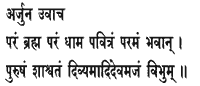
Arjuna said: Thou art the supreme Brahman, the supreme Abode, the supreme Purity, the one permanent, the divine Purusha, the original Godhead, the Unborn, the all-pervading Lord.
The Fullness of Spiritual Action
Sri Aurobindo
THE DEVELOPMENT of the idea of the Gita has reached a point at which one question alone remains for solution, —the question of our nature bound and defective and how it is to effect, not only in principle but in all its movements, its evolution from the lower to the higher being and from the law of its present action to the immortal Dharma. The difficulty is one which is implied in certain of the positions laid down in the Gita, but has to be brought out into greater prominence than it gets there and to be put into a clearer shape before our intelligence. The Gita proceeded on a psychological knowledge which was familiar to the mind of the time, and in the steps of its thought it was well able to abridge its transitions, to take much for granted and to leave many things unexpressed which we need to have put strongly into light and made precise to us. Its teaching sets out at the beginning to propose a new source and level for our action in the world; that was the startingpoint and that motives also the conclusion. Its initial object was not precisely to propose a way of liberation, moks.a, but rather to show the compatibility of works with the soul’s effort towards liberation and of spiritual freedom itself when once attained with continued action in the world, muktasya karma. Incidentally, a synthetic Yoga or psychological method of arriving at spiritual liberation and perfection has been developed and certain metaphysical affirmations have been put forward, certain truths of our being and nature on which the validity of this Yoga reposes. But the original preoccupation remains throughout, the original difficulty and problem, how Arjuna, dislodged by a strong revulsion of thought and feeling from the established natural and rational foundations and standards of action, is to find a new and satisfying spiritual norm of works, or how he is to live in the truth of the Spirit—since he can no longer act according to the partial truths of the customary reason and nature of man—and yet to do his appointed work on the battle-field of Kurukshetra. To live inwardly calm, detached, silent in the silence of the impersonal and universal Self and yet do dynamically the works of dynamic Nature, and more largely, to be one with the Eternal within us and to do all the will of the Eternal in the world expressed through a sublimated force, a divine height of the personal nature uplifted, liberated, universalised, made one with God-nature,—this is the Gita’s solution. Let us see what this comes to in the most plain and positive terms and from the standpoint of the problem which is at the root of Arjuna’s difficulty and refusal. His duty as a human being and a social being is the discharge of the high function of the Kshatriya without which the frame of society cannot be maintained, the ideals of the race cannot be vindicated, the harmonious order of right and justice cannot be upheld against the anarchic violence of oppression, wrong and injustice. And yet the appeal to duty by itself can no longer satisfy the protagonist of the struggle because in the terrible actuality of Kurukshetra it presents itself in harsh, perplexed and ambiguous terms. The discharge of his social duty has suddenly come to signify assent to an enormous result of sin and sorrow and suffering; the customary means of maintaining social order and justice is found to lead instead to a great disorder and chaos. The rule of just claim and interest, that which we call rights, will not serve him here; for the kingdom he has to win for himself and his brothers and his side in the war is indeed rightly theirs and its assertion an overthrow of Asuric tyranny and a vindication of justice, but a blood-bespattered justice and a kingdom possessed in sorrow and with the stain on it of a great sin, a monstrous harm done to society, a veritable crime against the race. Nor will the rule of Dharma, of ethical right, serve any better; for there is here a conflict of dharmas. A new and greater yet unguessed rule is needed to solve the problem, but what is that rule? For to withdraw from his work, to take refuge in a saintly inactivity and leave the imperfect world with its unsatisfying methods and motives to take care of itself is one possible solution easy to envisage, easy to execute, but this is the very cutting of the knot that has been insistently forbidden by the Teacher. Action is demanded of man by the Master of the world who is the master of all his works and whose world is a field of action, whether done through the ego and in the ignorance or partial light of the limited human reason or initiated from a higher and more largely seeing plane of vision and motive. Again, to abandon this particular action as evil would be another kind of solution, the ready resort of the shortsighted moralising mind, but to this evasion too the Teacher refuses his assent. Arjuna’s abstention would work a much greater sin and evil: it would mean, if it had any effect at all, the triumph of wrong and injustice and the rejection of his own mission as an instrument of the divine workings. A violent crisis in the destinies of the race has been brought about not by any blind motion of forces or solely by the confused clash of human ideas, interests, passions, egoisms, but by aWill which is behind these outward appearances. This truth Arjuna must be brought to see; he must learn to act impersonally, imperturbably as the instrument not of his little personal desires and weak human shrinkings, but of a vaster and more luminous Power, a greater all-wise divine and universal Will. He must act impersonally and universally in a high union of his soul with the inner and outer Godhead, yukta, in a calm Yoga with his own supreme Self and the informing Self of the universe. But this truth cannot be rightly seen and this kind of action cannot be rightly undertaken, cannot become real as long as man is governed by the ego, even by the half-enlightened unillumined sattwic ego of the reason and the mental intelligence. For this is a truth of the spirit, this is an action from a spiritual basis. A spiritual, not an intellectual knowledge is the indispensable requisite for this way of works, its sole possible light, medium, incentive. First, therefore, the Teacher points out that all these ideas and feelings which trouble, perplex and baffle Arjuna, joy and sorrow, desire and sin, the mind’s turn towards governing action by the outward results of action, the human shrinking from what seems terrible and formidable in the dealings of the universal Spirit with the world, are things born of the subjection of our consciousness to a natural ignorance, the way of working of a lower nature in which the soul is involved and sees itself as a separate ego returning to the action of things upon it dual reactions of pain and pleasure, virtue and vice, right and wrong, good happening and evil fortune. These reactions create a tangled web of perplexity in which the soul is lost and bewildered by its own ignorance; it has to guide itself by partial and imperfect solutions that serve ordinarily with a stumbling sufficiency in the normal life, but fail when brought to the test of a wider seeing and a profounder experience. To understand the real sense of action and existence one must retreat behind all these appearances into the truth of the spirit; one must found self-knowledge before one can have the basis of a right world-knowledge. The first requisite is to shake the wings of the soul free from desire and passion and troubling emotion and all this perturbed and distorting atmosphere of human mind and arrive into an ether of dispassionate equality, a heaven of impersonal calm, an egoless feeling and vision of things. For only in that lucid upper air, reaches free from all storm and cloud, can self-knowledge come and the law of the world and the truth of Nature be seen steadily and with an embracing eye and in an undisturbed and all-comprehending and all-penetrating light. Behind this little personality which is a helpless instrument, a passive or vainly resistant puppet of Nature and a form figured in her creations, there is an impersonal self one in all which sees and knows all things; there is an equal, impartial, universal presence and support of creation, a witnessing consciousness that suffers Nature to work out the becoming of things in their own type, svabh¯ava, but does not involve and lose itself in the action she initiates. To draw back from the ego and the troubled personality into this calm, equal, eternal, universal, impersonal Self is the first step towards a seeing action in Yoga done in conscious union with the divine Being and the infallible Will that, however obscure now to us, manifests itself in the universe. When we live tranquilly poised in this self of impersonal wideness, then because that is vast, calm, quiescent, impersonal, our other little false self, our ego of action disappears into its largeness and we see that it is Nature that acts and not we, that all action is the action of Nature and can be nothing else. And this thing we call Nature is a universal executive Power of eternal being in motion which takes different shapes and forms in this or that class of its creatures and in each individual of the species according to its type of natural existence and the resultant function and law of its works. According to its nature each creature must act and it cannot act by anything else. Ego and personal will and desire are nothing more than vividly conscious forms and limited natural workings of a universal Force that is itself formless and infinite and far exceeds them; reason and intelligence and mind and sense and life and body, all that we vaunt or take for our own, are Nature’s instruments and creations. But the impersonal Self does not act and is not part of Nature: it observes the action from behind and above and remains lord of itself and a free and impassive knower and witness. The soul that lives in this impersonality is not affected by the actions of which our nature is an instrument; it does not reply to them or their effects by grief and joy, desire and shrinking, attraction and repulsion or any of the hundred dualities that draw and shake and afflict us. It regards all men and all things and all happenings with equal eyes, watches the modes or qualities of Nature acting on the modes or qualities, sees the whole secret of the mechanism, but is itself beyond these modes and qualities, a pure absolute essential being, impassive, free, at peace. Nature works out her action and the soul impersonal and universal supports her but is not involved, is not attached, is not entangled, is not troubled, is not bewildered. If we can live in this equal self, we too are at peace; our works continue so long as Nature’s impulsion prolongs itself in our instruments, but there is a spiritual freedom and quiescence. This duality of Self and Nature, quiescent Purusha, active Prakriti, is not, however, the whole of our being; these are not really the two last words in thematter. If it were so, either all works would be quite indifferent to the soul and this or that action or refraining from action would take place by some ungoverned turn of the mobile variations of the gunas,—Arjuna would be moved to battle by rajasic impulse in the instruments orwithheld from it by tamasic inertia or sattwic indifference,—or else, if it so is that he must act and act only in this way, it would be by some mechanical determinism of Nature. Moreover, since the soul in its retreat would come to live in the impersonal quiescent Self and cease to live at all in active Nature, the final result would be quiescence, cessation, inertia, not the action imposed by the Gita. And, finally, this duality gives no real explanation why the soul is at all called to involve itself in Nature and her works; for it cannot be that the one ever uninvolved self-conscient spirit gets itself involved and loses its self-knowledge and has to return to that knowledge. This pure Self, this Atman is on the contrary always there, always the same, always the one self-conscient impersonal aloofWitness or impartial supporter of the action. It is this lacuna, this impossible vacuum that compels us to suppose two Purushas or two poses of the one Purusha, one secret in the Self that observes all from its self-existence—or perhaps observes nothing, another self-projected into Nature that lends itself to her action and identifies itself with her creations. But even this dualism of Self and Prakriti or Maya corrected by the dualism of the two Purushas is not the whole philosophic creed of the Gita. It goes beyond them to the supreme all-embracing oneness of a highest Purusha, Purushottama. The Gita affirms that there is a supreme Mystery, a highest Reality that upholds and reconciles the truth of these two different manifestations. There is an utmost supreme Self, Lord and Brahman, one who is both the impersonal and the personal, but other and greater than either of them and other and greater than both of them together. He is Purusha, Self and soul of our being, but he is also Prakriti; for Prakriti is the power of the All- Soul, the power of the Eternal and Infinite self-moved to action and creation. The supreme Ineffable, the universal Person, he becomes by his Prakriti all these creatures. The supreme Atman and Brahman, he manifests by his Maya of self-knowledge and hisMaya of ignorance the double truth of the cosmic riddle. The supreme Lord, master of his Force, his Shakti, he creates, impels and governs all this Nature and all the personality, power and works of these innumerable existences. Each soul is a partial being of this self-existent One, an eternal soul of this All-Soul, a partial manifestation of this supreme Lord and his universal Nature. All here is this Divine, this Godhead, Vasudeva; for by Nature and the soul in Nature he becomes all that is and everything proceeds from him and lives in or by him, though he himself is greater than any widest manifestation, any deepest spirit, any cosmic figure. This is the complete truth of existence and this all the secret of the universal action that we have seen disengaging itself from the later chapters of the Gita. But how does this greater truth modify or how affect the principle of spiritual action? It modifies it to begin with in this fundamental matter that the whole meaning of the relation of Self and soul and Nature gets changed, opens out to a new vision, fills in the blanks that were left, acquires a greater amplitude, assumes a true and spiritually positive, a flawlessly integral significance. The world is no longer a purely mechanical qualitative action and determination of Nature set over against the quiescence of an impersonal self-existence which has no quality or power of self-determination, no ability or impulse to create. The chasm left by this unsatisfactory dualism is bridged and an uplifting unity revealed between knowledge and works, the soul and Nature. The quiescent impersonal Self is a truth,— it is the truth of the calm of the Godhead, the silence of the Eternal, the freedom of the Lord of all birth and becoming and action and creation, his calm infinite freedom of self-existence not bound, troubled or affected by his creation, not touched by the action and reaction of his Nature. Nature itself is now no inexplicable illusion, no separated and opposite phenomenon, but a movement of the Eternal, all her stir and activity and multiplicity founded and supported on the detached and observing tranquillity of an immutable self and spirit. The Lord of Nature remains that immutable self even while he is at the same time the one and multiple soul of the universe and becomes in a partial manifestation all these forces, powers, consciousnesses, gods, animals, things, men. Nature of the gunas is a lower self limited action of his power; it is nature of imperfectly conscious manifestation and therefore of a certain ignorance. The truth of the self, even as the truth of the Divine, is held back from her surface force absorbed here in its outer action—much as man’s deeper being is held back from the knowledge of his surface consciousness—until the soul in her turns to find out this hidden thing, gets inside itself and discovers its own real verities, its heights and its depths. That is why it has to draw back from its little personal and egoistic to its large and impersonal, immutable and universal Self in order to become capable of self-knowledge. But the Lord is there, not only in that self, but in Nature. He is in the heart of every creature and guides by his presence the turnings of this great natural mechanism. He is present in all, all lives in him, all is himself because all is a becoming of his being, a portion or a figure of his existence. But all proceeds here in a lower partial working that has come out of a secret, a higher and greater and completer nature of Divinity, the eternal infinite nature or absolute self-power of the Godhead, dev¯atma´sakti. The perfect, integrally conscious soul hidden in man, an eternal portion of Deity, a spiritual being of the eternal Divine Being, can open in us and can too open us to him if we live constantly in this true truth of his action and our existence. The seeker of Godhead has to get back to the reality of his immutable and eternal impersonal self and at the same time he has to see everywhere the Divine from whom he proceeds, to see him as all, to see him in the whole of this mutable Nature and in every part and result of her and in all her workings, and there too to make himself one with God, there too to live in him, to enter there too into the divine oneness. He unites in that integrality the divine calm and freedom of his deep essential existence with a supreme power of instrumental action in his divinised self of Nature. But how is this to be done? It can be done first by a right spirit in our will of works. The seeker has to regard all his action as a sacrifice to the Lord of works who is the eternal and universal Being and his own highest Self and the Self of all others and the supreme all-inhabiting, all-containing, all-governing Godhead in the universe. The whole action of Nature is such a sacrifice,—offered at first indeed to the divine Powers that move her and move in her, but these powers are only limited forms and names of the One and Illimitable. Man ordinarily offers his sacrifice openly or under a disguise to his own ego; his oblation is the false action of his own self-will and ignorance. Or he offers his knowledge, action, aspiration, works of energy and effort to the gods for partial, temporal and personal aims. The man of knowledge, the liberated soul offers on the contrary all his activities to the one eternal Godhead without any attachment to their fruit or to the satisfaction of his lower personal desires. He works for God, not for himself, for the universal welfare, for the Soul of the world and not for any particular object which is of his own personal creation or for any construction of his mental will or object of his vital longings, as a divine agent, not as a principal and separate profiteer in the worldcommerce. And this, it must be noted, is a thing that cannot be really done except in proportion as the mind arrives at equality, universality, wide impersonality, and a clear freedom from every disguise of the insistent ego: for without these things the claim to be thus acting is a pretension or an illusion. The whole action of the world is the business of the Lord of the universe, the concern of the self-existent Spirit of whom it is the unceasing creation, the progressive becoming, the significant manifestation and living symbol in Nature. The fruits are his, the results are those determined by him and our personal action is only a minor contribution ruled or overruled, so far as its motive is an egoistic claim, by this Self and Spirit in us who is the Self and Spirit in all and governs things for the universal end and good and not for the sake of our ego. To work impersonally, desirelessly and without attachment to the fruits of our work, for the sake of God and the world and the greater Self and the fulfilment of the universal will,—this is the first step towards liberation and perfection. But beyond this step there lies that other greater motion, the inner surrender of all our actions to the Divinity within us. For it is infinite Nature that impels our works and a divine Will in and above her that demands action of us; the choice and turn our ego gives to it is a contribution of our tamasic, rajasic, sattwic quality, a deformation in the lower Nature. The deformation comes by the ego thinking of itself as the doer; the character of the act takes the form of the limited personal nature and the soul is bound up with that and its narrow figures and does not allow the act to proceed freely and purely from the infinite power within it. And the ego is chained to the act and its outcome; it must suffer the personal consequence and reaction even as it claims the responsible origination and personal will of the doing. The free perfect working comes first by referring and finally by surrendering altogether the action and its origination to the divineMaster of our existence; for we feel it progressively taken up by a supreme Presence within us, the soul drawn into deep intimacy and close unity with an inner Power and Godhead and the work originated directly from the greater Self, from the all-wise, infinite, universal force of an eternal being and not from the ignorance of the little personal ego. The action is chosen and shaped according to the nature, but entirely by the divineWill in the nature, and it is therefore free and perfect within, whatever its outward appearance; it comes stamped with the inward spiritual seal of the Infinite as the thing to be done, the movement and the step of the movement decreed in the ways of the omniscient Master of action, kartavyam˙ karma. The soul of the liberated man is free in its impersonality, even while he contributes to the action as its means and its occasion his instrumental personal self-creation and the special will and power in his nature. That will and power is now not separately, egoistically his own, but a force of the suprapersonal Divine who acts in this becoming of his own self, this one of his myriad personalities by means of the characteristic form of the natural being, the swabhava. This is the high secret and mystery, uttamam˙ rahasyam, of the action of the liberated man. It is the result of a growing of the human soul into a divine Light and of the union of its nature with a highest universal nature. This change cannot come about except by knowledge. There is necessary a right knowledge of self and God and world and a living and growing into the greater consciousness to which that knowledge admits us. We know now what the knowledge is. It is sufficient to remember that it reposes on another and wider vision than the human mental, a changed vision and experience by which one is first of all liberated from the limitations of the ego sense and its contacts and feels and sees the one self in all, all in God, all beings as Vasudeva, all as vessels of the Godhead and one’s self too as a significant being and soul-power of that one Godhead; it treats in a spiritual uniting consciousness all the happenings of the lives of others as if they were happenings of one’s own life; it allows no wall of separation and lives in a universal sympathy with all existences, while amidst the worldmovement one still does the work that has to be done for the good of all, sarva-bhu¯ ta-hite, according to the way appointed by the Divine and in the measures imposed by the command of the Spirit who is Master of Time. Thus living and acting in this knowledge the soul of man becomes united with the Eternal in personality and in impersonality, lives in the Eternal though acting in Time, even as the Eternal acts, and is free, perfect and blissful whatever may be the form and determination of the work done in Nature. The liberated man has the complete and total knowledge, kr.tsnavid, and does all works without any of the restrictions made by the mind, kr.tsna-karma-kr.t, according to the force and freedom and infinite power of the divine will within him. And since he is united with the Eternal, he has too the pure spiritual and illimitable joy of his eternal existence. He turns with adoration to the Self of whom he is a portion, theMaster of his works and divine Lover of his soul and nature. He is not an impassive calm spectator only; he lifts not only his knowledge and will to the Eternal, but his heart also of love and adoration and passion. For without that uplifting of the heart his whole nature is not fulfilled and united with God; the ecstasy of the spirit’s calm needs to be transformed by the ecstasy of the soul’s Ananda. Beyond the personal Jiva and the impersonal Brahman or Atman he reaches the supracosmic Purushottama who is immutable in impersonality and fulfils himself in personality and draws us to him through these two different attractions. The liberated seeker rises personally to that highest Numen by his soul’s love and joy in God and the adoration of the will in him for the Master of its works; the peace and largeness of his impersonal universal knowledge is perfected by delight in the self-existent integral close and intimate reality of this surpassing and universal Godhead. This delight glorifies his knowledge and unites it with the eternal delight of the Spirit in its self and its manifestation; this perfects too his personality in the superperson of the divine Purusha andmakes his natural being and action one with eternal beauty, eternal harmony, eternal love and Ananda. But all this change means a total passing from the lower human to the higher divine nature. It is a lifting of our whole being or at least of the whole mental being that wills, knows and feels beyond what we are into some highest spiritual consciousness, some satisfying fullest power of existence, some deepest widest delight of the spirit. And this may well be possible by a transcendence of our present natural life, it may well be possible in some celestial state beyond the earthly existence or still beyond in a supracosmic superconscience; it may happen by transition to an absolute and infinite power and status of the Spirit. But while we are here in the body, here in life, here in action, what in this change becomes of the lower nature? For at present all our activities are determined in their trend and shape by the nature, and this Nature here is the nature of the three gunas, and in all natural being and in all natural activities there is the triple guna, tamas with its ignorance and inertia, rajas with its kinesis and action, its passion and grief and perversion, sattwa with its light and happiness, and the bondage of these things. And granted that the soul becomes superior in the self to the three gunas, how does it escape in its instrumental nature from their working and result and bondage? For even the man of knowledge, says the Gita, must act according to his nature. To feel and bear the reactions of the gunas in the outer manifestation, but to be free from them and superior in the observing conscious self behind is not sufficient; for it leaves still a dualism of freedom and subjection, a contradiction between what we are within and what we are without, between our self and our power, what we know ourselves to be and what we will and do. Where is the release here, where the full elevation and transformation to the higher spiritual nature, the immortal Dharma, the law proper to the infinite purity and power of a divine being? If this change cannot be effected while in the body, then so it must be said, that the whole nature cannot be transformed and there must remain an unreconciled duality until the mortal type of existence drops off like a discarded shell from the spirit. But in that case the gospel of works cannot well be the right or at least cannot be the ultimate gospel: a perfect quiescence or at least as perfect a quiescence as possible, a progressive Sannyasa and renunciation of works would seem still to be the true counsel of perfection, —as indeed the Mayavadin contends, who says that the Gita’s way is no doubt the right way so long as we remain in action, but still all works are an illusion and quiescence the highest path. To act in this spirit is well, but only as a transition to a renunciation of all works, to cessation, to an absolute quiescence. This is the difficulty which the Gita has still to meet in order to justify works to the seeker after the Spirit. Otherwise it must say to Arjuna, “Act temporarily in this fashion, but afterwards seek the higher way of renunciation of works.” But on the contrary it has said that not the cessation of works, but renunciation of desire is the better way; it has spoken of the action of the liberated man, muktasya karma. It has even insisted on doing all actions, sarv ¯an.i karm¯an. i, kr.tsna-karmakr. t; it has said that in whatever way the perfected Yogin lives and acts, he lives and acts in God. This can only be, if the nature also in its dynamics and workings becomes divine, a power imperturbable, intangible, inviolate, pure and untroubled by the reactions of the inferior Prakriti. How and by what steps is this most difficult transformation to be effected? What is this last secret of the soul’s perfection? what the principle or the process of this transmutation of our human and earthly nature?
Sri Aurobindo
 About Us | ©1999 - 2009 searchforlight.org
All extracts and quotations from the written works of Sri Aurobindo and the Mother and the Photographs of
the Mother and Sri Aurobindo are copyright Sri Aurobindo Ashram Trust, Pondicherry -605002 India.