
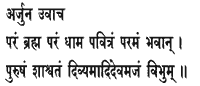
Arjuna said: Thou art the supreme Brahman, the supreme Abode, the supreme Purity, the one permanent, the divine Purusha, the original Godhead, the Unborn, the all-pervading Lord.
The Field and its Knower
Sri Aurobindo
THE GITA in its last six chapters, in order to found on a clear and complete knowledge the way of the soul’s rising out of the lower into the divine nature, restates in another form the enlightenment the Teacher has already imparted to Arjuna. Essentially it is the same knowledge, but details and relations are now made prominent and assigned their entire significance, thoughts and truths brought out in their full value that were alluded to only in passing or generally stated in the light of another purpose. Thus in the first six chapters the knowledge necessary for the distinction between the immutable self and the soul veiled in nature was accorded an entire prominence. The references to the supreme Self and Purusha were summary and not at all explicit; it was assumed in order to justify works in the world and it was affirmed to be the Master of being, but there was otherwise nothing to show what it was and its relations to the rest were not even hinted at, much less developed. The remaining chapters are devoted to the bringing out of this suppressed knowledge in a conspicuous light and strong preeminence. It is to the Lord, the Ishwara, it is to the distinction of the higher and the lower nature and to the vision of the alloriginating and all-constituting Godhead in Nature, it is to the One in all beings that prominence has been assigned in the next six Adhyayas (7-12) in order to found a root-unity of works and love with knowledge. But now it is necessary to bring out more definitely the precise relations between the supreme Purusha, the immutable self, the Jiva and Prakriti in her action and her gunas. Arjuna is therefore made to put a question which shall evoke a clearer elucidation of these still ill-lighted matters. He asks to learn of the Purusha and the Prakriti; he inquires of the
field of being and the knower of the field and of knowledge and the object of knowledge. Here is contained the sum of all the knowledge of self and the world that is still needed if the soul is to throw off its natural ignorance and staying its steps on a right use of knowledge, of life, of works and of its own relations with the Divine in these things ascend into unity of being with the eternal Spirit of existence. The essence of the Gita’s ideas in these matters has already, anticipating the final evolution of its thought, been elucidated in a certain measure; but, following its example, we may state them again from the point of view of its present preoccupation. Action being admitted, a divine action done with self-knowledge as the instrument of the divineWill in the cosmos being accepted as perfectly consistent with the Brahmic status and an indispensable part of the Godward movement, that action being uplifted inwardly as a sacrifice with adoration to the Highest, how does this way practically affect the great object of spiritual life, the rising from the lower into the higher nature, from mortal into immortal being? All life, all works are a transaction between the soul and Nature. What is the original character of that transaction? what does it become at its spiritual culminating point? to what perfection does it lead the soul that gets free from its lower and external motives and grows inwardly into the very highest poise of the Spirit and deepest motive-force of the works of its energy in the universe? These are the questions involved, —there are others which the Gita does not raise or answer, for they were not pressingly present to the human mind of that day, —and they are replied to in the sense of the solution drawn from a large-sighted combination of the Vedantic, Sankhya and Yoga views of existence which is the starting-point of the whole thought of the Gita. The Soul which finds itself here embodied in Nature has a triple reality to its own self-experience. First it is a spiritual being apparently subjected by ignorance to the outward workings of Prakriti and represented in her mobility as an acting, thinking, mutable personality, a creature of Nature, an ego. Next when it gets behind all this action and motion, it finds its own higher reality to be an eternal and impersonal self and immutable spirit which has no other share in the action and movement than to support it by its presence and regard it as an undisturbed equal witness. And last, when it looks beyond these two opposite selves, it discovers a greater ineffable Reality from which both proceed, the Eternal who is Self of the self and the Master of all Nature and all action, and not only the Master, but the origin and the spiritual support and scene of these workings of his own energy in Cosmos, and not only the origin and spiritual container, but the spiritual inhabitant in all forces, in all things and in all beings, and not only the inhabitant but, by the developments of this eternal energy of his being which we call Nature, himself all energies and forces, all things and all beings. This Nature itself is of two kinds, one derived and inferior, another original and supreme. There is a lower nature of the cosmic mechanism by association with which the soul in Prakriti lives in a certain ignorance born ofMaya, traigun.yamay¯ı m¯ay¯a, conceives of itself as an ego of embodied mind and life, works under the power of the modes of Nature, thinks itself bound, suffering, limited by personality, chained to the obligation of birth and the wheel of action, a thing of desires, transient, mortal, a slave of its own nature. Above this inferior power of existence there is a higher divine and spiritual nature of its own true being in which this soul is for ever a conscious portion of the Eternal and Divine, blissful, free, superior to its mask of becoming, immortal, imperishable, a power of the Godhead. To rise by this higher nature to the Eternal through divine knowledge, love and works founded on a spiritual universality is the key of the complete spiritual liberation. This much has been made clear; and we have to see now more in detail what farther considerations this change of being involves and especially what is the difference between these two natures and how our action and our soul-status are affected by the liberation. For that purpose the Gita enters largely into certain details of the highest knowledge which it had hitherto kept in the background. Especially it dwells on the relation between Being and becoming, Soul and Nature, the action of the three gunas, the highest liberation, the largest fullest self-giving of the human soul to the Divine Spirit. There is in all that it says in these closing six chapters much of the greatest importance, but it is the last thought with which it closes that is of supreme interest; for in it we shall find the central idea of its teaching, its great word to the soul of man, its highest message. First, the whole of existence must be regarded as a field of the soul’s construction and action in the midst of Nature. The Gita explains the ks.etram, field, by saying that it is this body which is called the field of the spirit, and in this body there is someone who takes cognizance of the field, ks.etrajn˜ a, the knower of Nature. It is evident, however, from the definitions that succeed that it is not the physical body alone which is the field, but all too that the body supports, the working of nature, the mentality, the natural action of the objectivity and subjectivity of our being.2 This wider body too is only the individual field; there is a larger, a universal, a world-body, a world-field of the same Knower. For in each embodied creature there is this one Knower: in each existence he uses mainly and centrally this single outward result of the power of his nature which he has formed for his habitation, ı¯s´a¯ va¯syam˙ sarvam˙ yat kin˜ ca, makes each separate sustained knot of his mobile Energy the first base and scope of his developing harmonies. In Nature he knows the world as it affects and is reflected by the consciousness in this one limited body; the world exists to us as it is seen in our single mind,—and in the end, even, this seemingly small embodied consciousness can so enlarge itself that it contains in itself the whole universe, ¯atmani vi´sva-dar´sanam. But, physically, it is a microcosm in a macrocosm, and the macrocosm too, the large world too, is a body and field inhabited by the spiritual knower. That becomes evident when the Gita proceeds to state the character, nature, source, deformations, powers of this sensible embodiment of our being.We see then that it is the whole working of the lower Prakriti that is meant by the ks.etra. That totality is the field of action of the embodied spirit here within us, the
field of which it takes cognizance. For a varied and detailed knowledge of all this world of Nature in its essential action as seen from the spiritual view-point we are referred to the verses of the ancient seers, the seers of the Veda and Upanishads, in which we get the inspired and intuitive account of these creations of the Spirit, and to the Brahma Sutras which will give us the rational and philosophic analysis. The Gita contents itself with a brief practical statement of the lower nature of our being in the terms of the Sankhya thinkers. First there is the indiscriminate unmanifest Energy; out of that has come the objective evolution of the five elemental states of matter; as also the subjective evolution of the senses, intelligence and ego; there are too five objects of the senses, or rather five different ways of sense cognizance of the world, powers evolved by the universal energy in order to deal with all the forms of things she has created from the five elemental states assumed by her original objective substance,—organic relations by which the ego endowed with intelligence and sense acts on the formations of the cosmos: this is the constitution of the kshetra. Then there is a general consciousness that first informs and then illumines the Energy in its works; there is a faculty of that consciousness by which the Energy holds together the relations of objects; there is too a continuity, a persistence of the subjective and objective relations of our consciousness with its objects. These are the necessary powers of the field; all these are common and universal powers at once of the mental, vital and physical Nature. Pleasure and pain, liking and disliking are the principal deformations of the kshetra. From the Vedantic point of view we may say that pleasure and pain are the vital or sensational deformations given by the lower energy to the spontaneous Ananda or delight of the spirit when brought into contact with her workings. And we may say from the same view-point that liking and disliking are the corresponding mental deformations given by her to the reactive Will of the spirit that determines its response to her contacts. These dualities are the positive and negative terms in which the ego soul of the lower nature enjoys the universe. The negative terms, pain, dislike, sorrow, repulsion and the rest, are perverse or at the best ignorantly reverse responses: the positive terms, liking, pleasure, joy, attraction, are ill-guided responses or at the best insufficient and in character inferior to those of the true spiritual experience. All these things taken together constitute the fundamental character of our first transactions with the world of Nature, but it is evidently not the whole description of our being; it is our actuality but not the limit of our possibilities. There is something beyond to be known, jn˜eyam, and it is when the knower of the field turns from the field itself to learn of himself within it and of all that is behind its appearances that real knowledge begins, jn˜a¯nam,—the true knowledge of the field no less than of the knower. That turning inward alone delivers from ignorance. For the farther we go inward, the more we seize on greater and fuller realities of things and grasp the complete truth both of God and the soul and of the world and its movements. Therefore, says the divine Teacher, it is the knowledge at once of the field and its knower, ks.etra-ks.etrajn˜ ayor jn˜a¯nam, a united and even unified self-knowledge and world-knowledge, which is the real illumination and the only wisdom. For both soul and nature are the Brahman, but the true truth of the world of Nature can only be discovered by the liberated sage who possesses also the truth of the spirit. One Brahman, one reality in Self and Nature is the object of all knowledge. The Gita then tells us what is the spiritual knowledge or rather it tells us what are the conditions of knowledge, the marks, the signs of the man whose soul is turned towards the inner wisdom. These signs are the recognised and traditional characteristics of the sage,—his strong turning away of the heart from attachment to outward and worldly things, his inward and brooding spirit, his steady mind and calm equality, the settled fixity of his thought and will upon the greatest inmost truths, upon the things that are real and eternal. First, there comes a certain moral condition, a sattwic government of the natural being. There is fixed in him a total absence of worldly pride and arrogance, a candid soul, a tolerant, long-suffering and benignant heart, purity of mind and body, tranquil firmness and steadfastness, self-control and a masterful government of the lower nature and the heart’s worship given to the Teacher, whether to the divine Teacher within or to the humanMaster in whom the divine Wisdom is embodied,—for that is the sense of the reverence given to the Guru. Then there is a nobler and freer attitude towards the outward world, an attitude of perfect detachment and equality, a firm removal of the natural being’s attraction to the objects of the senses and a radical freedom from the claims of that constant clamorous ego-sense, ego-idea, ego-motive which tyrannises over the normal man. There is no longer any clinging to the attachment and absorption of family and home. There is instead of these vital and animal movements an unattached will and sense and intelligence, a keen perception of the defective nature of the ordinary life of physical man with its aimless and painful subjection to birth and death and disease and age, a constant equalness to all pleasant or unpleasant happenings,—for the soul is seated within and impervious to the shocks of external events,—and a meditative mind turned towards solitude and away from the vain noise of crowds and the assemblies of men. Finally, there is a strong turn within towards the things that really matter, a philosophic perception of the true sense and large principles of existence, a tranquil continuity of inner spiritual knowledge and light, the Yoga of an unswerving devotion, love of God, the heart’s deep and constant adoration of the universal and eternal Presence. The one object to which the mind of spiritual knowledge must be turned is the Eternal by fixity in whom the soul clouded here and swathed in the mists of Nature recovers and enjoys its native and original consciousness of immortality and transcendence. To be fixed on the transient, to be limited in the phenomenon is to accept mortality; the constant truth in things that perish is that in them which is inward and immutable. The soul when it allows itself to be tyrannised over by the appearances of Nature, misses itself and goes whirling about in the cycle of the births and deaths of its bodies. There, passionately following without end the mutations of personality and its interests, it cannot draw back to the possession of its impersonal and unborn self-existence. To be able to do that is to find oneself and get back to one’s true being, that which assumes these births but does not perish with the perishing of its forms. To enjoy the eternity to which birth and life are only outward circumstances, is the soul’s true immortality and transcendence. That Eternal or that Eternity is the Brahman. Brahman is That which is transcendent and That which is universal: it is the free spirit who supports in front the play of soul with nature and assures behind their imperishable oneness; it is at once the mutable and the immutable, the All that is the One. In his highest supracosmic status Brahman is a transcendent Eternity without origin or change far above the phenomenal oppositions of existence and non-existence, persistence and transience between which the outward world moves. But once seen in the substance and light of this eternity, the world also becomes other than it seems to the mind and senses; for then we see the universe no longer as a whirl of mind and life and matter or a mass of the determinations of energy and substance, but as no other than this eternal Brahman. A spirit who immeasurably fills and surrounds all this movement with himself—for indeed the movement too is himself—and who throws on all that is finite the splendour of his garment of infinity, a bodiless and million-bodied spirit whose hands of strength and feet of swiftness are on every side of us, whose heads and eyes and faces are those innumerable visages which we see wherever we turn, whose ear is everywhere listening to the silence of eternity and the music of the worlds, is the universal Being in whose embrace we live. All relations of Soul and Nature are circumstances in the eternity of Brahman; sense and quality, their reflectors and constituents, are this supreme Soul’s devices for the presentation of the workings that his own energy in things constantly liberates into movement. He is himself beyond the limitation of the senses, sees all things but not with the physical eye, hears all things but not with the physical ear, is aware of all things but not with the limiting mind—mind which represents but cannot truly know. Not determined by any qualities, he possesses and determines in his substance all qualities and enjoys this qualitative action of his own Nature. He is attached to nothing, bound by nothing, fixed to nothing that he does; calm, he supports in a large and immortal freedom all the action and movement and passion of his universal Shakti. He becomes all that is in the universe; that which is in us is he and all that we experience outside ourselves is he. The inward and the outward, the far and the near, the moving and the unmoving, all this he is at once. He is the subtlety of the subtle which is beyond our knowledge, even as he is the density of force and substance which offers itself to the grasp of our minds. He is indivisible and the One, but seems to divide himself in forms and creatures and appears as all these separate existences. All things can get back in him, can return in the Spirit to the indivisible unity of their self-existence. All is eternally born from him, upborne in his eternity, taken eternally back into his oneness. He is the light of all lights and luminous beyond all the darkness of our ignorance. He is knowledge and the object of knowledge. The spiritual supramental knowledge that floods the illumined mind and transfigures it is this spirit manifesting himself in light to the force-obscured soul which he has put forth into the action of Nature. This eternal Light is in the heart of every being; it is he who is the secret knower of the field, ks.etrajn˜ a, and presides as the Lord in the heart of things over this province and over all these kingdoms of his manifested becoming and action. When man sees this eternal and universal Godhead within himself, when he becomes aware of the soul in all things and discovers the spirit in Nature, when he feels all the universe as a wave mounting in this Eternity and all that is as the one existence, he puts on the light of Godhead and stands free in the midst of the worlds of Nature. A divine knowledge and a perfect turning with adoration to this Divine is the secret of the great spiritual liberation. Freedom, love and spiritual knowledge raise us from mortal nature to immortal being. The Soul and Nature are only two aspects of the eternal Brahman, an apparent duality which founds the operations of his universal existence. The Soul is without origin and eternal, Nature too is without origin and eternal; but the modes of Nature and the lower forms she assumes to our conscious experience have an origin in the transactions of these two entities. They come from her, wear by her the outward chain of cause and effect, doing and the results of doing, force and its workings, all that is here transient and mutable. Constantly they change and the soul and Nature seem to change with them, but in themselves these two powers are eternal and always the same. Nature creates and acts, the Soul enjoys her creation and action; but in this inferior form of her action she turns this enjoyment into the obscure and petty figures of pain and pleasure. Forcibly the soul, the individual Purusha, is attracted by her qualitative workings and this attraction of her qualities draws him constantly to births of all kinds in which he enjoys the variations and vicissitudes, the good and evil of birth in Nature. But this is only the outward experience of the soul mutable in conception by identification with mutable Nature. Seated in this body is her and our Divinity, the supreme Self, Paramatman, the supreme Soul, the mighty Lord of Nature, who watches her action, sanctions her operations, upholds all she does, commands her manifold creation, enjoys with his universal delight this play of her figures of his own being. That is the self-knowledge to which we have to accustom our mentality before we can truly know ourselves as an eternal portion of the Eternal. Once that is fixed, no matter how the soul in us may comport itself outwardly in its transactions with Nature, whatever it may seem to do or however it may seem to assume this or that figure of personality and active force and embodied ego, it is in itself free, no longer bound to birth because one through impersonality of self with the inner unborn spirit of existence. That impersonality is our union with the supreme egoless I of all that is in cosmos. This knowledge comes by an inner meditation through which the eternal self becomes apparent to us in our own self-existence. Or it comes by the Yoga of the Sankhyas, the separation of the soul from nature. Or it comes by the Yoga of works in which the personal will is dissolved through the opening up of our mind and heart and all our active forces to the Lord who assumes to himself the whole of our works in nature. The spiritual knowledge may be awakened by the urging of the spirit within us, its call to this or that Yoga, this or that way of oneness. Or it may come to us by hearing of the truth from others and the moulding of the mind into the sense of that to which it listens with faith and concentration. But however arrived at, it carries us beyond death to immortality. Knowledge shows us high above the mutable transactions of the soul with the mortality of nature our highest Self as the supreme Lord of her actions, one and equal in all objects and creatures, not born in the taking up of a body, not subject to death in the perishing of all these bodies. That is the true seeing, the seeing of that in us which is eternal and immortal. As we perceive more and more this equal spirit in all things, we pass into that equality of the spirit; as we dwell more and more in this universal being, we become ourselves universal beings; as we grow more and more aware of this eternal, we put on our own eternity and are for ever. We identify ourselves with the eternity of the self and no longer with the limitation and distress of our mental and physical ignorance. Then we see that all our works are an evolution and operation of Nature and our real self not the executive doer, but the free witness and lord and unattached enjoyer of the action. All this surface of cosmic movement is a diverse becoming of natural existences in the one eternal Being, all is extended, manifested, rolled out by the universal Energy from the seeds of her Idea deep in his existence; but the spirit even though it takes up and enjoys her workings in this body of ours, is not affected by its mortality because it is eternal beyond birth and death, is not limited by the personalities which it multiply assumes in her because it is the one supreme self of all these personalities, is not changed by the mutations of quality because it is itself undetermined by quality, does not act even in action, kart¯aram api akart ¯aram, because it supports natural action in a perfect spiritual freedom from its effects, is the originator indeed of all activities, but in no way changed or affected by the play of its Nature. As the allpervading ether is not affected or changed by the multiple forms it assumes, but remains always the same pure subtle original substance, even so this spirit when it has done and become all possible things, remains through it all the same pure immutable subtle infinite essence. That is the supreme status of the soul, par¯a gatih. , that is the divine being and nature, madbh¯ava, and whoever arrives at spiritual knowledge, rises to that supreme immortality of the Eternal. This Brahman, this eternal and spiritual knower of the field of his own natural becoming, this Nature, his perpetual energy, which converts herself into that field, this immortality of the soul in mortal nature,—these things together make the whole reality of our existence. The spirit within, when we turn to it, illumines the entire field of Nature with its own truth in all the splendour of its rays. In the light of that sun of knowledge the eye of knowledge opens in us and we live in that truth and no longer in this ignorance. Then we perceive that our limitation to our present mental and physical nature was an error of the darkness, then we are liberated from the law of the lower Prakriti, the law of themind and body, thenwe attain to the supreme nature of the spirit. That splendid and lofty change is the last, the divine and infinite becoming, the putting off of mortal nature, the putting on of an immortal existence.
Sri Aurobindo
 About Us | ©1999 - 2009 searchforlight.org
All extracts and quotations from the written works of Sri Aurobindo and the Mother and the Photographs of
the Mother and Sri Aurobindo are copyright Sri Aurobindo Ashram Trust, Pondicherry -605002 India.