
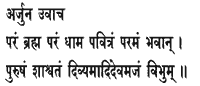
Arjuna said: Thou art the supreme Brahman, the supreme Abode, the supreme Purity, the one permanent, the divine Purusha, the original Godhead, the Unborn, the all-pervading Lord.
The Divine Truth and Way
Sri Aurobindo
THE GITA then proceeds to unveil the supreme and integral secret, the one thought and truth in which the seeker of perfection and liberation must learn to live and the one law of perfection of his spiritual members and of all their movements. This supreme secret is the mystery of the transcendent Godhead who is all and everywhere, yet so much greater and other than the universe and all its forms that nothing here contains him, nothing expresses him really, and no language which is borrowed from the appearances of things in space and time and their relations can suggest the truth of his unimaginable being. The consequent law of our perfection is an adoration by our whole nature and its self-surrender to its divine source and possessor. Our one ultimate way is the turning of our entire existence in the world, and not merely of this or that in it, into a single movement towards the Eternal. By the power and mystery of a divine Yoga we have come out of his inexpressible secrecies into this bounded nature of phenomenal things. By a reverse movement of the same Yoga we must transcend the limits of phenomenal nature and recover the greater consciousness by which we can live in the Divine and the Eternal. The supreme being of the Divine is beyond manifestation: the true sempiternal image of him is not revealed in matter, nor is it seized by life, nor is it cognisable by mind, acintyaru ¯ pa, avyaktamu¯ rti. What we see is only a self-created form, ru¯pa, not the eternal form of the Divinity, svaru¯pa. There is someone or there is something that is other than the universe, inexpressible, unimaginable, an ineffably infinite Godhead beyond anything that our largest or subtlest conceptions of infinity can shadow. All this weft of things to which we give the name of universe, all this immense sum of motion to which we can fix no limits and vainly seek in its forms and movements for any stable reality, any status, level and point of cosmic leverage, has been spun out, shaped, extended by this highest Infinite, founded upon this ineffable supracosmic Mystery. It is founded upon a self-formulation which is itself unmanifest and unthinkable. All this mass of becomings always changing and in motion, all these creatures, existences, things, breathing and living forms cannot contain him either in their sum or in their separate existence. He is not in them; it is not in them or by them that he lives, moves or has his being,—God is not the Becoming. It is they that are in him, it is they that live and move in him and draw their truth from him; they are his becomings, he is their being.1 In the unthinkable timeless and spaceless infinity of his existence he has extended this minor phenomenon of a boundless universe in an endless space and time. And even to say of him that all exists in him is not the whole truth of the matter, not the entirely real relation: for it is to speak of him with the idea of space, and the Divine is spaceless and timeless. Space and time, immanence and pervasion and exceeding are all of them terms and images of his consciousness. There is a Yoga of divine Power, me yoga ai´svarah., by which the Supreme creates phenomena of himself in a spiritual, not a material, self-formulation of his own extended infinity, an extension of which the material is only an image. He sees himself as one with that, is identified with that and all it harbours. In that infinite self-seeing, which is not his whole seeing,—the pantheist’s identity of God and universe is a still more limited view,—he is at once one with all that is and yet exceeds it; but he is other also than this self or extended infinity of spiritual being which contains and exceeds the universe. All exists here in his world-conscious infinite, but that again is upheld as a selfconception by the supracosmic reality of the Godhead which exceeds all our terms of world and being and consciousness.
This is the mystery of his being that he is supracosmic, yet not in any exclusive sense extracosmic. For he pervades it all as its self; there is a luminous uninvolved presence of the self-being of God, mama ¯atm¯a, which is in constant relation with the becoming and brings all its existences into manifestation by his simple presence.2 Therefore it is that we have these terms of Being and becoming, existence in itself, ¯atman, and existences dependent upon it, bhu¯ ta¯ni, mutable beings and immutable being. But the highest truth of these two relations and the resolution of their antinomy must be found in that which exceeds it; it is the supreme Godhead who manifests both containing self and its contained phenomena by the power of his spiritual consciousness, yogam¯ay¯a. And it is only through union with him in our spiritual consciousness that we can arrive at our real relations with his being. Metaphysically stated, this is the intention of these verses of the Gita: but they rest founded not upon any intellectual speculation, but on spiritual experience; they synthetise because they arise globally from certain truths of spiritual consciousness. When we attempt to put ourselves into conscious relations with whatever supreme or universal Being there exists concealed or manifest in the world, we arrive at a very various experience and one or other variant term of this experience is turned by different intellectual conceptions into their fundamental idea of existence. We have, to start with, the crude experience first of a Divine who is something quite different from and greater than ourselves, quite different from and greater than the universe in which we live; and so it is and no more so long as we live only in our phenomenal selves and see around us only the phenomenal face of the world. For the highest truth of the Supreme is supracosmic and all that is phenomenal seems a thing other than the infinity of the self-conscious spirit, seems an image of a lesser truth if not an illusion. When we dwell in this difference only, we regard the Divine as if extracosmic. That he is only in this sense that he is not, being supracosmic,
contained in the cosmos and its creations, but not in the sense that they are outside his being: for there is nothing outside the one Eternal and Real. We realise this first truth of the Godhead spiritually when we get the experience that we live and move and have our being in him alone, that however different from him we may be, we depend on him for our existence and the universe itself is only a phenomenon and movement in the Spirit. But again we have the farther and more transcendent experience that our self-existence is one with his self-existence. We perceive a one self of all and of that we have the consciousness and the vision: we can no longer say or think that we are entirely different from him, but that there is self and there is phenomenon of the self-existent; all is one in self, but all is variation in the phenomenon. By an exclusive intensity of union with the self we may even come to experience the phenomenon as a thing dreamlike and unreal. But again by a double intensity we may have too the double experience of a supreme self-existent oneness with him and yet of ourselves as living with him and in many relations to him in a persistent form, an actual derivation of his being. The universe, and our existence in the universe, becomes to us a constant and real form of the self-aware existence of the Divine. In that lesser truth we have our relations of difference between us and him and all these other living or inanimate powers of the Eternal and our dealings with his cosmic self in the nature of the universe. These relations are other than the supracosmic truth, they are derivative creations of a certain power of consciousness of the spirit, and because they are other and because they are creations the exclusive seekers of the supracosmic Absolute tax them with an unreality relative or complete. Yet are they from him, they are existent forms derived from his being, not figments created out of nothing. For it is ever itself and figures of itself and not things quite other than itself that the Spirit sees everywhere. Nor can we say that there is nothing at all in the supracosmic that corresponds to these relations. We cannot say that they are derivations of consciousness sprung from that source but yet with nothing in the source which at all supports or justifies them, nothing that is the eternal reality and supernal principle of these forms of his being. Again if we press in yet another way the difference between the self and the forms of self, we may come to regard the Self as containing and immanent, we may admit the truth of omnipresent spirit, and yet the forms of spirit, the moulds of its presence may affect us not only as something other than it, not only as transient, but as unreal images. We have the experience of the Spirit, the Divine Being immutable and ever containing in his vision the mutabilities of the universe; we have too the separate, the simultaneous or the coincident experience of the Divine immanent in ourselves and in all creatures. And yet the universe may be to us only an empirical form of his and our consciousness, or only an image or a symbol of existence by which we have to construct our significant relations with him and to grow gradually aware of him. But on the other hand, we get another revealing spiritual experience in which we are forced to see as the very Divine all things, not only that Spirit which dwells immutable in the universe and in its countless creatures, but all this inward and outward becoming. All is then to us a divine Reality manifesting himself in us and in the cosmos. If this experience is exclusive, we get the pantheistic identity, the One that is all: but the pantheistic vision is only a partial seeing. This extended universe is not all that the Spirit is, there is an Eternal greater than it by which alone its existence is possible. Cosmos is not the Divine in all his utter reality, but a single self-expression, a true but minor motion of his being. All these spiritual experiences, however different or opposed at first sight, are yet reconcilable if we cease to press on one or other exclusively and if we see this simple truth that the divine Reality is something greater than the universal existence, but yet that all universal and particular things are that Divine and nothing else,—significative of him, we might say, and not entirely That in any part or sum of their appearance, but still they could not be significative of him if they were something else and not term and stuff of the divine existence. That is the Real; but they are its expressive realities.3 This is what is intended by the phrase, v¯asudevah. sarvam iti; the Godhead is all that is universe and all that is in the universe and all that is more than the universe. The Gita lays stress first on his supracosmic existence. For otherwise the mind would miss its highest goal and remain turned towards the cosmic only or else attached to some partial experience of the Divine in the cosmos. It lays stress next on his universal existence in which all moves and acts. For that is the justification of the cosmic effort and that is the vast spiritual self-awareness in which the Godhead self-seen as the Time-Spirit does his universal works. Next it insists with a certain austere emphasis on the acceptance of the Godhead as the divine inhabitant in the human body. For he is the Immanent in all existences, and if the indwelling divinity is not recognised, not only will the divine meaning of individual existence be missed, the urge to our supreme spiritual possibilities deprived of its greatest force, but the relations of soul with soul in humanity will be left petty, limited and egoistic. Finally, it insists at great length on the divine manifestation in all things in the universe and affirms the derivation of all that is from the nature, power and light of the one Godhead. For that seeing too is essential to the God-knowledge; on it is founded the integral turn of the whole being and the whole nature Godwards, the acceptance by man of the works of the divine Power in the world and the possibility of remoulding his mentality and will into the type of the God-action, transcendent in initiation, cosmic in motive, transmitted through the individual, the Jiva. The supreme Godhead, the Self immutable behind the cosmic consciousness, the individual Divinity in the human being
and the Divine secretly conscious or partially manifested in cosmic Nature and all her works and creatures, are then one reality, one Godhead. But the truths that we can put forward the most confidently of one, are reversed or they alter their sense when we try to apply them to the other poises of the one Being. Thus the Divine is always the Lord, Ishwara; but we cannot therefore crudely apply the idea of his essential lordship and mastery in exactly the same way without change in all four fields. As the Divine manifest in cosmic Nature he acts in close identity with Nature. He is himself then Nature, so to speak, but with a spirit within her workings which foresees and forewills, understands and enforces, compels the action, overrules in the result. As the one silent self of all he is the non-doer, and Nature alone is the doer. He leaves all these works to be done by her according to the law of our being, svabh¯avas tu pravartate, and yet he is still the lord, prabhu vibhu, because he views and upholds our action and enables Nature to work by his silent sanction. He by his immobility transmits the power of the supreme Godhead through the compulsion of his pervading motionless Presence and supports its workings by the equal regard of his witness Self in all things. As the supreme supracosmic Godhead he originates all, but is above all; he compels all to manifest, but does not lose himself in what he creates or attach himself to the works of his Nature. His is the free presiding Will of being that is antecedent to all the necessities of the natural action. In the individual he is during the ignorance the secret Godhead in us who compels all to revolve on the machine of Nature on which the ego is carried round as part of themachinery, at once a clog and a convenience. But since all the Divine is within each being, we can rise above this relation by transcending the ignorance. For we can identify ourselveswith the one Self supporter of all things and become the witness and non-doer. Or else we can put our individual being into the human soul’s right relation with the supreme Godhead within us and make it in its parts of nature the immediate cause and instrument, nimitta, and in its spiritual self and person a high participant in the supreme, free and unattached mastery of that inner Numen. This is a thing we have to see clearly in the Gita; we have to allow for this variation of the sense of the same truth according to the nodus of relation from which its application comes into force. Otherwise we shall see mere contradiction and inconsistency where none exists or be baffled like Arjuna by what seems to us a riddling utterance. Thus the Gita begins by affirming that the Supreme contains all things in himself, but is not in any, matstha¯ni sarva-bhu¯ ta¯ni, “all are situated in Me, not I in them,” and yet it proceeds immediately to say, “and yet all existences are not situated in Me, my self is the bearer of all existences and it is not situated in existences.” And yet again it insists with an apparent selfcontradiction that the Divine has lodged himself, has taken up his abode in the human body, ma¯nus.¯ım˙ tanum a¯s´ritam, and that the recognition of this truth is necessary for the soul’s release by the integral way of works and love and knowledge. These statements are only in appearance inconsistent with each other. It is as the supracosmic Godhead that he is not in existences, nor even they in him; for the distinction we make between Being and becoming applies only to the manifestation in the phenomenal universe. In the supracosmic existence all is eternal Being and all, if there too there is any multiplicity, are eternal beings; nor can the spatial idea of indwelling come in, since a supracosmic absolute being is not affected by the concepts of time and space which are created here by the Lord’s Yogamaya. There a spiritual, not a spatial or temporal coexistence, a spiritual identity and coincidence must be the foundation. But on the other hand in the cosmic manifestation there is an extension of universe in space and time by the supreme unmanifest supracosmic Being, and in that extension he appears first as a self who supports all these existences; bhu¯ ta-bhr.t, he bears them in his all-pervading selfexistence. And, even, through this omnipresent self the supreme Self too, the Paramatman, can be said to bear the universe; he is its invisible spiritual foundation and the hidden spiritual cause of the becoming of all existences. He bears the universe as the secret spirit in us bears our thoughts, works, movements. He seems to pervade and to contain mind, life and body, to support them by his presence: but this pervasion is itself an act of consciousness, not material; the body itself is only a constant act of consciousness of the spirit. This divine Self contains all existences; all are situated in him, not materially in essence, but in that extended spiritual conception of self-being of which our too rigid notion of a material and etheric space is only a rendering in the terms of the physical mind and senses. In reality all even here is spiritual coexistence, identity and coincidence; but that is a fundamental truth which we cannot apply until we get back to the supreme consciousness. Till then such an idea would only be an intellectual concept to which nothing corresponds in our practical experience. We have to say, then, using these terms of relation in space and time, that the universe and all its beings exist in the divine Self-existent as everything else exists in the spatial primacy of ether. “It is as the great, the all-pervading aerial principle dwells in the etheric that all existences dwell in Me, that is how you have to conceive of it,” says the Teacher here to Arjuna. The universal existence is all-pervading and infinite and the Self-existent too is all-pervading and infinite; but the self-existent infinity is stable, static, immutable, the universal is an all-pervading movement, sarvatragah. . The Self is one, not many; but the universal expresses itself as all existence and is, as it seems, the sum of all existences. One is Being; the other is Power of Being which moves and creates and acts in the existence of the fundamental, supporting, immutable Spirit. The Self does not dwell in all these existences or in any of them; that is to say, he is not contained by any,—just as the ether here is not contained in any form, though all forms are derived ultimately from the ether. Nor is he contained in or constituted by all existences together—any more than the ether is contained in the mobile extension of the aerial principle or is constituted by the sum of its forms or its forces. But still in the movement also is the Divine; he dwells in the many as the Lord in each being. Both these relations are true of him at one and the same time. The one is a relation of self-existence to the universal movement; the other, the immanence, is a relation of the universal existence to its own forms. The one is a truth of being in its all-containing immutability, self-existent: the other is a truth of Power of the same being manifest in the government and information of its own self-veiling and self-revealing movements. The Supreme from above cosmic existence leans, it is here said, or presses down upon his Nature to loose from it in an eternal cyclic recurrence all that it contains in it, all that was once manifest and has become latent. All existences act in the universe in subjection to this impelling movement and to the laws of manifested being by which is expressed in cosmic harmonies the phenomenon of the divine All-existence. The Jiva follows the cycle of its becoming in the action of this divine Nature, prakr.ti ˙m m¯amik¯am, sv¯a ˙ m prakr. tim, the “own nature” of the Divine. It becomes in the turns of her progression this or that personality; it follows always the curve of its own law of being as a manifestation of the divine Nature, whether in her higher and direct or her lower and derived movement, whether in ignorance or in knowledge; it returns out of her action into her immobility and silence in the lapse of the cycle. Ignorant, it is subject to her cyclic whirl, not master of itself, but dominated by her, ava´sah. prakr.ter va´s ¯ at; only by return to the divine consciousness can it attain to mastery and freedom. The Divine too follows the cycle, not as subject to it, but as its informing Spirit and guide, not with his whole being involved in it, but with his power of being accompanying and shaping it. He is the presiding control of his own action of Nature, adhyaks.a,—not a spirit born in her, but the creative spirit who causes her to produce all that appears in the manifestation. If in his power he accompanies her and causes all her workings, he is outside it too, as if One seated above her universal action in the supracosmic mastery, not attached to her by any involving and mastering desire and not therefore bound by her works, because he infinitely exceeds them and precedes them, is the same before, during and after all their procession in the cycles of Time. All their mutations make no difference to his immutable being. The silent self that pervades and supports the cosmos is not affected by its changes because, though supporting, it does not participate in them. This greatest supreme supracosmic Self also is not affected because it exceeds and eternally transcends them. But also since this action is the action of the divine Nature, sv¯a prakr. tih. , and the divine Nature can never be separate from the Divine, in everything she creates the Godhead must be immanent. That is a relation which is not the whole truth of his being, but neither is it a truth which we can at all afford to ignore. He is lodged in the human body. Those who ignore his presence, who despise because of its masks the divinity in the human form, are bewildered and befooled by the appearances of Nature and they cannot realise that there is the secret Godhead within, whether conscious in humanity as in the Avatar or veiled by his Maya. Those who are great-souled, who are not shut up in their idea of ego, who open themselves to the indwelling Divinity, know that the secret spirit in man which appears here bounded by the limited human nature, is the same ineffable splendour which we worship beyond as the supreme Godhead. They become aware of the highest status of him in which he is master and lord of all existences and yet see that in each existence he is still the supreme Deity and the indwelling Godhead. All the rest is a selflimitation for the manifesting of the variations of Nature in the cosmos. They see too that as it is his Nature which has become all that is in the universe, everything here is in its inner fact nothing but one Divine, all is Vasudeva, and they worship him not only as the supreme Godhead beyond, but here in the world, in his oneness and in every separate being. They see this truth and in this truth they live and act; him they adore, live, serve both as the Transcendent of things and as God in the world and as the Godhead in all that is, serve him with works of sacrifice, seek him out by knowledge, see nothing else but him everywhere and lift their whole being to him both in its self and in all its inward and outward nature. This they know to be the large and perfect way; for it is the way of the whole truth of the one supreme and universal and individual Godhead.4
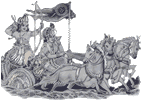
Sri Aurobindo
 About Us | ©1999 - 2009 searchforlight.org
All extracts and quotations from the written works of Sri Aurobindo and the Mother and the Photographs of
the Mother and Sri Aurobindo are copyright Sri Aurobindo Ashram Trust, Pondicherry -605002 India.