
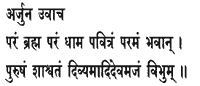
Arjuna said: Thou art the supreme Brahman, the supreme Abode, the supreme Purity, the one permanent, the divine Purusha, the original Godhead, the Unborn, the all-pervading Lord.
The Determinism of Nature
Sri Aurobindo
WHEN we can live in the higher Self by the unity of works and self-knowledge, we become superior to the method of the lower workings of Prakriti. We are no longer enslaved to Nature and her gunas, but, one with the Ishwara, the master of our nature, we are able to use her without subjection to the chain of Karma, for the purposes of the Divine Will in us; for that is what the greater Self in us is, he is the Lord of her works and unaffected by the troubled stress of her reactions. The soul ignorant in Nature, on the contrary, is enslaved by that ignorance to her modes, because it is identified there, not felicitously with its true self, not with the Divine who is seated above her, but stupidly and unhappily with the egomind which is a subordinate factor in her operations in spite of the exaggerated figure it makes, a mere mental knot and point of reference for the play of the natural workings. To break this knot, no longer to make the ego the centre and beneficiary of our works, but to derive all from and refer all to the divine Supersoul is theway to become superior to all the restless trouble of Nature’s modes. For it is to live in the supreme consciousness, of which the ego-mind is a degradation, and to act in an equal and unified Will and Force and not in the unequal play of the gunas which is a broken seeking and striving, a disturbance, an inferior Maya. The passages in which the Gita lays stress on the subjection of the ego-soul to Nature, have by some been understood as the enunciation of an absolute and a mechanical determinism which leaves no room for any freedom within the cosmic existence. Certainly, the language it uses is emphatic and seems very absolute. But we must take, here as elsewhere, the thought of the Gita as a whole and not force its affirmations in their solitary sense quite detached from each other,—as indeed every truth, however true in itself, yet, taken apart from others which at once limit and complete it, becomes a snare to bind the intellect and a misleading dogma; for in reality each is one thread of a complex weft and no thread must be taken apart from the weft. Everything in the Gita is even so interwoven and must be understood in its relation to the whole. The Gita itself makes a distinction between those who have not the knowledge of the whole, akr.tsnavidah. , and are misled by the partial truths of existence, and the Yogin who has the synthetic knowledge of the totality, kr.tsna-vit. To see all existence steadily and see it whole and not be misled by its conflicting truths, is the first necessity for the calm and complete wisdom to which the Yogin is called upon to rise. A certain absolute freedom is one aspect of the soul’s relations with Nature at one pole of our complex being; a certain absolute determinism by Nature is the opposite aspect at its opposite pole; and there is also a partial and apparent, therefore an unreal eidolon of liberty which the soul receives by a contorted reflection of these two opposite truths in the developing mentality. It is the latter to which we ordinarily give, more or less inaccurately, the name of free will; but the Gita regards nothing as freedom which is not a complete liberation and mastery. We have always to keep in mind the two great doctrines which stand behind all the Gita’s teachings with regard to the soul and Nature,—the Sankhya truth of the Purusha and Prakriti corrected and completed by the Vedantic truth of the threefold Purusha and the double Prakriti of which the lower form is the Maya of the three gunas and the higher is the divine nature and the true soul-nature. This is the key which reconciles and explains whatwemight have otherwise to leave as contradictions and inconsistencies. There are, in fact, different planes of our conscious existence, and what is practical truth on one plane ceases to be true, because it assumes a quite different appearance, as soon as we rise to a higher level from which we can see things more in the whole. Recent scientific discovery has shown that man, animal, plant and even the metal have essentially the same vital reactions and they would, therefore, if each has a certain kind of what for want of a better word we must call nervous consciousness, possess the same basis of mechanical psychology. Yet if each of these could give its own mental account of what it experiences, we should have four quite different and largely contradictory statements of the same reactions and the same natural principles, because they get, as we rise in the scale of being, a different meaning and value and have to be judged by a different outlook. So it is with the levels of the human soul. What we now call in our ordinary mentality our free will and have a certain limited justification for so calling it, yet appears to the Yogin who has climbed beyond and to whom our night is day and our day night, not free will at all, but a subjection to the modes of Nature. He regards the same facts, but from the higher outlook of the whole-knower, kr.tsna-vit, while we view it altogether from the more limited mentality of our partial knowledge, akr.tsnavidah. , which is an ignorance. What we vaunt of as our freedom is to him bondage. The perception of the ignorance of our assumption of freedom while one is all the time in the meshes of this lower nature, is the view-point at which the Gita arrives and it is in contradiction to this ignorant claim that it affirms the complete subjection of the ego-soul on this plane to the gunas. “While the actions are being entirely done by the modes of Nature,” it says, “he whose self is bewildered by egoism thinks that it is his ‘I’ which is doing them. But one who knows the true principles of the divisions of the modes and of works, realises that it is the modes which are acting and reacting on each other and is not caught in them by attachment. Those who are bewildered by the modes, get attached to the modes and their works; dull minds, not knowers of the whole, let not the knower of the whole disturb them in their mental standpoint. Giving up thy works to Me, free from desire and egoism, fight delivered from the fever of thy soul.” Here there is the clear distinction between two levels of consciousness, two standpoints of action, that of the soul caught in the web of its egoistic nature and doing works with the idea, but not the reality of free will, under the impulsion of Nature, and that of the soul delivered from its identification with the ego, observing, sanctioning and governing the works of Nature from above her. We speak of the soul being subject to Nature; but on the other hand the Gita in distinguishing the properties of the soul and Nature affirms that while Nature is the executrix, the soul is always the lord, ¯ı´svara. It speaks here of the self being bewildered by egoism, but the real Self to the Vedantin is the divine, eternally free and self-aware. What then is this self that is bewildered by Nature, this soul that is subject to her? The answer is that we are speaking here in the common parlance of our lower or mental view of things; we are speaking of the apparent self, of the apparent soul, not of the real self, not of the true Purusha. It is really the ego which is subject to Nature, inevitably, because it is itself part of Nature, one functioning of her machinery; but when the self-awareness in the mind-consciousness identifies itself with the ego, it creates the appearance of a lower self, an ego-self. And so too what we think of ordinarily as the soul is really the natural personality, not the true Person, the Purusha, but the desire-soul in us which is a reflection of the consciousness of the Purusha in the workings of Prakriti: it is, in fact, itself only an action of the three modes and therefore a part of Nature. Thus there are, we may say, two souls in us, the apparent or desire-soul, which changes with the mutations of the gunas and is entirely constituted and determined by them, and the free and eternal Purusha not limited by Nature and her gunas. We have two selves, the apparent self, which is only the ego, that mental centre in us which takes up this mutable action of Prakriti, this mutable personality, and which says “I am this personality, I am this natural being who am doing these works,”—but the natural being is simply Nature, a composite of the gunas,—and the true self which is, indeed, the upholder, the possessor and the lord of Nature and figured in her, but is not itself the mutable natural personality. The way to be free must then be to get rid of the desires of this desire-soul and the false self-view of this ego. “Having become free from desire and egoism,” cries the Teacher, “fight with all the fever of thy soul passed away from thee,”—nira¯ s´ı¯r nirmamo bhu¯ tva¯ . This view of our being starts from the Sankhya analysis of the dual principle in our nature, Purusha and Prakriti. Purusha is inactive, akart¯a; Prakriti is active, kartr¯ı: Purusha is the being full of the light of consciousness; Prakriti is the Nature, mechanical, reflecting all her works in the conscious witness, the Purusha. Prakriti works by the inequality of her three modes, gunas, in perpetual collision and intermixture and mutation with each other; and by her function of ego-mind she gets the Purusha to identify himself with all this working and so creates the sense of active, mutable, temporal personality in the silent eternity of the Self. The impure natural consciousness overclouds the pure soul-consciousness; the mind forgets the Person in the ego and the personality; we suffer the discriminating intelligence to be carried away by the sense-mind and its outgoing functions and by the desire of the life and the body. So long as the Purusha sanctions this action, ego and desire and ignorance must govern the natural being. But if this were all, then the only remedy would be to withdraw altogether the sanction, suffer or compel all our nature by this withdrawal to fall into a motionless equilibrium of the three gunas and so cease from all action. But this is precisely the remedy,—though it is undoubtedly a remedy, one which abolishes, we might say, the patient along with the disease,— which the Gita constantly discourages. Especially, to resort to a tamasic inaction is just what the ignorant will do if this truth is thrust upon them; the discriminating mind in them will fall into a false division, a false opposition, buddhibheda; their active nature and their intelligence will be divided against each other and produce a disturbance and confusion without true issue, a false and self-deceiving line of action, mithy¯ac¯ara, or else a mere tamasic inertia, cessation of works, diminution of the will to life and action, not therefore a liberation, but rather a subjection to the lowest of the three gunas, to tamas, the principle of ignorance and of inertia. Or else they will not be able to understand at all, they will find fault with this higher teaching, assert against it their present mental experience, their ignorant idea of free will and, yet more confirmed by the plausibility of their logic in their bewilderment and the deception of ego and desire, lose their chance of liberation in a deeper, more obstinate confirmation of the ignorance. In fact, these higher truths can only be helpful, because there only they are true to experience and can be lived, on a higher and vaster plane of consciousness and being. To view these truths from below is to mis-see, misunderstand and probably to misuse them. It is a higher truth that the distinction of good and evil is indeed a practical fact and law valid for the egoistic human life which is the stage of transition from the animal to the divine, but on a higher plane we rise beyond good and evil, are above their duality even as the Godhead is above it. But the unripe mind, seizing on this truth without rising from the lower consciousness where it is not practically valid, will simply make it a convenient excuse for indulging its Asuric propensities, denying the distinction between good and evil altogether and falling by self-indulgence deeper into the morass of perdition, sarva-j ˜ n¯ana-vim ¯ ud. h¯an nas.t. ¯an acetasah. . So too with this truth of the determinism of Nature; it will be mis-seen and misused, as those misuse it who declare that a man is what his nature has made him and cannot do otherwise than as his nature compels him. It is true in a sense, but not in the sense which is attached to it, not in the sense that the ego-self can claim irresponsibility and impunity for itself in its works; for it has will and it has desire and so long as it acts according to its will and desire, even though that be its nature, it must bear the reactions of its Karma. It is in a net, if you will, a snare which may well seem perplexing, illogical, unjust, terrible to its present experience, to its limited self-knowledge, but a snare of its own choice, a net of its own weaving. The Gita says, indeed, “All existences follow their nature and what shall coercing it avail?” which seems, if we take it by itself, a hopelessly absolute assertion of the omnipotence of Nature over the soul; “even theman of knowledge acts according to his own nature.” And on this it founds the injunction to follow faithfully in our action the law of our nature. “Better is one’s own law of works, svadharma, though in itself faulty than an alien law well wrought out; death in one’s own law of being is better, perilous is it to follow an alien law.” What is precisely meant by this svadharma we have to wait to see until we get to the more elaborate disquisition in the closing chapters about Purusha and Prakriti and the gunas; but certainly it does not mean that we are to follow any impulse, even though evil, which what we call our nature dictates to us. For between these two verses the Gita throws in this further injunction, “In the object of this or that sense liking and disliking are set in ambush; fall not into their power, for they are the besetters of the soul in its path.” And immediately after this, in answer to Arjuna’s objection who asks him, if there is no fault in following our Nature, what are we then to say of that in us which drives a man to sin, as if by force, even against his own struggling will, the Teacher replies that this is desire and its companion wrath, children of rajas, the second guna, the principle of passion, and this desire is the soul’s great enemy and has to be slain. Abstention from evil-doing it declares to be the first condition for liberation, and always it enjoins selfmastery, self-control, sam˙ yama, control of the mind, senses, all the lower being. There is therefore a distinction to be made between what is essential in the nature, its native and inevitable action, which it avails not at all to repress, suppress, coerce, and what is accidental to it, its wanderings, confusions, perversions, over which we must certainly get control. There is a distinction implied too between coercion and suppression, nigraha, and control with right use and right guidance, sam˙ yama. The former is a violence done to the nature by the will, which in the end depresses the natural powers of the being, ¯atm¯anam avas ¯adayet; the latter is the control of the lower by the higher self, which successfully gives to those powers their right action and their maximum efficiency,—yogah. karmasu kaus´alam. This nature of sam˙ yama is made very clear by the Gita in the opening of its sixth chapter, “By the self thou shouldst deliver the self, thou shouldst not depress and cast down the self (whether by self-indulgence or suppression); for the self is the friend of the self and the self is the enemy. To the man is his self a friend in whom the (lower) self has been conquered by the (higher) self, but to him who is not in possession of his (higher) self, the (lower) self is as if an enemy and it acts as an enemy.” When one has conquered one’s self and attained to the calm of a perfect self-mastery and self-possession, then is the supreme self in a man founded and poised even in his outwardly conscious human being, sam¯ ahita. In other words, tomaster the lower self by the higher, the natural self by the spiritual is the way of man’s perfection and liberation. Here then is a very great qualification of the determinism of Nature, a precise limitation of its meaning and scope. How the passage from subjection to mastery works out is best seen if we observe the working of the gunas in the scale of Nature from the bottom to the top. At the bottom are the existences in which the principle of tamas is supreme, the beings who have not yet attained to the light of self-consciousness and are utterly driven by the current of Nature. There is a will even in the atom, but we see clearly enough that it is not free will, because it is mechanical and the atom does not possess the will, but is possessed by it. Here the buddhi, the element of intelligence and will in Prakriti, is actually and plainly what the Sankhya asserts it to be, jad. a, a mechanical, even an inconscient principle in which the light of the conscious Soul has not at all struggled to the surface: the atom is not conscious of an intelligent will; tamas, the inert and ignorant principle, has its grip on it, contains rajas, conceals sattva within itself and holds a high holiday of mastery, Nature compelling this form of existence to act with a stupendous force indeed, but as a mechanical instrument, yantra¯ru¯d. ham˙ ma¯yaya¯ . Next, in the plant the principle of rajas has struggled to the surface, with its power of life, with its capacity of the nervous reactions which in us are recognisable as pleasure and suffering, but sattva is quite involved, has not yet emerged to awaken the light of a conscious intelligent will; all is still mechanical, subconscient or half-conscient, tamas stronger than rajas, both gaolers of the imprisoned sattwa. In the animal, though tamas is still strong, though we may still describe him as belonging to the tamasic creation, t ¯amasa sarga, yet rajas prevails much more against tamas, brings with it its developed power of life, desire, emotion, passion, pleasure, suffering, while sattwa, emerging, but still dependent on the lower action, contributes to these the first light of the conscious mind, the mechanical sense of ego, conscious memory, a certain kind of thought, especially the wonders of instinct and animal intuition. But as yet the buddhi, the intelligent will, has not developed the full light of consciousness; therefore, no responsibility can be attributed to the animal for its actions. The tiger can be no more blamed for killing and devouring than the atom for its blind movements, the fire for burning and consuming or the storm for its destructions. If it could answer the question, the tiger would indeed say, like man, that it had free will, it would have the egoism of the doer, it would say, “I kill, I devour”; but we can see clearly enough that it is not really the tiger, but Nature in the tiger that kills, it is Nature in the tiger that devours; and if it refrains from killing or devouring, it is from satiety, from fear or from indolence, from another principle of Nature in it, from the action of the guna called tamas. As it was Nature in the animal that killed, so it is Nature in the animal that refrained from killing. Whatever soul is in it, sanctions passively the action of Nature, is as much passive in its passion and activity as in its indolence or inaction. The animal like the atom acts according to the mechanism of its Nature, and not otherwise, sadr. ´sa ˙ m ces.t. ate svasy¯ah. prakr.teh. , as if mounted on a machine, yantra¯ru¯d.ho ma¯yaya¯ . Well, but in man at least there is another action, a free soul, a free will, a sense of responsibility, a real doer other than Nature, other than the mechanism ofMaya? So it seems, because in man there is a conscious intelligent will; buddhi is full of the light of the observing Purusha, who through it, it seems, observes, understands, approves or disapproves, gives or withholds the sanction, seems indeed at last to begin to be the lord of his nature. Man is not like the tiger or the fire or the storm; he cannot kill and say as a sufficient justification, “I am acting according to my nature”, and he cannot do it, because he has not the nature and not, therefore, the law of action, svadharma, of the tiger, storm or fire. He has a conscious intelligent will, a buddhi, and to that he must refer his actions. If he does not do so, if he acts blindly according to his impulses and passions, then the law of his being is not rightly worked out, svadharmah. su-anus.t. hitah. , he has not acted according to the full measure of his humanity, but even as might the animal. It is true that the principle of rajas or the principle of tamas gets hold of his buddhi and induces it to justify any and every action he commits or any avoidance of action; but still the justification or at least the reference to the buddhi must be there either before or after the action is committed. And, besides, in man sattva is awake and acts not only as intelligence and intelligent will, but as a seeking for light, for right knowledge and right action according to that knowledge, as a sympathetic perception of the existence and claims of others, as an attempt to know the higher law of his own nature, which the sattwic principle in him creates, and to obey it, and as a conception of the greater peace and happiness which virtue, knowledge and sympathy bring in their train. He knows more or less imperfectly that he has to govern his rajasic and tamasic by his sattwic nature and that thither tends the perfection of his normal humanity. But is the condition of the predominantly sattwic nature freedom and is this will in man a free will? That the Gita from the standpoint of a higher consciousness in which alone is true freedom, denies. The buddhi or conscious intelligent will is still an instrument of Nature and when it acts, even in the most sattwic sense, it is still Nature which acts and the soul which is carried on the wheel by Maya. At any rate, at least ninetenths of our freedom of will is a palpable fiction; that will is created and determined not by its own self-existent action at a given moment, but by our past, our heredity, our training, our environment, the whole tremendous complex thing we call Karma, which is, behind us, the whole past action of Nature on us and the world converging in the individual, determining what he is, determining what his will shall be at a given moment and determining, as far as analysis can see, even its action at that moment. The ego associates itself always with its Karma and it says “I did” and “I will” and “I suffer”, but if it looks at itself and sees how it was made, it is obliged to say of man as of the animal, “Nature did this in me, Nature wills in me”, and if it qualifies by saying “my Nature”, that only means “Nature as self-determined in this individual creature”. It was the strong perception of this aspect of existence which compelled the Buddhists to declare that all is Karma and that there is no self in existence, that the idea of self is only a delusion of the ego-mind. When the ego thinks “I choose and will this virtuous and not that evil action”, it is simply associating itself, somewhat like the fly on the wheel, or rather as might a cog or other part of a mechanism if it were conscious, with a predominant wave or a formed current of the sattwic principle by which Nature chooses through the buddhi one type of action in preference to another. Nature forms itself in us and wills in us, the Sankhya would say, for the pleasure of the inactive observing Purusha. But even if this extreme statement has to be qualified, and we shall see hereafter in what sense, still the freedom of our individual will, if we choose to give it that name, is very relative and almost infinitesimal, so much is it mixed up with other determining elements. Its strongest power does not amount to mastery. It cannot be relied upon to resist the strong wave of circumstance or of other nature which either overbears or modifies or mixes up with it or at the best subtly deceives and circumvents it. Even the most sattwic will is so overborne or mixed up with or circumvented by the rajasic and tamasic gunas as to be only in part sattwic, and thence arises that sufficiently strong element of self-deception, of a quite involuntary and even innocent makebelieve and hiding from oneself which the merciless eye of the psychologist detects even in the best human action. When we think that we are acting quite freely, powers are concealed behind our action which escape the most careful self-introspection; when we think that we are free from ego, the ego is there, concealed, in the mind of the saint as in that of the sinner. When our eyes are really opened on our action and its springs, we are obliged to say with the Gita “gun. ¯a gun. es.u vartante”, “it was the modes of Nature that were acting upon the modes.” For this reason even a high predominance of the sattwic principle does not constitute freedom. For, as the Gita points out, the sattwa binds, as much as the other gunas, and binds just in the same way, by desire, by ego; a nobler desire, a purer ego,—but so long as in any form these two hold the being, there is no freedom. The man of virtue, of knowledge, has his ego of the virtuous man, his ego of knowledge, and it is that sattwic ego which he seeks to satisfy; for his own sake he seeks virtue and knowledge. Only when we cease to satisfy the ego, to think and to will from the ego, the limited “I” in us, then is there a real freedom. In other words, freedom, highest self-mastery begin when above the natural self we see and hold the supreme Self of which the ego is an obstructing veil and a blinding shadow. And that can only be when we see the one Self in us seated above Nature and make our individual being one with it in being and consciousness and in its individual nature of action only an instrument of a supreme Will, the one Will that is really free. For that we must rise high above the three gunas, become trigun. ¯ at¯ıta; for that Self is beyond even the sattwic principle.We have to climb to it through the sattwa, but we attain to it only when we get beyond sattwa; we reach out to it from the ego, but only reach it by leaving the ego.We are drawn towards it by the highest, most passionate, most stupendous and ecstatic of all desires; but we can securely live in it only when all desire drops away from us. We have at a certain stage to liberate ourselves even from the desire of our liberation.
Sri Aurobindo
 About Us | ©1999 - 2009 searchforlight.org
All extracts and quotations from the written works of Sri Aurobindo and the Mother and the Photographs of
the Mother and Sri Aurobindo are copyright Sri Aurobindo Ashram Trust, Pondicherry -605002 India.