
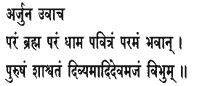
Arjuna said: Thou art the supreme Brahman, the supreme Abode, the supreme Purity, the one permanent, the divine Purusha, the original Godhead, the Unborn, the all-pervading Lord.
The Creed of the Aryan Fighter
Sri Aurobindo
THE ANSWER of the divine Teacher to the first flood of Arjuna’s passionate self-questioning, his shrinking from slaughter, his sense of sorrow and sin, his grieving for an empty and desolate life, his forecast of evil results of an evil deed, is a strongly-worded rebuke. All this, it is replied, is confusion of mind and delusion, a weakness of the heart, an unmanliness, a fall from the virility of the fighter and the hero. Not this was fitting in the son of Pritha, not thus should the champion and chief hope of a righteous cause abandon it in the hour of crisis and peril or suffer the sudden amazement of his heart and senses, the clouding of his reason and the downfall of his will to betray him into the casting away of his divine weapons and the refusal of his God-given work. This is not the way cherished and followed by the Aryan man; this mood came not from heaven nor can it lead to heaven, and on earth it is the forfeiting of the glory that waits upon strength and heroism and noble works. Let him put from him this weak and self-indulgent pity, let him rise and smite his enemies! The answer of a hero to a hero, shall we say, but not that which we should expect from a divine Teacher from whom we demand rather that he shall encourage always gentleness and saintliness and self-abnegation and the recoil from worldly aims and cessation from the ways of the world? The Gita expressly says that Arjuna has thus lapsed into unheroic weakness, “his eyes full and distressed with tears, his heart overcome by depression and discouragement,” because he is invaded by pity, kr.pay¯ avis.t. am. Is this not then a divine weakness? Is not pity a divine emotion which should not thus be discouraged with harsh rebuke? Or are we in face of a mere gospel of war and heroic
action, a Nietzschean creed of power and high-browed strength, of Hebraic or old Teutonic hardness which holds pity to be a weakness and thinks like the Norwegian hero who thanked God because He had given him a hard heart? But the teaching of the Gita springs from an Indian creed and to the Indian mind compassion has always figured as one of the largest elements of the divine nature. The Teacher himself enumerating in a later chapter the qualities of the godlike nature in man places among them compassion to creatures, gentleness, freedom from wrath and from the desire to slay and do hurt, no less than fearlessness and high spirit and energy. Harshness and hardness and fierceness and a satisfaction in slaying enemies and amassing wealth and unjust enjoyments are Asuric qualities; they come from the violent Titanic nature which denies the Divine in the world and the Divine in man and worships Desire only as its deity. It is not then from any such standpoint that the weakness of Arjuna merits rebuke. “Whence has come to thee this dejection, this stain and darkness of the soul in the hour of difficulty and peril?” asks Krishna of Arjuna. The question points to the real nature of Arjuna’s deviation from his heroic qualities. There is a divine compassion which descends to us from on high and for the man whose nature does not possess it, is not cast in its mould, to pretend to be the superior man, the master-man or the superman is a folly and an insolence, for he alone is the superman who most manifests the highest nature of the Godhead in humanity. This compassion observes with an eye of love and wisdom and calm strength the battle and the struggle, the strength and weakness of man, his virtues and sins, his joy and suffering, his knowledge and his ignorance, his wisdom and his folly, his aspiration and his failure and it enters into it all to help and to heal. In the saint and philanthropist it may cast itself into the mould of a plenitude of love or charity; in the thinker and hero it assumes the largeness and the force of a helpful wisdom and strength. It is this compassion in the Aryan fighter, the soul of his chivalry, which will not break the bruised reed, but helps and protects the weak and the oppressed and the wounded and the fallen. But it is also the divine compassion that smites down the strong tyrant and the confident oppressor, not in wrath and with hatred,— for these are not the high divine qualities, the wrath of God against the sinner, God’s hatred of the wicked are the fables of half-enlightened creeds, as much a fable as the eternal torture of the Hells they have invented,—but, as the old Indian spirituality clearly saw, with as much love and compassion for the strong Titan erring by his strength and slain for his sins as for the sufferer and the oppressed who have to be saved from his violence and injustice. But such is not the compassion which actuates Arjuna in the rejection of his work and mission. That is not compassion but an impotence full of a weak self-pity, a recoil from the mental suffering which his act must entail on himself,—“I see not what shall thrust from me the sorrow that dries up the senses,”—and of all things self-pity is among the most ignoble and un-Aryan of moods. Its pity for others is also a form of selfindulgence; it is the physical shrinking of the nerves from the act of slaughter, the egoistic emotional shrinking of the heart from the destruction of the Dhritarashtrians because they are “one’s own people” and without them life will be empty. This pity is a weakness of the mind and senses,—a weakness which may well be beneficial to men of a lower grade of development, who have to be weak because otherwise they will be hard and cruel; for they have to cure the harsher by the gentler forms of sensational egoism, they have to call in tamas, the debile principle, to help sattwa, the principle of light, in quelling the strength and excess of their rajasic passions. But this way is not for the developed Aryan man who has to grow not by weakness, but by an ascension from strength to strength. Arjuna is the divine man, the master-man in the making and as such he has been chosen by the gods. He has a work given to him, he has God beside him in his chariot, he has the heavenly bow Gandiva in his hand, he has the champions of unrighteousness, the opponents of the divine leading of the world in his front. Not his is the right to determine what he shall do or not do according to his emotions and his passions, or to shrink from a necessary destruction by the claim of his egoistic heart and reason, or to decline his work because it will bring sorrow and emptiness to his life or because its earthly result has no value to him in the absence of the thousands who must perish. All that is a weak falling from his higher nature. He has to see only the work that must be done, kartavyam˙ karma, to hear only the divine command breathed through his warrior nature, to feel only for the world and the destiny of mankind calling to him as its god-sent man to assist its march and clear its path of the dark armies that beset it. Arjuna in his reply to Krishna admits the rebuke even while he strives against and refuses the command. He is aware of his weakness and yet accepts subjection to it. It is poorness of spirit, he owns, that has smitten away from him his true heroic nature; his whole consciousness is bewildered in its view of right and wrong and he accepts the divine Friend as his teacher; but the emotional and intellectual props on which he had supported his sense of righteousness have been entirely cast down and he cannot accept a command which seems to appeal only to his old standpoint and gives him no new basis for action. He attempts still to justify his refusal of the work and puts forward in its support the claim of his nervous and sensational being which shrinks from the slaughter with its sequel of blood-stained enjoyments, the claim of his heart which recoils from the sorrow and emptiness of life that will follow his act, the claim of his customary moral notions which are appalled by the necessity of slaying his gurus, Bhishma and Drona, the claim of his reason which sees no good but only evil results of the terrible and violent work assigned to him. He is resolved that on the old basis of thought and motive he will not fight and he awaits in silence the answer to objections that seem to him unanswerable. It is these claims of Arjuna’s egoistic being that Krishna sets out first to destroy in order to make place for the higher law which shall transcend all egoistic motives of action. The answer of the Teacher proceeds upon two different lines, first, a brief reply founded upon the highest ideas of the general Aryan culture in which Arjuna has been educated, secondly, another and larger founded on a more intimate knowledge, opening into deeper truths of our being, which is the real starting-point of the teaching of the Gita. This first answer relies on the philosophic and moral conceptions of the Vedantic philosophy and the social idea of duty and honour which formed the ethical basis of Aryan society. Arjuna has sought to justify his refusal on ethical and rational grounds, but he has merely cloaked by words of apparent rationality the revolt of his ignorant and unchastened emotions. He has spoken of the physical life and the death of the body as if these were the primary realities; but they have no such essential value to the sage and the thinker. The sorrow for the bodily death of his friends and kindred is a grief to which wisdom and the true knowledge of life lend no sanction. The enlightened man does not mourn either for the living or the dead, for he knows that suffering and death are merely incidents in the history of the soul. The soul, not the body, is the reality. All these kings of men for whose approaching death he mourns, have lived before, they will live again in the human body; for as the soul passes physically through childhood and youth and age, so it passes on to the changing of the body. The calm and wise mind, the dh¯ıra, the thinker who looks upon life steadily and does not allow himself to be disturbed and blinded by his sensations and emotions, is not deceived by material appearances; he does not allow the clamour of his blood and his nerves and his heart to cloud his judgment or to contradict his knowledge. He looks beyond the apparent facts of the life of the body and senses to the real fact of his being and rises beyond the emotional and physical desires of the ignorant nature to the true and only aim of the human existence. What is that real fact? that highest aim? This, that human life and death repeated through the aeons in the great cycles of the world are only a long progress by which the human being prepares and makes himself fit for immortality. And how shall he prepare himself? who is theman that is fit? The man who rises above the conception of himself as a life and a body, who does not accept the material and sensational touches of the world at their own value or at the value which the physical man attaches to them, who knows himself and all as souls, learns himself to live in his soul and not in his body and deals with others too as souls and not as mere physical beings. For by immortality is meant not the survival of death,—that is already given to every creature born with a mind,—but the transcendence of life and death. It means that ascension by which man ceases to live as a mind-informed body and lives at last as a spirit and in the Spirit. Whoever is subject to grief and sorrow, a slave to the sensations and emotions, occupied by the touches of things transient cannot become fit for immortality. These things must be borne until they are conquered, till they can give no pain to the liberated man, till he is able to receive all the material happenings of the world whether joyful or sorrowful with a wise and calm equality, even as the tranquil eternal Spirit secret within us receives them. To be disturbed by sorrow and horror as Arjuna has been disturbed, to be deflected by them from the path that has to be travelled, to be overcome by self-pity and intolerance of sorrow and recoil from the unavoidable and trivial circumstance of the death of the body, this is un-Aryan ignorance. It is not the way of the Aryan climbing in calm strength towards the immortal life. There is no such thing as death, for it is the body that dies and the body is not the man. That which really is, cannot go out of existence, though it may change the forms through which it appears, just as that which is non-existent cannot come into being. The soul is and cannot cease to be. This opposition of is and is not, this balance of being and becoming which is the mind’s view of existence, finds its end in the realisation of the soul as the one imperishable self by whom all this universe has been extended. Finite bodies have an end, but that which possesses and uses the body, is infinite, illimitable, eternal, indestructible. It casts away old and takes up new bodies as a man changes worn-out raiment for new; and what is there in this to grieve at and recoil and shrink? This is not born, nor does it die, nor is it a thing that comes into being once and passing away will never come into being again. It is unborn, ancient, sempiternal; it is not slain with the slaying of the body.Who can slay the immortal spirit? Weapons cannot cleave it, nor the fire burn, nor do the waters drench it, nor the wind dry. Eternally stable, immobile, all-pervading, it is for ever and for ever. Not manifested like the body, but greater than all manifestation, not to be analysed by the thought, but greater than all mind, not capable of change and modification like the life and its organs and their objects, but beyond the changes of mind and life and body, it is yet the Reality which all these strive to figure. Even if the truth of our being were a thing less sublime, vast, intangible by death and life, if the self were constantly subject to birth and death, still the death of beings ought not to be a cause of sorrow. For that is an inevitable circumstance of the soul’s self-manifestation. Its birth is an appearing out of some state in which it is not non-existent but unmanifest to our mortal senses, its death is a return to that unmanifest world or condition and out of it it will again appear in the physical manifestation. The to-do made by the physical mind and senses about death and the horror of death whether on the sick-bed or the battlefield, is the most ignorant of nervous clamours. Our sorrow for the death of men is an ignorant grieving for those for whom there is no cause to grieve, since they have neither gone out of existence nor suffered any painful or terrible change of condition, but are beyond death no less in being and no more unhappy in circumstance than in life. But in reality the higher truth is the real truth. All are that Self, that One, that Divine whom we look on and speak and hear of as the wonderful beyond our comprehension, for after all our seeking and declaring of knowledge and learning from those who have knowledge no human mind has ever known this Absolute. It is this which is here veiled by the world, the master of the body; all life is only its shadow; the coming of the soul into physical manifestation and our passing out of it by death is only one of its minor movements. When we have known ourselves as this, then to speak of ourselves as slayer or slain is an absurdity. One thing only is the truth in which we have to live, the Eternal manifesting itself as the soul of man in the great cycle of its pilgrimage with birth and death for milestones, with worlds beyond as resting-places, with all the circumstances of life happy or unhappy as the means of our progress and battle and victory and with immortality as the home to which the soul travels. Therefore, says the Teacher, put away this vain sorrow and shrinking, fight, O son of Bharata. But wherefore such a conclusion? This high and great knowledge, this strenuous selfdiscipline of the mind and soul by which it is to rise beyond the clamour of the emotions and the cheat of the senses to true self-knowledge, may well free us from grief and delusion; it may well cure us of the fear of death and the sorrow for the dead; it may well show us that those whom we speak of as dead are not dead at all nor to be sorrowed for, since they have only gone beyond; it may well teach us to look undisturbed upon the most terrible assaults of life and upon the death of the body as a trifle; it may exalt us to the conception of all life’s circumstances as a manifestation of the One and as a means for our souls to raise themselves above appearances by an upward evolution until we know ourselves as the immortal Spirit. But how does it justify the action demanded of Arjuna and the slaughter of Kurukshetra? The answer is that this is the action required of Arjuna in the path he has to travel; it has come inevitably in the performance of the function demanded of him by his svadharma, his social duty, the law of his life and the law of his being. This world, this manifestation of the Self in the material universe is not only a cycle of inner development, but a field in which the external circumstances of life have to be accepted as an environment and an occasion for that development. It is a world of mutual help and struggle; not a serene and peaceful gliding through easy joys is the progress it allows us, but every step has to be gained by heroic effort and through a clash of opposing forces. Those who take up the inner and the outer struggle even to the most physical clash of all, that of war, are the Kshatriyas, the mighty men; war, force, nobility, courage are their nature; protection of the right and an unflinching acceptance of the gage of battle is their virtue and their duty. For there is continually a struggle between right and wrong, justice and injustice, the force that protects and the force that violates and oppresses, and when this has once been brought to the issue of physical strife, the champion and standard-bearer of the Right must not shake and tremble at the violent and terrible nature of the work he has to do; he must not abandon his followers or fellow-fighters, betray his cause and leave the standard of Right and Justice to trail in the dust and be trampled into mire by the blood-stained feet of the oppressor, because of a weak pity for the violent and cruel and a physical horror of the vastness of the destruction decreed. His virtue and his duty lie in battle and not in abstention from battle; it is not slaughter, but non-slaying which would here be the sin. The Teacher then turns aside for a moment to give another answer to the cry of Arjuna over the sorrow of the death of kindred which will empty his life of the causes and objects of living. What is the true object of the Kshatriya’s life and his true happiness? Not self-pleasing and domestic happiness and a life of comfort and peaceful joy with friends and relatives, but to battle for the right is his true object of life and to find a cause for which he can lay down his life or by victory win the crown and glory of the hero’s existence is his greatest happiness. “There is no greater good for the Kshatriya than righteous battle, and when such a battle comes to them of itself like the open gate of heaven, happy are the Kshatriyas then. If thou doest not this battle for the right, then hast thou abandoned thy duty and virtue and thy glory, and sin shall be thy portion.” He will by such a refusal incur disgrace and the reproach of fear and weakness and the loss of his Kshatriya honour. For what is worst grief for a Kshatriya? It is the loss of his honour, his fame, his noble station among the mighty men, the men of courage and power; that to him is much worse than death. Battle, courage, power, rule, the honour of the brave, the heaven of those who fall nobly, this is the warrior’s ideal. To lower that ideal, to allow a smirch to fall on that honour, to give the example of a hero among heroes whose action lays itself open to the reproach of cowardice and weakness and thus to lower the moral standard of mankind, is to be false to himself and to the demand of the world on its leaders and kings. “Slain thou shalt win Heaven, victorious thou shalt enjoy the earth; therefore arise, O son of Kunti, resolved upon battle.” This heroic appeal may seem to be on a lower level than the stoical spirituality which precedes and the deeper spirituality which follows; for in the next verse the Teacher bids him tomake grief and happiness, loss and gain, victory and defeat equal to his soul and then turn to the battle,—the real teaching of the Gita. But Indian ethics has always seen the practical necessity of graded ideals for the developing moral and spiritual life of man. The Kshatriya ideal, the ideal of the four orders is here placed in its social aspect, not as afterwards in its spiritual meaning. This, says Krishna in effect, is my answer to you if you insist on joy and sorrow and the result of your actions as your motive of action. I have shown you in what direction the higher knowledge of self and the world points you; I have now shown you in what direction your social duty and the ethical standard of your order point you, svadharmam api c ¯aveks.ya. Whichever you consider, the result is the same. But if you are not satisfied with your social duty and the virtue of your order, if you think that leads you to sorrow and sin, then I bid you rise to a higher and not sink to a lower ideal. Put away all egoism from you, disregard joy and sorrow, disregard gain and loss and all worldly results; look only at the cause you must serve and the work that you must achieve by divine command; “so thou shalt not incur sin.” Thus Arjuna’s plea of sorrow, his plea of the recoil from slaughter, his plea of the sense of sin, his plea of the unhappy results of his action, are answered according to the highest knowledge and ethical ideals to which his race and age had attained. It is the creed of the Aryan fighter. “Know God,” it says, “know thyself, help man; protect the Right, do without fear or weakness or faltering thy work of battle in the world. Thou art the eternal and imperishable Spirit, thy soul is here on its upward path to immortality; life and death are nothing, sorrow and wounds and suffering are nothing, for these things have to be conquered and overcome. Look not at thy own pleasure and gain and profit, but above and around, above at the shining summits to which thou climbest, around at this world of battle and trial in which good and evil, progress and retrogression are locked in stern conflict.Men call to thee, their strong man, their hero for help; help then, fight. Destroy when by destruction the world must advance, but hate not that which thou destroyest, neither grieve for all those who perish. Know everywhere the one self, know all to be immortal souls and the body to be but dust. Do thy work with a calm, strong and equal spirit; fight and fall nobly or conquer mightily. For this is the work that God and thy nature have given to thee to accomplish.”
Sri Aurobindo
 About Us | ©1999 - 2009 searchforlight.org
All extracts and quotations from the written works of Sri Aurobindo and the Mother and the Photographs of
the Mother and Sri Aurobindo are copyright Sri Aurobindo Ashram Trust, Pondicherry -605002 India.