
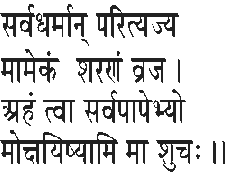
Abandon all dharmas and take refuge in Me alone. I will deliver thee from all sin and evil, do not grieve.
The Core of the Gita's Meaning
Part1 | Part 2
Part 2
The mind itself has the vague sense of some surpassing factor of this kind and in the pursuit of its absolutes frequently strikes against it. It glimpses a state, a power, a presence that is near and within and inmost to it and yet immeasurably greater and singularly distant and above it; it has a vision of something more essential, more absolute than its own absolutes, intimate, infinite, one, and it is that which we call God, Self or Spirit. This then the mind attempts to know, enter, touch and seize wholly, to approach it or become it, to arrive at some kind of unity or lose itself in a complete identity with that mystery,ascaryam. The difficulty is that this spirit in its purity seems something yet farther than the mental absolutes from the actualities of life, something not translatable by mind into its own terms, much less into those of life and action. Therefore we have the intransigent absolutists of the spirit who reject the mental and condemn the material being and yearn after a pure spiritual existence happily purchased by the dissolution of all that we are in life and mind, a Nirvana. The rest of spiritual effort is for these fanatics of the Absolute a mental preparation or a compromise, a spiritualising of life and mind as much as possible. And because the difficulty most constantly insistent on man's mentality in practice is that presented by the claims of his vital being, by life and conduct and action, the direction taken by this preparatory endeavour consists mainly in a spiritualising of the ethical supported by the psychical mind—or rather it brings in the spiritual power and purity to aid these in enforcing their absolute claim and to impart a greater authority than life allows to the ethical ideal of right and truth of conduct or the psychic ideal of love and sympathy and oneness. These things are helped to some highest expression, given their broadest luminous basis by an assent of the reason and will to the underlying truth of the absolute oneness of the spirit and therefore the essential oneness of all living creatures. This kind of spirituality linked on in some way to the demands of the normal mind of man, persuaded to the acceptance of useful social duty and current law of social conduct, popularised by cult and ceremony and image is the outward substance of the world's greater religions. These religions have their individual victories, call in some ray of a higher light, impose some shadow of a larger spiritual or semi-spiritual rule, but cannot effect a complete victory, end flatly in a compromise and in the act of compromise are defeated by life. Its problems remain and even recur in their fiercest forms—even such as this grim problem of Kurukshetra. The idealising intellect and ethical mind hope always to eliminate them, to discover some happy device born of their own aspiration and made effective by their own imperative insistence, which will annihilate this nether untoward aspect of life; but it endures and is not eliminated. The spiritualised intelligence on the other hand offers indeed by the voice of religion the promise of some victorious millennium hereafter, but meanwhile half convinced of terrestrial impotence, persuaded that the soul is a stranger and intruder upon earth, declares that after all not here in the life of the body or in the collective life of mortal man but in some immortal Beyond lies the heaven or the Nirvana where alone is to be found the true spiritual existence.
It is here that the Gita intervenes with a restatement of the truth of the Spirit, of the Self, of God and of the world and Nature. It extends and remoulds the truth evolved by a later thought from the ancient Upanishads and ventures with assured steps on an endeavour to apply its solving power to the problem of life and action. The solution offered by the Gita does not disentangle all the problem as it offers itself to modern mankind; as stated here to a more ancient mentality, it does not meet the insistent pressure of the present mind of man for a collective advance, does not respond to its cry for a collective life that will at last embody a greater rational and ethical and if possible even a dynamic spiritual ideal. Its call is to the individual who has become capable of a complete spiritual existence; but for the rest of the race it prescribes only a gradual advance, to be wisely effected by following out faithfully with more and more of intelligence and moral purpose and with a final turn to spirituality the law of their nature. Its message touches the other smaller solutions but, even when it accepts them partly, it is to point them beyond themselves to a higher and more integral secret into which as yet only the few individuals have shown themselves fit to enter.
The Gita's message to the mind that follows after the vital and material life is that all life is indeed a manifestation of the universal Power in the individual, a derivation from the Self, a ray from the Divine, but actually it figures the Self and the Divine veiled in a disguising Maya, and to pursue the lower life for its own sake is to persist in a stumbling path and to enthrone our nature's obscure ignorance and not at all to find the true truth and complete law of existence. A gospel of the will to live, the will to power, of the satisfaction of desire, of the glorification of mere force and strength, of the worship of the ego and its vehement acquisitive self-will and tireless self-regarding intellect is the gospel of the Asura and it can lead only to some gigantic ruin and perdition. The vital and material man must accept for his government a religious and social and ideal dharma by which, while satisfying desire and interest under right restrictions, he can train and subdue his lower personality and scrupulously attune it to a higher law both of the personal and the communal life.
The Gita's message to the mind occupied with the pursuit of intellectual, ethical and social standards, the mind that insists on salvation by the observance of established dharmas, the moral law, social duty and function or the solutions of the liberated intelligence, is that this is indeed a very necessary stage, the dharma has indeed to be observed and, rightly observed, can raise the stature of the spirit and prepare and serve the spiritual life, but still it is not the complete and last truth of existence. The soul of man has to go beyond to some more absolute dharma of man's spiritual and immortal nature. And this can only be done if we repress and get rid of the ignorant formulations of the lower mental elements and the falsehood of egoistic personality, impersonalise the action of the intelligence and will, live in the identity of the one self in all, break out of all ego-moulds into the impersonal spirit. The mind moves under the limiting compulsion of the triple lower nature, it erects its standards in obedience to the tamasic, rajasic or at highest the sattwic qualities; but the destiny of the soul is a divine perfection and liberation and that can only be based in the freedom of our highest self, can only be found by passing through its vast impersonality and universality beyond mind into the integral light of the immeasurable Godhead and supreme Infinite who is beyond all dharmas.
The Gita's message to those, absolutist seekers of the Infinite, who carry impersonality to an exclusive extreme, entertain an intolerant passion for the extinction of life and action and would have as the one ultimate aim and ideal an endeavour to cease from all individual being in the pure silence of the ineffable Spirit, is that this is indeed one path of journey and entry into the Infinite, but the most difficult, the ideal of inaction a dangerous thing to hold up by precept or example before the world, this way, though great, yet not the best way for man and this knowledge, though true, yet not the integral knowledge. The Supreme, the all-conscious Self, the Godhead, the Infinite is not solely a spiritual existence remote and ineffable; he is here in the universe at once hidden and expressed through man and the gods and through all beings and in all that is. And it is by finding him not only in some immutable silence but in the world and its beings and in all self and in all Nature, it is by raising to an integral as well as to a highest union with him all the activities of the intelligence, the heart, the will, the life that man can solve at once his inner riddle of self and God and the outer problem of his active human existence. Made Godlike, God-becoming, he can enjoy the infinite breadth of a supreme spiritual consciousness that is reached through works no less than through love and knowledge. Immortal and free, he can continue his human action from that highest level and transmute it into a supreme and all-embracing divine activity,—that indeed is the ultimate crown and significance here of all works and living and sacrifice and the world's endeavour.
This highest message is first for those who have the strength to follow after it, the master men, the great spirits, the God-knowers, God-doers, God-lovers who can live in God and for God and do their work joyfully for him in the world, a divine work uplifted above the restless darkness of the human mind and the false limitations of the ego. At the same time, and here we get the gleam of a larger promise which we may even extend to the hope of a collective turn towards perfection,—for if there is hope for man, why should there not be hope for mankind?—the Gita declares that all can if they will, even to the lowest and sinfullest among men, enter into the path of this Yoga. And if there is a true self-surrender and an absolute unegoistic faith in the indwelling Divinity, success is certain in this path. The decisive turn is needed; there must be an abiding belief in the Spirit, a sincere and insistent will to live in the Divine, to be in self one with him and in Nature—where too we are an eternal portion of his being—one with his greater spiritual Nature, God-possessed in all our members and Godlike.
The Gita in the development of its idea raises many issues, such as the determinism of Nature, the significance of the universal manifestation and the ultimate status of the liberated soul, questions that have been the subject of unending and inconclusive debate. It is not necessary in this series of essays of which the object is a scrutiny and positive affirmation of the substance of the Gita and a disengaging of its contribution to the abiding spiritual thought of humanity and its kernel of living practice, to enter far into these discussions or to consider where we may differ from its standpoint or conclusions, make any reserves- in our assent or even, strong in later experience, go beyond its metaphysical teaching or its Yoga. It will be sufficient to close with a formulation of the living message it still brings for man the eternal seeker and discoverer to guide him through the present circuits and the possible steeper ascent of his life up to the luminous heights of his spirit.
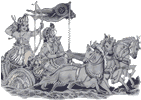
Sri Aurobindo
 About Us | ©1999 - 2009 searchforlight.org
All extracts and quotations from the written works of Sri Aurobindo and the Mother and the Photographs of
the Mother and Sri Aurobindo are copyright Sri Aurobindo Ashram Trust, Pondicherry -605002 India.