
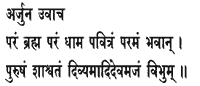
Arjuna said: Thou art the supreme Brahman, the supreme Abode, the supreme Purity, the one permanent, the divine Purusha, the original Godhead, the Unborn, the all-pervading Lord.
Sankhya and Yoga
Sri Aurobindo
IN THE moment of his turning from this first and summary answer to Arjuna’s difficulties and in the very first words which strike the keynote of a spiritual solution, the Teacher makes at once a distinction which is of the utmost importance for the understanding of the Gita,—the distinction of Sankhya and Yoga. “Such is the intelligence (the intelligent knowledge of things and will) declared to thee in the Sankhya, hear now this in the Yoga, for if thou art in Yoga by this intelligence, O son of Pritha, thou shalt cast away the bondage of works.” That is the literal translation of the words in which the Gita announces the distinction it intends to make. The Gita is in its foundation a Vedantic work; it is one of the three recognised authorities for the Vedantic teaching and, although not described as a revealed Scripture, although, that is to say, it is largely intellectual, ratiocinative, philosophical in its method, founded indeed on the Truth, but not the directly inspired Word which is the revelation of the Truth through the higher faculties of the seer, it is yet so highly esteemed as to be ranked almost as a thirteenth Upanishad. But still its Vedantic ideas are throughout and thoroughly coloured by the ideas of the Sankhya and the Yoga way of thinking and it derives from this colouring the peculiar synthetic character of its philosophy. It is in fact primarily a practical system of Yoga that it teaches and it brings in metaphysical ideas only as explanatory of its practical system; nor does it merely declare Vedantic knowledge, but it founds knowledge and devotion upon works, even as it uplifts works to knowledge, their culmination, and informs them with devotion as their very heart and kernel of their spirit. Again its Yoga is founded upon the analytical philosophy of the Sankhyas, takes that as a starting-point and always keeps it as a large element of its method and doctrine; but still it proceeds far beyond it, negatives even some of its characteristic tendencies and finds a means of reconciling the lower analytical knowledge of Sankhya with the higher synthetic and Vedantic truth. What, then, are the Sankhya and Yoga of which the Gita speaks? They are certainly not the systems which have come down to us under these names as enunciated respectively in the Sankhya Karika of Ishwara Krishna and the Yoga aphorisms of Patanjali. This Sankhya is not the system of the Karikas,— at least as that is generally understood; for the Gita nowhere for a moment admits the multiplicity of Purushas as a primal truth of being and it affirms emphatically what the traditional Sankhya strenuously denies, the One as Self and Purusha, that One again as the Lord, Ishwara or Purushottama, and Ishwara as the cause of the universe. The traditional Sankhya is, to use our modern distinctions, atheistic; the Sankhya of the Gita admits and subtly reconciles the theistic, pantheistic and monistic views of the universe. Nor is this Yoga the Yoga system of Patanjali; for that is a purely subjective method of Rajayoga, an internal discipline, limited, rigidly cut out, severely and scientifically graded, by which the mind is progressively stilled and taken up into Samadhi so that we may gain the temporal and eternal results of this self-exceeding, the temporal in a great expansion of the soul’s knowledge and powers, the eternal in the divine union. But the Yoga of the Gita is a large, flexible and many-sided system with various elements, which are all successfully harmonised by a sort of natural and living assimilation, and of these elements Rajayoga is only one and not the most important and vital. This Yoga does not adopt any strict and scientific gradation but is a process of natural soul-development; it seeks by the adoption of a few principles of subjective poise and action to bring about a renovation of the soul and a sort of change, ascension or new birth out of the lower nature into the divine. Accordingly, its idea of Samadhi is quite different from the ordinary notion of the Yogic trance; and while Patanjali gives to works only an initial importance for moral purification and religious concentration, the Gita goes so far as to make works the distinctive characteristic of Yoga. Action to Patanjali is only a preliminary, in the Gita it is a permanent foundation; in the Rajayoga it has practically to be put aside when its result has been attained or at any rate ceases very soon to be a means for the Yoga, for the Gita it is a means of the highest ascent and continues even after the complete liberation of the soul. This much has to be said in order to avoid any confusion of thought that might be created by the use of familiar words in a connotation wider than the technical sense now familiar to us. Still, all that is essential in the Sankhya and Yoga systems, all in them that is large, catholic and universally true, is admitted by the Gita, even though it does not limit itself by them like the opposing schools. Its Sankhya is the catholic and Vedantic Sankhya such as we find it in its first principles and elements in the great Vedantic synthesis of the Upanishads and in the later developments of the Puranas. Its idea of Yoga is that large idea of a principally subjective practice and inner change, necessary for the finding of the Self or the union with God, of which the Rajayoga is only one special application. The Gita insists that Sankhya and Yoga are not two different, incompatible and discordant systems, but one in their principle and aim; they differ only in their method and starting-point. The Sankhya also is a Yoga, but it proceeds by knowledge; it starts, that is to say, by intellectual discrimination and analysis of the principles of our being and attains its aim through the vision and possession of the Truth. Yoga, on the other hand, proceeds by works; it is in its first principle Karmayoga; but it is evident from the whole teaching of the Gita and its later definitions that the word karma is used in a very wide sense and that by Yoga is meant the selfless devotion of all the inner as well as the outer activities as a sacrifice to the Lord of all works, offered to the Eternal as Master of all the soul’s energies and austerities. Yoga is the practice of the Truth of which knowledge gives the vision, and its practice has for its motor-power a spirit of illumined devotion, of calm or fervent consecration to that which knowledge sees to be the Highest. But what are the truths of Sankhya? The philosophy drew its name from its analytical process. Sankhya is the analysis, the enumeration, the separative and discriminative setting forth of the principles of our being of which the ordinary mind sees only the combinations and results of combination. It did not seek at all to synthetise. Its original standpoint is in fact dualistic, not with the very relative dualism of the Vedantic schools which call themselves by that name, Dwaita, but in a very absolute and trenchant fashion. For it explains existence not by one, but by two original principles whose inter-relation is the cause of the universe,—Purusha, the inactive, Prakriti, the active. Purusha is the Soul, not in the ordinary or popular sense of the word, but of pure conscious Being immobile, immutable and self-luminous. Prakriti is Energy and its process. Purusha does nothing, but it reflects the action of Energy and its processes; Prakriti is mechanical, but by being reflected in Purusha it assumes the appearance of consciousness in its activities, and thus there are created those phenomena of creation, conservation, dissolution, birth and life and death, consciousness and unconsciousness, sense-knowledge and intellectual knowledge and ignorance, action and inaction, happiness and suffering which the Purusha under the influence of Prakriti attributes to itself although they belong not at all to itself but to the action or movement of Prakriti alone. For Prakriti is constituted of three gun. as or essential modes of energy; sattwa, the seed of intelligence, conserves the workings of energy; rajas, the seed of force and action, creates the workings of energy; tamas, the seed of inertia and nonintelligence, the denial of sattwa and rajas, dissolves what they create and conserve. When these three powers of the energy of Prakriti are in a state of equilibrium, all is in rest, there is no movement, action or creation and there is therefore nothing to be reflected in the immutable luminous being of the conscious Soul. But when the equilibrium is disturbed, then the three gunas fall into a state of inequality in which they strive with and act upon each other and the whole inextricable business of ceaseless creation, conservation and dissolution begins, unrolling the phenomena of the cosmos. This continues so long as the Purusha consents to reflect the disturbance which obscures his eternal nature and attributes to it the nature of Prakriti; but when he withdraws his consent, the gunas fall into equilibrium and the soul returns to its eternal, unchanging immobility; it is delivered from phenomena. This reflection and this giving or withdrawal of consent seem to be the only powers of Purusha; he is the witness of Nature by virtue of reflection and the giver of the sanction, s ¯aks.¯ı and anumant¯a of the Gita, but not actively the Ishwara. Even his giving of consent is passive and his withdrawing of consent is only another passivity. All action subjective or objective is foreign to the Soul; it has neither an active will nor an active intelligence. It cannot therefore be the sole cause of the cosmos and the affirmation of a second cause becomes necessary. Not Soul alone by its nature of conscious knowledge, will and delight is the cause of the universe, but Soul and Nature are the dual cause, a passive Consciousness and an active Energy. So the Sankhya explains the existence of the cosmos. But whence then come this conscious intelligence and conscious will which we perceive to be so large a part of our being and which we commonly and instinctively refer not to the Prakriti, but to the Purusha? According to the Sankhya this intelligence and will are entirely a part of the mechanical energy of Nature and are not properties of the soul; they are the principle of Buddhi, one of the twenty-four tattvas, the twenty-four cosmic principles. Prakriti in the evolution of the world bases herself with her three gunas in her as the original substance of things, unmanifest, inconscient, out of which are evolved successively five elemental conditions of energy or matter,—for Matter and Force are the same in the Sankhya philosophy. These are called by the names of the five concrete elements of ancient thought, ether, air, fire, water and earth; but it must be remembered that they are not elements in the modern scientific sense but subtle conditions of material energy and nowhere to be found in their purity in the gross material world. All objects are created by the combination of these five subtle conditions or elements. Again, each of these five is the base of one of five subtle properties of energy or matter, sound, touch, form, taste and smell, which constitute the way in which the mind-sense perceives objects. Thus by these five elements of Matter put forth from primary energy and these five sense relations through which Matter is known is evolved what we would call in modern language the objective aspect of cosmic existence. Thirteen other principles constitute the subjective aspect of the cosmic Energy,—Buddhi or Mahat, Ahankara, Manas and its ten sense-functions, five of knowledge, five of action. Manas, mind, is the original sense which perceives all objects and reacts upon them; for it has at once an inferent and an efferent activity, receives by perception what the Gita calls the outward touches of things, b¯ahya spar´sa, and so forms its idea of the world and exercises its reactions of active vitality. But it specialises its most ordinary functions of reception by aid of the five perceptive senses of hearing, touch, sight, taste and smell, which make the five properties of things their respective objects, and specialises certain necessary vital functions of reaction by aid of the five active senses which operate for speech, locomotion, the seizing of things, ejection and generation. Buddhi, the discriminating principle, is at once intelligence and will; it is that power in Nature which discriminates and coordinates. Ahankara, the egosense, is the subjective principle in Buddhi by which the Purusha is induced to identify himself with Prakriti and her activities. But these subjective principles are themselves as mechanical, as much a part of the inconscient energy as those which constitute her objective operations. If we find it difficult to realise how intelligence and will can be properties of the mechanical Inconscient and themselves mechanical (jad. a), we have only to remember that modern Science itself has been driven to the same conclusion. Even in the mechanical action of the atom there is a power which can only be called an inconscient will and in all the works of Nature that pervading will does inconsciently the works of intelligence. What we call mental intelligence is precisely the same thing in its essence as that which discriminates and coordinates subconsciously in all the activities of the material universe, and conscious Mind itself, Science has tried to demonstrate, is only a result and transcript of the mechanical action of the inconscient. But Sankhya explains what modern Science leaves in obscurity, the process by which the mechanical and inconscient takes on the appearance of consciousness. It is because of the reflection of Prakriti in Purusha; the light of consciousness of the Soul is attributed to the workings of the mechanical energy and it is thus that the Purusha, observing Nature as the witness and forgetting himself, is deluded with the idea generated in her that it is he who thinks, feels, wills, acts, while all the time the operation of thinking, feeling, willing, acting is conducted really by her and her three modes and not by himself at all. To get rid of this delusion is the first step towards the liberation of the soul from Nature and her works. There are certainly plenty of things in our existence which the Sankhya does not explain at all or does not explain satisfactorily, but if all we need is a rational explanation of the cosmic processes in their principles as a basis for the great object common to the ancient philosophies, the liberation of the soul from the obsession of cosmic Nature, then the Sankhya explanation of the world and the Sankhya way of liberation seem as good and as effective as any other.What we do not seize at first is why it should bring in an element of pluralism into its dualism by affirming one Prakriti, but many Purushas. It would seem that the existence of one Purusha and one Prakriti should be sufficient to account for the creation and procession of the universe. But the Sankhya was bound to evolve pluralism by its rigidly analytical observation of the principles of things. First, actually, we find that there are many conscious beings in the world and each regards the same world in his own way and has his independent experience of its subjective and objective things, his separate dealings with the same perceptive and reactive processes. If there were only one Purusha, there would not be this central independence and separativeness, but all would see the world in an identical fashion and with a common subjectivity and objectivity. Because Prakriti is one, all witness the same world; because her principles are everywhere the same, the general principles which constitute internal and external experience are the same for all; but the infinite difference of view and outlook and attitude, action and experience and escape from experience,— a difference not of the natural operations which are the same but of the witnessing consciousness,—are utterly inexplicable except on the supposition that there is a multiplicity of witnesses, many Purushas. The separative ego-sense, we may say, is a sufficient explanation? But the ego-sense is a common principle of Nature and need not vary; for by itself it simply induces the Purusha to identify himself with Prakriti, and if there is only one Purusha, all beings would be one, joined and alike in their egoistic consciousness; however different in detail might be the mere forms and combinations of their natural parts, there would be no difference of soul-outlook and soul-experience. The variations of Nature ought not to make all this central difference, this multiplicity of outlook and from beginning to end this separateness of experience in one Witness, one Purusha. Therefore the pluralism of souls is a logical necessity to a pure Sankhya system divorced from the Vedantic elements of the ancient knowledge which first gave it birth. The cosmos and its process can be explained by the commerce of one Prakriti with one Purusha, but not the multiplicity of conscious beings in the cosmos. There is another difficulty quite as formidable. Liberation is the object set before itself by this philosophy as by others. This liberation is effected, we have said, by the Purusha’s withdrawal of his consent from the activities of Prakriti which she conducts only for his pleasure; but, in sum, this is only a way of speaking. The Purusha is passive and the act of giving or withdrawing consent cannot really belong to it, but must be a movement in Prakriti itself. If we consider, we shall see that it is, so far as it is an operation, a movement of reversal or recoil in the principle of Buddhi, the discriminative will. Buddhi has been lending itself to the perceptions of the mind-sense; it has been busy discriminating and coordinating the operations of the cosmic energy and by the aid of the ego-sense identifying the Witness with her works of thought, sense and action. It arrives by the process of discriminating things at the acid and dissolvent realisation that this identity is a delusion; it discriminates finally the Purusha from Prakriti and perceives that all is mere disturbance of the equilibrium of the gunas; the Buddhi, at once intelligence and will, recoils from the falsehood which it has been supporting and the Purusha, ceasing to be bound, no longer associates himself with the interest of the mind in the cosmic play. The ultimate result will be that Prakriti will lose her power to reflect herself in the Purusha; for the effect of the ego-sense is destroyed and the intelligent will becoming indifferent ceases to be the means of her sanction: necessarily then her gunas must fall into a state of equilibrium, the cosmic play must cease, the Purusha return to his immobile repose. But if there were only the one Purusha and this recoil of the discriminating principle from its delusions took place, all cosmos would cease. As it is, we see that nothing of the kind happens. A few beings among innumerable millions attain to liberation or move towards it; the rest are in no way affected, nor is cosmic Nature in her play with them one whit inconvenienced by this summary rejection which should be the end of all her processes. Only by the theory ofmany independent Purushas can this fact be explained. The only at all logical explanation from the point of view of Vedantic monism is that of theMayavada; but there the whole thing becomes a dream, both bondage and liberation are circumstances of the unreality, the empirical blunderings of Maya; in reality there is none freed, none bound. The more realistic Sankhya view of things does not admit this phantasmagoric idea of existence and therefore cannot adopt this solution. Here too we see that the multiplicity of souls is an inevitable conclusion from the data of the Sankhya analysis of existence. The Gita starts from this analysis and seems at first, even in its setting forth of Yoga, to accept it almost wholly. It accepts Prakriti and her three gunas and twenty-four principles; accepts the attribution of all action to the Prakriti and the passivity of the Purusha; accepts the multiplicity of conscious beings in the cosmos; accepts the dissolution of the identifying ego-sense, the discriminating action of the intelligent will and the transcendence of the action of the three modes of energy as the means of liberation. The Yoga which Arjuna is asked to practise from the outset is Yoga by the Buddhi, the intelligent will. But there is one deviation of capital importance,—the Purusha is regarded as one, not many; for the free, immaterial, immobile, eternal, immutable Self of the Gita, but for one detail, is a Vedantic description of the eternal, passive, immobile, immutable Purusha of the Sankhyas. But the capital difference is that there is One and not many. This brings in the whole difficulty which the Sankhya multiplicity avoids and necessitates a quite different solution. This the Gita provides by bringing into its Vedantic Sankhya the ideas and principles of Vedantic Yoga. The first important new element we find is in the conception of Purusha itself. Prakriti conducts her activities for the pleasure of Purusha; but how is that pleasure determined? In the strict Sankhya analysis it can only be by a passive consent of the silent Witness. Passively the Witness consents to the action of the intelligent will and the ego-sense, passively he consents to the recoil of that will from the ego-sense. He is Witness, source of the consent, by reflection upholder of the work of Nature, s ¯aks.¯ı anumant¯a bhart¯a, but nothing more. But the Purusha of the Gita is also the Lord of Nature; he is Ishwara. If the operation of the intelligent will belongs to Nature, the origination and power of the will proceed from the conscious Soul; he is the Lord of Nature. If the act of intelligence of theWill is the act of Prakriti, the source and light of the intelligence are actively contributed by the Purusha; he is not only the Witness, but the Lord and Knower, master of knowledge and will, jn˜ a¯ ta¯ ı¯s´varah.. He is the supreme cause of the action of Prakriti, the supreme cause of its withdrawal from action. In the Sankhya analysis Purusha and Prakriti in their dualism are the cause of the cosmos; in this synthetic Sankhya Purusha by his Prakriti is the cause of the cosmos.We see at once how far we have travelled from the rigid purism of the traditional analysis. But what of the one self immutable, immobile, eternally free, with which the Gita began? That is free from all change or involution in change, avik¯arya, unborn, unmanifested, the Brahman, yet it is that “by which all this is extended.” Therefore it would seem that the principle of the Ishwara is in its being; if it is immobile, it is yet the cause and lord of all action and mobility. But how? And what of the multiplicity of conscious beings in the cosmos? They do not seem to be the Lord, but rather very much not the Lord, an¯ı´sa, for they are subject to the action of the three gunas and the delusion of the ego-sense, and if, as the Gita seems to say, they are all the one self, how did this involution, subjection and delusion come about or how is it explicable except by the pure passivity of the Purusha? And whence the multiplicity? or how is it that the one self in one body and mind attains to liberation while in others it remains under the delusion of bondage? These are difficulties which cannot be passed by without a solution. The Gita answers them in its later chapters by an analysis of Purusha and Prakriti which brings in new elements very proper to a Vedantic Yoga, but alien to the traditional Sankhya. It speaks of three Purushas or rather a triple status of the Purusha. The Upanishads in dealing with the truths of Sankhya seem sometimes to speak only of two Purushas. There is one unborn of three colours, says a text, the eternal feminine principle of Prakriti with its three gunas, ever creating; there are two unborn, two Purushas, of whom one cleaves to and enjoys her, the other abandons her because he has enjoyed all her enjoyments. In another verse they are described as two birds on one tree, eternally yoked companions, one of whom eats the fruits of the tree,—the Purusha in Nature enjoying her cosmos,— the other eats not, but watches his fellow,—the silent Witness, withdrawn from the enjoyment; when the first sees the second and knows that all is his greatness, then he is delivered from sorrow. The point of view in the two verses is different, but they have a common implication. One of the birds is the eternally silent, unbound Self or Purusha by whom all this is extended and he regards the cosmos he has extended, but is aloof from it; the other is the Purusha involved in Prakriti. The first verse indicates that the two are the same, represent different states, bound and liberated, of the same conscious being,—for the second Unborn has descended into the enjoyment of Nature and withdrawn from her; the other verse brings out what we would not gather from the former, that in its higher status of unity the self is for ever free, inactive, unattached, though it descends in its lower being into the multiplicity of the creatures of Prakriti and withdraws from it by reversion in any individual creature to the higher status. This theory of the double status of the one conscious soul opens a door; but the process of the multiplicity of the One is still obscure. To these two the Gita, developing the thought of other passages in the Upanishads,1 adds yet another, the supreme, the Purushottama, the highest Purusha, whose greatness all this creation is. Thus there are three, the Kshara, the Akshara, the Uttama. Kshara, the mobile, the mutable is Nature, svabh¯ava, it is the various becoming of the soul; the Purusha here is the multiplicity of the divine Being; it is the Purusha multiple not apart from, but in Prakriti. Akshara, the immobile, the immutable, is the silent and inactive self, it is the unity of the divine Being, Witness of Nature, but not involved in its movement; it is the inactive Purusha free from Prakriti and her works. The Uttama is the Lord, the supreme Brahman, the supreme Self, who possesses both the immutable unity and the mobile multiplicity. It is by a large mobility and action of His nature, His energy, His will and power, that He manifests Himself in the world and by a greater stillness and immobility of His being that He is aloof from it; yet is He as Purushottama above both the aloofness from Nature and the attachment to Nature. This idea of the Purushottama, though continually implied in the Upanishads, is disengaged and definitely brought out by the Gita and has exercised a powerful influence on the later developments of the Indian religious consciousness. It is the foundation of the highest Bhaktiyoga which claims to exceed the rigid definitions of monistic philosophy; it is at the back of the philosophy of the devotional Puranas. The Gita is not content, either, to abide within the Sankhya analysis of Prakriti; for that makes room only for the ego-sense and not for the multiple Purusha, which is there not a part of
Prakriti, but separate from her. The Gita affirms on the contrary that the Lord by His nature becomes the Jiva. How is that possible, since there are only the twenty-four principles of the cosmic Energy and no others? Yes, says the divine Teacher in effect, that is a perfectly valid account for the apparent operations of the cosmic Prakriti with its three gunas, and the relation attributed to Purusha and Prakriti there is also quite valid and of great use for the practical purposes of the involution and the withdrawal. But this is only the lower Prakriti of the three modes, the inconscient, the apparent; there is a higher, a supreme, a conscient and divine Nature, and it is that which has become the individual soul, the Jiva. In the lower nature each being appears as the ego, in the higher he is the individual Purusha. In other words multiplicity is part of the spiritual nature of the One. This individual soul is myself, in the creation it is a partial manifestation of me, mamaiva am˙ s´ah. , and it possesses all my powers; it is witness, giver of the sanction, upholder, knower, lord. It descends into the lower nature and thinks itself bound by action, so to enjoy the lower being: it can draw back and know itself as the passive Purusha free from all action. It can rise above the three gunas and, liberated from the bondage of action, yet possess action, even as I do myself, and by adoration of the Purushottama and union with him it can enjoy wholly its divine Nature. Such is the analysis, not confining itself to the apparent cosmic process but penetrating into the occult secrets of superconscious Nature, uttamam˙ rahasyam, by which the Gita founds its synthesis of Vedanta, Sankhya and Yoga, its synthesis of knowledge, works and devotion. By the pure Sankhya alone the combining of works and liberation is contradictory and impossible. By pure Monism alone the permanent continuation of works as a part of Yoga and the indulgence of devotion after perfect knowledge and liberation and union are attained, become impossible or at least irrational and otiose. The Sankhya knowledge of the Gita dissipates and the Yoga system of the Gita triumphs over all these obstacles.
Sri Aurobindo
 About Us | ©1999 - 2009 searchforlight.org
All extracts and quotations from the written works of Sri Aurobindo and the Mother and the Photographs of
the Mother and Sri Aurobindo are copyright Sri Aurobindo Ashram Trust, Pondicherry -605002 India.