
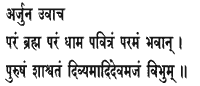
Arjuna said: Thou art the supreme Brahman, the supreme Abode, the supreme Purity, the one permanent, the divine Purusha, the original Godhead, the Unborn, the all-pervading Lord.
Nirvana and Works in the World
Sri Aurobindo
THE UNION of the soul with the Purushottama by a Yoga of the whole being is the complete teaching of the Gita and not only the union with the immutable Self as in the narrower doctrine which follows the exclusive way of knowledge. That is why the Gita subsequently, after it has effected the reconciliation of knowledge and works, is able to develop the idea of love and devotion, unified with both works and knowledge, as the highest height of the way to the supreme secret. For if the union with the immutable Self were the sole secret or the highest secret, that would not at all be possible; for then at a given point our inner basis for love and devotion, no less than our inner foundation of works, would crumble away and collapse. Union utter and exclusive with the immutable Self alone means the abolition of the whole point of view of the mutable being, not only in its ordinary and inferior action but in its very roots, in all that makes its existence possible, not only in the works of its ignorance, but in the works of its knowledge. It would mean the abolition of all that difference in conscious poise and activity between the human soul and the Divine which makes possible the play of the Kshara; for the action of the Kshara would become then entirely a play of the ignorance without any root or basis of divine reality in it. On the contrary, union by Yoga with the Purushottama means the knowledge and enjoyment of our oneness with him in our selfexistent being and of a certain differentiation in our active being. It is the persistence of the latter in a play of divine works which are urged by the motive power of divine love and constituted by a perfected divineNature, it is the vision of the Divine in the world harmonised with a realisation of the Divine in the self which makes action and devotion possible to the liberated man, and not only possible but inevitable in the perfect mode of his being. But the direct way to union lies through the firm realisation of the immutable Self, and it is the Gita’s insistence on this as a first necessity, after which alone works and devotion can acquire their whole divine meaning, that makes it possible for us to mistake its drift. For if we take the passages in which it insists most rigorously upon this necessity and neglect to observe the whole sequence of thought in which they stand, we may easily come to the conclusion that it does really teach actionless absorption as the final state of the soul and action only as a preliminary means towards stillness in the motionless Immutable. It is in the close of the fifth and throughout the sixth chapter that this insistence is strongest and most comprehensive. There we get the description of a Yoga which would seem at first sight to be incompatible with works and we get the repeated use of the word Nirvana to describe the status to which the Yogin arrives. The mark of this status is the supreme peace of a calm selfextinction, s´a¯ ntim˙ nirva¯n. a-parama¯m, and, as if to make it quite clear that it is not the Buddhist’s Nirvana in a blissful negation of being, but the Vedantic loss of a partial in a perfect being that it intends, the Gita uses always the phrase brahma-nirv¯an. a, extinction in the Brahman; and the Brahman here certainly seems to mean the Immutable, to denote primarily at least the inner timeless Self withdrawn from active participation even though immanent in the externality of Nature. We have to see then what is the drift of the Gita here, and especially whether this peace is the peace of an absolute inactive cessation, whether the self-extinction in the Akshara means the absolute excision of all knowledge and consciousness of the Kshara and of all action in the Kshara. We are accustomed indeed to regard Nirvana and any kind of existence and action in the world as incompatible and we might be inclined to argue that the use of the word is by itself sufficient and decides the question. But if we look closely at Buddhism, we shall doubt whether the absolute incompatibility really existed even for the Buddhists; and if we look closely at the Gita, we shall see that it does not form part of this supreme Vedantic teaching. The Gita after speaking of the perfect equality of the Brahman-knower who has risen into the Brahman-consciousness, brahmavid brahman. i sthitah. , develops in nine verses that follow its idea of Brahmayoga and of Nirvana in the Brahman. “When the soul is no longer attached to the touches of outward things,” it begins, “then one finds the happiness that exists in the Self; such a one enjoys an imperishable happiness, because his self is in Yoga, yukta, by Yoga with the Brahman.” The non-attachment is essential, it says, in order to be free from the attacks of desire and wrath and passion, a freedom without which true happiness is not possible. That happiness and that equality are to be gained entirely by man in the body: he is not to suffer any least remnant of the subjection to the troubled lower nature to remain in the idea that the perfect release will come by a putting off of the body; a perfect spiritual freedom is to be won here upon earth and possessed and enjoyed in the human life, pr¯ak ´sar¯ıra-vimoks.an. ¯ at. It then continues, “He who has the inner happiness and the inner ease and repose and the inner light, that Yogin becomes the Brahman and reaches self-extinction in the Brahman, brahma-nirv¯an.am.” Here, very clearly, Nirvana means the extinction of the ego in the higher spiritual, inner Self, that which is for ever timeless, spaceless, not bound by the chain of cause and effect and the changes of the world-mutation, self-blissful, self-illumined and for ever at peace. The Yogin ceases to be the ego, the little person limited by the mind and the body; he becomes the Brahman; he is unified in consciousness with the immutable divinity of the eternal Self which is immanent in his natural being. But is this a going in into some deep sleep of samadhi away from all world-consciousness, or is it the preparatory movement for a dissolution of the natural being and the individual soul into some absolute Self who is utterly and for ever beyond Nature and her works, laya, moks.a? Is that withdrawal necessary before we can enter into Nirvana, or is Nirvana, as the context seems to suggest, a state which can exist simultaneously with worldconsciousness and even in its own way include it? Apparently the latter, for in the succeeding verse the Gita goes on to say, “Sages win Nirvana in the Brahman, they in whom the stains of sin are effaced and the knot of doubt is cut asunder, masters of their selves, who are occupied in doing good to all creatures, sarvabhu¯ ta-hite rata¯h. .” That would almost seem to mean that to be thus is to be in Nirvana. But the next verse is quite clear and decisive, “Yatis (those who practise self-mastery by Yoga and austerity) who are delivered from desire and wrath and have gained self-mastery, for them Nirvana in the Brahman exists all about them, encompasses them, they already live in it because they have knowledge of the Self.” That is to say, to have knowledge and possession of the self is to exist in Nirvana. This is clearly a large extension of the idea of Nirvana. Freedom from all stain of the passions, the self-mastery of the equalmind on which that freedom is founded, equality to all beings, sarvabhu¯ tes.u, and beneficial love for all, final destruction of that doubt and obscurity of the ignorance which keeps us divided from the allunifying Divine and the knowledge of the One Self within us and in all are evidently the conditions of Nirvana which are laid down in these verses of the Gita, go to constitute it and are its spiritual substance. Thus Nirvana is clearly compatible with world-consciousness and with action in the world. For the sages who possess it are conscious of and in intimate relation by works with the Divine in the mutable universe; they are occupied with the good of all creatures, sarvabhu¯ ta-hite. They have not renounced the experiences of the Kshara Purusha, they have divinised them; for the Kshara, the Gita tells us, is all existences, sarvabhu¯ ta¯ni, and the doing universal good to all is a divine action in the mutability of Nature. This action in the world is not inconsistent with living in Brahman, it is rather its inevitable condition and outward result because the Brahman in whom we find Nirvana, the spiritual consciousness in which we lose the separative ego-consciousness, is not only within us but within all these existences, exists not only above and apart from all these universal happenings, but pervades them, contains them and is extended in them. Therefore by Nirvana in the Brahman must be meant a destruction or extinction of the limited separative consciousness, falsifying and dividing, which is brought into being on the surface of existence by the lower Maya of the three gunas, and entry into Nirvana is a passage into this other true unifying consciousness which is the heart of existence and its continent and its whole containing and supporting, its whole original and eternal and final truth. Nirvana when we gain it, enter into it, is not only within us, but all around, abhito vartate, because this is not only the Brahman-consciousness which lives secret within us, but the Brahman-consciousness in which we live. It is the Self which we are within, the supreme Self of our individual being but also the Self which we are without, the supreme Self of the universe, the self of all existences. By living in that self we live in all, and no longer in our egoistic being alone; by oneness with that self a steadfast oneness with all in the universe becomes the very nature of our being and the root status of our active consciousness and root motive of all our action. But again we get immediately afterwards two verses which might seem to lead away from this conclusion. “Having put outside of himself all outward touches and concentrated the vision between the eyebrows and made equal the pr¯an. a and the ap¯ana moving within the nostrils, having controlled the senses, the mind and the understanding, the sage devoted to liberation, from whom desire and wrath and fear have passed away is ever free.” Here we have a process of Yoga that brings in an element which seems quite other than the Yoga of works and other even than the pure Yoga of knowledge by discrimination and contemplation; it belongs in all its characteristic features to the system, introduces the psycho-physical askesis of Rajayoga. There is the conquest of all the movements of themind, cittavr.ttinirodha; there is the control of the breathing, Pranayama; there is the drawing in of the sense and the vision. All of them are processes which lead to the inner trance of Samadhi, the object of all of them moks.a, and moks.a signifies in ordinary parlance the renunciation not only of the separative ego-consciousness, but of the whole active consciousness, a dissolution of our being into the highest Brahman. Are we to suppose that the Gita gives this process in that sense as the last movement of a release by dissolution or only as a special means and a strong aid to overcome the outward-going mind? Is this the finale, the climax, the last word? We shall find reason to regard it as both a special means, an aid, and at least one gate of a final departure, not by dissolution, but by an uplifting to the supracosmic existence. For even here in this passage this is not the last word; the last word, the finale, the climax comes in a verse that follows and is the last couplet of the chapter. “When a man has known Me as the Enjoyer of sacrifice and tapasya (of all askesis and energisms), the mighty lord of all the worlds, the friend of all creatures, he comes by the peace.” The power of the Karmayoga comes in again; the knowledge of the active Brahman, the cosmic supersoul, is insisted on among the conditions of the peace of Nirvana. We get back to the great idea of the Gita, the idea of the Purushottama,— though that name is not given till close upon the end, it is always that which Krishna means by his “I” and “Me”, the Divine who is there as the one self in our timeless immutable being, who is present too in the world, in all existences, in all activities, the master of the silence and the peace, the master of the power and the action, who is here incarnate as the divine charioteer of the stupendous conflict, the Transcendent, the Self, the All, the master of every individual being. He is the enjoyer of all sacrifice and of all tapasya, therefore shall the seeker of liberation do works as a sacrifice and as a tapasya; he is the lord of all the worlds, manifested in Nature and in these beings, therefore shall the liberated man still do works for the right government and leading on of the peoples in these worlds, lokasan ˙ graha; he is the friend of all existences, therefore is the sage who has found Nirvana within him and all around, still and always occupied with the good of all creatures,—even as the Nirvana of Mahayana Buddhism took for its highest sign the works of a universal compassion. Therefore too, even when he has found oneness with the Divine in his timeless and immutable self, is he still capable, since he embraces the relations also of the play of Nature, of divine love for man and of love for the Divine, of bhakti. That this is the drift of the meaning, becomes clearer when we have fathomed the sense of the sixth chapter which is a large comment on and a full development of the idea of these closing verses of the fifth,—that shows the importance which the Gita attaches to them. We shall therefore run as briefly as possible through the substance of this sixth chapter. First the Teacher emphasises—and this is very significant—his often repeated asseveration about the real essence of Sannyasa, that it is an inward, not an outward renunciation. “Whoever does the work to be done without resort to its fruits, he is the Sannyasin and the Yogin, not theman who lights not the sacrificial fire and does not the works. What they have called renunciation (Sannyasa), know to be in truth Yoga; for none becomes a Yogin who has not renounced the desire-will in the mind.” Works are to be done, but with what purpose and in what order? They are first to be done while ascending the hill of Yoga, for then works are the cause, k¯aran.am. The cause of what? The cause of self-perfection, of liberation, of nirvana in the Brahman; for by doing works with a steady practice of the inner renunciation this perfection, this liberation, this conquest of the desire-mind and the ego-self and the lower nature are easily accomplished. But when one has got to the top? Then works are no longer the cause; the calm of self-mastery and self-possession gained by works becomes the cause. Again, the cause of what? Of fixity in the Self, in the Brahman-consciousness and of the perfect equality in which the divine works of the liberated man are done. “For when one does not get attached to the objects of sense or to works and has renounced all will of desire in the mind, then is he said to have ascended to the top of Yoga.” That, as we know already, is the spirit in which the liberated man does works; he does them without desire and attachment, without the egoistic personal will and the mental seeking which is the parent of desire. He has conquered his lower self, reached the perfect calm in which his highest self is manifest to him, that highest self always concentrated in its own being, sam¯ ahita, in Samadhi, not only in the trance of the inward-drawn consciousness, but always, in the waking state of the mind as well, in exposure to the causes of desire and of the disturbance of calm, to grief and pleasure, heat and cold, honour and disgrace, all the dualities, ´s¯ıtos.n. a-sukhaduh. khes.u tath ¯a m¯an¯apam¯anayoh. . This higher self is the Akshara, ku¯ t.astha, which stands above the changes and the perturbations of the natural being; and the Yogin is said to be in Yoga with it when he also is like it, ku¯ t.astha, when he is superior to all appearances and mutations, when he is satisfied with self-knowledge, when he is equal-minded to all things and happenings and persons. But this Yoga is after all no easy thing to acquire, as Arjuna indeed shortly afterwards suggests, for the restless mind is always liable to be pulled down from these heights by the attacks of outward things and to fall back into the strong control of grief and passion and inequality. Therefore, it would seem, the Gita proceeds to give us in addition to its general method of knowledge and works a special process of Rajayogic meditation also, a powerful method of practice, abhy¯asa, a strong way to the complete control of the mind and all its workings. In this process the Yogin is directed to practise continually union with the Self so that that may become his normal consciousness. He is to sit apart and alone, with all desire and idea of possession banished from his mind, self-controlled in his whole being and consciousness. “He should set in a pure spot his firm seat, neither too high, nor yet too low, covered with a cloth, with a deer-skin, with sacred grass, and there seatedwith a concentratedmind and with the workings of the mental consciousness and the senses under control he should practise Yoga for self-purification, ¯atmavi ´suddhaye.” The posture he takes must be the motionless erect posture proper to the practice of Rajayoga; the vision should be drawn in and fixed between the eye-brows, “not regarding the regions.” The mind is to be kept calm and free from fear and the vow of Brahmacharya observed; the whole controlled mentality must be devoted and turned to the Divine so that the lower action of the consciousness shall be merged in the higher peace. For the object to be attained is the still peace of Nirvana. “Thus always putting himself in Yoga by control of his mind the Yogin attains to the supreme peace of Nirvana which has its foundation in Me, s´a¯ ntim˙ nirva¯n. a-parama¯m˙ matsam˙ stha¯m.” This peace of Nirvana is reached when all the mental consciousness is perfectly controlled and liberated from desire and remains still in the Self, when, motionless like the light of a lamp in a windless place, it ceases from its restless action, shut in from its outward motion, and by the silence and stillness of the mind the Self is seen within, not disfigured as in the mind, but in the Self, seen, not as it is mistranslated falsely or partially by the mind and represented to us through the ego, but self-perceived by the Self, svaprak¯a´sa. Then the soul is satisfied and knows its own true and exceeding bliss, not that untranquil happiness which is the portion of the mind and the senses, but an inner and serene felicity in which it is safe from the mind’s perturbations and can no longer fall away from the spiritual truth of its being. Not even the fieriest assault of mental grief can disturb it; for mental grief comes to us from outside, is a reaction to external touches, and this is the inner, the self-existent happiness of those who no longer accept the slavery of the unstable mental reactions to external touches. It is the putting away of the contact with pain, the divorce of the mind’s marriage with grief, duh. khasam ˙ yoga-viyogam. The firm winning of this inalienable spiritual bliss is Yoga, it is the divine union; it is the greatest of all gains and the treasure beside which all others lose their value. Therefore is this Yoga to be resolutely practised without yielding to any discouragement by difficulty or failure until the release, until the bliss of Nirvana is secured as an eternal possession. The main stress here has fallen on the stilling of the emotive mind, the mind of desire and the senses which are the recipients of outward touches and reply to them with our customary emotional reactions; but even the mental thought has to be stilled in the silence of the self-existent being. First, all the desires born of the desire-will have to be wholly abandoned without any exception or residue and the senses have to be held in by the mind so that they shall not run out to all sides after their usual disorderly and restless habit; but next the mind itself has to be seized by the buddhi and drawn inward. One should slowly cease from mental action by a buddhi held in the grasp of fixity and having fixed the mind in the higher self one should not think of anything at all. Whenever the restless and unquiet mind goes forth, it should be controlled and brought into subjection in the Self. When the mind is thoroughly quieted, then there comes upon the Yogin the highest, stainless, passionless bliss of the soul that has become the Brahman. “Thus freed from stain of passion and putting himself constantly into Yoga, the Yogin easily and happily enjoys the touch of the Brahman which is an exceeding bliss.” And yet the result is not, while one yet lives, a Nirvana which puts away every possibility of action in the world, every relation with beings in the world. It would seem at first that it ought to be so. When all the desires and passions have ceased, when the mind is no longer permitted to throw itself out in thought, when the practice of this silent and solitary Yoga has become the rule, what farther action or relation with the world of outward touches and mutable appearances is any longer possible? No doubt, the Yogin for a time still remains in the body, but the cave, the forest, the mountain-top seem now the fittest, the only possible scene of his continued living and constant trance of Samadhi his sole joy and occupation. But, first, while this solitary Yoga is being pursued, the renunciation of all other action is not recommended by the Gita. This Yoga, it says, is not for the man who gives up sleep and food and play and action, even as it is not for those who indulge too much in these things of the life and the body; but the sleep and waking, the food, the play, the putting forth of effort in works should all be yukta. This is generally interpreted as meaning that all should be moderate, regulated, done in fit measure, and that may indeed be the significance. But at any rate when the Yoga is attained, all this has to be yukta in another sense, the ordinary sense of the word everywhere else in the Gita. In all states, in waking and in sleeping, in food and play and action, the Yogin will then be in Yoga with the Divine, and all will be done by him in the consciousness of the Divine as the self and as the All and as that which supports and contains his own life and his action. Desire and ego and personal will and the thought of the mind are the motives of action only in the lower nature; when the ego is lost and the Yogin becomes Brahman, when he lives in and is, even, a transcendent and universal consciousness, action comes spontaneously out of that, luminous knowledge higher than the mental thought comes out of that, a power other and mightier than the personal will comes out of that to do for him his works and bring its fruits:1 personal action has ceased, all has been taken up into the Brahman and assumed by the Divine, mayi sannyasya karm¯an. i. For when the Gita describes the nature of this self-realisation and the result of the Yoga which comes by Nirvana of the separative ego-mind and its motives of thought and feeling and action into the Brahman-consciousness, it includes the cosmic sense, though lifted into a new kind of vision. “The man whose self is in Yoga, sees the self in all beings and all beings in the self, he sees all with an equal vision.” All that he sees is to him the Self, all is his self, all is the Divine. But is there no danger, if he dwells at all in the mutability of the Kshara, of his losing all the results of this difficult Yoga, losing the Self and falling back into the mind, of the Divine losing him and the world getting him, of his losing the Divine and getting back in its place the ego and the lower nature? No, says the Gita; “he who sees Me everywhere and sees all in Me, to him I do not get lost, nor does he get lost to Me.” For this peace of Nirvana, though it is gained through the Akshara, is founded upon the being of the Purushottama, mat-sam˙ stha¯m, and that is extended, the Divine, the Brahman is extended too in the world of beings and, though transcendent of it, not imprisoned in its own transcendence. One has to see all things as He and live and act wholly in that vision; that is the perfect fruit of the Yoga. But why act? Is it not safer to sit in one’s solitude looking out upon the world, if you will, seeing it in Brahman, in the Divine, but not taking part in it, not moving in it, not living in it, not acting in it, living rather ordinarily in the inner Samadhi? Should not that be the law, the rule, the dharma of this highest spiritual
condition? No, again; for the liberated Yogin there is no other law, rule, dharma than simply this, to live in the Divine and love the Divine and be one with all beings; his freedom is an absolute and not a contingent freedom, self-existent and not dependent any longer on any rule of conduct, law of life or limitation of any kind. He has no longer any need of a process of Yoga, because he is now perpetually in Yoga. “The Yogin who has taken his stand upon oneness and loves Me in all beings, however and in all ways he lives and acts, lives and acts in Me.” The love of the world spiritualised, changed from a sense-experience to a soul-experience, is founded on the love of God and in that love there is no peril and no shortcoming. Fear and disgust of the world may often be necessary for the recoil from the lower nature, for it is really the fear and disgust of our own ego which reflects itself in the world. But to see God in the world is to fear nothing, it is to embrace all in the being of God; to see all as the Divine is to hate and loathe nothing, but love God in the world and the world in God. But at least the things of the lower nature will be shunned and feared, the things which the Yogin has taken so much trouble to surmount? Not this either; all is embraced in the equality of the self-vision. “He,OArjuna, who sees with equality everything in the image of the Self, whether it be grief or it be happiness, him I hold to be the supreme Yogin.” And by this it is not meant at all that he himself shall fall from the griefless spiritual bliss and feel again worldly unhappiness, even in the sorrow of others, but seeing in others the play of the dualities which he himself has left and surmounted, he shall still see all as himself, his self in all, God in all and, not disturbed or bewildered by the appearances of these things, moved only by them to help and heal, to occupy himself with the good of all beings, to lead men to the spiritual bliss, to work for the progress of the world Godwards, he shall live the divine life, so long as days upon earth are his portion. The God-lover who can do this, can thus embrace all things in God, can look calmly on the lower nature and the works of the Maya of the three gunas and act in them and upon them without perturbation or fall or disturbance from the height and power of the spiritual oneness, free in the largeness of the God-vision, sweet and great and luminous in the strength of the God-nature, may well be declared to be the supreme Yogin. He indeed has conquered the creation, jitah. sargah. . The Gita brings in here as always bhakti as the climax of the Yoga, sarvabhu¯ tasthitam˙ yo ma¯m˙ bhajati ekatvam a¯sthitah. ; that may almost be said to sum up the whole final result of the Gita’s teaching—whoever loves God in all and his soul is founded upon the divine oneness, however he lives and acts, lives and acts in God. And to emphasise it still more, after an intervention of Arjuna and a reply to his doubt as to how so difficult a Yoga can be at all possible for the restless mind of man, the divine Teacher returns to this idea and makes it his culminating utterance. “The Yogin is greater than the doers of askesis, greater than the men of knowledge, greater than the men of works; become then the Yogin, O Arjuna,” the Yogin, one who seeks for and attains, by works and knowledge and askesis or by whatever other means, not even spiritual knowledge or power or anything else for their own sake, but the union with God alone; for in that all else is contained and in that lifted beyond itself to a divinest significance. But even among Yogins the greatest is the Bhakta. “Of all Yogins he who with all his inner self given up toMe, forMe has love and faith, ´sraddh¯av¯an bhajate, him I hold to be the most united with Me in Yoga.” It is this that is the closing word of these first six chapters and contains in itself the seed of the rest, of that which still remains unspoken and is nowhere entirely spoken; for it is always and remains something of a mystery and a secret, rahasyam, the highest spiritual mystery and the divine secret.
Sri Aurobindo
 About Us | ©1999 - 2009 searchforlight.org
All extracts and quotations from the written works of Sri Aurobindo and the Mother and the Photographs of
the Mother and Sri Aurobindo are copyright Sri Aurobindo Ashram Trust, Pondicherry -605002 India.