
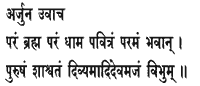
Arjuna said: Thou art the supreme Brahman, the supreme Abode, the supreme Purity, the one permanent, the divine Purusha, the original Godhead, the Unborn, the all-pervading Lord.
Equality
Sri Aurobindo
SINCE knowledge, desirelessness, impersonality, equality, the inner self-existent peace and bliss, freedom from or at least superiority to the tangled interlocking of the three modes of Nature are the signs of the liberated soul, they must accompany it in all its activities. They are the condition of that unalterable calm which this soul preserves in all the movement, all the shock, all the clash of forces which surround it in the world. That calm reflects the equable immutability of the Brahman in the midst of all mutations, and it belongs to the indivisible and impartial Oneness which is for ever immanent in all the multiplicities of the universe. For an equal and all-equalising spirit is that Oneness in the midst of the million differences and inequalities of the world; and equality of the spirit is the sole real equality. For in all else in existence there can only be similarity, adjustment and balance; but even in the greatest similarities of the world we find difference of inequality and difference of unlikeness and the adjusted balancings of the world can only come about by a poising of combined unequal weights. Hence the immense importance attached by the Gita in its elements of Karmayoga to equality; it is the nodus of the free spirit’s free relations with the world. Self-knowledge, desirelessness, impersonality, bliss, freedom from the modes of Nature, when withdrawn into themselves, self-absorbed, inactive, have no need of equality; for they take no cognisance of the things in which the opposition of equality and inequality arises. But the moment the spirit takes cognisance of and deals with the multiplicities, personalities, differences, inequalities of the action of Nature, it has to effectuate these other signs of its free status by this one manifesting sign of equality. Knowledge is the consciousness of unity with the One; and in relation with the many different beings and existences of the universe it must show itself by an equal oneness with all. Impersonality is the one immutable spirit’s superiority to the variations of its multiple personality in the world; in its dealings with the personalities of the universe it must show itself in the equal and impartial spirit of its action with regard to all, however various that action may be made by the variety of relations into which it is moulded or of the conditions under which it has to take place. So Krishna in the Gita says that none is dear to him, none hated, to all he is equal in spirit; yet is the God-lover the special receiver of his grace, because the relation he has created is different and the one impartial Lord of all yet meets each soul according to its way of approach to him. Desirelessness is the illimitable Spirit’s superiority to the limiting attraction of the separate objects of desire in the world; when it has to enter into relations with those objects, it must show it either by an equal and impartial indifference in their possession or by an equal and impartial unattached delight in all and love for all which, because it is self-existent, does not depend upon possession or non-possession, but is in its essence unperturbed and immutable. For the spirit’s bliss is in itself, and if this bliss is to enter into relations with things and creatures, it is only in this way that it can manifest its free spirituality. Traigun. ¯ at¯ıtya, transcendence of the gunas, is the unperturbed spirit’s superiority to that flux of action of the modes of Nature which is in its constant character perturbed and unequal; if it has to enter into relations with the conflicting and unequal activities of Nature, if the free soul is to allow its nature any action at all, it must show its superiority by an impartial equality towards all activities, results or happenings. Equality is the sign and also for the aspirant the test.Where there is inequality in the soul, there there is in evidence some unequal play of the modes of Nature, motion of desire, play of personal will, feeling and action, activity of joy and grief or that disturbed and disturbing delight which is not true spiritual bliss but a mental satisfaction bringing in its train inevitably a counterpart or recoil of mental dissatisfaction. Where there is inequality of soul, there there is deviation from knowledge, loss of steadfast abiding in the all-embracing and all-reconciling oneness of the Brahman and unity of things. By his equality the Karmayogin knows in the midst of his action that he is free. It is the spiritual nature of the equality enjoined, high and universal in its character and comprehension, which gives its distinctive note to the teaching of the Gita in this matter. For otherwise the mere teaching of equality in itself as the most desirable status of the mind, feelings and temperament in which we rise superior to human weakness, is by no means peculiar to the Gita. Equality has always been held up to admiration as the philosophic ideal and the characteristic temperament of the sages. The Gita takes up indeed this philosophic ideal, but carries it far beyond into a higher region where we find ourselves breathing a larger and purer air. The Stoic poise, the philosophic poise of the soul are only its first and second steps of ascension out of the whirl of the passions and the tossings of desire to a serenity and bliss, not of the Gods, but of the Divine himself in his supreme self-mastery. The Stoic equality,making character its pivot, founds itself upon self-mastery by austere endurance; the happier and serener philosophic equality prefers self-mastery by knowledge, by detachment, by a high intellectual indifference seated above the disturbances to which our nature is prone, ud¯ as¯ınavad ¯ as¯ınah. , as the Gita expresses it; there is also the religious or Christian equality which is a perpetual kneeling or a prostrate resignation and submission to the will of God. These are the three steps and means towards divine peace, heroic endurance, sage indifference, pious resignation, titiks. ¯a, ud¯ as¯ınat ¯a, namas or nati. The Gita takes them all in its large synthetic manner and weaves them into its upward soul-movement, but it gives to each a profounder root, a larger outlook, a more universal and transcendent significance. For to each it gives the values of the spirit, its power of spiritual being beyond the strain of character, beyond the difficult poise of the understanding, beyond the stress of the emotions. The ordinary human soul takes a pleasure in the customary disturbances of its nature-life; it is because it has this pleasure and because, having it, it gives a sanction to the troubled play of the lower nature that the play continues perpetually; for the Prakriti does nothing except for the pleasure and with the sanction of its lover and enjoyer, the Purusha. We do not recognise this truth because under the actual stroke of the adverse disturbance, smitten by grief, pain, discomfort, misfortune, failure, defeat, blame, dishonour, the mind shrinks back from the blow, while it leaps eagerly to the embrace of the opposite and pleasurable disturbances, joy, pleasure, satisfactions of all kinds, prosperity, success, victory, glory, praise; but this does not alter the truth of the soul’s pleasure in life which remains constant behind the dualities of the mind. The warrior does not feel physical pleasure in his wounds or find mental satisfaction in his defeats; but he has a complete delight in the godhead of battle which brings to him defeat and wounds as well as the joy of victory, and he accepts the chances of the former and the hope of the latter as part of the mingled weft of war, the thing which the delight in him pursues. Even, wounds bring him a joy and pride in memory, complete when the pain of them has passed, but often enough present even while it is there and actually fed by the pain. Defeat keeps for him the joy and pride of indomitable resistance to a superior adversary, or, if he is of a baser kind, the passions of hatred and revenge which also have their darker and crueller pleasures. So it is with the pleasure of the soul in the normal play of our life. The mind recoils by pain and dislike from the adverse strokes of life; that is Nature’s device for enforcing a principle of self-protection, jugups¯a, so that the vulnerable nervous and bodily parts of us may not unduly rush upon self-destruction to embrace it: it takes joy in the favourable touches of life; that is Nature’s lure of rajasic pleasure, so that the force in the creature may overcome the tamasic tendencies of inertia and inactivity and be impelled fully towards action, desire, struggle, success, and by its attachment to these things her ends may be worked out. Our secret soul takes a pleasure in this strife and effort, and even a pleasure in adversity and suffering, which can be complete enough in memory and retrospect, but is present too behind at the time and often even rises to the surface of the afflicted mind to support it in its passion; but what really attracts the soul is the whole mingled weft of the thing we call life with all its disturbance of struggle and seeking, its attractions and repulsions, its offer and its menace, its varieties of every kind. To the rajasic desire-soul in us a monotonous pleasure, success without struggle, joy without a shadow must after a time become fatiguing, insipid, cloying; it needs a background of darkness to give full value to its enjoyment of light: for the happiness it seeks and enjoys is of that very nature, it is in its very essence relative and dependent on the perception and experience of its opposite. The joy of the soul in the dualities is the secret of the mind’s pleasure in living. Ask it to rise out of all this disturbance to the unmingled joy of the pure bliss-soul which all the time secretly supports its strength in the struggle and makes its own continued existence possible,—it will draw back at once from the call. It does not believe in such an existence; or it believes that it would not be life, that it would not be at all the varied existence in the world around it in which it is accustomed to take pleasure; it would be something tasteless and without savour. Or it feels that the effort would be too difficult for it; it recoils from the struggle of the ascent, although in reality the spiritual change is not at all more difficult than the realisation of the dreams the desire-soul pursues, nor entails more struggle and labour in the attainment than the tremendous effort which the desire-soul expends in its passionate chase after its own transient objects of pleasure and desire. The true cause of its unwillingness is that it is asked to rise above its own atmosphere and breathe a rarer and purer air of life, whose bliss and power it cannot realise and hardly even conceives as real, while the joy of this lower turbid nature is to it the one thing familiar and palpable. Nor is this lower satisfaction in itself a thing evil and unprofitable; it is rather the condition for the upward evolution of our human nature out of the tamasic ignorance and inertia to which its material being is most subject; it is the rajasic stage of the graded ascent of man towards the supreme self-knowledge, power and bliss. But if we rest eternally on this plane, the madhyam¯a gatih. of the Gita, our ascent remains unfinished, the evolution of the soul incomplete. Through the sattwic being and nature to that which is beyond the three gunas lies the way of the soul to its perfection. The movement which will lead us out of the disturbances of the lower nature must be necessarily a movement towards equality in the mind, in the emotional temperament, in the soul. But it is to be noted that, although in the end we must arrive at a superiority to all the three gunas of the lower nature, it is yet in its incipience by a resort to one or other of the three that the movement must begin. The beginning of equality may be sattwic, rajasic or tamasic; for there is a possibility in the human nature of a tamasic equality. It may be purely tamasic, the heavy equability of a vital temperament rendered inertly irresponsive to the shocks of existence by a sort of dull insensibility undesirous of the joy of life. Or it may result from a weariness of the emotions and desires accumulated by a surfeit and satiety of the pleasure or else, on the contrary, a disappointment and a disgust and shrinking from the pain of life, a lassitude, a fear and horror and dislike of the world: it is then in its nature a mixed movement, rajaso-tamasic, but the lower quality predominates. Or, approaching the sattwic principle, it may aid itself by the intellectual perception that the desires of life cannot be satisfied, that the soul is too weak to master life, that the whole thing is nothing but sorrow and transient effort and nowhere in it is there any real truth or sanity or light or happiness; this is the sattwotamasic principle of equality and is not so much equality, though it may lead to that, as indifference or equal refusal. Essentially, the movement of tamasic equality is a generalisation of Nature’s principle of jugups¯a or self-protecting recoil extended from the shunning of particular painful effects to a shunning of the whole life of Nature itself as in sum leading to pain and self-tormenting and not to the delight which the soul demands. In tamasic equality by itself there is no real liberation; but it can bemade a powerful starting-point, if, as in Indian asceticism, it is turned into the sattwic by the perception of the greater existence, the truer power, the higher delight of the immutable Self above Nature. The natural turn of such a movement, however, is towards Sannyasa, the renunciation of life and works, rather than to that union of inner renunciation of desire with continued activity in the world of Nature which the Gita advocates. The Gita, however, admits and makes room for this movement; it allows as a recoiling starting-point the perception of the defects of the world-existence, birth and disease and death and old age and sorrow, the historic starting-point of the Buddha, janmamr. tyu-jar ¯a-vy¯adhi-duh. kha-dos. ¯anudar´sanam, and it accepts the effort of those whose self-discipline is motived by a desire for release, even in this spirit, from the curse of age and death, jar ¯a-maran. a-moks. ¯aya m¯am ¯a´sritya yatanti ye. But that, to be of any profit, must be accompanied by the sattwic perception of a higher state and the taking delight and refuge in the existence of the Divine, m¯am ¯a´sritya. Then the soul by its recoil comes to a greater condition of being, lifted beyond the three gunas and free from birth and death and age and grief, and enjoys the immortality of its self-existence, janma-mr.tyu-jar ¯a-duh. khair vimukto ’mr.tam a´snute. The tamasic unwillingness to accept the pain and effort of life is indeed by itself a weakening and degrading thing, and in this lies the danger of preaching to all alike the gospel of asceticism and world-disgust, that it puts the stamp of a tamasic weakness and shrinking on unfit souls, confuses their understanding, buddhibhedam˙ janayet, diminishes the sustained aspiration, the confidence in living, the power of effort which the soul of man needs for its salutary, its necessary rajasic struggle to master its environment, without really opening to it—for it is yet incapable of that—a higher goal, a greater endeavour, a mightier victory. But in souls that are fit this tamasic recoil may serve a useful spiritual purpose by slaying their rajasic attraction, their eager preoccupation with the lower life which prevents the sattwic awakening to a higher possibility. Seeking then for a refuge in the void they have created, they are able to hear the divine call, “O soul that findest thyself in this transient and unhappy world, turn and put thy delight in Me,” anityam asukham˙ lokam imam˙ pra¯pya bhajasva ma¯m. Still, in this movement, the equality consists only in an equal recoil from all that constitutes the world; and it arrives at indifference and aloofness, but does not include that power to accept equally all the touches of the world pleasurable or painful without attachment or disturbance which is a necessary element in the discipline of the Gita. Therefore, even if we begin with the tamasic recoil,—which is not at all necessary,—it can only be as a first incitement to a greater endeavour, not as a permanent pessimism. The real discipline begins with the movement tomastery over these things from which we were first inclined merely to flee. It is here that the possibility of a kind of rajasic equality comes in, which is at its lowest the strong nature’s pride in selfmastery, self-control, superiority to passion and weakness; but the Stoic ideal seizes upon this point of departure and makes it the key to an entire liberation of the soul from subjection to all weakness of its lower nature. As the tamasic inward recoil is a generalisation of Nature’s principle of jugups¯a or self-protection from suffering, so the rajasic upward movement is a generalisation of Nature’s other principle of the acceptance of struggle and effort and the innate impulse of life towards mastery and victory; but it transfers the battle to the field where alone complete victory is possible. Instead of a struggle for scattered outward aims and transient successes, it proposes nothing less than the conquest of Nature and the world itself by a spiritual struggle and an inner victory. The tamasic recoil turns from both the pains and pleasures of the world to flee from them; the rajasic movement turns upon them to bear, master and rise superior to them. The Stoic self-discipline calls desire and passion into its embrace of the wrestler and crushes them between its arms, as did old Dhritarashtra in the epic the iron image of Bhima. It endures the shock of things painful and pleasurable, the causes of the physical and mental affections of the nature, and breaks their effects to pieces; it is complete when the soul can bear all touches without being pained or attracted, excited or troubled. It seeks to make man the conqueror and king of his nature. The Gita, making its call on the warrior nature of Arjuna, starts with this heroic movement. It calls on him to turn on the great enemy desire and slay it. Its first description of equality is that of the Stoic philosopher. “He whose mind is undisturbed in themidst of sorrows and amid pleasures is free from desire, from whom liking and fear and wrath have passed away, is the sage of settled understanding. Who in all things is without affection though visited by this good or that evil and neither hates nor rejoices, his intelligence sits firmly founded in wisdom.” If one abstains from food, it says, giving a physical example, the object of sense ceases to affect, but the affection itself of the sense, the rasa, remains; it is only when, even in the exercise of the sense, it can keep back from seeking its sensuous aim in the object, artha, and abandon the affection, the desire for the pleasure of taste, that the highest level of the soul is reached. It is by using the mental organs on the objects, “ranging over them with the senses,” vis.ay¯an indriyai´s caran, but with senses subject to the self, freed from liking and disliking, that one gets into a large and sweet clearness of soul and temperament in which passion and grief find no place. All desires have to enter into the soul, as waters into the sea, and yet it has to remain immovable, filled but not disturbed: so in the end all desires can be abandoned. To be freed from wrath and passion and fear and attraction is repeatedly stressed as a necessary condition of the liberated status, and for this we must learn to bear their shocks, which cannot be done without exposing ourselves to their causes. “He who can bear here in the body the velocity of wrath and desire, is the Yogin, the happy man.” Titiks. ¯a, the will and power to endure, is the means. “The material touches which cause heat and cold, happiness and pain, things transient which come and go, these learn to endure. For the man whom these do not trouble nor pain, the firm and wise who is equal in pleasure and suffering, makes himself apt for immortality.” The equalsouled has to bear suffering and not hate, to receive pleasure and not rejoice. Even the physical affections are to be mastered by endurance and this too is part of the Stoic discipline. Age, death, suffering, pain are not fled from, but accepted and vanquished by a high indifference.1 Not to flee appalled from Nature in her
lower masks, but to meet and conquer her is the true instinct of the strong nature, purus.ars.abha, the leonine soul among men. Thus compelled, she throws aside her mask and reveals to him his true nature as the free soul, not her subject but her king and lord, svar ¯ at., samr¯ at.. But the Gita accepts this Stoic discipline, this heroic philosophy, on the same condition that it accepts the tamasic recoil, —it must have above it the sattwic vision of knowledge, at its root the aim at self-realisation and in its steps the ascent to the divine Nature. A Stoic discipline which merely crushed down the common affections of our human nature,—although less dangerous than a tamasic weariness of life, unfruitful pessimism and sterile inertia, because it would at least increase the power and self-mastery of the soul,—would still be no unmixed good, since it might lead to insensibility and an inhuman isolation without giving the true spiritual release. The Stoic equality is justified as an element in the discipline of the Gita because it can be associated with and can help to the realisation of the free immutable Self in the mobile human being, para ˙ m dr. s. t. v¯a, and to status in that new self-consciousness, es. ¯a br¯ahm¯ı sthitih. . “Awakening by the understanding to the Highest which is beyond even the discerning mind, put force on the self by the self to make it firm and still, and slay this enemy who is so hard to assail, Desire.” Both the tamasic recoil of escape and the rajasic movement of struggle and victory are only justified when they look beyond themselves through the sattwic principle to the self-knowledge which legitimises both the recoil and the struggle. The pure philosopher, the thinker, the born sage not only relies upon the sattwic principle in him as his ultimate justification, but uses it from the beginning as his instrument of self-mastery. He starts from the sattwic equality. He too observes the transitoriness of the material and external world and its failure to satisfy the desires or to give the true delight, but this causes in him no grief, fear or disappointment. He observes all with an eye of tranquil discernment and makes his choice without repulsion or perplexity. “The enjoyments born of the touches of things are causes of sorrow, they have a beginning and an end; therefore the sage, the man of awakened understanding, budhah. , does not place his delight in these.” “The self in him is unattached to the touches of external things; he finds his happiness in himself.” He sees, as the Gita puts it, that he is himself his own enemy and his own friend, and therefore he takes care not to dethrone himself by casting his being into the hands of desire and passion, n¯atm¯anam avas¯adayet, but delivers himself out of that imprisonment by his own inner power, uddhared ¯atman¯atm¯anam; for whoever has conquered his lower self, finds in his higher self his best friend and ally. He becomes satisfied with knowledge, master of his senses, aYogin by sattwic equality,—for equality is Yoga, samatvam˙ yoga ucyate,—regarding alike clod and stone and gold, tranquil and self-poised in heat and cold, suffering and happiness, honour and disgrace. He is equal in soul to friend and enemy and to neutral and indifferent, because he sees that these are transitory relations born of the changing conditions of life. Even by the pretensions of learning and purity and virtue and the claims to superiority which men base upon these things, he is not led away. He is equal-souled to all men, to the sinner and the saint, to the virtuous, learned and cultured Brahmin and the fallen outcaste. All these are the Gita’s descriptions of the sattwic equality, and they sum up well enough what is familiar to the world as the calm philosophic equality of the sage. Where then is the difference between this and the larger equality taught by the Gita? It lies in the difference between the intellectual and philosophic discernment and the spiritual, the Vedantic knowledge of unity on which the Gita founds its teaching. The philosopher maintains his equality by the power of the buddhi, the discerning mind; but even that by itself is a doubtful foundation. For, thoughmaster of himself on the whole by a constant attention or an acquired habit ofmind, in reality he is not free from his lower nature, and it does actually assert itself in many ways and may at any moment take a violent revenge for its rejection and suppression. For, always, the play of the lower nature is a triple play, and the rajasic and tamasic qualities are ever lying in wait for the sattwic man. “Even the mind of the wise man who labours for perfection is carried away by the vehement insistence of the senses.” Perfect security can only be had by resorting to something higher than the sattwic quality, something higher than the discerning mind, to the Self,—not the philosopher’s intelligent self, but the divine sage’s spiritual self which is beyond the three gunas. All must be consummated by a divine birth into the higher spiritual nature. And the philosopher’s equality is like the Stoic’s, like the world-fleeing ascetic’s, inwardly a lonely freedom, remote and aloof from men; but the man born to the divine birth has found the Divine not only in himself, but in all beings. He has realised his unity with all and his equality is therefore full of sympathy and oneness. He sees all as himself and is not intent on his lonely salvation; he even takes upon himself the burden of their happiness and sorrow by which he is not himself affected or subjected. The perfect sage, the Gita more than once repeats, is ever engaged with a large equality in doing good to all creatures and makes that his occupation and delight, sarvabhu¯ tahite ratah. . The perfect Yogin is no solitary musing on the Self in his ivory tower of spiritual isolation, but yuktah. kr.tsna-karma-kr.t, a many-sided universal worker for the good of the world, for God in the world. For he is a bhakta, a lover and devotee of the Divine, as well as a sage and a Yogin, a lover who loves God wherever he finds Him and who finds Him everywhere; and what he loves, he does not disdain to serve, nor does action carry him away from the bliss of union, since all his acts proceed from the One in him and to the One in all they are directed. The equality of the Gita is a large synthetic equality in which all is lifted up into the integrality of the divine being and the divine nature.
Sri Aurobindo
 About Us | ©1999 - 2009 searchforlight.org
All extracts and quotations from the written works of Sri Aurobindo and the Mother and the Photographs of
the Mother and Sri Aurobindo are copyright Sri Aurobindo Ashram Trust, Pondicherry -605002 India.