
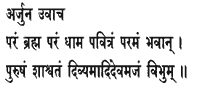
Arjuna said: Thou art the supreme Brahman, the supreme Abode, the supreme Purity, the one permanent, the divine Purusha, the original Godhead, the Unborn, the all-pervading Lord.
Equality and Knowledge
Sri Aurobindo
YOGA and knowledge are, in this early part of the Gita’s teaching, the two wings of the soul’s ascent. By Yoga is meant union through divine works done without desire, with equality of soul to all things and all men, as a sacrifice to the Supreme, while knowledge is that on which this desirelessness, this equality, this power of sacrifice is founded. The two wings indeed assist each other’s flight; acting together, yet with a subtle alternation of mutual aid, like the two eyes in a man which see together because they see alternately, they increase one another mutually by interchange of substance. As the works grow more and more desireless, equal-minded, sacrificial in spirit, the knowledge increases; with the increase of the knowledge the soul becomes firmer in the desireless, sacrificial equality of its works. The sacrifice of knowledge, says the Gita therefore, is greater than any material sacrifice. “Even if thou art the greatest doer of sin beyond all sinners, thou shalt cross over all the crookedness of evil in the ship of knowledge. . . . There is nothing in the world equal in purity to knowledge.” By knowledge desire and its first-born child, sin, are destroyed. The liberated man is able to do works as a sacrifice because he is freed from attachment through his mind, heart and spirit being firmly founded in selfknowledge, gata-san˙ gasya jn˜ a¯na¯vasthita-cetasah. . All his work disappears completely as soon as done, suffers laya, as one might say, in the being of the Brahman, pravil¯ıyate; it has no reactionary consequence on the soul of the apparent doer. The work is done by the Lord through his Nature, it is no longer personal to the human instrument. The work itself becomes but power of the nature and substance of the being of the Brahman. It is in this sense that the Gita is speaking when it says that all the totality of work finds its completion, culmination, end in knowledge, sarvam˙ karma¯khilam˙ jn˜a¯ne parisama¯pyate. “As a fire kindled turns to ashes its fuel, so the fire of knowledge turns all works to ashes.” By this it is not at all meant that when knowledge is complete, there is cessation from works. What is meant is made clear by the Gita when it says that he who has destroyed all doubt by knowledge and has by Yoga given up all works and is in possession of the Self is not bound by his works, yoga-sannyasta-karma¯n.am a¯tmavantam˙ na karma¯n. i nibadhnanti, and that he whose self has become the self of all existences, acts and yet is not affected by his works, is not caught in them, receives from them no soul-ensnaring reaction, kurvann api na lipyate. Therefore, it says, the Yoga of works is better than the physical renunciation of works, because, while Sannyasa is difficult for embodied beings who must do works so long as they are in the body, Yoga of works is entirely sufficient and it rapidly and easily brings the soul to Brahman. That Yoga of works is, we have seen, the offering of all action to the Lord, which induces as its culmination an inner and not an outer, a spiritual, not a physical giving up of works into the Brahman, into the being of the Lord, brahman. i ¯adh¯aya karm¯an. i, mayi sannyasya. When works are thus “reposed on the Brahman,” the personality of the instrumental doer ceases; though he acts, he does nothing; for he has given up not only the fruits of his works, but the works themselves and the doing of them to the Lord. The Divine then takes the burden of works from him; the Supreme becomes the doer and the act and the result. This knowledge of which the Gita speaks, is not an intellectual activity of the mind; it is a luminous growth into the highest state of being by the outshining of the light of the divine sun of Truth, “that Truth, the Sun lying concealed in the darkness” of our ignorance of which the Rigveda speaks, tat satyam˙ s ¯ urya ˙ m tamasi ks. iyantam. The immutable Brahman is there in the spirit’s skies above this troubled lower nature of the dualities, untouched either by its virtue or by its sin, accepting neither our sense of sin nor our self-righteousness, untouched by its joy and its sorrow, indifferent to our joy in success and our grief in failure, master of all, supreme, all-pervading, prabhu vibhu, calm, strong, pure, equal in all things, the source of Nature, not the direct doer of our works, but the witness of Nature and her works, not imposing on us either the illusion of being the doer, for that illusion is the result of the ignorance of this lower Nature. But this freedom, mastery, purity we cannot see; we are bewildered by the natural ignorance which hides from us the eternal self-knowledge of the Brahman secret within our being. But knowledge comes to its persistent seeker and removes the natural self-ignorance; it shines out like a long-hidden sun and lights up to our vision that self-being supreme beyond the dualities of this lower existence, ¯ adityavat prak¯a´sayati tat param. By a long whole-hearted endeavour, by directing our whole conscious being to that, by making that our whole aim, by turning it into the whole object of our discerning mind and so seeing it not only in ourselves but everywhere, we become one thought and self with that, tad-buddhayas tad-¯atm¯anah. , we are washed clean of all the darkness and suffering of the lower man by the waters of knowledge,1 jn˜ a¯na-nirdhu¯ ta-kalmas.a¯h. . The result is, says the Gita, a perfect equality to all things and all persons; and then only can we repose our works completely in the Brahman. For the Brahman is equal, samam˙ brahma, and it is only when we have this perfect equality, s ¯amye sthitam˙ manah. , “seeing with an equal eye the learned and cultured Brahmin, the cow, the elephant, the dog, the outcaste” and knowing all as one Brahman, that we can, living in that oneness, see like the Brahman our works proceeding from the nature freely without any fear of attachment, sin or bondage. Sin and stain then cannot be; for we have overcome that creation full of desire and its works and reactions which belongs to the ignorance, tair jitah. sargah. , and living in the supreme and divine Nature there is no longer fault or defect in our works; for these are created by the inequalities of the ignorance. The equal Brahman is faultless, nirdos.am˙ hi samam˙ brahma, beyond the confusion of good and evil, and living in the Brahman we
too rise beyond good and evil; we act in that purity, stainlessly, with an equal and single purpose of fulfilling the welfare of all existences, ks.ı¯n. a-kalmas.a¯h. sarvabhu¯ ta-hite rata¯h.. The Lord in our hearts is in the ignorance also the cause of our actions, but through his Maya, through the egoism of our lower nature which creates the tangled web of our actions and brings back upon our egoism the recoil of their tangled reactions affecting us inwardly as sin and virtue, affecting us outwardly as suffering and pleasure, evil fortune and good fortune, the great chain of Karma. When we are freed by knowledge, the Lord, no longer hidden in our hearts, but manifest as our supreme self, takes up our works and uses us as faultless instruments, nimitta-m¯atram, for the helping of the world. Such is the intimate union between knowledge and equality; knowledge here in the buddhi reflected as equality in the temperament; above, on a higher plane of consciousness, knowledge as the light of the Being, equality as the stuff of the Nature. Always in this sense of a supreme self-knowledge is this word jn˜ a¯na used in Indian philosophy and Yoga; it is the light by which we grow into our true being, not the knowledge by which we increase our information and our intellectual riches; it is not scientific or psychological or philosophic or ethical or aesthetic or worldly and practical knowledge. These too no doubt help us to grow, but only in the becoming, not in the being; they enter into the definition of Yogic knowledge only when we use them as aids to know the Supreme, the Self, the Divine,—scientific knowledge, when we can get through the veil of processes and phenomena and see the one Reality behind which explains them all; psychological knowledge, when we use it to know ourselves and to distinguish the lower from the higher, so that this we may renounce and into that we may grow; philosophical knowledge, when we turn it as a light upon the essential principles of existence so as to discover and live in that which is eternal; ethical knowledge, when by it having distinguished sin from virtue we put away the one and rise above the other into the pure innocence of the divine Nature; aesthetic knowledge, when we discover by it the beauty of the Divine; knowledge of the world, when we see through it the way of the Lord with his creatures and use it for the service of the Divine in man. Even then they are only aids; the real knowledge is that which is a secret to the mind, of which the mind only gets reflections, but which lives in the spirit. The Gita in describing how we come by this knowledge, says that we get first initiation into it from the men of knowledge who have seen, not those who know merely by the intellect, its essential truths; but the actuality of it comes from within ourselves: “the man who is perfected by Yoga, finds it of himself in the self by the course of Time,” it grows within him, that is to say, and he grows into it as he goes on increasing in desirelessness, in equality, in devotion to the Divine. It is only of the supreme knowledge that this can altogether be said; the knowledge which the intellect of man amasses, is gathered laboriously by the senses and the reason from outside. To get this other knowledge, self-existent, intuitive, self-experiencing, self-revealing, we must have conquered and controlled our mind and senses, sam˙ yatendriyah. , so that we are no longer subject to their delusions, but rather the mind and senses become its pure mirror; we must have fixed our whole conscious being on the truth of that supreme reality in which all exists, tat-parah., so that it may display in us its luminous self-existence. Finally, we must have a faith which no intellectual doubt can be allowed to disturb, s´raddha¯va¯n labhate jn˜a¯nam. “The ignorant who has not faith, the soul of doubt goeth to perdition; neither this world, nor the supreme world, nor any happiness is for the soul full of doubts.” In fact, it is true that without faith nothing decisive can be achieved either in this world or for possession of the world above, and that it is only by laying hold of some sure basis and positive support that man can attain any measure of terrestrial or celestial success and satisfaction and happiness; the merely sceptical mind loses itself in the void. But still in the lower knowledge doubt and scepticism have their temporary uses; in the higher they are stumbling-blocks: for there the whole secret is not the balancing of truth and error, but a constantly progressing realisation of revealed truth. In intellectual knowledge there is always a mixture of falsehood or incompleteness which has to be got rid of by subjecting the truth itself to sceptical inquiry; but in the higher knowledge falsehood cannot enter and that which intellect contributes by attaching itself to this or that opinion, cannot be got rid of by mere questioning, but will fall away of itself by persistence in realisation. Whatever incompleteness there is in the knowledge attained, it must be got rid of, not by questioning in its roots what has already been realised, but by proceeding to further and more complete realisation through a deeper, higher and wider living in the Spirit. And what is not yet realised must be prepared for by faith, not by sceptical questioning, because this truth is one which the intellect cannot give and which is indeed often quite opposed to the ideas in which the reasoning and logical mind gets entangled: it is not a truth which has to be proved, but a truth which has to be lived inwardly, a greater reality into which we have to grow. Finally, it is in itself a self-existent truth and would be self-evident if it were not for the sorceries of the ignorance in which we live; the doubts, the perplexities which prevent us from accepting and following it, arise from that ignorance, from the sense-bewildered, opinion-perplexed heart andmind, living as they do in a lower and phenomenal truth and therefore questioning the higher realities, ajn˜ a¯na-sambhu¯ tam˙ hr.tstham˙ sam˙ s´ayam. They have to be cut away by the sword of knowledge, says the Gita, by the knowledge that realises, by resorting constantly to Yoga, that is, by living out the union with the Supreme whose truth being known all is known, yasmin vijn˜ a¯ te sarvam˙ vijn˜a¯tam. The higher knowledge we then get is that which is to the knower of Brahman his constant vision of things when he lives uninterruptedly in the Brahman, brahmavid brahman. i sthitah. . That is not a vision or knowledge or consciousness of Brahman to the exclusion of all else, but a seeing of all in Brahman and as the Self. For, it is said, the knowledge by which we rise beyond all relapse back into the bewilderment of our mental nature, is “that by which thou shalt see all existences without exception in the Self, then in Me.” Elsewhere the Gita puts it more largely, “Equal-visioned everywhere, he sees the Self in all existences and all existences in the Self. He who sees Me everywhere and all and each in Me, is never lost to Me nor I to him. He who has reached oneness and loves Me in all beings, that Yogin, howsoever he lives and acts, is living and acting in Me. O Arjuna, he who sees all equally everywhere as himself, whether it be happiness or suffering, I hold him to be the supreme Yogin.” That is the old Vedantic knowledge of the Upanishads which the Gita holds up constantly before us; but it is its superiority to other later formulations of it that it turns persistently this knowledge into a great practical philosophy of divine living. Always it insists on the relation between this knowledge of oneness and Karmayoga, and therefore on the knowledge of oneness as the basis of a liberated action in the world.Whenever it speaks of knowledge, it turns at once to speak of equality which is its result; whenever it speaks of equality, it turns to speak too of the knowledge which is its basis. The equality it enjoins does not begin and end in a static condition of the soul useful only for self-liberation; it is always a basis of works. The peace of the Brahman in the liberated soul is the foundation; the large, free, equal, worldwide action of the Lord in the liberated nature radiates the power which proceeds from that peace; these two made one synthesise divine works and God-knowledge. We see at once what a profound extension we get here for the ideas which otherwise the Gita has in common with other systems of philosophic, ethical or religious living. Endurance, philosophic indifference, resignation are, we have said, the foundation of three kinds of equality; but the Gita’s truth of knowledge not only gathers them all up together, but gives them an infinitely profound, a magnificently ample significance. The Stoic knowledge is that of the soul’s power of self-mastery by fortitude, an equality attained by a struggle with one’s nature, maintained by a constant vigilance and control against its natural rebellions: it gives a noble peace, an austere happiness, but not the supreme joy of the liberated self living not by a rule, but in the pure, easy, spontaneous perfection of its divine being, so that “however it may act and live, it acts and lives in the Divine,” because here perfection is not only attained but possessed in its own right and has no longer to be maintained by effort, for it has become the very nature of the soul’s being. The Gita accepts the endurance and fortitude of our struggle with the lower nature as a preliminary movement; but if a certain mastery comes by our individual strength, the freedom of mastery only comes by our union with God, by a merging or dwelling of the personality in the one divine Person and the loss of the personal will in the divineWill. There is a divineMaster ofNature and her works, above her though inhabiting her, who is our highest being and our universal self; to be one with him is to make ourselves divine. By union with God we enter into a supreme freedom and a supreme mastery. The ideal of the Stoic, the sage who is king because by self-rule he becomes master also of outward conditions, resembles superficially the Vedantic idea of the selfruler and all-ruler, svar ¯ at. samr¯ at.; but it is on a lower plane. The Stoic kingship is maintained by a force put upon self and environment; the entirely liberated kingship of the Yogin exists naturally by the eternal royalty of the divine nature, a union with its unfettered universality, a finally unforced dwelling in its superiority to the instrumental nature through which it acts. His mastery over things is because he has become one soul with all things. To take an image from Roman institutions, the Stoic freedom is that of the libertus, the freedman, who is still really a dependent on the power that once held him enslaved; his is a freedom allowed by Nature because he has merited it. The freedom of the Gita is that of the freeman, the true freedom of the birth into the higher nature, self-existent in its divinity. Whatever he does and however he lives, the free soul lives in the Divine; he is the privileged child of the mansion, b¯ alavat, who cannot err or fall because all he is and does is full of the Perfect, the All-blissful, the All-loving, the All-beautiful. The kingdom which he enjoys, r ¯ ajya ˙ m samr. ddham, is a sweet and happy dominion of which it may be said, in the pregnant phrase of the Greek thinker, “The kingdom is of the child.” The knowledge of the philosopher is that of the true nature of mundane existence, the transience of outward things, the vanity of the world’s differences and distinctions, the superiority of the inner calm, peace, light, self-dependence. It is an equality of philosophic indifference; it brings a high calm, but not the greater spiritual joy; it is an isolated freedom, a wisdom like that of the Lucretian sage high in his superiority upon the cliff-top whence he looks down on men tossed still upon the tempestuous waters from which he has escaped,—in the end something after all aloof and ineffective. The Gita admits the philosophic motive of indifference as a preliminary movement; but the indifference to which it finally arrives, if indeed that inadequate word can be at all applied, has nothing in it of the philosophic aloofness. It is indeed a position as of one seated above, ud¯ as¯ınavat, but as the Divine is seated above, having no need at all in the world, yet he does works always and is present everywhere supporting, helping, guiding the labour of creatures. This equality is founded upon oneness with all beings. It brings in what is wanting to the philosophic equality; for its soul is the soul of peace, but also it is the soul of love. It sees all beings without exception in the Divine, it is one self with the Self of all existences and therefore it is in supreme sympathy with all of them.Without exception, a´ses.en. a, not only with all that is good and fair and pleases; nothing and no one, however vile, fallen, criminal, repellent in appearance, can be excluded from this universal, this whole-souled sympathy and spiritual oneness. Here there is no room, not merely for hatred or anger or uncharitableness, but for aloofness, disdain or any petty pride of superiority. A divine compassion for the ignorance of the struggling mind, a divine will to pour forth on it all light and power and happiness there will be, indeed, for the apparent man; but for the divine Soul within him there will be more, there will be adoration and love. For from all, from the thief and the harlot and the outcaste as from the saint and the sage, the Beloved looks forth and cries to us, “This is I.” “He who loves Me in all beings,”—what greater word of power for the utmost intensities and profundities of divine and universal love, has been uttered by any philosophy or any religion? Resignation is the basis of a kind of religious equality, submission to the divine will, a patient bearing of the cross, a submissive forbearance. In the Gita this element takes the more ample form of an entire surrender of the whole being to God. It is not merely a passive submission, but an active self-giving; not only a seeing and an accepting of the divineWill in all things, but a giving up of one’s own will to be the instrument of the Master of works, and this not with the lesser idea of being a servant of God, but, eventually at least, of such a complete renunciation both of the consciousness and the works to him that our being becomes one with his being and the impersonalised nature only an instrument and nothing else. All result good or bad, pleasing or unpleasing, fortunate or unfortunate, is accepted as belonging to theMaster of our actions, so that finally not only are grief and suffering borne, but they are banished: a perfect equality of the emotional mind is established. There is no assumption of personal will in the instrument; it is seen that all is already worked out in the omniscient prescience and omnipotent effective power of the universal Divine and that the egoism of men cannot alter the workings of that Will. Therefore, the final attitude is that enjoined on Arjuna in a later chapter, “All has been already done by Me in my divine will and foresight; become only the occasion, O Arjuna,” nimitta-ma¯ tram˙ bhava savyasa¯cin. This attitude must lead finally to an absolute union of the personal with the Divine Will and, with the growth of knowledge, bring about a faultless response of the instrument to the divine Power and Knowledge. A perfect, an absolute equality of self-surrender, the mentality a passive channel of the divine Light and Power, the active being a mightily effective instrument for its work in the world, will be the poise of this supreme union of the Transcendent, the universal and the individual. Equality too there will be with regard to the action of others upon us. Nothing that they can do will alter the inner oneness, love, sympathy which arises from the perception of the one Self in all, the Divine in all beings. But a resigned forbearance and submission to them and their deeds, a passive non-resistance, will be no necessary part of the action; it cannot be, since a constant instrumental obedience to the divine and universalWill must mean in the shock of opposite forces that fill the world a conflict with personal wills which seek rather their own egoistic satisfaction. Therefore Arjuna is bidden to resist, to fight, to conquer; but, to fight without hatred or personal desire or personal enmity or antagonism, since to the liberated soul these feelings are impossible. To act for the lokasan˙ graha, impersonally, for the keeping and leading of the peoples on the path to the divine goal, is a rule which rises necessarily from the oneness of the soul with the Divine, the universal Being, since that is the whole sense and drift of the universal action. Nor does it conflict with our oneness with all beings, even those who present themselves here as opponents and enemies. For the divine goal is their goal also, since it is the secret aim of all, even of those whose outward minds, misled by ignorance and egoism, would wander from the path and resist the impulsion. Resistance and defeat are the best outward service that can be done to them. By this perception the Gita avoids the limiting conclusion which might have been drawn from a doctrine of equality impracticably overriding all relations and of a weakening love without knowledge, while it keeps the one thing essential unimpaired. For the soul oneness with all, for the heart calm universal love, sympathy, compassion, but for the hands freedom to work out impersonally the good, not of this or that person only without regard to or to the detriment of the divine plan, but the purpose of the creation, the progressing welfare and salvation of men, the total good of all existences. Oneness with God, oneness with all beings, the realisation of the eternal divine unity everywhere and the drawing onwards of men towards that oneness are the law of life which arises from the teachings of the Gita. There can be none greater, wider, more profound. Liberated oneself, to live in this oneness, to help mankind on the path that leads towards it and meanwhile to do all works for God and help man also to do with joy and acceptance all the works to which he is called, kr.tsna-karma-kr.t, sarvakarm¯an.i jos. ayan, no greater or more liberal rule of divine works can be given. This freedom and this oneness are the secret goal of our human nature and the ultimate will in the existence of the race. It is that to which it must turn for the happiness all mankind is now vainly seeking, when once men lift their eyes and their hearts to see the Divine in them and around, in all and everywhere, sarves.u, sarvatra, and learn that it is in him they live, while this lower nature of division is only a prison-wall which they must break down or at best an infant-school which they must outgrow, so that they may become adult in nature and free in spirit. To be made one self with God above and God in man and God in the world is the sense of liberation and the secret of perfection.
Sri Aurobindo
 About Us | ©1999 - 2009 searchforlight.org
All extracts and quotations from the written works of Sri Aurobindo and the Mother and the Photographs of
the Mother and Sri Aurobindo are copyright Sri Aurobindo Ashram Trust, Pondicherry -605002 India.