
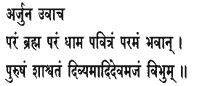
Arjuna said: Thou art the supreme Brahman, the supreme Abode, the supreme Purity, the one permanent, the divine Purusha, the original Godhead, the Unborn, the all-pervading Lord.
Above the Gunas
Sri Aurobindo
THE DISTINCTIONS between the Soul and Nature rapidly drawn in the verses of the thirteenth chapter by a few decisive epithets, a few brief but packed characterisations of their separate power and functioning, and especially the distinction between the embodied soul subjected to the action of Nature by its enjoyment of her gunas, qualities or modes and the Supreme Soul which dwells enjoying the gunas, but not subject because it is itself beyond them, are the basis on which the Gita rests its whole idea of the liberated being made one in the conscious law of its existence with the Divine. That liberation, that oneness, that putting on of the divine nature, s ¯adharmya, it declares to be the very essence of spiritual freedom and the whole significance of immortality. This supreme importance assigned to s ¯adharmya is a capital point in the teaching of the Gita. To be immortal was never held in the ancient spiritual teaching to consist merely in a personal survival of the death of the body: all beings are immortal in that sense and it is only the forms that perish. The souls that do not arrive at liberation, live through the returning aeons; all exist involved or secret in the Brahman during the dissolution of the manifest worlds and are born again in the appearance of a new cycle. Pralaya, the end of a cycle of aeons, is the temporary disintegration of a universal form of existence and of all the individual forms which move in its rounds, but that is only a momentary pause, a silent interval followed by an outburst of new creation, reintegration and reconstruction in which they reappear and recover the impetus of their progression. Our physical death is also a pralaya,— the Gita will presently use the word in the sense of this death,
pralayam˙ ya¯ti deha-bhr.t, “the soul bearing the body comes to a pralaya,” to a disintegration of that form of matter with which its ignorance identified its being and which now dissolves into the natural elements. But the soul itself persists and after an interval resumes in a new body formed from those elements its round of births in the cycle, just as after the interval of pause and cessation the universal Being resumes his endless round of the cyclic aeons. This immortality in the rounds of Time is common to all embodied spirits. To be immortal in the deeper sense is something different from this survival of death and this constant recurrence. Immortality is that supreme status in which the Spirit knows itself to be superior to death and birth, not conditioned by the nature of its manifestation, infinite, imperishable, immutably eternal, —immortal, because never being born it never dies. The divine Purushottama, who is the supreme Lord and supreme Brahman, possesses for ever this immortal eternity and is not affected by his taking up a body or by his continuous assumption of cosmic forms and powers because he exists always in this selfknowledge. His very nature is to be unchangeably conscious of his own eternity; he is self-aware without end or beginning. He is here the Inhabitant of all bodies, but as the unborn in every body, not limited in his consciousness by that manifestation, not identified with the physical nature which he assumes; for that is only a minor circumstance of his universal activised play of existence. Liberation, immortality is to live in this unchangeably conscious eternal being of the Purushottama.2 But to arrive here at this greater spiritual immortality the embodied soul must cease to live according to the law of the lower nature; it must
put on the law of the Divine’s supreme way of existence which is in fact the real law of its own eternal essence. In the spiritual evolution of its becoming, no less than in its secret original being, it must grow into the likeness of the Divine. And this great thing, to rise from the human into the divine nature, we can only do by an effort of Godward knowledge, will and adoration. For the soul sent forth by the Supreme as his eternal portion, his immortal representative into the workings of universal Nature is yet obliged by the character of those workings, ava´sa ˙ m prakr. ter va´s ¯ at, to identify itself in its external consciousness with her limiting conditions, to identify itself with a life, mind and body that are oblivious of their inner spiritual reality and of the innate Godhead. To get back to self-knowledge and to the knowledge of the real as distinct from the apparent relations of the soul with Nature, to know God and ourselves and the world with a spiritual and no longer with a physical or externalised experience, through the deepest truth of the inner soul-consciousness and not through the misleading phenomenal significances of the sense-mind and the outward understanding, is an indispensable means of this perfection. Perfection cannot come without self-knowledge and God-knowledge and a spiritual attitude towards our natural existence, and that is why the ancient wisdom laid so much stress on salvation by knowledge, —not an intellectual cognizance of things, but a growing of man themental being into a greater spiritual consciousness. The soul’s salvation cannot come without the soul’s perfection, without its growing into the divine nature; the impartial Godhead will not effect it for us by an act of caprice or an arbitrary sanad of his favour. Divine works are effective for salvation because they lead us towards this perfection and to a knowledge of self and nature and God by a growing unity with the inner Master of our existence. Divine love is effective because by it we grow into the likeness of the sole and supreme object of our adoration and call down the answering love of the Highest to flood us with the light of his knowledge and the uplifting power and purity of his eternal spirit. Therefore, says the Gita, this is the supreme knowledge and the highest of all knowings because it leads to the highest perfection and spiritual status, para¯m˙ siddhim, and brings the soul to likeness with the Divine, s ¯adharmya. It is the eternal wisdom, the great spiritual experience by which all the sages attained to that highest perfection, grew into one law of being with the Supreme and live for ever in his eternity, not born in the creation, not troubled by the anguish of the universal dissolution. This perfection, then, this s ¯adharmya is the way of immortality and the indispensable condition without which the soul cannot consciously live in the Eternal. The soul of man could not grow into the likeness of the Divine, if it were not in its secret essence imperishably one with the Divine and part and parcel of his divinity: it could not be or become immortal if it were merely a creature of mental, vital and physical Nature. All existence is a manifestation of the divine Existence and that which is within us is spirit of the eternal Spirit. We have come indeed into the lower material nature and are under its influence, but we have come there from the supreme spiritual nature: this inferior imperfect status is our apparent, but that our real being. The Eternal puts all this movement forth as his self-creation. He is at once the Father and Mother of the universe; the substance of the infinite Idea, vijn˜ a¯na, the Mahad Brahman, is the womb into which he casts the seed of his self-conception. As the Over-Soul he casts the seed; as the Mother, the Nature-Soul, the Energy filled with his conscious power, he receives it into this infinite substance of being made pregnant with his illimitable, yet self-limiting Idea. He receives into this Vast of self-conception and develops there the divine embryo into mental and physical form of existence born from the original act of conceptive creation. All we see springs from that act of creation; but that which is born here is only finite idea and form of the unborn and infinite. The Spirit is eternal and superior to all its manifestation: Nature, eternal without beginning in the Spirit, proceeds for ever with the rhythm of the cycles by unending act of creation and unconcluding act of cessation; the Soul too which takes on this or that form in Nature, is no less eternal than she, an¯ad¯ı ubh¯av api. Even while in Nature it follows the unceasing round of the cycles, it is, in the Eternal from which it proceeds into them, for ever raised above the terms of birth and death, and even in its apparent consciousness here it can become aware of that innate and constant transcendence. What is it then that makes the difference, what is it that gets the soul into the appearance of birth and death and bondage,— for this is patent that it is only an appearance? It is a subordinate act or state of consciousness, it is a self-oblivious identification with the modes of Nature in the limited workings of this lower motivity and with this self-wrapped ego-bounded knot of action of the mind, life and body. To rise above the modes of Nature, to be traigun. y¯ at¯ıta, is indispensable, if we are to get back into our fully conscious being away from the obsessing power of the lower action and to put on the free nature of the spirit and its eternal immortality. That condition of the s ¯adharmya is what the Gita next proceeds to develop. It has already alluded to it and laid it down with a brief emphasis in a previous chapter; but it has now to indicate more precisely what are these modes, these gunas, how they bind the soul and keep it back from spiritual freedom and what ismeant by rising above the modes ofNature. The modes of Nature are all qualitative in their essence and are called for that reason its gunas or qualities. In any spiritual conception of the universe this must be so, because the connecting medium between spirit and matter must be psyche or soul power and the primary action psychological and qualitative, not physical and quantitative; for quality is the immaterial, the more spiritual element in all the action of the universal Energy, her prior dynamics. The predominance of physical Science has accustomed us to a different view of Nature, because there the first thing that strikes us is the importance of the quantitative aspect of her workings and her dependence for the creation of forms on quantitative combinations and dispositions. And yet even there the discovery that matter is rather substance or act of energy than energy a motive power of self-existent material substance or an inherent power acting in matter has led to some revival of an older reading of universal Nature. The analysis of the ancient Indian thinkers allowed for the quantitative action of Nature, m¯ atr ¯a; but that it regarded as proper to its more objective and formally executive working, while the innately ideative executive power which disposes things according to the quality of their being and energy, gun. a, svabh¯ava, is the primary determinant and underlies all the outer quantitative dispositions. In the basis of the physical world this is not apparent only because there the underlying ideative spirit, the Mahad Brahman, is overlaid and hidden up by the movement of matter and material energy. But even in the physical world the miraculous varying results of different combinations and quantities of elements otherwise identical with each other admits of no conceivable explanation if there is not a superior power of variative quality of which these material dispositions are only the convenient mechanical devices. Or let us say at once, there must be a secret ideative capacity of the universal energy, vijn˜ a¯na,—even if we suppose that energy and its instrumental idea, buddhi, to be themselves mechanical in their nature,—which fixes the mathematics and decides the resultants of these outer dispositions: it is the omnipotent Idea in the spirit which invents and makes use of these devices. And in the vital and mental existence quality at once openly appears as the primary power and amount of energy is only a secondary factor. But in fact the mental, the vital, the physical existence are all subject to the limitations of quality, all are governed by its determinations, even though that truth seems more and more obscured as we descend the scale of existence. Only the Spirit, which by the power of its idea-being and its ideaforce called mahat and vijn˜ a¯na fixes these conditions, is not so determined, not subject to any limitations either of quality or quantity because its immeasurable and indeterminable infinity is superior to the modes which it develops and uses for its creation. But, again, the whole qualitative action of Nature, so infinitely intricate in its detail and variety, is figured as cast into the mould of three general modes of quality everywhere present, intertwined, almost inextricable, sattva, rajas, tamas. These modes are described in the Gita only by their psychological action in man, or incidentally in things such as food according as they produce a psychological or vital effect on human beings. If we look for a more general definition, we shall perhaps catch a glimpse of it in the symbolic idea of Indian religion which attributes each of these qualities respectively to one member of the cosmic Trinity, sattwa to the preserver Vishnu, rajas to the creator Brahma, tamas to the destroyer Rudra. Looking behind this idea for the rationale of the triple ascription, we might define the three modes or qualities in terms of the motion of the universal Energy as Nature’s three concomitant and inseparable powers of equilibrium, kinesis and inertia. But that is only their appearance in terms of the external action of Force. It is otherwise if we regard consciousness and force as twin terms of the one Existence, always coexistent in the reality of being, however in the primal outward phenomenon of material Nature light of consciousness may seem to disappear in a vast action of nescient unillumined energy, while at an opposite pole of spiritual quiescence action of force may seem to disappear in the stillness of the observing or witness consciousness. These two conditions are the two extremes of an apparently separated Purusha and Prakriti, but each at its extreme point does not abolish but at the most only conceals its eternal mate in the depths of its own characteristic way of being. Therefore, since consciousness is always there even in an apparently inconscient Force, we must find a corresponding psychological power of these three modes which informs their more outward executive action. On their psychological side the three qualities may be defined, tamas as Nature’s power of nescience, rajas as her power of active seeking ignorance enlightened by desire and impulsion, sattwa as her power of possessing and harmonising knowledge. The three qualitative modes ofNature are inextricably intertwined in all cosmic existence. Tamas, the principle of inertia, is a passive and inert nescience which suffers all shocks and contacts without any effort of mastering response and by itself would lead to a disintegration of the whole action of the energy and a radical dispersion of substance. But it is driven by the kinetic power of rajas and even in the nescience of Matter is met and embraced by an innate though unpossessed preserving principle of harmony and balance and knowledge. Material energy appears to be tamasic in its basic action, jad. a, nescient, mechanic and in movement disintegrative. But it is dominated by a huge force and impulsion of mute rajasic kinesis which drives it, even in and even by its dispersion and disintegration, to build and create and again by a sattwic ideative element in its apparently inconscient force which is always imposing a harmony and preservative order on the two opposite tendencies. Rajas, the principle of creative endeavour and motion and impulsion in Prakriti, kinesis, pravr.tti, so seen in Matter, appears more evidently as a conscious or half-conscious passion of seeking and desire and action in the dominant character of Life,—for that passion is the nature of all vital existence. And it would lead by itself in its own nature to a persistent but always mutable and unstable life and activity and creation without any settled result. But met on one side by the disintegrating power of tamas with death and decay and inertia, its ignorant action is on the other side of its functioning settled and harmonised and sustained by the power of sattwa, subconscient in the lower forms of life, more and more conscient in the emergence of mentality, most conscious in the effort of the evolved intelligence figuring as will and reason in the fully developed mental being. Sattwa, the principle of understanding knowledge and of according assimilation, measure and equilibrium, which by itself would lead only to some lasting concord of fixed and luminous harmonies, is in the motions of this world impelled to follow the mutable strife and action of the eternal kinesis and constantly overpowered or hedged in by the forces of inertia and nescience. This is the appearance of a world governed by the interlocked and mutually limited play of the three qualitative modes of Nature. The Gita applies this generalised analysis of the universal Energy to the psychological nature of man in relation to his bondage to Prakriti and the realisation of spiritual freedom. Sattwa, it tells us, is by the purity of its quality a cause of light and illumination and by virtue of that purity it produces no disease or morbidity or suffering in the nature. When into all the doors in the body there comes a flooding of light, as if the doors and windows of a closed house were opened to sunshine, a light of understanding, perception and knowledge, —when the intelligence is alert and illumined, the senses quickened, the whole mentality satisfied and full of brightness and the nervous being calmed and filled with an illumined ease and clarity, pras¯ada, one should understand that there has been a great increase and uprising of the sattwic guna in the nature. For knowledge and a harmonious ease and pleasure and happiness are the characteristic results of sattwa. The pleasure that is sattwic is not only that contentment which an inner clarity of satisfied will and intelligence brings with it, but all delight and content produced by the soul’s possession of itself in light or by an accord or an adequate and truthful adjustment between the regarding soul and the surrounding Nature and her offered objects of desire and perception. Rajas, again, the Gita tells us, has for its essence attraction of liking and longing. Rajas is a child of the attachment of the soul to the desire of objects; it is born from the nature’s thirst for an unpossessed satisfaction. It is therefore full of unrest and fever and lust and greed and excitement, a thing of seeking impulsions, and all this mounts in us when the middle guna increases. It is the force of desire which motives all ordinary personal initiative of action and all that movement of stir and seeking and propulsion in our nature which is the impetus towards action and works, pravr.tti. Rajas, then, is evidently the kinetic force in the modes of Nature. Its fruit is the lust of action, but also grief, pain, all kinds of suffering; for it has no right possession of its object— desire in fact implies non-possession—and even its pleasure of acquired possession is troubled and unstable because it has not clear knowledge and does not know how to possess nor can it find the secret of accord and right enjoyment. All the ignorant and passionate seeking of life belongs to the rajasic mode of Nature. Tamas, finally, is born of inertia and ignorance and its fruit too is inertia and ignorance. It is the darkness of tamas which obscures knowledge and causes all confusion and delusion. Therefore it is the opposite of sattwa, for the essence of sattwa is enlightenment, prak¯a´sa, and the essence of tamas is absence of light, nescience, aprak¯a´sa. But tamas brings incapacity and negligence of action as well as the incapacity and negligence of error, inattention and misunderstanding or non-understanding; indolence, languor and sleep belong to this guna. Therefore it is the opposite too of rajas; for the essence of rajas is movement and impulsion and kinesis, pravr.tti, but the essence of tamas is inertia, apravr.tti. Tamas is inertia of nescience and inertia of inaction, a double negative. These three qualities of Nature are evidently present and active in all human beings and none can be said to be quite devoid of one and another or free from any one of the three; none is cast in the mould of one guna to the exclusion of the others. All men have in them in whatever degree the rajasic impulse of desire and activity and the sattwic boon of light and happiness, some balance, some adjustment of mind to itself and its surroundings and objects, and all have their share of tamasic incapacity and ignorance or nescience. But these qualities are not constant in any man in the quantitative action of their force or in the combination of their elements; for they are variable and in a continual state of mutual impact, displacement and interaction. Now one leads, now another increases and predominates, and each subjects us to its characteristic action and consequences. Only by a general and ordinary predominance of one or other of the qualities can a man be said to be either sattwic or rajasic or tamasic in his nature; but this can only be a general and not an exclusive or absolute description. The three qualities are a triple power which by their interaction determine the character and disposition and through that and its various motions the actions of the natural man. But this triple power is at the same time a triple cord of bondage. “The three gunas born of Prakriti” says the Gita “bind in the body the imperishable dweller in the body.” In a certain sense we can see at once that there must be this bondage in following the action of the gunas; for they are all limited by their finite of quality and operation and cause limitation. Tamas is on both its sides an incapacity and therefore very obviously binds to limitation. Rajasic desire as an initiator of action is a more positive power, but still we can see well enough that desire with its limiting and engrossing hold on man must always be a bondage. But how does sattwa, the power of knowledge and happiness, become a chain? It so becomes because it is a principle of mental nature, a principle of limited and limiting knowledge and of a happiness which depends upon right following or attainment of this or that object or else on particular states of the mentality, on a light of mind which can be only a more or less clear twilight. Its pleasure can only be a passing intensity or a qualified ease. Other is the infinite spiritual knowledge and the free self-existent delight of our spiritual being. But then there is the question, how does our infinite and imperishable spirit, even involved in Nature, come thus to confine itself to the lower action of Prakriti and undergo this bondage and how is it not, like the supreme spirit of which it is a portion, free in its infinity even while enjoying the self-limitations of its active evolution? The reason, says the Gita, is our attachment to the gunas and to the result of their workings. Sattwa, it says, attaches to happiness, rajas attaches to action, tamas covers up the knowledge and attaches to negligence of error and inaction. Or again, “sattwa binds by attachment to knowledge and attachment to happiness, rajas binds the embodied spirit by attachment to works, tamas binds by negligence and indolence and sleep.” In other words, the soul by attachment to the enjoyment of the gunas and their results concentrates its consciousness on the lower and outward action of life, mind and body in Nature, imprisons itself in the form of these things and becomes oblivious of its own greater consciousness behind in the spirit, unaware of the free power and scope of the liberating Purusha. Evidently, in order to be liberated and perfect, we must get back from these things, away from the gunas and above them and return to the power of that free spiritual consciousness above Nature. But this would seem to imply a cessation of all doing, since all natural action is done by the gunas, by Nature through her modes. The soul cannot act by itself, it can only act through Nature and her modes. And yet the Gita, while it demands freedom from the modes, insists upon the necessity of action. Here comes in the importance of its insistence on the abandonment of the fruits; for it is the desire of the fruits which is the most potent cause of the soul’s bondage and by abandoning it the soul can be free in action. Ignorance is the result of tamasic action, pain the consequence of rajasic works, pain of reaction, disappointment, dissatisfaction or transience, and therefore in attachment to the fruits of this kind of activity attended as they are with these undesirable accompaniments there is no profit. But of works rightly done the fruit is pure and sattwic, the inner result is knowledge and happiness. Yet attachment even to these pleasurable things must be entirely abandoned, first, because in the mind they are limited and limiting forms and, secondly, because, since sattwa is constantly entangled with and besieged by rajas and tamas which may at any moment overcome it, there is a perpetual insecurity in their tenure. But, even if one is free from any clinging to the fruit, there may be an attachment to the work itself, either for its own sake, the essential rajasic bond, or owing to a lax subjection to the drive of Nature, the tamasic, or for the sake of the attracting rightness of the thing done, which is the sattwic attaching cause powerful on the virtuous man or the man of knowledge. And here evidently the resource is in that other injunction of the Gita, to give up the action itself to the Lord of works and be only a desireless and equal-minded instrument of his will. To see that the modes of Nature are the whole agency and cause of our works and to know and turn to that which is supreme above the gunas, is the way to rise above the lower nature. Only so can we attain to the movement and status of the Divine, mad-bh¯ava, by which free from subjection to birth and death and their concomitants, decay, old age and suffering, the liberated soul shall enjoy in the end immortality and all that is eternal. But what, asks Arjuna, are the signs of such a man, what his action and how is he said even in action to be above the three gunas? The sign, says Krishna, is that equality of which I have so constantly spoken; the sign is that inwardly he regards happiness and suffering alike, gold and mud and stone as of equal value and that to him the pleasant and the unpleasant, praise and blame, honour and insult, the faction of his friends and the faction of his enemies are equal things. He is steadfast in a wise imperturbable and immutable inner calm and quietude. He initiates no action, but leaves all works to be done by the gunas of Nature. Sattwa, rajas or tamas may rise or cease in his outer mentality and his physical movements with their results of enlightenment, of impulsion to works or of inaction and the clouding over of the mental and nervous being, but he does not rejoice when this comes or that ceases, nor on the other hand does he abhor or shrink from the operation or the cessation of these things. He has seated himself in the conscious light of another principle than the nature of the gunas and that greater consciousness remains steadfast in him, above these powers and unshaken by their motions like the sun above clouds to one who has risen into a higher atmosphere. He from that height sees that it is the gunas that are in process of action and that their storm and calm are not himself but only a movement of Prakriti; his self is immovable above and his spirit does not participate in that shifting mutability of things unstable. This is the impersonality of the Brahmic status; for that higher principle, that greater wide high-seated consciousness, ku¯ t.astha, is the immutable Brahman. But still there is evidently here a double status, there is a scission of the being between two opposites; a liberated spirit in the immutable Self or Brahman watches the action of an unliberated mutable Nature,—Akshara and Kshara. Is there no greater status, no principle of more absolute perfection, or is this division the highest consciousness possible in the body, and is the end of Yoga to drop the mutable nature and the gunas born of the embodiment in Nature and disappear into the impersonality and everlasting peace of the Brahman? Is that laya or dissolution of the individual Purusha the greatest liberation? There is, it would seem, something else; for the Gita says at the close, always returning to this one final note, “He also who loves and strives after Me with an undeviating love and adoration, passes beyond the three gunas and he too is prepared for becoming the Brahman.” This “I” is the Purushottama who is the foundation of the silent Brahman and of immortality and imperishable spiritual existence and of the eternal dharma and of an utter bliss of happiness. There is a status then which is greater than the peace of the Akshara as it watches unmoved the strife of the gunas. There is a highest spiritual experience and foundation above the immutability of the Brahman, there is an eternal dharma greater than the rajasic impulsion to works, pravr.tti, there is an absolute delight which is untouched by rajasic suffering and beyond the sattwic happiness, and these things are found and possessed by dwelling in the being and power of the Purushottama. But since it is acquired by bhakti, its status must be that divine delight, Ananda, in which is experienced the union of utter love3 and possessing oneness, the crown of bhakti. And to rise into that Ananda, into that imperishable oneness must be the completion of spiritual perfection and the fulfilment of the eternal immortalising dharma.
Sri Aurobindo
 About Us | ©1999 - 2009 searchforlight.org
All extracts and quotations from the written works of Sri Aurobindo and the Mother and the Photographs of
the Mother and Sri Aurobindo are copyright Sri Aurobindo Ashram Trust, Pondicherry -605002 India.